
A modern dance film to remember, with a more emotive story than expected, Carmen (2022) is an evocative and thrilling experience that has peaks as high as you’ll find this year. An adaptation in name alone, choreographer and first-time feature filmmaker Benjamin Millepied has crafted, alongside a terrific collection of talent in front of and behind the camera, a complete reimagining of the Carmen opera. The film is vibrant and alive, and while the script is slight and only gestures mildly at its location and setting as a Mexico-American border romance, it still moves with a rapturous passion.
At the heart of the story is Carmen, played with fierce precision by emerging star Melissa Barrera, escaping across the border after the murder of her mother Zilah (flamenco dancer Marina Tamayo with one of the best opening scenes of the year). On the other side, we have Paul Mescal, a recently returning war vet Aiden, who is withholding his PTSD from those around him. On top of this, due to the struggling financial situation of the area, Aiden is forced to volunteer as a border patrol officer (the only real work in town), which pulls him into the path of Carmen.

It would be easy to reduce this film to a tragic love story between a Mexican immigrant and a border patrol officer, but that would discredit all of the work being done by screenwriters Lisa Loomer, Loïc Barrere, and Alexander Dinelaris to give these characters an agency and poignancy that surpasses these easy conventions.
What allows a dance-focused film to thrive as a theatrical experience is the incredible work of the great composer Nicolas Brittel. Brittell’s choral and string focused score is a work of magic, showing the extraordinary composer’s range while still driven by a focus on uplifting the emotion and narrative. Whether on Succession or his work with Barry Jenkins – his work on The Underground Railroad (2021) and If Beale Street Could Talk (2018) ought to be the stuff of legend – Britell’s compositions never overwhelm the narrative as they appear to come from the very core of the character’s beings. It is a shame a lot of his best work is on TV (Succession, The Underground Railroad, Andor), as it is a privilege to hear his work in a cinema.
Millepied and veteran cinematographer Jörg Widmer both understand the power of movement on screen, especially when shown in deep contrast by a solemn stillness. An emotive dance performance is often followed by an extended stationary shot centring an isolated performer in a chair or in isolation in some form. Wielding a combination of natural and neon lighting, Carmen operates well in both static frame and in movement, constantly fighting a balance between the two poles.
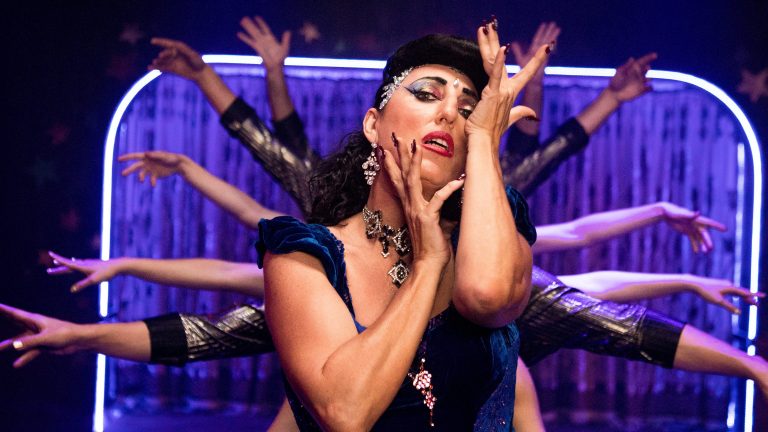
When the film is at its best, all of the film’s elements come together to make something magical. The dancers alongside Barrera, Mescal’s war-torn performance, Widmer’s camera, Millepied’s gorgeous choreography, and Brittell’s score brings the whole film to life, transcending certain moments into awe-inspiring sequences. While it is his first time behind the camera for a feature film, Millepied has a clear knowledge of how these different elements, when operated by some of the best in the industry, can overwhelm an audience.
Bob Fosse paved the way for undeniable dance choreographers leaving their mark on cinema with style and personality, and while Carmen is no Cabaret (1972) or All That Jazz (1979), Millepied has a clear understanding of the energy an expressive, well filmed dance number can give an audience.
The lowest point of the film is certainly the stretch in the final hour without any large dance sequence, a standard for dance-forward films of this ilk. Millepied is aware of this lull, however, with two eruptive dance moments in the club and an underground fight ring that holds nothing back. The fight scene in particular sneaks out of the shadows, building naturally in a thrilling way. Focusing the scene on hip-hop legend The D.O.C and his original song ‘Pelea’ heightens the moment and makes for a terrific finale. Collaborating with Brittel on the song brings to mind Pusha T’s incredible Succession theme remix with its mix of modern Hip Hop and the composer’s cinematic style.
There is power in an artist, uncertain if an opportunity like this will arise again, leaving it all on the floor. This is why the best debut albums are always so powerful. And while this is certainly the case here with Carmen, what makes it unique is how collaborator-focused Millepied’s film is. In a tour de force score from Brittell, a balletic work behind the camera from Widmer and Australian Steadicam operator Andrew ‘AJ’ Johnson, and a potent ensemble highlighted by Barrera and Mescal, Millepied has made an intoxicating debut to remember.
Carmen is in select theatres now.
 Rating Frames