The breakout film of Cannes, with a loud purchase by Netflix and an eye towards the Academy Awards, Spanish queer epic La Bola Negra (2026) has a deeply felt connection to the stories of the untold and how that untelling can create the uneasy ground for future generations to live on.
Inspired by the unfinished work of the same name by Federico García Lorca, as well as the play La piedra oscura by co-screenwriter Alberto Conejero, filmmaking duo Javier Calvo and Javier Ambrossi, commonly known as Los Javis, have announced themselves to the wider world with a bold and evocative epic spread across decades in Spain.
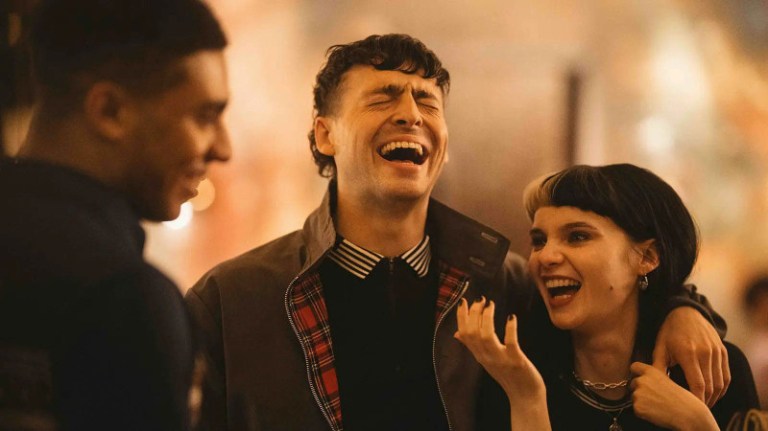
In 1932, Carlos (Milo Quifes), at the behest of his father, seeks to gain membership in the city’s exclusive casino but is denied (blackballed) on account of local rumours of him being homosexual. In 1937, listless musician Sebastián (Spanish singer-songwriter Guitarricadelafuente in one of the best performances of the year) is conscripted into the Spanish Civil War by the pro-Franco army, where he meets and falls for a leftist POW. In 2017, Alberto (Carlos Gonzalez), a playwright turned historian, receives an unexpected inheritance from a distant grandfather, causing friction in his already fraught relationship with his mother.
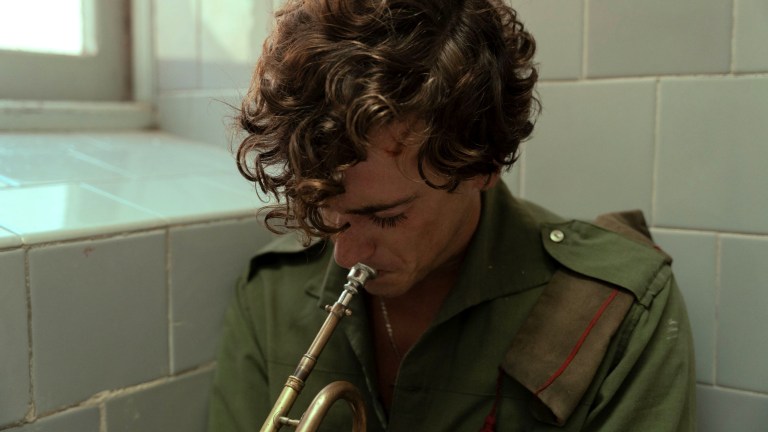
Guitarricadelafuente as Sebastián in La Bola Negra
From the opening images, we see that Los Javis are interested in the great human scale of classic Hollywood, but with the modern digital lens rather than pure nostalgic lens that would’ve been terminal to a film of this kind.
The film is a tragedy of what happens when we deny ourselves; this queer identity triptych is didactic and bold, wearing its desire for acclaim proudly across its shoulders. With an eye towards One Perfect Shot maximalism, the Carlos sequences in particular. La Bola Negra is constantly pressing meaning out of every camera placement and blocking choice. When it is revealed the nature of why these moments are so heightened, the film more naturally locks into place.
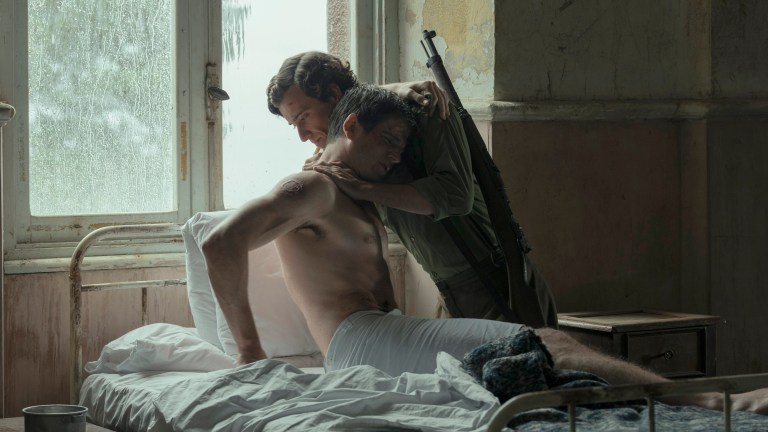
Sebastián, in the centre of the film’s timeline, is the beating heart of the film. A mess of emotions and desires, forced into the most rigid of boxes, he discovers a glimpse of a brighter and more expansive Spain upon meeting Rafael Rodríguez Rapún (Miguel Bernardeau). A real life footballer, soldier, and personal companion of Lorca, Rapún blends the timelines together in unexpected ways, pulling beauty, tragedy and melodramatic poetry out of difficult scenes that require a delicate touch.
Sebastián, whose inability to navigate the moment has him retreating to a bathroom windowsill, frantically playing his trumpet to calm himself. The film has supreme confidence in landing these moments of overwhelming emotion, using Guitarricadelafuente’s embodied tumult and heartbreak as a pillar that generations will be built upon.
Guitarricadelafuente Miguel Bernardeau as Sebastián and Rafael Rodríguez Rapún in La Bola Negra
There is a palpable modernity to Alberto that allows the torch-passing cuts from story to story to land with potency. A digital alarm. A Grindr notification. Martin Solveig and Dragonette’s Hello, the directing pair know how to use modern moments to create friction with the past. His search for meaning in the past is more grounded and elliptical than the narratives taking place in the 30s, turning a film that begins with a shout into a more measured narrative speaking volume. This does create an inconsistent tone that, while clearly intentional, lacks the avalanche-like structure Los Javis are striving for.
Weaving these stories of queer men unmoored and uncertain on how to navigate a combative, fascistic Spain across decades with dedication, La Bold Negra flitters between a tactile poetry and uninspired melodrama until finally arriving at a surprisingly emotional and potent final act.
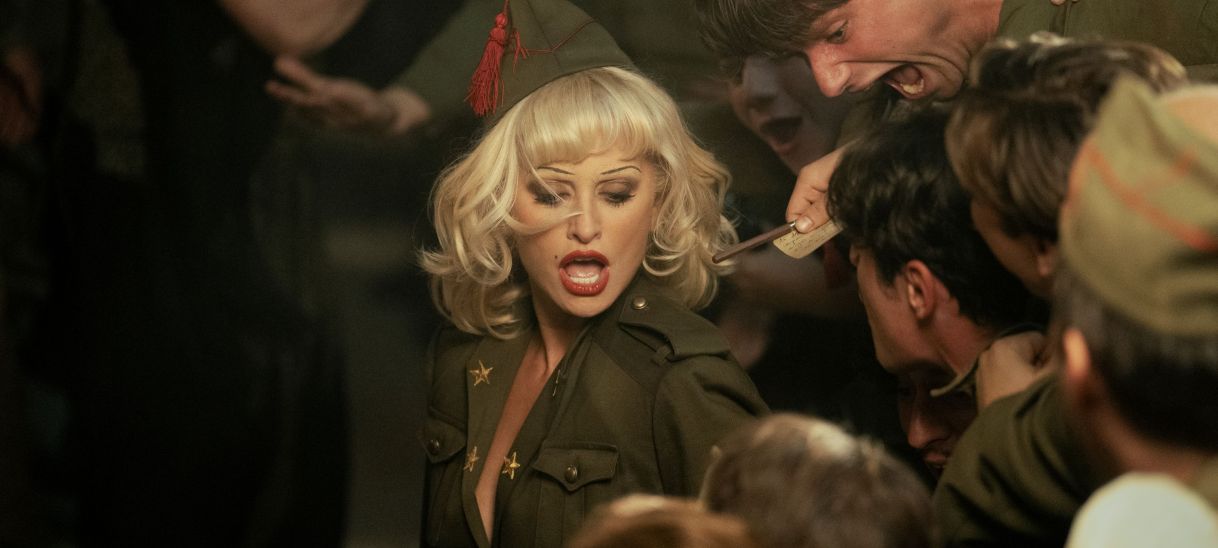
With a second half in need of a jolt, the film offers us an explosive performance by Penélope Cruz. Arriving at the perfect time in the epic, giving Sebastián a true north star with the promise of a future in Madrid.
Where the film discovers transcendence is in its moments of musicality, either through the original song “La Nieve” (“The Snow”) by Guitarricadelafuente, or through composer Raül Refree, who is given key scenes to shine through a combination of modern synths and older instrumentation. The film has an air of deep collaboration and heart from many great Spanish artists, with an eye to telling the stories of Lorca’s unfinished work to a new audience eager to hear it.
“This country has too many love stories buried in the fields”. Operatic in theme and style, La Bola Negra knows how to land its climax with La Nieve, pushing past melodrama to arrive at a moment of poetic, emotional clarity that defines the ambitious goal Los Javis are searching for in their epic. With a groundbreaking performance from multi-hyphenate Guitarricadelafuente, La Bola Negra has a pillar to build an ambitious queer epic we too rarely see in modern cinema. While occasionally dipping into rote melodrama that can feel manicured, Los Javis still achieves moments of emotional reckoning most films only hope to glean, with characters that live long in the minds of its audience.
La Bola Negrais in select theatres from October 15th.
We, as a species, are cooked. Greenhouse gases continue to warm our planet at an alarming rate, the effects of which can be seen in our worsening, and ever-increasing natural disasters. Our world leaders flirt with autocracy at the behest of capitalists who wield far too much power. Our air is toxic, made less breathable with each passing day thanks to the byproducts of the fuel and gas we rely on to power our technology. And the only means of comfort we have left is our ability to point and laugh at the very people who gifted us this bleak, miserable existence.
That’s both this writer’s assessment of the reality in which we find ourselves, and the morbid view expressed in Mexican director Alejandro González Iñárritu’s latest feature, Digger (2026). Its plot takes place in a world of two halves, one of which has an eccentric, arrogant American oil tycoon, Digger Rockwell (Tom Cruise) grappling with an environmental catastrophe triggered by his very company, and a Trump-coded US president (John Goodman) who would love nothing more than to absolve himself of all responsibility. As for the other half, there we have a theatrical play being directed by the young, inexperienced Hannah (Australia’s Sophie Wilde) and an executive producer (Jesse Plemons) who’s taking a very keen interest in proceedings.
Details of this second narrative were oddly absent from the marketing materials for Digger, which seem to be positioning the film as Don’t Look Up (2021) meets Dr Strangelove (1964). In reality, its tone and artistry is closer in spirit to Wes Anderson’s Asteroid City (2023) by way of a previous Iñárritu feature, Birdman (2014) – less a pointed satire of modern politics, and more a commentary on how art informs our lives. This distinction isn’t wholly apparent upon initial viewing, with the viewer likely to be confused by the dual plots and pondering what (if any) connection they share; yet all becomes clear when the story enters its third act and nears its conclusion, all before landing a vicious blow just as the credits roll.
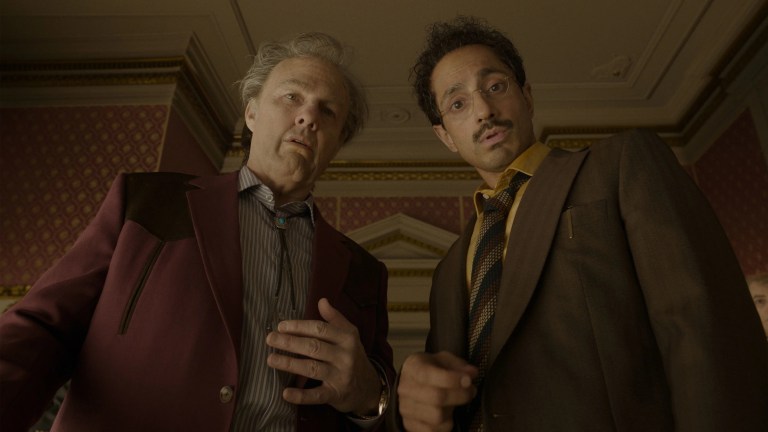
Digger Rockwell (Tom Cruise, left) and Ganesh (Riz Ahmed) in Digger
Those hoping for a satirical lambasting of our policymakers will inevitably be left disappointed, for Digger instead favours meta-commentary on the state of political comedy. The picture appears quite content to be a parody in the extreme, openly acknowledging that its characters are far more buffoonish than the counterparts from whom they’ve taken inspiration, in the belief that doing so will provide a sense of catharsis for the audience. There is some merit in this argument, particularly during the current era when certain heads of government are becoming more deranged by the minute, though the manner in which the story posits that very dictum proves quite heavy-handed and abrasive.
Digger may not possess much in the way of literary prowess, but can boast some nous in the form of its performances, chief among them Cruise. Despite being clad under a fat-suit and heavy prosthetics applied by Oscar-winning makeup artist Kazu Hiro, the acting veteran offers boundless energy in the role of Rockwell, his talent coming to the fore during a caustic monologue delivered to a rowdy crowd. His co-stars shine almost as brightly, including the aforementioned Goodman, Wilde and Plemons, as well as Sandra Hüller in the role of Digger’s half-sister Emma, Riz Ahmed as scientist Ganesh and Michael Stuhlbarg as a meek, ineffective vice-president. Further praise should be given to the cinematography of Emmanuel Lubezki, and production design of Dennis Gassner and Richard L. Johnson, even if they’re borrowing a few too many cues from Wes Anderson.
Being subversive, incendiary and brazen in equal measure, Digger ought to be the highpoint of Iñárritu’s storied career that has also given us acclaimed productions like Amores Perros (2000), Babel (2007) and The Revenant (2016). Unfortunately though, his latest effort doesn’t quite reach those heights, owing to a muddled screenplay that contains just enough bite, yet too few laughs and a clumsily-delivered message. Consider the feature instead as a showcase for a talented cast, and it can’t be faulted.
It’s taken almost 9 years, but we finally have a new Michael Bay Transformers film, except it isn’t Transformers and it isn’t by Michael Bay. Na Hong-jin’s Hope (2026) hails from South Korea and is carved from the same rowdy, loud and unshamedly plotless stone as a Bayhem Transformers film, and the result is a wild experience that you’re either with or against, with no room in-between.
The context for this wild experience is as such: a creature is wreaking havoc across a small mining/fishing town called Hope, with some locals saying it’s a bear, and others claiming it’s a tiger, and it’s up to police chief Bum-seok (Hwang Jung-min) to get to the bottom of what is going on. I’ll admit, I wasn’t feeling convinced that Hope would be worth seeing through beyond the first hour where nonsensical gunfire and chase scenes seem to just repeat on a loop with little to show in the way of any plot or character development. These scenes, while technically sound, left me on the edge of my seat, and less in the the “I’m gripped” way and more in the “I’m about to leave this cinema” way, but then the turning point happens: we see the creature.
Like Bay’s Transformers films, there’s more than meets the eye to this foreign, 10-foot green looking being, and it’s enough for Na to show a tear drop on its face in a close up as it’s being hunted to tell you that the first hour was worth your patience. This one close-up flips the film on its head by turning what was essentially a hunt you were rooting for, to a revelation where you quickly realise that even in moments where a human can recognise suffering on a foreign being, the urge to gun it down is too tempting.
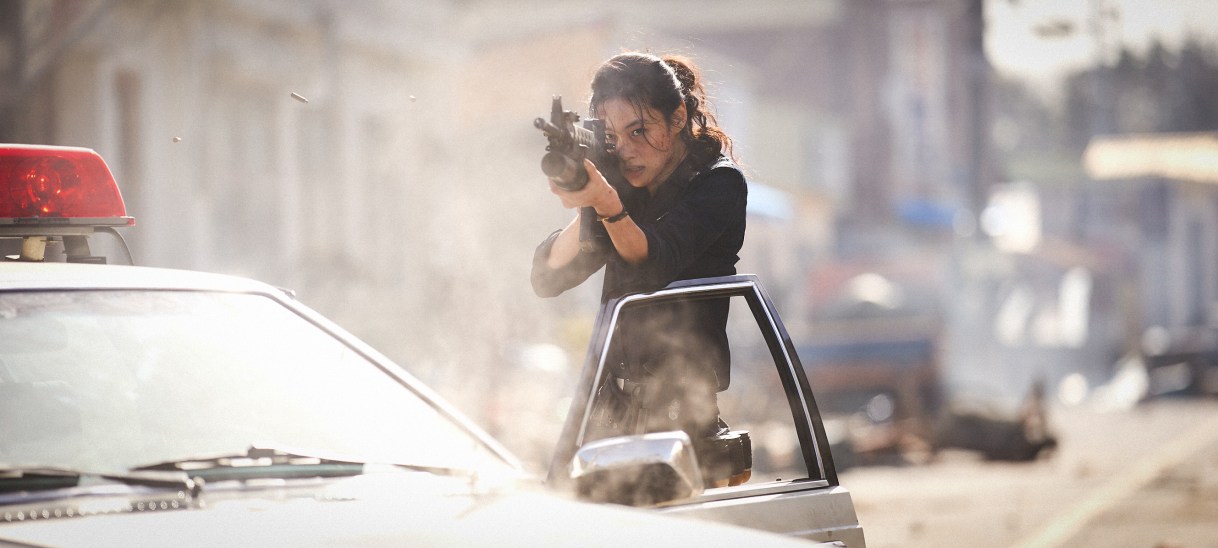
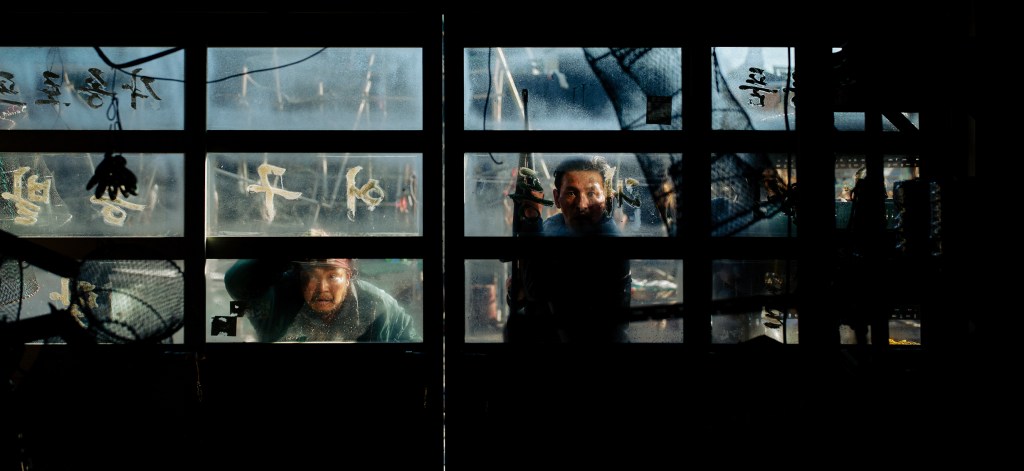
A still from Na Hong-jin’s Hope (2026)
Na cleverly relegates the humans to one-dimensional, underwritten goofballs —a feature, more than a shortcoming in Korean films— and this gives the second and third act an edge that reduces the idea of the Western hero (someone who fights for their land, for justice) to something more akin to a monster than the monsters themselves.
That’s right, there are multiple monsters, with Taylor Russell, Alicia Vikander, and Michael Fassbender each playing them. Whether it was clever marketing, a decision to cut costs, or both (I think the latter), the A-list actors have almost nothing to do as they’re masked behind shoddy CGI that, weirdly, I found quite memorable. Much of the film is cleverly shot with frenetic tracking shots and haphazard editing that gives urgency even when the setting (as beautiful as it can be, like in the final act) is barren and lifeless; it’s a testament to the commitment to just lean into the gung ho of it all and double down on the nonsense, with a particular monologue from an older gentleman that had my cinema of established Melburnian critics in hysterics.
It’s hard to believe that Hope exists. In his recent press tour for The Odyssey (2026), Christopher Nolan noted that Guillermo del Toro taught him that “a monster is never just a monster” and Na has taken that to the extreme by turning the mirror back on the audience, subverting expectations and flipping the film on its head to almost make you want to believe that it’s really the humans who are encroaching on these extraterrestrial beings. Hope is a thought-provoking genre picture that takes sharp turns at every turn, challenging the audience to look inward while simultaneously seeing Na adopt an unwavering, uncompromising adrenaline-induced approach to filmmaking that doesn’t disappoint, punching above its weight boldly and assuredly.
From Cannes favourites to local newcomers making their mark, the Melbourne International Film Festival is a fixture in the Australian cinema calendar, with the 2026 entry in the loaded program having something for everyone. Whether you just want to get the jump on Oscar prediction morning or need to spend the last weeks of a brittle Melbourne winter in packed cinemas, the festival will provide. Below is part two of our resident festival obsessive Darcy’s notebook on what he’s seen and loved this year.
All of a Sudden (2026) – Ryusuke Hamaguchi
⭐⭐⭐⭐⭐
Rating: 4.5 out of 5.
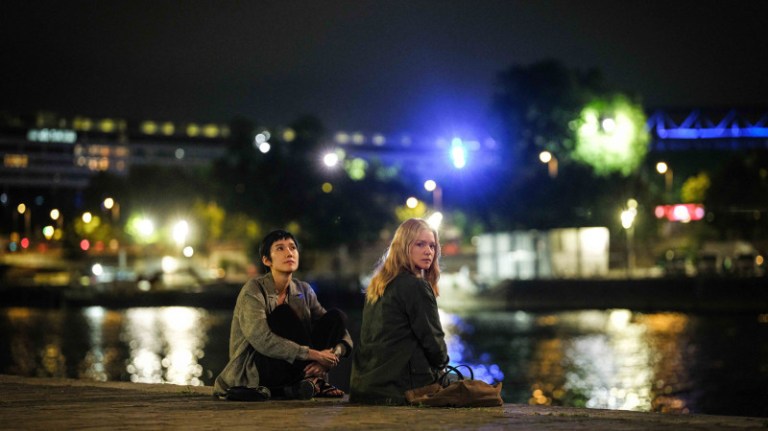
As a keen Drive My Car (2021) evangelist, Ryusuke Hamaguchi’s newest film, a near 200-minute luxuriation on connection, empathy, and capitalism inside a nursing home in France, was the must-see event of the festival. And it did not disappoint. With a unique pair of performances from Virginie Efira and Tao Okamoto (who shared the best actress award at Cannes) that glue you to the screen for its extended runtime, All of a Sudden has a dramatic and thematic engine you never want to leave. Whether it’s during a walk along the river or a whiteboard-assisted monologue on the cancerous nature of capitalism, Hamaguchi knows what he has in Efira and Okamoto and his characters, moving through a world of care and empathy without falling into saccharine traps that would doom a film of this nature.
But this isn’t just a talky film; it also contains perhaps the best use of natural lighting since Barry Lyndon (1975), particularly in its duration capture of sunrises and sunsets. There is a unique magic to having radical natural light changes within a durational scene, and Hamaguchi and cinematographer Alan Guichaoua build many of their extended sequences around it. Hamaguchi’s films may not be to everyone’s taste, but the observational clarity of storytelling he builds his work around should be required viewing for anyone still open to having their world altered by a work of cinema.
Minotaur (2026) – Andrey Zvyagintsev
⭐⭐⭐⭐
Rating: 4 out of 5.
The weaving of a simmering political turmoil with a pulpy affair plot would be an ill-fitting suit, but with Andrey Zvyagintsev, we immediately feel a cool, meticulous guidance. Coupled with a ruthless consideration by cinematographer Mikhail Krichman to achieve a level of voyeurism that probes without gawking, Zvyagintsev’s film is impressive and engrossing. Even when the film’s gentle simmer reaches boiling point, we are asked to observe and consider its characters rather than place ourselves inside their lives. A reimagining of Claude Chabrol’s 1969 classic The Unfaithful Wife — also made into the erotic thriller Unfaithful in 2002 with Richard Gere and Diane Lane — against the backdrop of the Ukraine war, wealthy local CEO Gleb (Dmitriy Mazurov) suspects his wife Galina (Iris Lebedeva) of hiding an affair. As the pressure mounts to sacrifice 14 workers to the war effort, Gleb’s family and personal turmoil begin to boil over.
The film excels as both high art drama and family melodrama through this melding of the weight of the personal and the existential. The political undertow pulling us to the violence of the sea is constant and powerfully considered, landing in a place of resonance in its final act that manages to echo Burn After Reading (2008) and postwar Soviet cinema. This high-wire act of tonal precision has to be seen to be believed, particularly with an active and engaged crowd.
Nagi Notes (2026) – Koji Fukada
⭐⭐⭐⭐
Rating: 3.5 out of 5.
A gentle, clear-eyed look at human dynamics playing out across the struggling small town of Nagi, Koji Fukada’s probing drama Nagi Notes is deeply fascinated by places and their impact on people, unfolding itself slowly but warmly. 630 kilometres outside Tokyo, Nagi is a small farming town that was forced to sell off most of its land to the government for an army base, creating a transitory aspect to the once stationary place.
The film is centred around a coming and going. The coming: an ex-sister-in-law from the city, Yuri (Shizuka Ishibashi), moves in with sculptor and farmer Yoriko (Takako Matsu), to sit for an art piece. The going: the son of a military family, Keita (Kiyora Fujiwara), tells his friend and crush HarukiIguchi (Kawaguchi Waku) he has to move away in two weeks. The joy of Nagi Notes comes from how Fukada weaves narrative and character dynamics in unexpected ways through this seemingly simple story, so the less said before viewing the better; just know you are in the hands of a caring and inquisitive writer and filmmaker.
Sweet Milk Lake (2026) – Harvey Zielinski
⭐⭐⭐⭐
Rating: 3.5 out of 5.
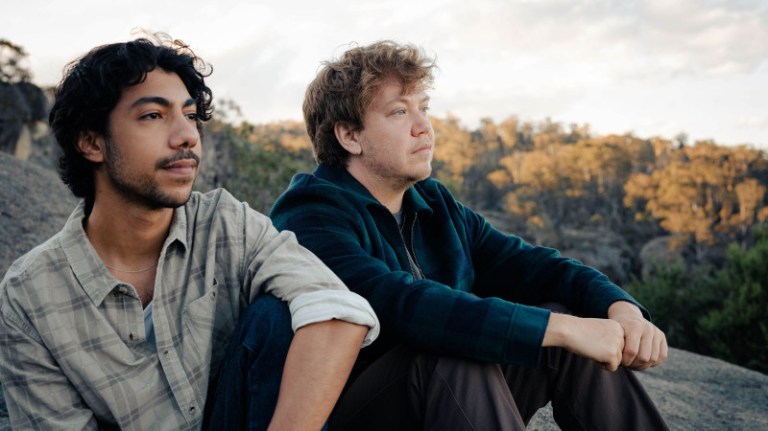
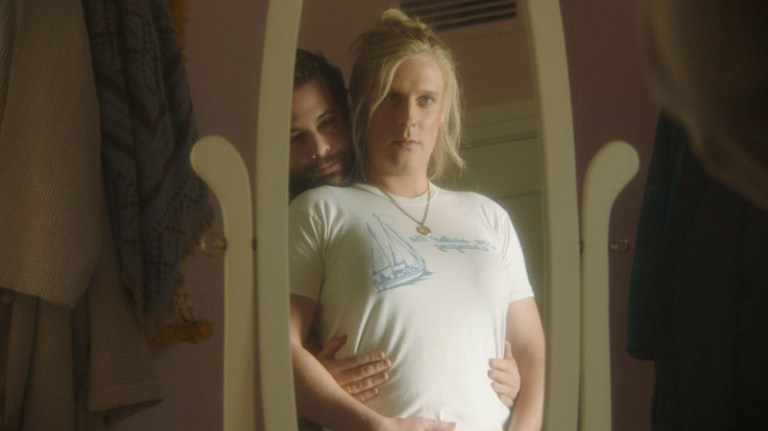
Harvey Zielinski bursts onto the Australian film scene with a debut to remember. Confidently entering the conversation for best Aussie film of the 2020s, Zielinski writes, directs, and leads Sweet Milk Lake (2026) in dual roles as sibling pair Sam and Jake.
Jake has recently transitioned and is struggling for their place in the city while living under the shadow of his more confident and successful brother Sam. While his brother is wonderfully supportive and offers a job to them, Jake is unsure where they see themselves. On an impulse, Jake travels down to the remote country town of Sweet Milk to see his terminally ill father (Kieran Darcy-Smith), who doesn’t know about their transition. After being mistaken for his brother Sam, Jake decides to stay longer than intended in Sweet Milk. The film is a charming and unique look into wider Australian culture and how gender is performed in different contexts while never losing its narrative drive. Zielinski’s writing is assured and moves with a syncopated rhythm that allows the awkward humour and piercing family drama to arrive and crescendo at unexpected moments, making for a thrilling watch.
Josephine (2026) – Beth de Araújo
⭐⭐⭐⭐
Rating: 4 out of 5.
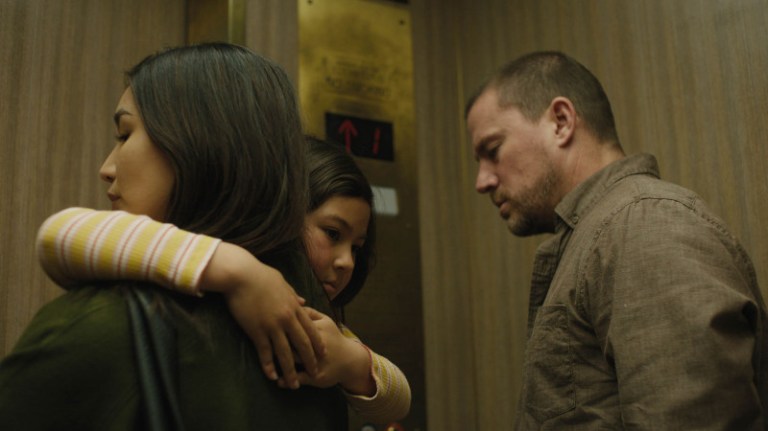
“In some ways I’ve been writing this since I was eight years old”. A to-the-core film of devastation from the intimate perspective of a child who witnesses a sexual assault and the emotional ripples of that moment. Told from the perspective of Josephine (Mason Reeves), we view the failed attempts at comfort and understanding from the adults surrounding her, particularly her parents, played by Gemma Chan and Channing Tatum.
Beth de Araújo knows in her bones that the only way to tell a story like this is through force. Some may find moments or scenes manipulative or lacking subtlety, but that is to deny the argumentative nature of the filmmaking. This is a film to be shown to all who can see it, not to be watched passively or with any remove. To understand that perspective is to know the power of Josephine.
La Gradiva (2026) – Marine Atlan
⭐⭐⭐⭐
Rating: 4 out of 5.
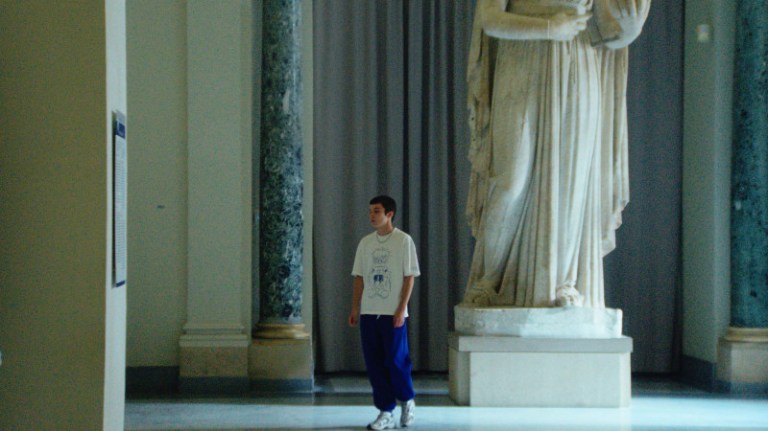
A worthy winner of MIFF Bright Horizons competition, cinematographer turned writer and director Marine Atlan has crafted what could be a definitional coming-of-age film through its extraordinary blend of modernity and timelessness.
One of the best films of the year, Atlan and her co-cinematographer Pierre Mazoyer have an eye for documentary-like importance even as the scenes flow with the casualness of youth. Following a French school group on a trip to Pompeii on the precipice of their final exam results, Atlan is delicately placing her characters, with their youthful drive and view of eternality in a famous space of stolen time, swallowed by ash. There is depth here I will be mining for years to come, like staring at an ash-encased body, interpreting the life underneath by the surface and shape placed in front of us.
Erupcja (2025) – Pete Ohs
⭐⭐⭐
Rating: 3 out of 5.
A soft wisp of a modern 71-minute Godard riff starring Charli XCX as Bethany, a Londoner visiting Warsaw with her soon-to-be fiancé Rob (Will Madden). Questioned why Bethany wanted to go to Warsaw over somewhere like Paris, she responds, “it’s more romantic”. This is a half-truth, as the answer is Nel (a magnetic Lena Góra), who owns a flower shop in town.
Their connection is tectonic, as the pair will tell you. Each time they encounter one another, a volcano erupts. Like the magnificent and frightening energy of the natural event, Bethany and Nel radically change the environment around their reunions, oftentimes leaving others in the ensuing ash. Filmmaker Pete Ohs was clearly working with fragments of ideas and a loose plot coming into production, allowing the ease of connection between the cast to drive the story like the French New Wave films Erupcja is indebted to. The key cast members all have writing and producing credits here, which is deeply felt scene to scene and allows the film to reach several poignant moments inside its modest framework.
The Only Living Pickpocket in New York (2026) – Noah Segan
⭐⭐⭐
Rating: 3 out of 5.
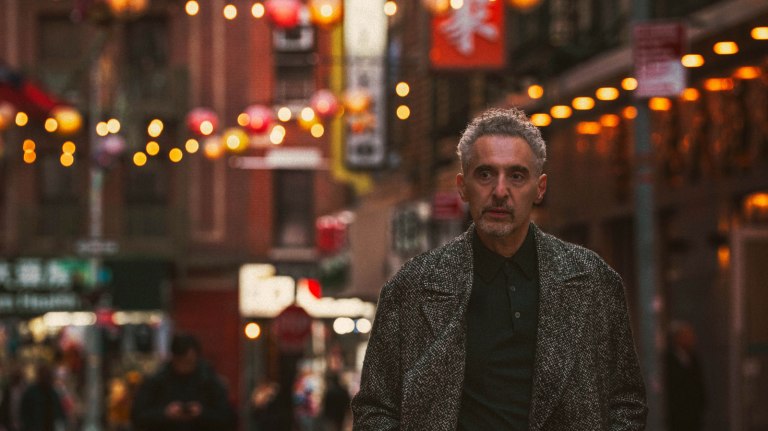
A charming and thoughtful exploration of aging and legacy shot beautifully across the five boroughs, Noah Segan’s newest film as director longs for a previous golden age of cinema with New York streets operating as its veins. John Turturro excels as Harry, a career pickpocket making do in a world with fewer floating wallets and cash than ever before as he hustles to care for his ailing wife.
Segan’s film is Uncut Gems (2019) in a pair of moccasins, with the stakes never raising the blood pressure too high. An over-the-hill pickpocket moving through the city is a lovely way of weaving through modern life in New York. Harry’s reticence to change tactics to online or credit scams gives him an air of a Lupin-tinged gentleman thief, where even his detective rival, Allen (Giancarlo Esposito) respects him. A delightful film that works best on an older crowd.
The Samurai and the Prisoner (2026) – Kiyoshi Kurosawa
⭐⭐⭐⭐
Rating: 4 out of 5.
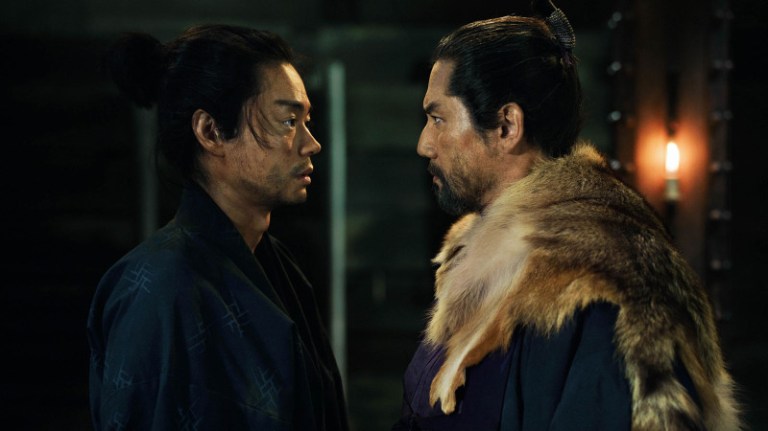
Equal parts political war drama and samurai Columbo, horror master Kiyoshi Kurosawa’s adaptation of the 2021 novel The Samurai and the Prisoner (2026) moves to its own rhythms, knowing its audience is hooked to every moment.
Set in 16th-century Japan, samurai lord Murashige Araki (Masahiro Motoki) is locked in his castle as Oda Nobunaga lays siege to his home. The film begins in earnest when rival envoy Kanbei Kuroda (Masaki Suda) is captured by Murashige. The award-winning novel opens with the line “Toss him in the dungeon; do not let anyone see him and do not kill him. Keep him alive until I say otherwise.” In a time of ruthless killing and few prisoners of war, the stage is set for a defensively woven chamber drama that is keen to charm an audience by its movements towards Agatha Christie and other European-style mystery fiction. The pair of performances between Suda and Motoki is gripping and falls easily into Kurosawa’s unique film style that allows long sequences to play out naturally, ratcheting the tension inside a still frame that has made his horror features the best in the genre. Overlaying this perfected style of storytelling over a samurai chamber epic makes The Samurai and the Prisoner a wholly unique and captivating viewing experience.
The Man I Love (2026) – Ira Sachs
⭐⭐⭐⭐
Rating: 3.5 out of 5.
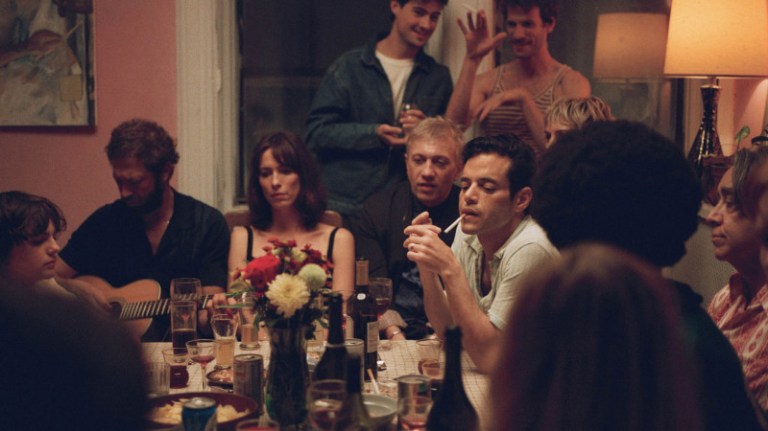
There is a certain surreality that occurs when you’re around a sick person who, after a gruelling treatment process, returns, however fleetingly, to their previous self. An almost religious experience. Screenwriters Ira Sachs and Mauricio Zacharias know this intimately.
Handling the AIDS crisis in 1980s New York with a passion and care for those caught in its crosshairs, and how they choose to respond, Sachs imbues his characters with the dramatic tension of uncertainty and sharp edges, complicating each conversation scene with where we expect it to conclude. Rami Malek and Tom Sturridge have never been better, and with the introduction of Luther Ford to cinema with support from Rebecca Hall and Ebon Moss-Bachrach, Sachs can paint with a wider canvas than his previous couple of films to show the community and isolation of this well-documented era of American history.
The Dog Stars preview screening provided by Disney.
From first glance, The Dog Stars (2026) has the makings of a Ridley Scott film with its post-apocalytic setting giving the veteran director an opportunity to build suspense in the unknown, but it feels like anything but a Ridley Scott film.
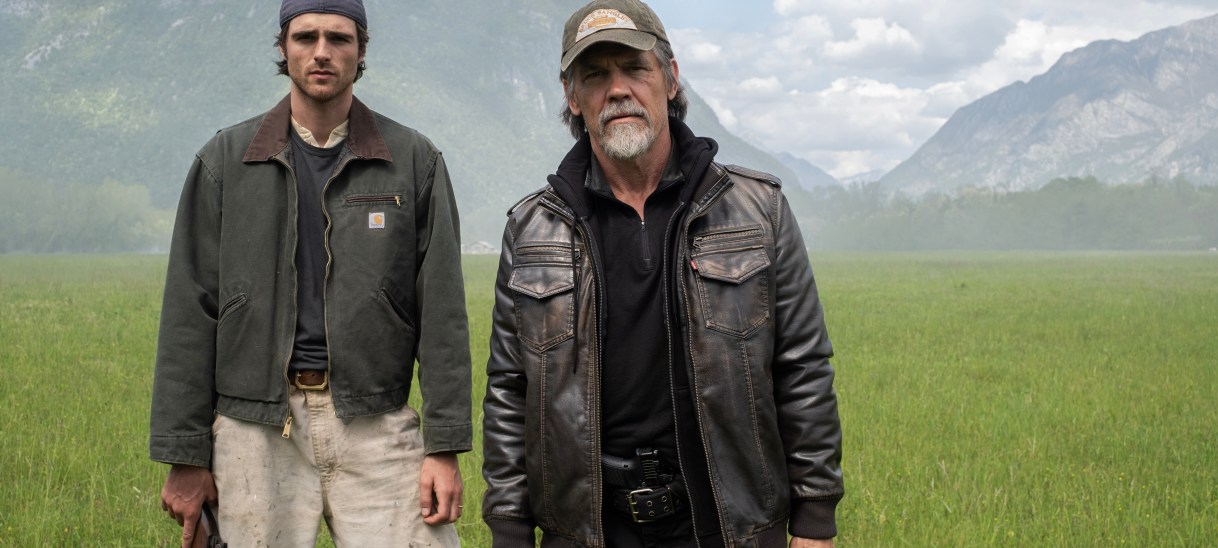
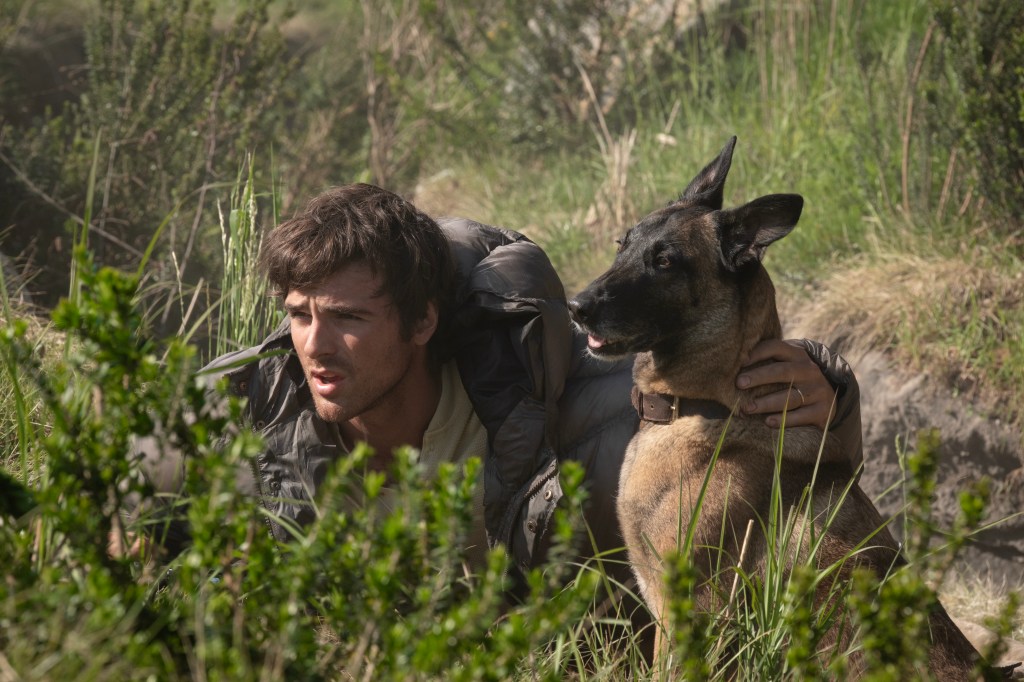
Having been adapted for the screen by Mark L. Smith from Peter Heller’s 2012 novel of the same name, the film calls to mind the recent hit show The Last of Us (2023 – ), opting for the same sort of lived-in yet barren wasteland as the backdrop to events. Mankind has experienced a plague of some kind that has taken the lives of the majority and left others scraping by, defending the little they can gather while scavengers work to steal it. Jacob Elordi plays a mechanic who lives out on a big block of land with a rugged Josh Brolin and a dog, Jasper.
The film almost carries a tranquil quality with sweeping vistas, shots of a plane flying over said vistas and just a serenity that makes you wonder how it’ll be disrupted. There’s a whole lofty backstory built around Elordi’s character that informs his attachment to his dog, with flashbacks cutting from the past to the present showing these interactions with his wife. At some point though, the plot needs to move forward and what better way to get it moving than by having a scuffle with those aforementioned scavengers which sees his dog be killed. (John Wick vibes, anyone?). This leads to Hig (Elordi’s character) making the decision to head out with his plane to the “Grand Junction” in search of a mystery voice he’s been picking up while surveying the land from the sky.
Jacob Elordi as Hig and Jasper in 20th Century Studios’ THE DOG STARS.
There’s a sloppiness to the writing to get the plot to this point, and just a randomness to proceedings which doesn’t stop here. Hig ventures out where he crash lands and meets the duo of “pop” (a Guy Pearce who the audience I was with said looked like Brolin) and a young former medical student Cima (Margaret Qualley). Here, the film splits into two: you have Brolin’s character facing a wrath of skinhead-like scavengers who look like they’ve been pulled from Mad Max: Fury Road (2015), and Elordi and co getting acquainted.
The latter side sees a wonky, unconvincing love subplot be thrown in between Elordi and Qualley’s characters that is incredibly underwritten and isn’t helped by the actors having zero chemistry with each other. Elordi’s performance also feels incredibly stale —no doubt due to the terrible writing— and probably wasn’t helped by him being cast on account of Paul Mescal dropping out of the film (there’ll be no Oscar nomination this time like when Elordi was recast in the Frankenstein’s monster role).
It’s as though there was a desire to have a more contemplative approach to a novel with writing that no doubt reads that way, but the need to add action and energy was playing on people’s minds so some of it was thrown in for good measure. Beyond that, there just isn’t the punchiness of a Ridley film; the stakes feel watered down, the set pieces are quite blasé and this just plays like a very ‘autopilot’ project from a director we know can do so much more.
The Dog Stars opens nationally from 27 August 2026.
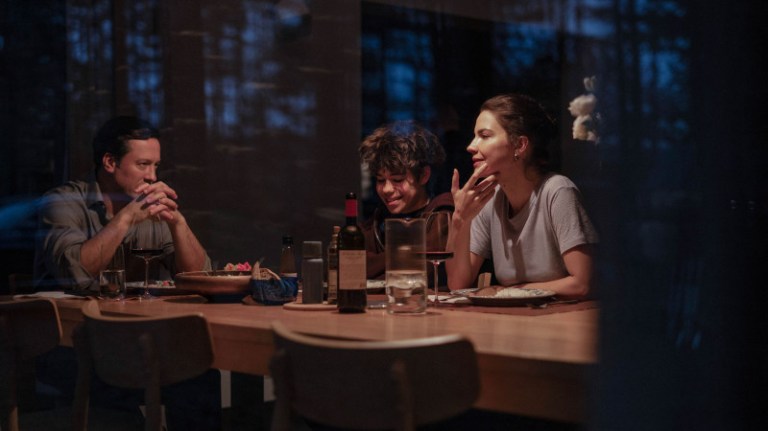
Treacly and warm as any movie this into honey and bees should be, The Rivals of Amziah King (2025) is an entertaining and shapeshifting tale of revenge, interpersonal legacy, and community built on music. A true film out of time, one that dynamically shifts its focus constantly, and, while it has stumbles, arrives at a place of unexpected poignancy.
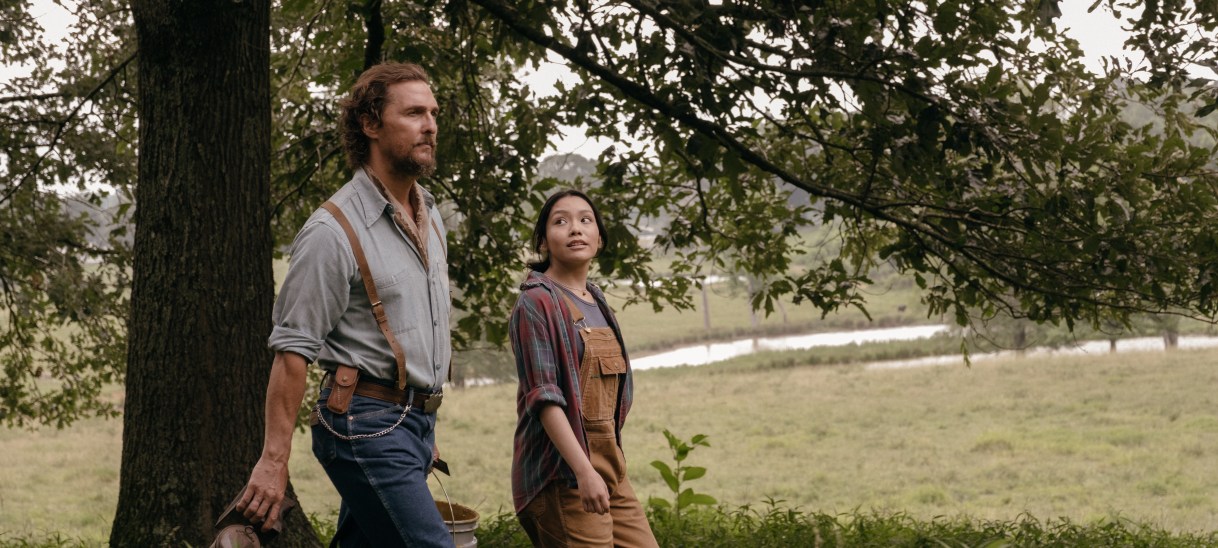
The film opens with an earnestness that fuels our journey. Amziah (Matthew McConaughey) is the last to arrive for a stitched together bluegrass performance at a local outdoor diner with his bandmates that immediately calls to mind the 80s and 90s hangout movies that defined McConaughey’s early career. After an uptempo jig and title sequence, we tail Amziah as he is whisked away by the police, not for any wrongdoing, but due to Amziah being the local beekeeper who can assist them in uncovering whose honey had been stolen from the back of a truck in town.
The following extended sequence is frenetic, matching Amziah’s energy and ability to weave himself into the lives of the community. Filmmaker Andrew Patterson knows what he has in this McConaughey performance, and builds the style and narrative around his charm and magnetism, allowing the film to evolve and develop through and eventually expand past him.
(From left) Angelina LookingGlass and Matthew McConaughey in The Rivals of Amziah King.
The shared connection of music is the foundation of The Rivals of Amziah King, with every moment bursting with the frenetic energy of a brash bluegrass group working a tune out together. The story takes a turn when Kateri (Angelina LookingGlass), a foster child Amziah and his late wife raised and cared for, returns to town and is swept up into his exuberant storm. To the uninitiated, as Kateri is, Amziah’s brash inclusivity is overwhelming, but comes from a palpable desire to uplift those around him. The world is unforgiving and cruel, why not spend one’s time surrounded by music and friends. McConaughey and LookingGlass have an easy connection that feels rooted in the characters’ shared history. Her nervousness and modern sensibilities clash with his old-school bravado without ever causing friction, a charming dynamic that allows the film to stay balanced as it shifts gears in its second half.
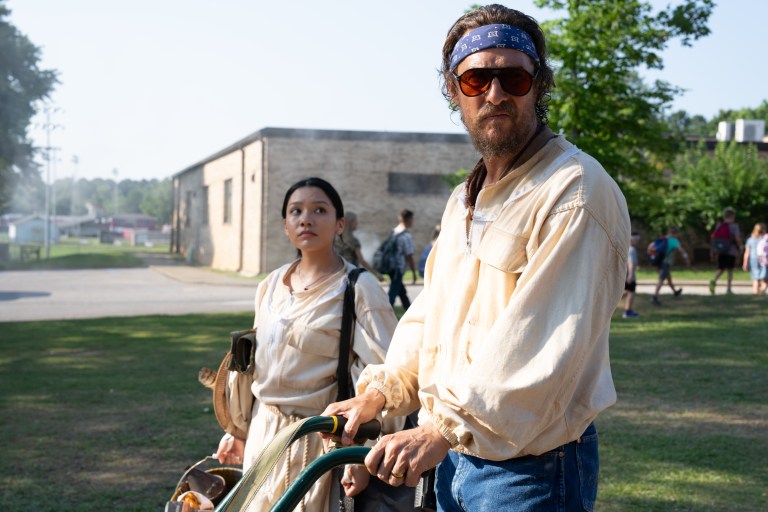
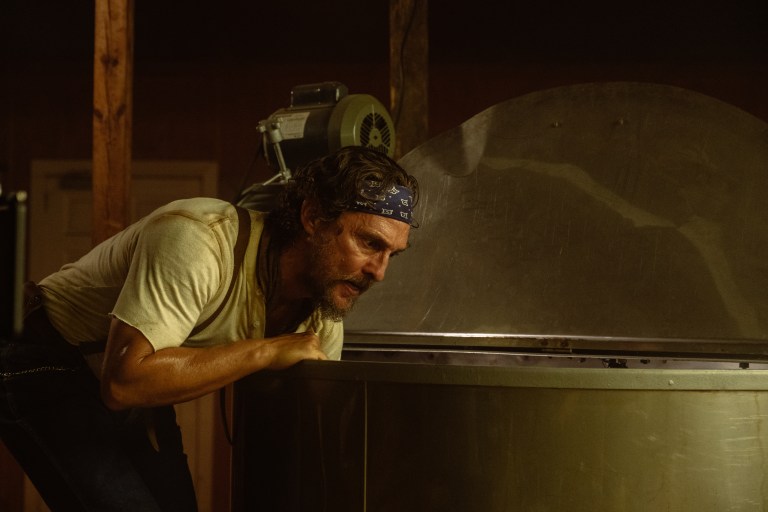
There are several sequences here that are exhilarating with a crowd and worth taking the chance on. One, a charming, farcical escapade in a school cursed with an aggressive hive. The other, an extended bee hive heist set against the backdrop of the swampy backwaters of Oklahoma that calls to mind some great Kelly Reichardt films.
But the film isn’t all sweetness and treacle. Tastes will greatly vary for the effectiveness of the film’s second half depending on how one feels about the groundwork laid in its opening chapters. The Rivals of Amaziah King moves with a clouded confusion in its back half, shifting gears with abandon, relying on the location and its relentless stomp clap score to stay on the rails.
While a film built on top of people playing music constantly, this is not a traditional music film about folks trying to make it big. Amziah and his troupe of friends play at the local hall not to leave their small lives and be the next big stomp folk act, they play to entertain and connect with their community in the same way the potluck served alongside the event does. There is a sweet beauty in these moments that pierce through the overwhelming earnestness and makes a true impact.
After the emergence of The Vast of Night (2020), a film that struggled to break out and was greatly heralded by critics to get more eyes on it, there were fears Patterson would quickly follow it up inside a bigger tent, or god forbid pivot to television. The double-edged sword of Patterson’s follow-up being an intimate look at his local Oklahoma community is that it comes to screens a painful seven years after his debut. Thankfully, with a towering and human return to screen by McConaughey, we are rewarded with Patterson’s return with a unique comfort film that blends the old and the new, with a sweet aftertaste.
From Cannes favourites to local newcomers making their mark, the Melbourne International Film Festival is a fixture in the Australian cinema calendar, with the 2026 entry in the loaded program having something for everyone. Whether you just want to get the jump on Oscar prediction morning or need to spend the last weeks of a brittle Melbourne winter in packed cinemas, the festival will provide. Below is part one of our resident festival obsessive Darcy’s notebook on what he’s seen and loved this year.
I See Buildings Fall Like Lightning (2026) – Clio Barnard
⭐⭐⭐⭐
Rating: 4 out of 5.
One of the finds of the festival, a gorgeous and riveting tableau from Clio Barnard based on the novel from writer and poet Keiran Goddard, cramming what felt like a season of a revered BBC miniseries into 109-minutes with the best editing of the year by Maya Maffioli.
I’m a total sucker for Northern UK street poeticism, with its blue collar groundedness with a powerful north star of where to point the millennial finger of ennui and uncertainty at. The film with the title of the year (sharing the name with the novel) follows a tight group of young Gen Z friends growing together and apart, set amongst a constantly shifting Birmingham. With an honesty and clarity into youthful modernity and the crippling weight of housing pressure on individuals and a community. A must see.
Maddie’s Secret (2025) – John Early
⭐⭐⭐⭐
Rating: 4 out of 5.
There is something magical about watching a film with an extreme amount of conviction that brings a totally game audience to the edge of a cliff but still begs for more. John Early had already made a name for himself as an impressive comedian and actor, but in Maddie’s Secret (2025), we see the emergence of Early as one of the most impressive comedic filmmakers to come out of a decade struggling for cinematic laughs.
The Far From Heaven (2002) for the Bon Appétit content mill sounds like a difficult pitch to audiences, but the power and potency of the satire Early is operating from, performance to lighting elevates this to astonishing levels. Dealing with the underdiscussed world of bulimia and eating disorders with the maturity and understanding that allows it to remain as silly and extreme as it is with the knowledge the audience will never jump ship. In a just world Early and Kate Berlant will be in awards conversations.
Wicker (2026) – Eleanor Wilson and Alex Huston Fischer
⭐⭐⭐⭐
Rating: 3.5 out of 5.
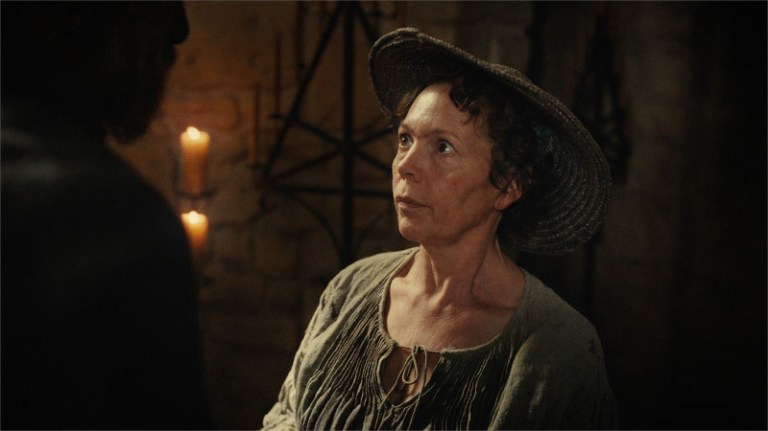
An incredibly well-cast 19th-century small-town fable about a fishmonger (Olivia Colman) who asks the local basket weaver (Peter Dinklage) to make her a husband, just to get her nosy neighbours off her back. The Weaver obliges, crafting her a perfect wicker husband — played wonderfully by Alexander Skarsgård, wrapped in an astonishing wooden body made by the Wētā Workshop — asking only for coin in return. The film is a riot. With a unique take on gender struggles with its bashful comedy and storytelling echoing the Brothers Grimm, Wicker comes by its fantasy matter-of-factly, with a lyricism that keeps you on the hook for where Wilson and Fischer want to take us.
Rose (2026) – Markus Schlesinger
⭐⭐⭐⭐
Rating: 4 out of 5.
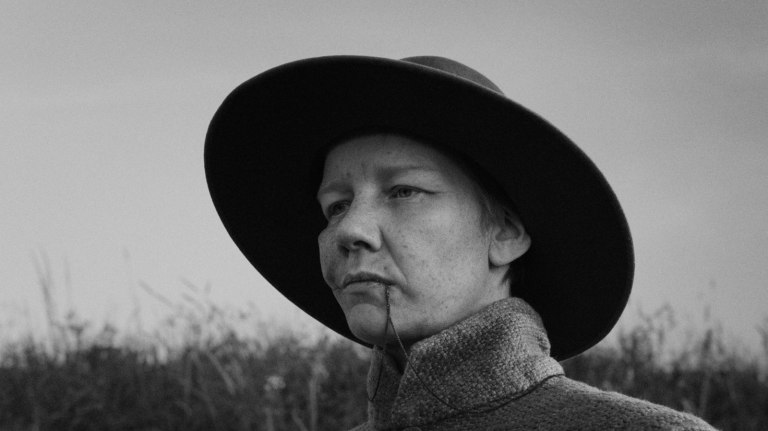
All gender is performance, and it can give you desires you didn’t think you possessed if you embody the performance for long enough. Markus Schlesinger and Sandra Hüller are on a very targeted wavelength in Rose, a period film about the not uncommon situation of a woman assuming the role of a man to garner a level of respect and equity they see for themselves, particularly around wartime and, notably here, postwar time.
With a considered palette from Schlesinger and cinematographer Gerald Kerkletz, Rose at once feels both in command of her situation and burdened by its crushing weight. The film gains some real drama and tension akin to The Passion of Joan of Arc (1928) in its final act, with Hüller’s rugged demeanour giving way to an unkind world when the truth begins to leak out.
We Are All Strangers (2026) – Anthony Chen
⭐⭐⭐
Rating: 2.5 out of 5.
A wide tapestry of a film on family, Anthony Chen’s compelling yet frustrating new work is a tale of almosts. A rare film set and filmed in Singapore and the first Singaporean film to screen in competition in the Berlinale’s 70-plus-year history, We Are All Strangers weaves in its setting well across its 157-minute runtime, even as it feels in a rush to arrive at its destination rather than ruminate and observe its surroundings. Centring a father and son trying to make it in the rapidly changing city flooding in with new money, characters come and go through their lives (in fascinating and infuriating ways) that propel you from scene to scene.
The Fox (2026) – Dario Russo
⭐⭐⭐⭐
Rating: 3.5 out of 5.
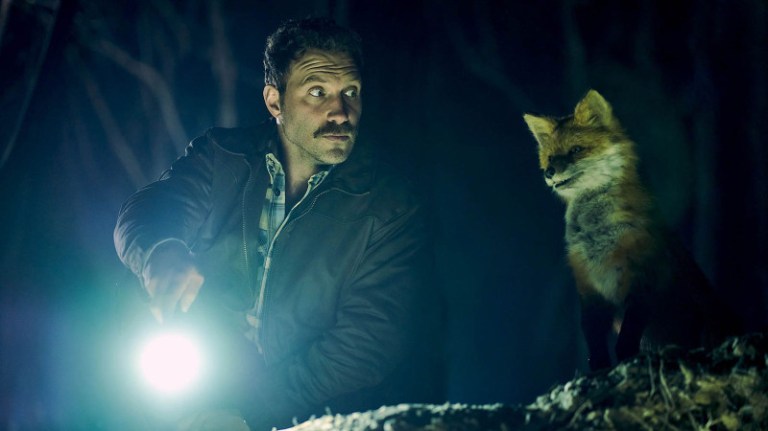
Dario Russo’s Adelaide set film The Fox is the hottest ticket of the festival. A charming and well-cast comedy that would make a fascinating double feature with Obsession (2026), with its ideas on relationships, control, and gendered violence inside a gnarly and knowing bit of magical realism. With brilliant voice performances by Olivia Colman and the late great Sam Neill as a fox and magpie, respectively, in a quiet town, Russo’s ear for Australian idiosyncrasies makes for a wall-shaking cinema experience of locals, as the film raises its brow up at our culture of quiet contempt subdued by our heavy drinking tendencies. While not groundbreaking in any form, it is refreshing to have a proud Australian comedy making waves at the festival.
Lost Land (2025) – Akio Fujimoto
⭐⭐⭐⭐
Rating: 4 out of 5.
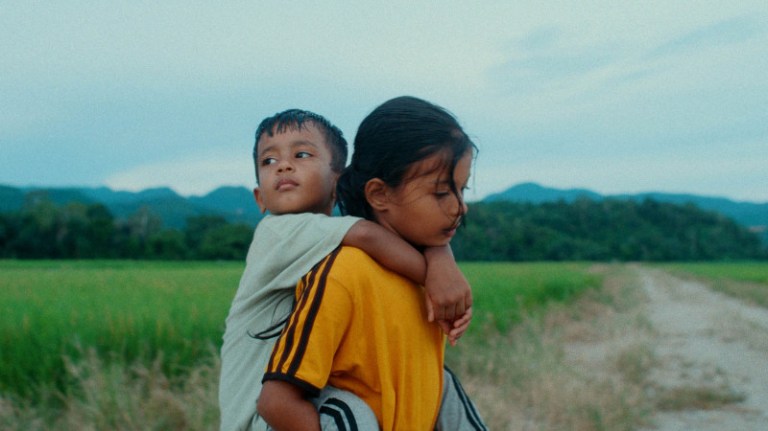
There is an overwhelming nature to docufiction that makes it a uniquely cinematic genre of storytelling, and Akio Fujimoto’s Lost Land (2025) is as good an entry point for audiences as you’ll find. The film approaches the stories of Rohingya asylum seekers through a pair of real siblings, Shomira Rias Uddin and Muhammad Shofik Rias Uddin playing nine-year old Somira and four-year old Shafi, as they have to journey from a Bangladeshi refugee camp to Malaysia to hopefully get confirmed asylum status, a necessity for a stateless people.
There are questions to be had about filmmaking ethics here akin to Nathan Fielder’s The Rehearsal (2022), but the power of docufiction comes from the blurred line of ethical artistry when a subject of such weight centres the work. Left with more ideas and questions than anything I’ve seen at the festival this year.
Mad Rush (2026) – Madellin McKenna
⭐⭐⭐
Rating: 3 out of 5.
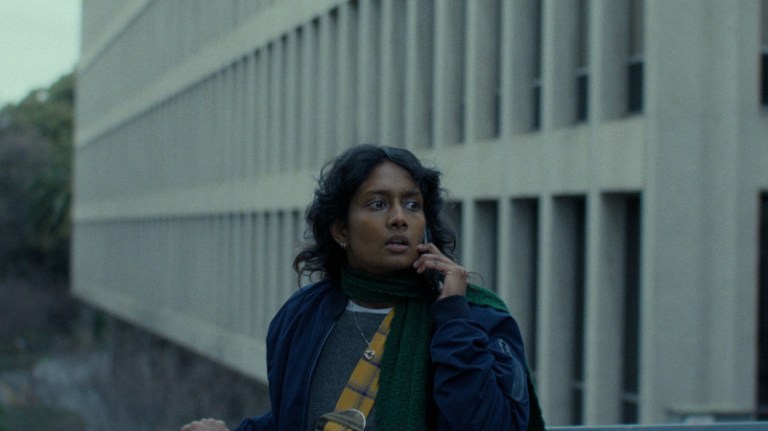
There’s nothing like seeing a hometown success story at the festival. At the premiere of Madellin McKenna’s debut, the Capitol was buzzing with locals eager to wrap its arms around a film so invested in the city. A madcap rush of blood to the head pierces through Melbourne streets after Madisha (Senuri Chandrani), a struggling young person fresh out of work and potentially forced to return home, is targeted by an ATO phone scam trying to bleed her for everything she’s got.
Mad Rush attempts to walk a difficult thematic and narrative tightrope, as McKenna tries to blend a high-octane movement-based thriller with a contemplative and lyrical exploration of modern life as a 20-something. Albeit in rare bursts, when the performances, editing, and narrative settle into a groove that has both tracks building together, the audience is quick to be swept up into Madisha’s world.
Rose of Nevada (2025) – Mark Jenkin
⭐⭐⭐⭐
Rating: 3.5 out of 5.
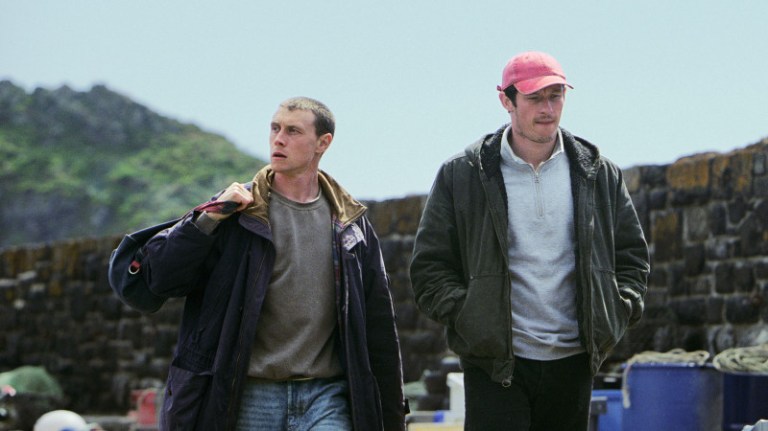
No one is doing it like Mark Jenkin. A truly singular artistic expression of the British community, wielding vintage Bolex cameras that capture no audio, giving the film a detached and mythic distortion, Rose of Nevada is a bitter, acquired taste. It touches on truly weighty subjects like the destruction of personhood for the benefit of those you may never meet through its jagged edges and abrasive storytelling, leaving the door slightly ajar to lose yourself in.
Indie film’s lynchpin weirdo, George Mackay, plays wonderfully alongside the more laissez-faire partner in Callum Turner, giving the film a beating heart surrounded by the rust and the chains. The story is best left unsaid, as it is best to uncover the strangeness of Rose of Nevada alongside its characters, entering its brittle trance at the same pace.
The Odyssey Melbourne premiere screening provided by Universal Pictures
As one of the seminal works in literature, The Odyssey brought the mythical down to Earth, pitted gods against man and set the tone for the sort of storytelling we have seen ever since across various mediums. There have been numerous adaptations in film and TV, some focusing on key moments like Troy (2004) and The Return (2024) while others were more loose in their approach like O Brother, Where Art Thou (2000), but Christopher Nolan’s rendition stands on its own as a triumphant exercise in scale and possibility, breathing new life into a classic.
While scholars largely agree that The Odyssey was communicated orally before ever being written down anywhere, the question of whether Homer was ever actually one person or one part of a whole has always been a point of contention. What is unmistakable is that Nolan writes his version for the screen entirely in IMAX, a trailblazing feat for a director who has constantly worked to push the medium forward. His effort has seen a widespread ‘pilgrimage’ from devoted fans to locations that are showcasing the film in all its 70mm glory (one of which is here in Melbourne), and it’s worth every effort to see in that way.
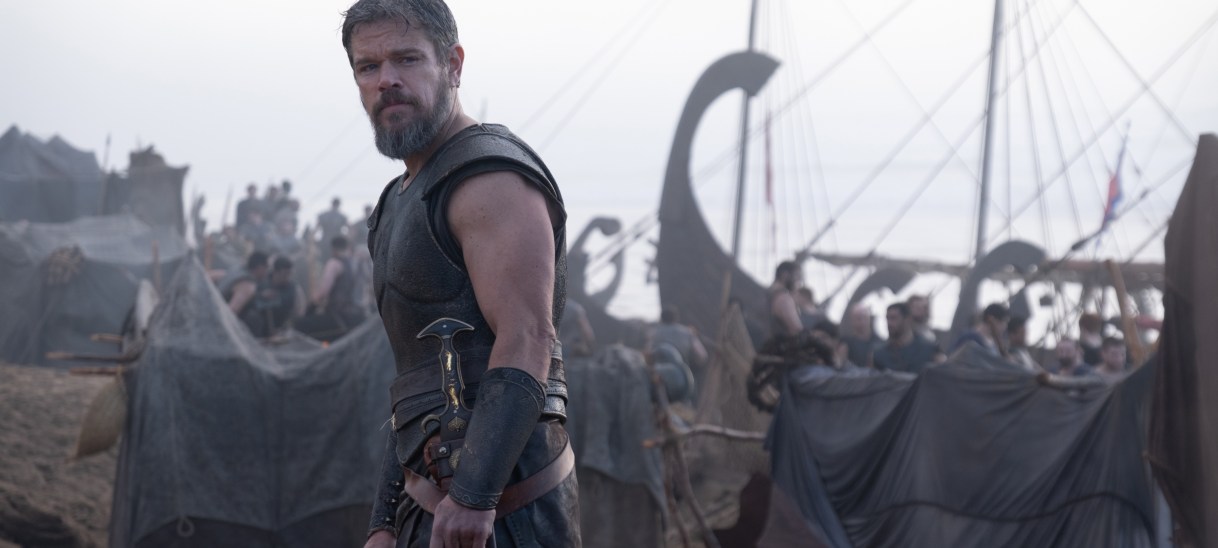
Nolan’s film finds a balance between the more contemplative moments of the novel and the sudden shifts in momentum as tension brews. Godly interactions are replaced with allusions to greater powers like the crash of thunder, flashbacks are used seamlessly to connect one moment to the next, and the film is underscored by layers of greed and regret that compliment rather than detract from the unfurling of events. After all, Nolan has always been interested in men who have self-destructive tendencies and carry grief, greed and regret within them which makes Odysseus (played expertly by Matt Damon) the perfect vessel from which to delve further into that thematic exploration.
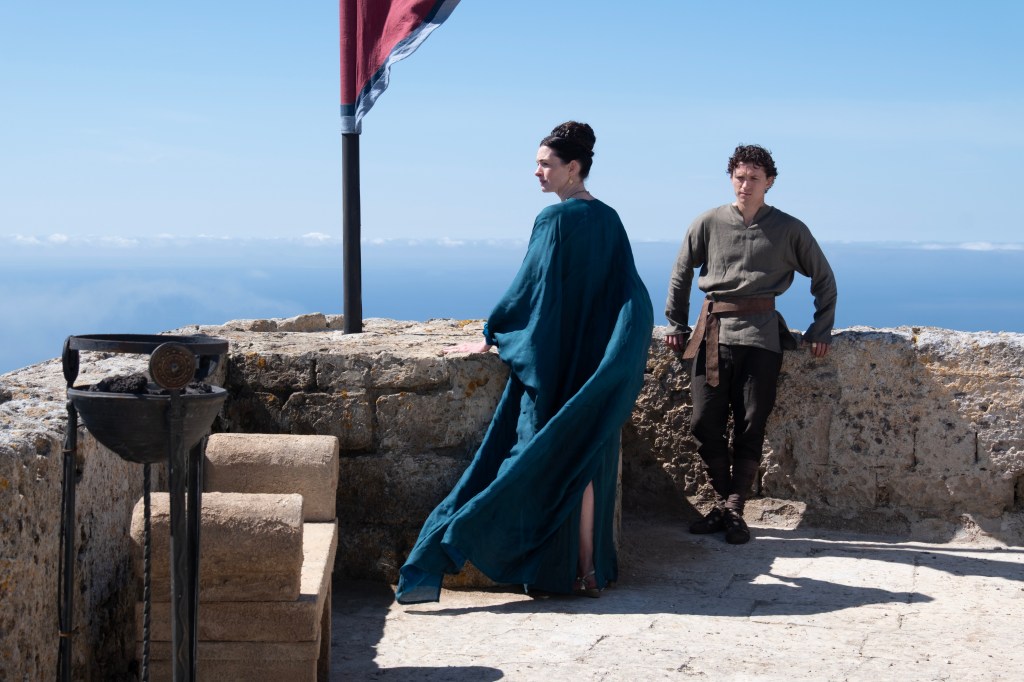
L to R: Anne Hathaway is Penelope and Tom Holland is Telemachus in The Odyssey, written, produced, and directed by Christopher Nolan.
Odysseus, like Oppenheimer, carries the weight of the world on his shoulders and people will live and die based on his actions; however, for Oppenheimer that weight threatened to destroy the world while for Odysseus, it threatens to destroy him. It’s why his journey from Ithaca to the beaches of Troy tickles Nolan’s fancy, a journey that is met by moments where the sacrifice of the few is in service of the collective whole. It leads to some of Nolan’s most haunting images of said greed, where the trials and tribulations from the novel bring into question what is morally right (like burying dead warriors) versus what is necessary (escaping and surviving).
It does take a good 30 or so minutes to actually get the ball rolling, as establishing an epic of this scale with so many potential directions to springboard from is no easy ask. This is especially the case as Nolan works to figure out how to get Telemachus (Tom Holland) out of Ithaca and away from the suitors like Antinous (Robert Pattinson) courting his mother Penelope (Anne Hathaway) while bringing Odysseus into the picture as soon as possible.
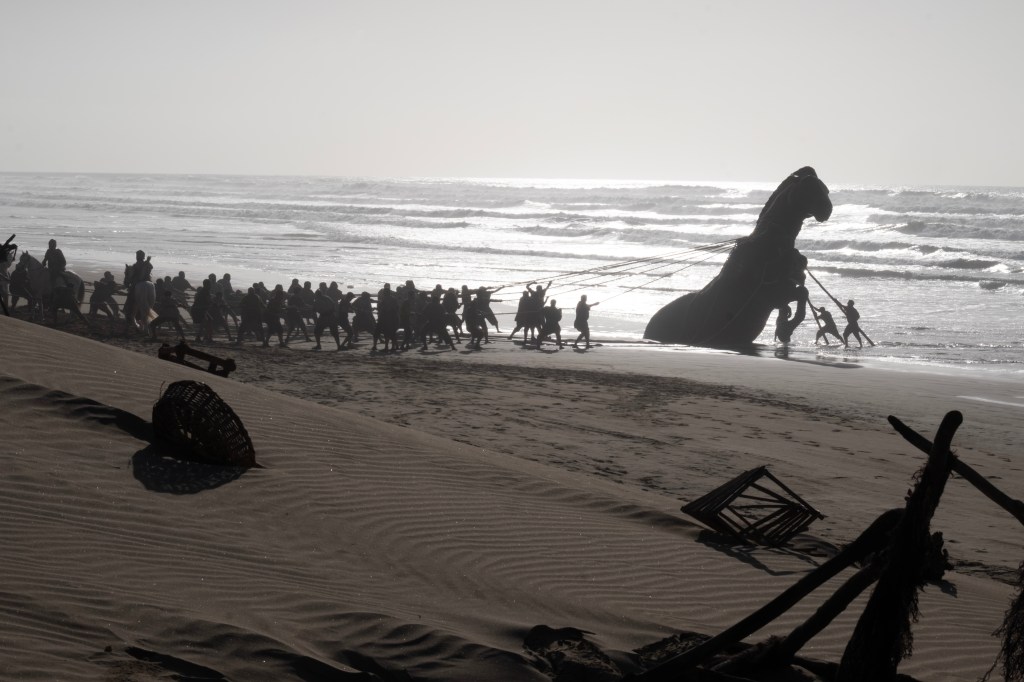
The Odyssey isn’t a complex story, but finding a way to navigate the presence of gods which so crucially inform every cause and effect chain in the story, is a challenge, especially since Nolan’s approach usually involves crashing non-chronological moments into each other like oars against rocks. His approach here is a bit more considered and surprisingly seamless though, as flashbacks do a lot of heavy lifting, cutting from the past to the present; from Calypso’s (Charlize Theron) gradual unlocking of Odysseus’ memory to Telemachus hearing the stories of his father’s journey from those who battled with him like Menelaus (Jon Bernthal). The key moment the flashbacks come back to, and the part of The Odyssey that even those who haven’t read it will be most familiar with, is the Trojan horse infiltrating Troy. This is the nucleus that bridges the rest of the film together, showing the path that Odysseus and his men took that ultimately led him to his predicament.
The Odyssey, written, produced, and directed by Christopher Nolan.
This path leads them from encounters with creatures like a cyclops that was physically built to tower over the actors, to a forest of giants in armour that equally tower like the Mountain from Game of Thrones, and an encounter with the dead men in ‘hell’ where ice and fire meet. A particular highlight occurs with Circe (Samantha Morton), a witch who conjures dark magic to usurp her victims. Without spoilng too much, her presence (along with that of the aforementioned creatures) almost evokes an element of horror that is reminiscent of Sam Raimi’s little horror moments throughout his Spider-Man films, and makes a strong case for a Nolan horror film at some point. The visual effects of these encounters are used sparingly, giving the film its mythical edge without overwhelming the meditative, ponderous tone that Nolan is going for.
These encounters leave Odysseus a wreck just like his ship was for the greed his men showed when they went against the wisdom that he granted them, falling victim to their own desires and demise, and Odysseus, to his self-reckoning. Matt Damon’s performance is enchanting and really crucial in buying into Odysseus’ emotional plight; he commands the screen and, especially in the film’s closing stages, brings an awe to the character that I can best compare to the first time you see Luke Skywalker take his hood off at the end of Star Wars: The Force Awakens (2015). The supporting cast are just as crucial, with Robert Pattinson playing the part of a nuisance you can’t wait to see killed, with a grace that has characterised his career, and John Leguizamo grounding the scenes back at Ithaca as the watchful Eumaeus.
The Odyssey is ultimately about one man’s journey home, charting his rise and fall from different vantage points all the while giving an otherworldly and godly feel to his presence without ever having to spell out and showcase the actual gods and their moments of intervention. Propelled forward by a rapturous score from Ludwig Göransson, one that holds tension as it pounds in synths and drumbeats that have the aura of battle about them and is supported by a hefty, transportative soundscape, as well as strong performances across the deck, Nolan’s film has the wonder of Lawrence of Arabia (1962) and the transcendent look of Denis Villeneuve’s Dune films. It is unequivocally Nolan’s film though, with the result being a measured, meditative look at the cost of triumph, the bodies it leaves in its wake, and the weight of decisions that stick with us long after we have made them.
Supergirl fan screening provided by Universal Pictures
When James Gunn and Peter Safran were tasked with reinvigorating the DC Universe, it was clear that a shakeup involving culling star faces like Henry Cavill, Gal Gadot and Jason Momoa (to name a few) heralded a no nonsense approach to this task. Of course, actors out-age the characters they play, and Gunn’s first film in this new phase of the DC Universe, Superman (2025), replaced one of the staple names of that universe in Cavill.
The second DC film to be released in this new phase, Supergirl (2026) never had to face that Cavill-ier sized backlash given this was the first mainline Supergirl movie. While Gunn isn’t at the helm this time around, his fingerprints are all over Craig Gillespe’s film, a director known for more measured character studies rather than big budget blockbusters. It’s easy to see why Gillespe was viewed as the right man for this job though: films like I, Tonya (2017) and Cruella (2021) follow the origin story of strong female characters and see them manifest into something larger than life that they never saw in themselves to begin with. Naturally, that makes Supergirl a super candidate for a director like Gillespe.
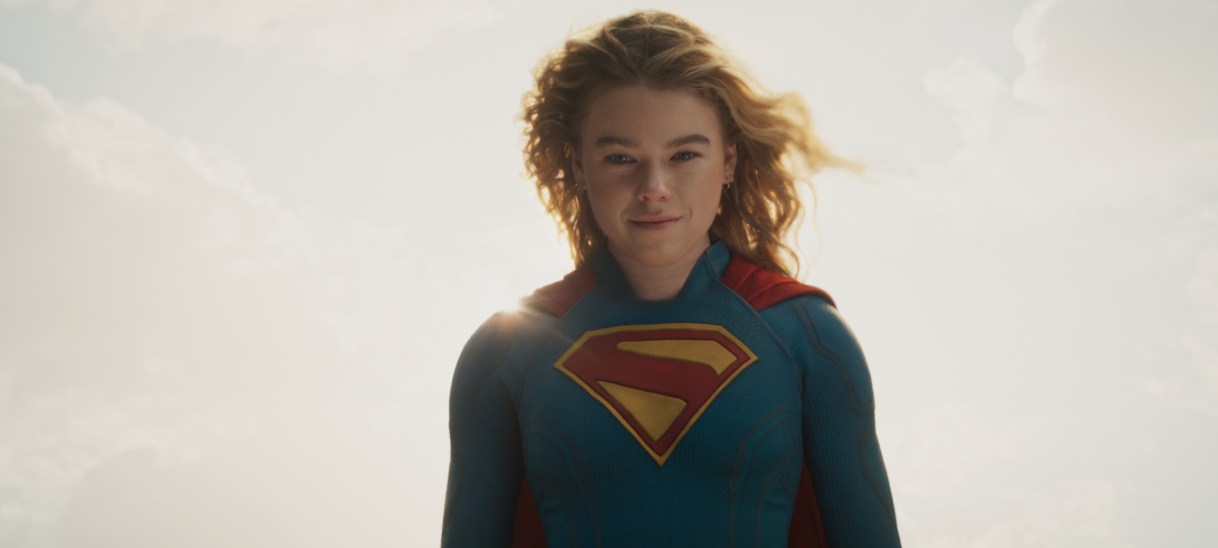
While that is the case to an extent this time around, Gunn’s said fingerprints have left smudges on Kara Zor-El / Supergirl (Milly Alcock), keeping her feeling like she’s being held back by kryptonite —poor writing, drab subplots and a one dimensional villain — rather than allowed to charge up and shine in a similar way to David Corenswet’s Superman.
Opening with a scene involving a family being slaughtered by chief movie villain Krem (Matthias Schoenaerts), lone survivor Ruthye (Eve Ridley) is left wanting revenge for their murder. She soon finds Kara drinking away in one of her pub crawls, with the duo eventually teaming up after Kara’s dog Krypto, is poisoned by Krem as he steals her ship and flys off. If this sounds like a sort of pseudo-revenge John Wick dog movie, you’re bang on the money. But revenge isn’t what Ruthye should be seeking, or so Kara tries to hammer into her. There’s more to life than revenge, Kara goes on, so let me handle this…oh wait you didn’t listen to me and now we’re on a buddy up adventure involving Marvel like one-liners and less than flashy CGI.
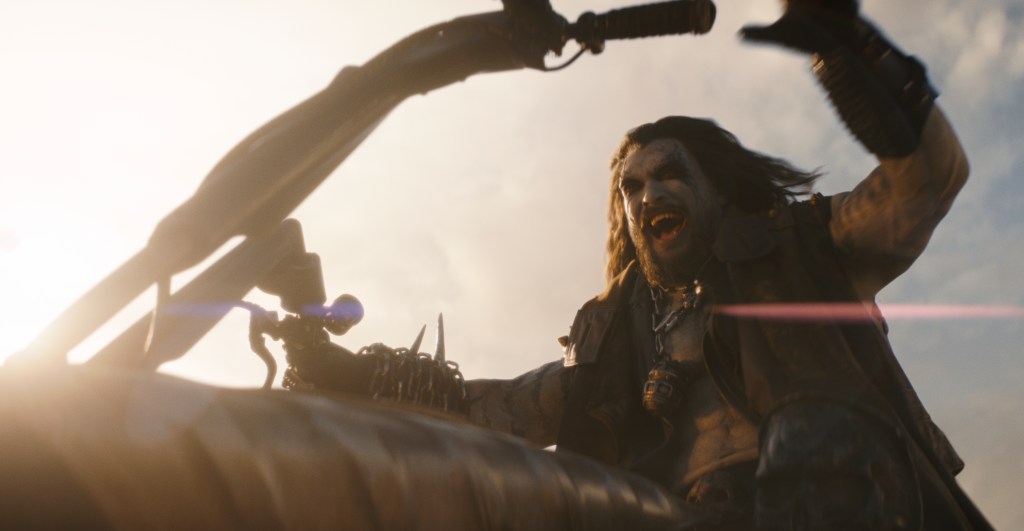
Jason Momoa as Lobo in Supergirl
It’s telling that in reinvigorating DC, Gunn has done a control c, control v approach to these first two films. While I can’t blame him for utlising a tried and true formula that (really) he put in motion with Guardians of the Galaxy (2014) —for better and worse— it reduces the film to a predictable, beat-by-beat exercise where Supergirl could be replaced by Wonder Woman and you wouldn’t bat an eyelid.
Milly Alcock does as much as she can with a script that washes over any stakes with a shrug of the shoulder and cheeky wink. Krem is about as one-dimensional a superhero villain as they come, right up there with Christian Bale’s Gorr. His motives are unclear, as he steals swords and young women who he wants to wed off in some sense like he’s Immortan Joe from Mad Max: Fury Road (2015).
The plot is as much tied to Ruthye’s character as it is to Kara, and it leaves a lot to be desired in the way of character development and a reason to care about what is happening to these people. There’s flashbacks to Kara’s home planet, giving us a different perspective to the fall of Krypton that we’ve always gotten in a Superman film. It’s welcome and makes sense for a character we haven’t seen much of on the big screen, but it leaves the moments in the present feeling short lived. Jason Momoa jets around as Lobo on a motorcycle, having as much fun as he can while scoffing down bears and revving the engine (not far from what he does in real life), and some of the action is serviceable, but beyond that this feels like a set up to an inevitable Superman and Supergirl movie at some point.
Ultimately, Gillespe’s film chooses to look forward and remind audiences that Supergirl will be a part of a wider Justice League at some point rather than giving her an origin story worth its weight.
As the title suggests, The Death of Robin Hood (2026) begins with Robin Hood seemingly at the end of his journey. Somewhat of an extended coda, he has no desire to continue; Robin Hood (an aged and grizzled Hugh Jackman) spends his days pushing through the days, weighed towards the centre of the Earth by the gravity of his past. Long gone are his famous troupe who scampered across England as outlaws, robbing the rich and giving to the poor.
Instead, the famed outlaw is alone in the English hearth, making do with simple hunting to survive with no home or companionship. It is not until his old friend Little John (Bill Skarsgård) asks Robin for help rescuing his wife and daughter from bandits that the outlaw is pushed to purpose. This scene is quickly riddled with conflict, as in the same breath we learn of how Little John came about this family; having acquired them after he killed their husband and father years prior.
Filmmaker Michael Sarnoski made a name for himself with his 2021 breakout, Pig, starring Nicolas Cage, a mature and reflective look at an older man with a lifetime of regrets forced back into society through violence — all themes that also drive The Death of Robin Hood. It is fascinating that Sarnoski, the now 31-year-old American, has a deep pull to these stories and is deftly able to probe humanist questions on regret at the beginning of his artistic career.
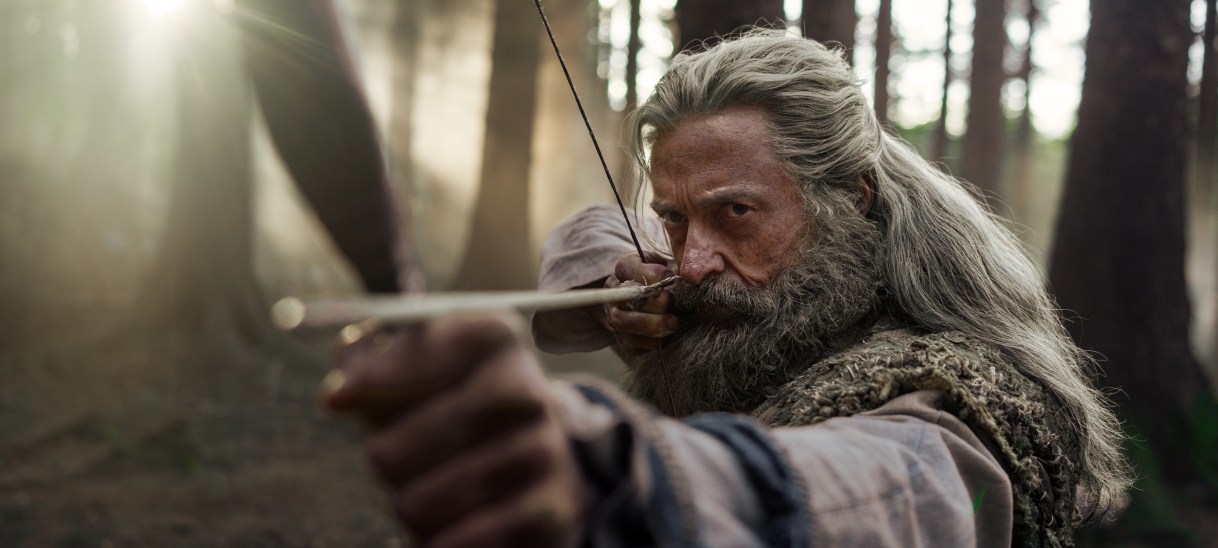
The metatextual element of casting Hugh Jackman as the waking ghost of Robin Hood is effective, layering on his legacy as an old-fashioned showman to this storied character worthy of reinvestigation. Similar in many respects to Logan (2017), Jackman’s greatest performance as the weathered Wolverine, Robin Hood is a man with a code that can easily morph into self-mythologisation through nothing but the immovable passage of time. The stories we tell ourselves to survive, especially ones that shield us from the stories others tell about us, drive Robin, even in his withered state. Throughout the film, Robin is both correcting the record of his folklore and forgetting the names of those he has slain, a fascinating bit of oscillation that creates an engine of revisionism that powers Sarnoski’s gritty screenplay.
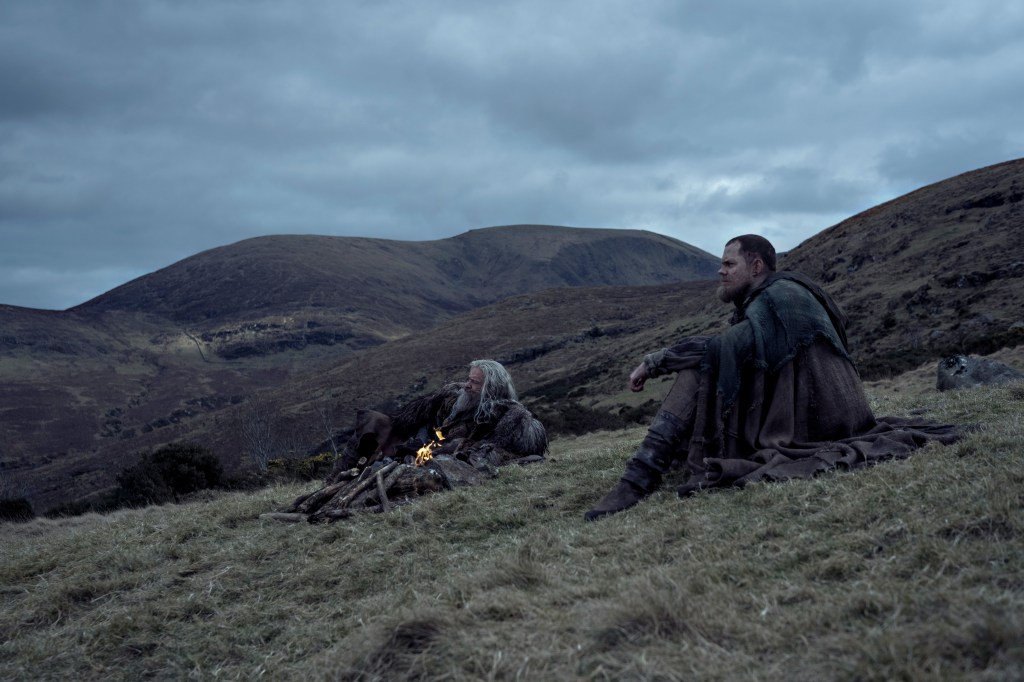
From Left: Hugh Jackman and Bill Skarsgård in The Death of Robin Hood.
Whether Sarnoski is deeply connected to the Robin Hood folk tale or just enjoyed one of many depictions across cinema, his iteration on the character is a mere shorthand to investigate the life of an outlaw defined by mythmaking and storytelling that justifies one’s violence until violence is all that remains. This is a film with a relentless drive to revise notions of history at scale through an intimate lens.
The Death of Robin Hood is an adult film that wields its violence with a sharp knife. It cares for its impact both in the moment and in how it ripples through generations. Beginning with a stark moment of brutal violence – Robin killing a teenager who has come for revenge in the night is straight out of Robert Eggers’ grimy historical epic The Northman (2022), a lynchpin inspiration here – Sarnoski is signalling to the audience the film to come. This moment is one of a long line of sons and daughters seeking revenge on Robin’s trail of blood. Even through several wistful and lyrical sequences that weave in and out of the film, it is this graphic violence that chains the story to the damp soil.
After the rescue attempt goes as expected for a film this cold and bleak, Robin is beaten and left within inches of a death he so clearly craves, and shipped out to an island priory to heal. Surprisingly, in a shrewd piece of filmmaking, this island is where we are left for the remainder of the film. The film is split in two, with Robin Hood made to support the small community led by the prioress, sister Bridgid (Jodie Comer), as his wounds heal. A bifurcated film is difficult to pull off, but Sarnoski’s lush visual lyricism creates a flowing river of moments that land.
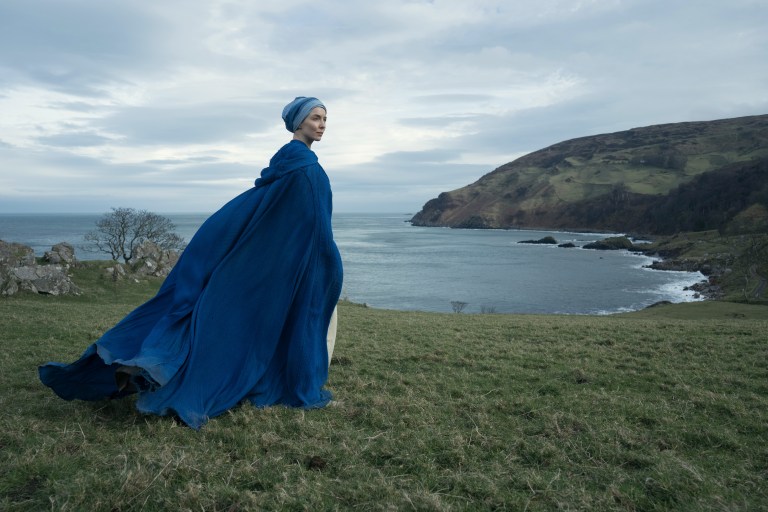
Jodie Comer in The Death of Robin Hood.
Plucked from the Sheffield folk scene, musician Jim Ghedi’s score and soundtrack both shroud and dampen the opening section of the film as much as they light the scenes in the priory. Coupled with an aspect ratio shift after the first act, cinematographer Pat Scola focuses on the warmth of sunlight seemingly hitting Robin’s cheek for the first time in decades. Sarnoski is driven to guide the famed outlaw and us towards the light.
But the past cannot be willfully ignored even at an island retreat. With new visitors steadily coming to the priory for care, Robin’s desire to fade into obscurity becomes harder and harder. Coupled with this is the punishing repetition of Robin Hood not remembering those he has killed along his journey. This is the sturdy rock Sarnoski’s film is built on. The why does not matter, as the why never matters when it comes to those that carry on the legacy of those that have been lost. There is only the loss.
For a film with a loud fight scene set in front of a burning building, it surprisingly has its most gripping moment in an infirmary, involving several intimate bloodletting scenes between Comer and Jackson, with Sarnoski carefully building up the tension of his grisly film to this point. Comer elevates these moments and the back half of the film even as her character is kept to the side, with Sarnoski clearly driven by singular character portraits and how people enter and exit a person’s life.
Whether it arrives at its emotional climax in its dying moments with legitimacy is in the eye of the beholder, but Sarnoski is serious enough about his adult drama to conclude his film with an aching sentimentality that is all too rare. With a sturdy ensemble that occasionally elevates above Sarnoski’s considered lens, The Death of Robin Hood is the dramatic adult period piece probing at the heart of heroism and violence that is rarely seen on a big screen anymore. Now all we need is Sarnoski to make his Ned Kelly film.