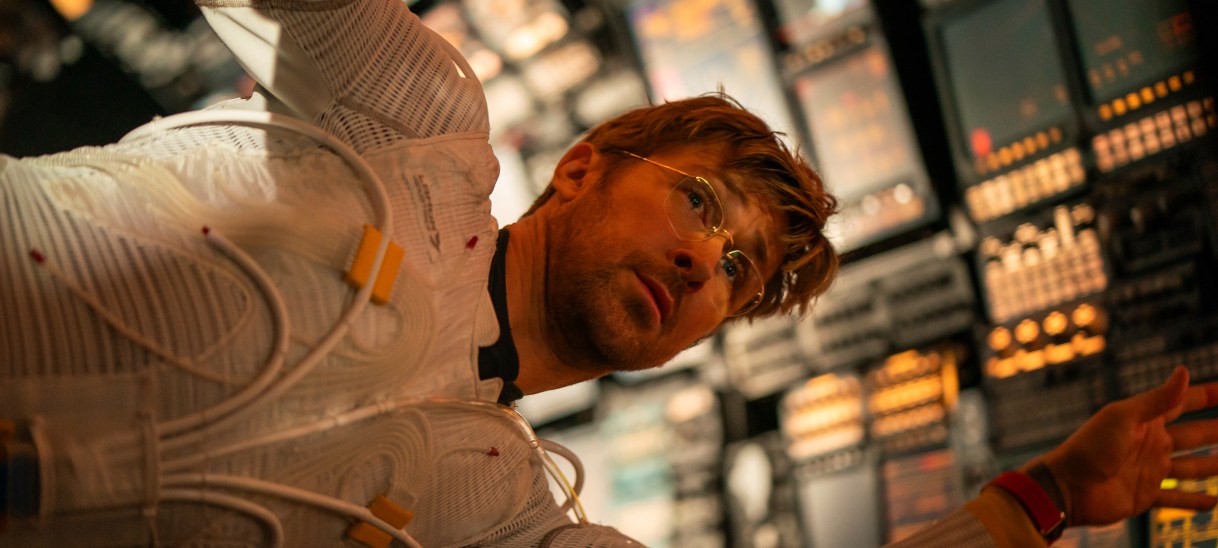
Project Hail Mary is a Charming, Wholesome Buddy-Up Space Adventure

Rating: 3.5 out of 5.

Project Hail Mary preview screening provided by Sony Pictures

If you’re like me and you’ve recently added Andy Weir’s hit novel, Project Hail Mary, to your Audible library, thinking that listening to it beforehand or reading the physical version might be the best way to first experience this story, well the 2026 screen adaptation might just quell those thoughts. That’s because directors Phil Lord and Christopher Miller have taken a screenplay by The Martian (2015) screenwriter, Drew Goddard, and imbued it with their signature warmth and whimsicality to the point where this might be the only version of this intellectual property that you’ll need (and want) to experience.

After all, a premise about a school-teacher-turned-world-saving-astronaut who befriends a rock alien in the depths of space (who also happens to be on a mission to save his planet), isn’t really a hard sell, especially when Ryan Gosling is involved (think of it as an appetiser for the upcoming Mandalorian and Grogu film). But beyond that, Lord and Miller have managed to make a 2.5 hour runtime feel breezy and unique, especially at a time where films that take place out beyond our world have tended to play to familiar story beats — I’m looking at you, Predator: Badlands (2025) and Alien: Romulus (2024).

Of course, without Gosling’s signature charm and dry wit, the bright tone of this film would not shine through nearly as much. He plays science teacher Ryland Grace (referred to as Grace throughout) who we meet while he’s waking from a coma in the depths of an outer-space mission. From here, Goddard’s screenplay oscillates between the past and the present, giving us insights into how our protagonist found himself light years away from Earth. It turns out mankind is on course to being wiped out as the sun is being cooled by what is known as the Petrova Line (a line of radiation between Venus and the Sun) that is comprised of sun-eating “astrophage” or an organism that is, for reasons I won’t spoil, cooling the sun. So, yeah, things aren’t looking too great for Earth dwellers.
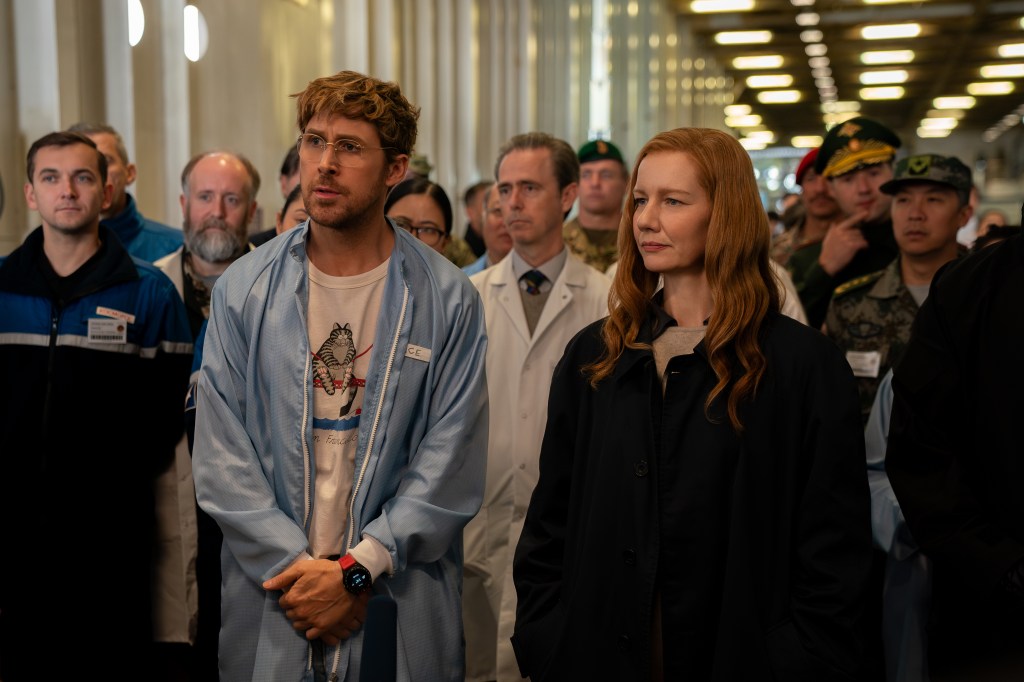
Ryan Gosling stars as Ryland Grace and Sandra Hüller as Eva Stratt in Project Hail Mary

Cue Project Hail Mary, a secret mission that only the world’s top minds who have any familiarity with what’s at stake, are privy to. While much of his life is quite unexplored for the majority of the film (namely, why he’s without anyone significant in his life from family to friends), Grace ends up becoming central to the mission after being recruited by a secret government operative, Eva Stratt (Sandra Hüller), with Lord and Miller finding a decent balance between showing you the events leading up to Grace’s being in space, and the being in space.

Grace’s mission is far from straightforward though as he is tasked with finding out why one particular planet some 11 years away is the only star in the solar system that isn’t being cooled by these infectious astrophage. Grace’s one saving grace (pun intended) is that he’s not the only one who has ventured out to this star, with a crab/spider shaped rock alien scientist (whom Grace fittingly names Rocky) also looking to see what’s coolin. It’s in their unusual connection that Lord and Miller’s film stops itself from becoming another by-the-books-Earth-saving-mission. For starters, Rocky is lovable and really grows on you to the point where you can’t help but buy into the idea of these two learning how to communicate with one another through some tinkering on a sophisticated translation software before becoming best buds.

Project Hail Mary brings to mind the great unlikely friendship films from history like E.T. (1982) and The Iron Giant (1999) and offers a wholesome, heart-tugging buddy-up adventure that leaves you feeling all warm and fuzzy by the end. If there’s any criticism that comes to mind it’s that sometimes less is more, especially in the film’s closing sequence which feels like it could have ended at about 3 different points, but beyond that, Goddard’s screenplay and Lord and Miller’s knack for creating thought provoking moments amidst the craze of a situation is second to none. Sure, the significance of what’s at stake (the extinction of mankind) takes a backseat at times to just let you enjoy being in the company of Grace and Rocky, but it’s really through their friendship and “every little thing is gonna be alright” energy that Project Hail Mary finds its groove.

Project Hail Mary opens nationally from Thursday 19 March.

Mickey 17: Bong Joon-ho’s Long-Awaited Follow-Up to Parasite is Amusing, Insightful and Downright Fun

Rating: 4 out of 5.

Mickey 17 preview screening provided by Universal Pictures.

It doesn’t take a genius to understand that a film about a guy who wants to leave on an expedition and chooses to willingly die and get reprinted (literally) with his memories in-tact, only to keep dying and being reprinted, is right up Bong Joon-ho’s alley. While that doesn’t capture the multifaceted space adventure that is Mickey 17 (2025) to nearly the full extent of the word, Bong’s interests are very particular in that, human dispensability —especially with regards to people in lower socio-economic situations— is a pertinent concern throughout his oeuvre.

In Snowpiercer (2013), a train is used as a motif to portray the various carriages of the caste system, with the back of the train being the lowest class citizens and the front, the highest class, while in Mickey 17, a large spaceship serves a similar purpose. In other words, it’s no secret that capitalism and the presence of an oligarchy are concerns that he hasn’t been shy about critiquing, and they’re a thematic consistency across his work. Regarding dispensability, Mickey 17 is much more literal than any of his previous films in how it reduces the human body to something that can be done away with, something that goes beyond even that of the lowliest of workers to just a recycled carcass.

That’s at least the seed from which the rest of the film grows and revolves around as Mickey (Robert Pattinson) signs himself up to be an “expendable” or an unfortunate soul who would choose to live a quasi-immortal life by living to die and dying to live. He does this after finding himself in bad company on Earth following a debt he hasn’t paid back, before ending up on a government spaceship headed up by a pompous failed politician, Kenneth Marshall (a goofy Mark Ruffalo whose performance echoes that of his one in 2023’s Poor Things), that’s on an expedition to find a new planet to preserve mankind — if this is sounding like Passengers (2016) mixed with Edge of Tomorrow (2014), then you’d be on the right track.

Robert Pattinson in Mickey 17

The spaceship finds itself headed towards Niflheim (not to be confused with that area in 2018’s God of War game), a cold planet inhabited by woolly creatures that look like roly polie, pill bugs (dubbed “Creepers”). It’s here that Mickey’s expendable state is really tested, as he’s exposed to the planet’s toxic air over and over again until a cure can be found and applied; it’s also where we eventually get to the 17th version of Mickey that opens the film in a scene we circle back to later. While comical in its portrayal of the printing process after every Mickey death, Bong’s commentary on how human life can be reduced so willy-nilly by those in power makes for a tasty treat, especially when it comes to just how dispensable the human body is in real life, especially when it comes to matters of war.

Bong never dwells though, he keeps the film moving and he keeps the action and dialogue light-hearted and cosy, but his ability to go a step further in his critique of capitalism and the frivolousness of those in power who look down on others, shows a director who is maturing in his own ideas and isn’t afraid to mine them to the full extent. It helps that Marshall and Gwen (Toni Collette) are so effortlessly unlikable in their bougieness which helps those ideas evolve easier.

But their relationship is hardly the most shocking: after being saved by the aforementioned woolly pill bugs (following a harsh fall in an ice cave), Mickey 17 manages to find his way back to the ship where he comes across a clone of himself or a “multiple” as they’re called. It turns out Mickey 17 was presumed dead so the 18th version of him was printed, but without his pitchy accent and more akin to Pattinson’s Bruce Wayne in cadence.

Mark Ruffalo and Toni Collette in Mickey 17

It also turns out “multiples” aren’t permitted, so much so that Mickey 18 tries to kill Mickey 17 from the outset, but they soon find a commonality in the form of taking down their oppressors (very much in the vein of Snowpiercer). Pattinson’s dual performance is really a make-or-break factor in understanding what makes these multiples so unique from one another — that these reprints exhibit more humanity than the majority of the crew really adds weight to just how narcissistic and morally bleak humans can be at their worst.

At the end of the day, this is easily Bong’s most optimistic film, one that doesn’t present a bleak future but offers a chance for its characters to carve a brighter tomorrow on their own terms. Sure, he isn’t subtle about his growing interest in ideas he’s previously explored, but he also doesn’t pander to his audience, choosing to let the film’s amusing story take you on a rollercoaster comprised of the grotesque, heartfelt and humorous. In this way, it feels like his most accessible film as there are no hidden windows that keep you guessing.

Mickey 17 opens nationally from today.

Fly Me to the Moon: Scarlett Johansson and Channing Tatum Team Up for Space Race

Rating: 3 out of 5.

Fly Me to the Moon preview screening provided by Sony Pictures.

As far as films about space go, Fly Me to the Moon is about as far from the launchpad as they come —which is not to say there isn’t a takeoff. Set against the backdrop of the 60s, specifically around the Space Race, Greg Berlanti’s (director of 2018’s Love, Simon) film mixes romance with rockets, focusing on one of mankind’s greatest achievements in the man-finally-meets-moon Apollo 11 mission, while throwing Scarlett Johansson and Channing Tatum in the mix to see how they bounce off of one another. There’s a sincere, if not contrived aura about Fly Me to the Moon; in other words, it’s incredibly playful, sometimes to its own detriment.

Johansson plays con artist advertiser, Kelly Jones, whose successful career is noticed by the Nixon administration and one of their shady executives, Moe Berkus (Woody Harrelson). Moe commissions Kelly to sell the moon landing with her advertising chops. On the other side of the coin is Cole Davis (Tatum), a NASA employee and veteran who oversaw the tragic Apollo 1 mission. Their paths briefly cross in a flirtatious happenstance at a diner, one they thought was just a once off, before they realise they’ll be spending more time together.

Berlanti’s film is surprisingly clever, taking the conspiracy ideas behind the Apollo 11 mission and working them into an original script that satirises this notion playfully. But more than that, Fly Me to the Moon (though too long for its own good) makes good use of its two leads who effortlessly bicker and banter amongst all the turmoil around the launch. In particular, Johansson commands the screen, playing the part with the same zest and reverence for the time as in Asteroid City (2023), proving she could be warped back to the 1960s and fit right into the classic Hollywood setting.

Kelly Jones (Scarlett Johansson) and Cole Davis (Channing Tatum) in Fly Me to the Moon.

It’s almost bemusing that a film like this would cut past streaming and land on the big screen, not because it isn’t deserving of it, but because it seems like a hard sell —even with the Johansson/Tatum pairing. While the Apollo 11 mission was a big deal at the time, it’s easy to see audiences struggling to stay with it for 132 minutes. Characters like Lance (an unsurprising scene stealer in Jim Rash) and Moe inject energy when the pace starts to falter, giving moments like a sequence around building a fake Apollo 11 stage, a much needed boost.

While still a stud at 44, Tatum doesn’t completely bring the same flair as he does in the Magic Mike films or Logan Lucky (2017). His character is there to bear the weight of deceit from Kelly, but he often plays in Johansson’s shadow, even with their enjoyable jabs, serving more as a weight that levels her character out when she’s reaching for the stars faster than others.

Fly Me to the Moon does come at an interesting time though, where conspiracies and disinformation, truth and reality, are as distorted as ever. Though it doesn’t necessarily usher the audience to think a certain way, Berlanti’s film offers food for thought for those familiar with the controversy around the moon landing, and an interesting foot in the door for those that never paid it any mind. It doesn’t quite hit the landing it hopes for, but it’s not short on fuel.

Fly Me to the Moon opens nationally from the 11th of July.