This Power Ballad is Off Key

Rating: 2 out of 5.

Power Ballad preview screening provided by Madman.

Like the familiar restaurant on the corner that knows your order as you open the door, one knows what to expect coming into a John Carney film. A focus on the healing power of music. The power music has in mending frayed relationships as well as allowing new ones to bloom.

In Power Ballad (2026), Carney shifts into a contrasting mix of styles, with a more Judd Apatow American studio-comedy style pushing up against his sharp but enchanting Irish swoon. Carney’s characters are always down on their luck but never out for the count, an element that allows for some iconic screen performances over the last 20 years.

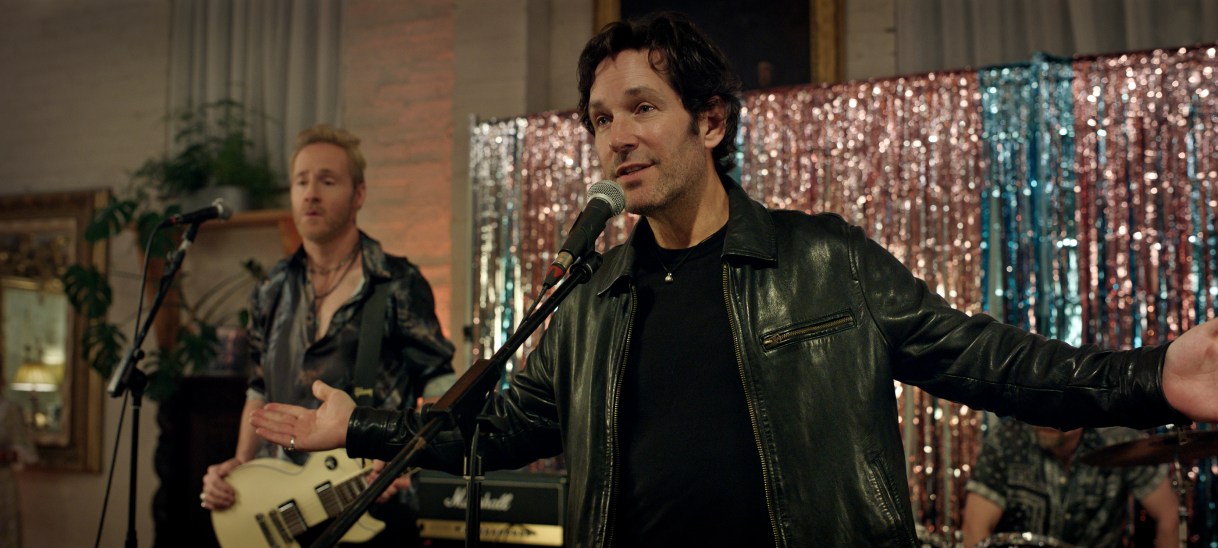
Enter Paul Rudd as the washed-up wedding band singer, Rick. Settled into his life in Dublin with wife Rachel (Marcella Plunkett) and teenage daughter Aja (Beth Fallon), Rick tours around local weddings performing the thankless task that has been swapped out to DJs in recent years. This is somehow not a pressing issue for a film that has a strange, outside-of-time quality that is destabilising, one of many aspects that slow the film down in its desperate search for greater drive.
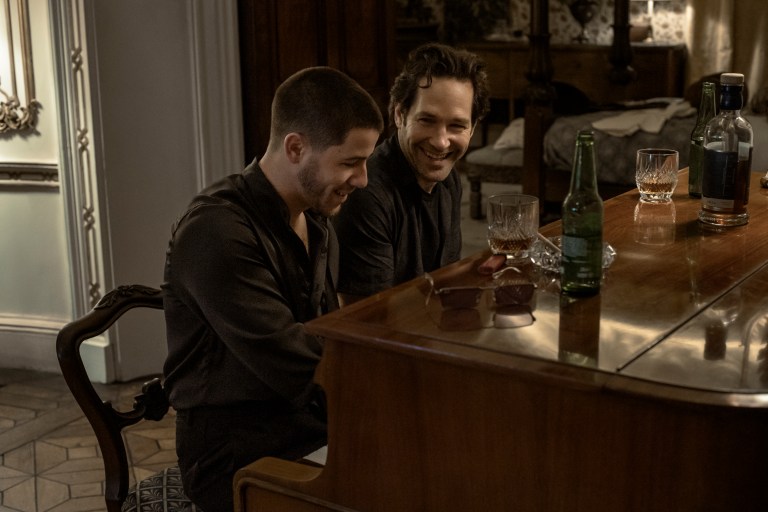
Nick Jonas as Danny and Paul Rudd as Rick in Power Ballad. Photo Credit: David Cleary

The drama that pushes the film forward occurs when an ex-boy band member, Danny (Nick Jonas), gets up on stage and performs with Rick and the band at the wedding, which spirals into an all-nighter between the pop star and the wedding singer. The conversations are as you expect, without a hint of passion or interiority that is needed for these scenes to serve as the spark that allows a feature film to burn.

Desperate to be taken seriously, Danny steals one of Rick’s songs he plays for him late at night, turning it into his breakthrough hit, wielding the song’s lifetime of anguish and pain for his own gain, never fully grappling with the song he’s singing. There is a powerful thread Carney weaves throughout the film about the potency of original songwriting compared to the pop machine version of being given a song to sculpt, even if it never develops into much inside the film’s narrative. Upon hearing Danny’s version and his ensuing success, Rick is driven insane, especially as none of his loved ones can remember him ever playing it for them.

Seemingly built out of a desire for metatextuality with Nick Jonas’s casting, Power Ballad doesn’t seem all that interested in developing the film into a tale of two musicians, but rather of a faded musician and singer having what he views as his life’s work taken from under him. Carney seems completely unsure of the relationship we should be cultivating with Danny, leaving him for long stretches of the film where the crux of his emotional narrative is taking shape.
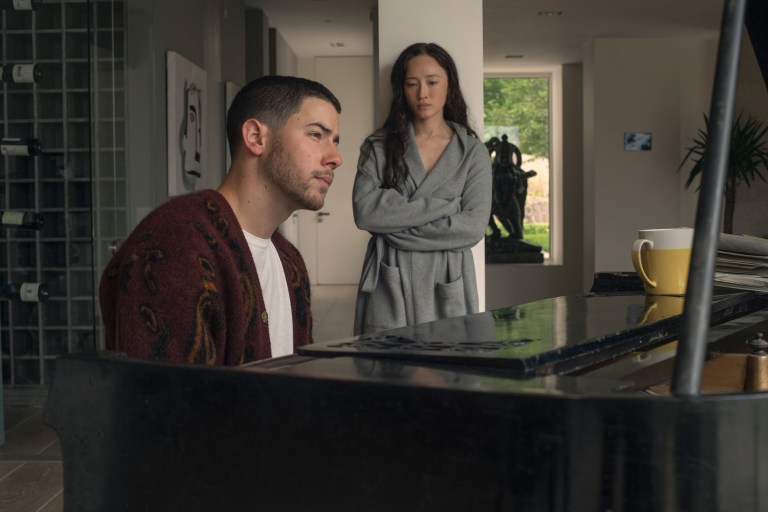
Nick Jonas as Danny and Havana Rose Liu as Marcia in Power Ballad. Photo Credit: David Cleary

When we finally do return to Danny’s story, the audience spends the majority of the scene playing catch-up with the film to understand the emotional context in which we find him. This never gives Jonas a chance to prove himself here or elevate the material, which is in desperate need of a great performance. While it’s charming to see Rudd settle into a role in a small-budget film with this and the wonderful 2024 comedy Friendship, the results are mixed. Due to the hacked-up nature of the film and edit, Rudd’s relaxed improvisational style gets no air to breathe in scenes compared to the Tim Robinson film, ending up in a bizarre mixture of languid pacing and disjointed scene shifts.

Coupled with these issues is the film being fuelled by a confounding engine of anti-drama. So reticent to enjoy the fruits of the music film genre tropes that we do not enjoy much of anything throughout. So when we eventually arrive at the climactic confrontation between Rick and Danny, the film rests its shoulders on, none of the legwork has been done to appreciate anything in the scene, falling completely flat.

There is no more egregious sin the film makes than introducing a fascinating relationship with Danny and Marcia (Havanna Rose Liu), only to break up this relationship through a choppy news clipping montage straight out of 2006. Do Carney and co-writer Peter McDonald not believe audiences are interested in that personal dynamic? Was this a studio note to cut down time? These are not questions that should be asked of a light dramedy of this scale.

Power Ballad is in theatres now.

Anaconda Struggles to Swallow the Weight of its own Ambition

Rating: 2 out of 5.

Anaconda preview screening provided by Sony Pictures.

It’s been almost 30 years since Luis Llosa’s Anaconda (1997) hit cinemas, a film which I’ll remember for it having traumatised me as an unsupervised five year old who shouldn’t have had access to the remote after 10pm. Tom Gormican’s 2025 remake/reboot/spiritual successor pays homage to the Jennifer Lopez led cult classic while carving out its own little corner, one that is tonally all over the place, incredibly self-aware and yet had me giddy in moments.

In fact, Anaconda finds an odd equilibrium between comedy, action and horror as it uses its funny star duo of Jack Black and Paul Rudd to present itself as a comedy, while keeping you guessing at every turn through conventional jump scares that sometimes land while falling flat at other times. Gormican’s last film, The Unbearable Weight of Massive Talent (2022) took a similar approach but in the opposite sense by using an often serious actor in Nicolas Cage to play a fictional Nicolas Cage while building the comedy around him and his seriousness.

Incredibly self-aware in its presentation of events, Gormican chooses to focus on a group of childhood friends who used to make short films together, and while they still concern themselves with filmmaking in their adult lives, they aren’t exactly doing what they love. For starters, Doug (Jack Black) shoots weddings, Ronald (Paul Rudd) is a struggling actor, Kenny (Steve Zahn) is a cinematographer who gets rowdy and drunk, and Claire (Thandiwe Newton) more or less is doing better than the rest of them. It’s not until Ronald acquires the rights to the Anaconda intellectual property that he begins to make everyone believe they’re sitting on success.

After some convincing (namely of Doug), the group decide to go and shoot a reboot of the 1997 classic in the Amazon where they become embroiled in a game of cat and mouse with a real anaconda as well as a wider subplot of illegal gold miners. If this sounds like the sort of silly Hollywood blockbuster that tends to cap off the year, well it is. But this silliness (mostly) works, namely because the central cast are all so damn charming and likeable that it’s hard not to have a cheeky grin when something totally irrelevant to the plot happens, like Kenny getting over his peeing-in-public fear to piss on a supposed spider bite that Doug has sustained. There’s plenty of similar brain-dead humor that might leave you scratching your head, but what more can you expect with Jack Black leading the pack?

Anaconda isn’t groundbreaking by any stretch of the word, and it often calls attention to the lack of creativity in Hollywood, poking fun at its own studio in the process. That said, Anaconda becomes the very film it seeks to mock, with dialogue for dialogue’s sake and references to real world people and events. The film will probably be swallowed up by audiences in the moment with chase sequences and explosions all around, but when all is said and done, it’ll just as quickly be regurgitated.

Anaconda opens nationally from Boxing Day.

Ant-Man and the Wasp: Quantumania is the Most Inventive Marvel Film in Years

Rating: 3 out of 5.

Marvel (by way of Star Wars and Rick and Morty), the surprising third instalment in the Ant-Man franchise, Ant-Man and the Wasp: Quantumania (2023), is one of the most enjoyable and cohesive Marvel films in years, and a great entry point into the new Phase of the universe. With a wildly inventive world that enchants and inspires awe, Quantumania manages to create something that’s been lacking from Marvel of late: pure imagination and efficient storytelling.

Quantumania kicks off with a return to the Lang family. Scott (Paul Rudd) is touring his ant-pun-filled memoir; Hope (Evangeline Lily) is running the company to improve many noble causes from affordable housing to environmental rehabilitation; Hank (Michael Douglas) and Janet (Michelle Pfieffer) are reunited and retired; and Cassie (Kathryn Newton), now 18, is getting arrested protesting the police for tearing down displacement camps. The surprising heart of the film, Cassie both sparks the plot by creating a beacon to the Quantum Realm, as well as the thematic (socialist uprising via ants combats tyranny in a blockbuster? A+) and emotional story that is never beholden to other properties. The speed in which we are thrown into the world is appreciated and economical, especially in comparison to recent superhero films that have felt bloated and undercooked. 

The Rick and Morty-fication of Marvel is complete in Ant-Man and the Wasp: Quantumania, with longtime comedy writer Jeff Loveness (Jimmy Kimmel Live, Rick and Morty) given sole screenwriting credit here. Previous Rick and Morty writers landing at Marvel include Jessica Gao (She-Hulk: Attorney at Law), Michael Waldron (Loki, Doctor Strange in the Multiverse of Madness, Avengers: Secret Wars), and Loveness. This connection to the cult TV show is felt particularly through its world-building and humour, as Loveness and Reed are clearly having a blast creating these unique quantum aliens, from snail horses to amoeba buildings and freedom fighters, all with a visual and comedic flair that feels considered. The parallel is also felt in its storytelling, as Loveness is able to craft an efficient and entertaining film that works independently of its outside world, maintaining a coherent thematic pull with compelling characters that feel genuinely changed through the experience. 

(From left) Paul Rudd, Kathryn Newton, and Evangeline Lily in Ant-Man and the Wasp: Quantumania

Fears were rising that, with the emergence of the multiverse and glut of recent Marvel products, regular movie fans would be left in the dust. Thankfully, Quantumania is a refreshingly standalone film and a great entry point for this new phase of Marvel. The briskness of the storytelling allows you to get swept up in the world-building and creature design, sharing the sense of wonder Scott and Cassie have for the Quantum Realm. We are shown many sides to this new realm, from its refugee camps to its high society bars inspired by the Star Wars cantina (I was shocked not to have an original tune playing when they entered the room), all fully realised. The craft and consideration here are leagues ahead of recent entry Doctor Strange in the Multiverse of Madness (2022), where the biggest leap in the boundless opportunity of multiversal storytelling was an Earth where green means stop.

Director Peyton Reed, hot off helming a couple of great episodes of The Mandalorian, returns to complete his highly improbable but all-enjoyable Ant-Man trilogy. The list of directors crafting a full trilogy is short, with Reed joining Spider-Man directors Sam Raimi and Jon Watts on the superhero trilogy front. Through a consistently robust supporting cast, the Rudd-helmed franchise has always felt light on its feet and affable, mirroring its star.

Reed’s Ant-Man films thrive more in the conversational moments, both in comedy and tension than when action is required. Early entries allowed the action set pieces to play out like big-budget Honey I Shrunk the Kids (1989) homages, but in Quantumania, the action feels taken straight from the Marvel assembly line, with its rapid cuts, poor blocking, and hand lasers. Fortunately, Reed seems aware of these shortcomings, as the film does not rely on these moments for its crescendos, opting instead for more personal battles against Kang the Conqueror.

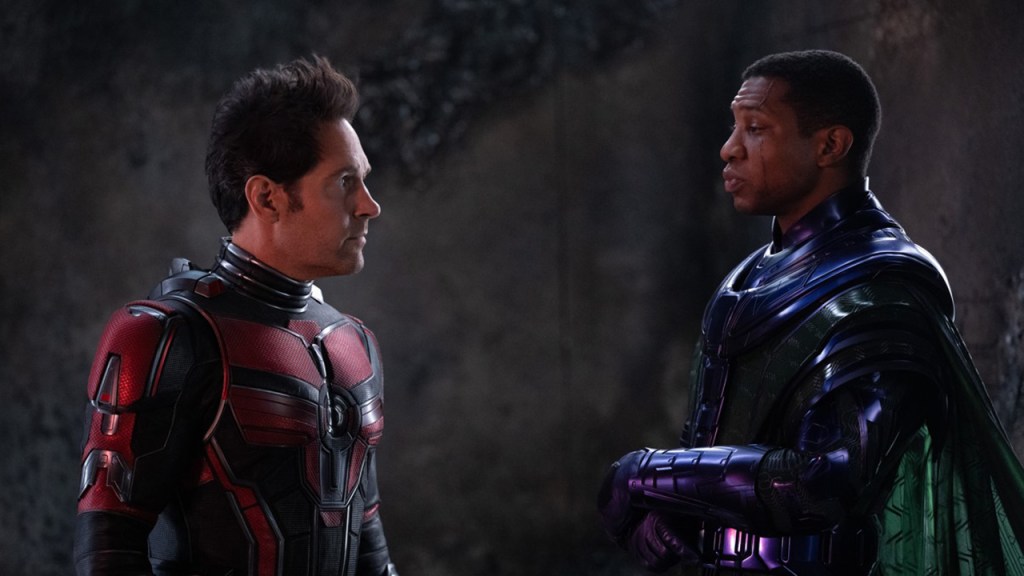
Paul Rudd and Jonathan Majors in Ant-Man and the Wasp: Quantumania

Jonathan Majors, the greatest recruit into the Marvel acting army thrives as the ominous but deeply felt villain Kang the Conqueror. Acting alongside Michelle Pfieffer for many scenes, Majors uses his physicality and always surprising depth of feeling to keep Kang more interesting and compelling to the audience, allowing him to balance out the film in ways we rarely see in Marvel villains. There is a tension and friction to his scenes that allows other actors to occupy space to play off of Majors, instead of merely dominating every moment of screen time, a rare gift to be used in a blockbuster film. The next Avengers film, Kang Dynasty (2025), is more likely to match the quality of Endgame with the emerging A-lister at its core.

No one would’ve imagined back in 2015 that Reed and Rudd would be completing a trilogy of Ant-Man films in 2023, with the third entry becoming crucial to the wider Marvel project with the emergence of Johnathan Majors’ Kang as the next Avengers villain (Loki appearance notwithstanding), let alone creating one of this quality. While still overfilled with messy CGI action set pieces, Quantumania thrives in its inventive world-building, with an economic and satisfying script by Loveness that allows its impressive ensemble to shine.

Ant-Man and the Wasp: Quantumania is in theatres now.