This Power Ballad is Off Key

Rating: 2 out of 5.

Power Ballad preview screening provided by Madman.

Like the familiar restaurant on the corner that knows your order as you open the door, one knows what to expect coming into a John Carney film. A focus on the healing power of music. The power music has in mending frayed relationships as well as allowing new ones to bloom.

In Power Ballad (2026), Carney shifts into a contrasting mix of styles, with a more Judd Apatow American studio-comedy style pushing up against his sharp but enchanting Irish swoon. Carney’s characters are always down on their luck but never out for the count, an element that allows for some iconic screen performances over the last 20 years.

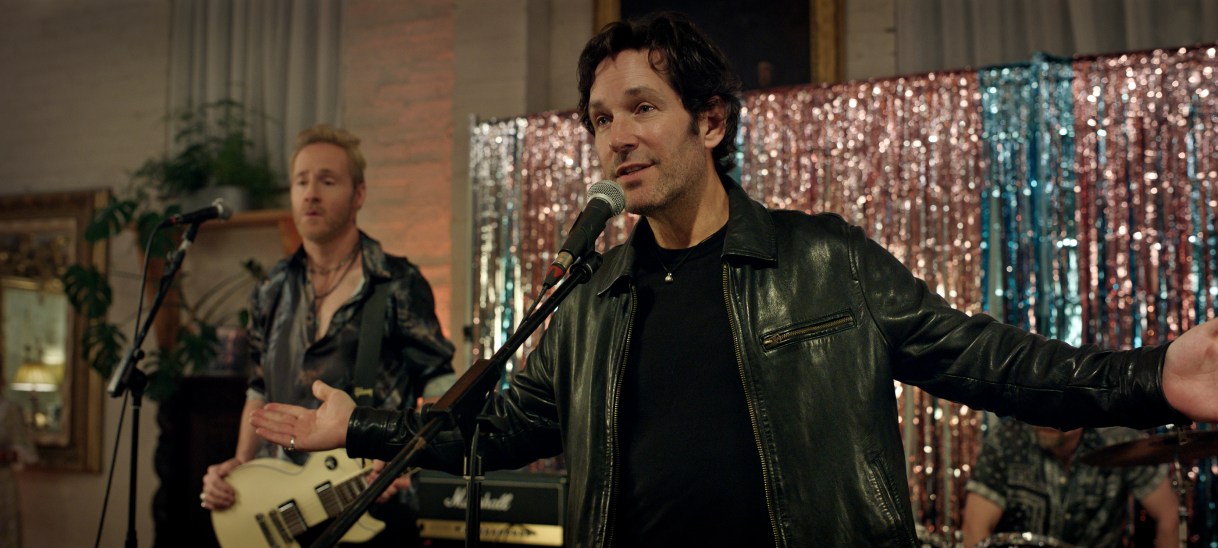
Enter Paul Rudd as the washed-up wedding band singer, Rick. Settled into his life in Dublin with wife Rachel (Marcella Plunkett) and teenage daughter Aja (Beth Fallon), Rick tours around local weddings performing the thankless task that has been swapped out to DJs in recent years. This is somehow not a pressing issue for a film that has a strange, outside-of-time quality that is destabilising, one of many aspects that slow the film down in its desperate search for greater drive.
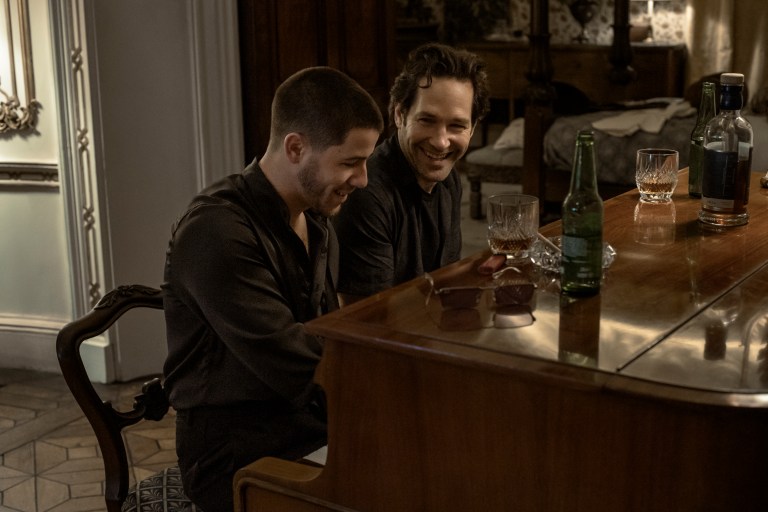
Nick Jonas as Danny and Paul Rudd as Rick in Power Ballad. Photo Credit: David Cleary

The drama that pushes the film forward occurs when an ex-boy band member, Danny (Nick Jonas), gets up on stage and performs with Rick and the band at the wedding, which spirals into an all-nighter between the pop star and the wedding singer. The conversations are as you expect, without a hint of passion or interiority that is needed for these scenes to serve as the spark that allows a feature film to burn.

Desperate to be taken seriously, Danny steals one of Rick’s songs he plays for him late at night, turning it into his breakthrough hit, wielding the song’s lifetime of anguish and pain for his own gain, never fully grappling with the song he’s singing. There is a powerful thread Carney weaves throughout the film about the potency of original songwriting compared to the pop machine version of being given a song to sculpt, even if it never develops into much inside the film’s narrative. Upon hearing Danny’s version and his ensuing success, Rick is driven insane, especially as none of his loved ones can remember him ever playing it for them.

Seemingly built out of a desire for metatextuality with Nick Jonas’s casting, Power Ballad doesn’t seem all that interested in developing the film into a tale of two musicians, but rather of a faded musician and singer having what he views as his life’s work taken from under him. Carney seems completely unsure of the relationship we should be cultivating with Danny, leaving him for long stretches of the film where the crux of his emotional narrative is taking shape.
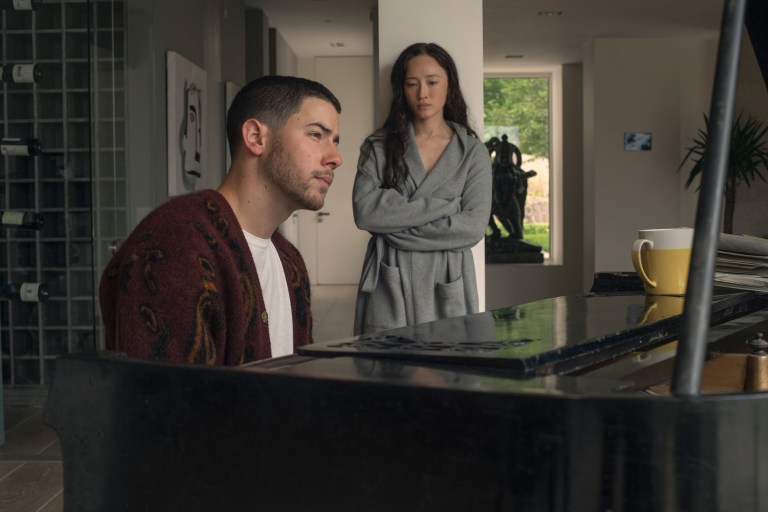
Nick Jonas as Danny and Havana Rose Liu as Marcia in Power Ballad. Photo Credit: David Cleary

When we finally do return to Danny’s story, the audience spends the majority of the scene playing catch-up with the film to understand the emotional context in which we find him. This never gives Jonas a chance to prove himself here or elevate the material, which is in desperate need of a great performance. While it’s charming to see Rudd settle into a role in a small-budget film with this and the wonderful 2024 comedy Friendship, the results are mixed. Due to the hacked-up nature of the film and edit, Rudd’s relaxed improvisational style gets no air to breathe in scenes compared to the Tim Robinson film, ending up in a bizarre mixture of languid pacing and disjointed scene shifts.

Coupled with these issues is the film being fuelled by a confounding engine of anti-drama. So reticent to enjoy the fruits of the music film genre tropes that we do not enjoy much of anything throughout. So when we eventually arrive at the climactic confrontation between Rick and Danny, the film rests its shoulders on, none of the legwork has been done to appreciate anything in the scene, falling completely flat.

There is no more egregious sin the film makes than introducing a fascinating relationship with Danny and Marcia (Havanna Rose Liu), only to break up this relationship through a choppy news clipping montage straight out of 2006. Do Carney and co-writer Peter McDonald not believe audiences are interested in that personal dynamic? Was this a studio note to cut down time? These are not questions that should be asked of a light dramedy of this scale.

Power Ballad is in theatres now.

MIFF 2024: Powerful Performances Amplify the Trauma of Memory

Rating: 3.5 out of 5.

Screener provided as part of MIFF 2024

With heavy handed issues such as dementia and rape, films always run the risk of oversimplification and misrepresentation in less-than capable hands. Michel Franco’s Memory (2023) tackles these issues with a sincerity and empathy that doesn’t demote or reduce them, but rather examines them from the perspective of two struggling souls.

It’s through Sylvia (Jessica Chastain), a recovered alcoholic who was raped when she was 12, and Saul (Peter Sarsgaard), a widower with onset dementia, that Franco’s examination unfolds. If the situations of the two aforementioned characters are anything to go by, Memory is the sort of film that could very easily tailspin into, and be written off as, a grim and depressing sob story that treads old ground that similar films have already excelled at (like 2020’s The Father); fortunately, it does not.

The film’s tone is set from the outset, with Sylvia attending an AA meeting with her daughter, immediately establishing the sort of emotional roller-coaster that awaits. Clearly in a better place in her life now, Sylvia’s past deliberately remains unclear for most of the film (at least until a wider reveal in the third act) to ensure that enough tension remains throughout the modest 99-minute runtime.

Franco frames her as uneasy and on-edge, as she pedantically locks her apartment door, sets her alarms and assumes a guarded position when in uncomfortable situations, something that she extends to her daughter in an instinctively maternal, but overprotective, way.

It’s not until an evening at a high-school reunion, that the direction of Memory becomes clear. Sylvia is followed home by a man who casually approached and sat next to her, going so far as to sleep outside of her apartment in a tyre with nothing but a rubbish bag as a blanket. Saul is his name, and Sylvia quickly finds out that he’s not well.

It’s from here that Franco takes the duo and their past and current problems, and uses them as a catalyst for exploring how peoples situations and serious problems can so easily be reduced by those closest to them, that these people ultimately gravitate towards other troubled souls to find solace and understanding. And that approach is felt mainly because Chastain and Sarsgaard deliver profoundly moving and complex performances. The duo capture the trauma and pain their characters are going through in a way that elevates what, on paper, could have been a very basic thematic exercise that comfortably ticks the sort of boxes you’d expect from a film about grief.

Sarsgaard is subtle as Saul, giving enough from his performance to capture a man who is on the brink of losing his sense of self, while never losing the warmth he brings that draws you in; in this way, I was reminded a lot of Robin Williams’ Oscar-winning performance in 1997’s Good Will Hunting. Chastain is just as compelling, playing off of Sarsgaard effortlessly, and giving greater depth to Sylvia the more the two are on the screen together, slowly opening up as she builds trust for him after being asked to be his caretaker by his brother. It’s hard to take your eyes off of them, and if there is something that will stick with you beyond the end credits, it’s definitely the choices they make in bringing these characters to life.

Bubbling beneath the surface of the film’s central duo is a dysfunctional family thread that, while relevant in understanding the circumstances of Sylvia’s situation, does almost pop up at a wobbly moment. That said, it speaks to the idea that there never really is a great time to confront your past, especially when it’s as harrowing as Sylvia’s — it just presents itself in a tacked-on kind of fashion (especially when the film is at its strongest when it’s solely with Sylvia and Saul).

While the relationship that develops between Sylvia and Saul might not sit comfortably with everyone (given Saul’s growing dementia and need for specialist care), Memory asks its audience to see beyond circumstance and try to empathise with two damaged human beings who understand each other more than their own families do — something that its non-ending ending, invites.

Memory will be screening as part of MIFF 2024 in August.