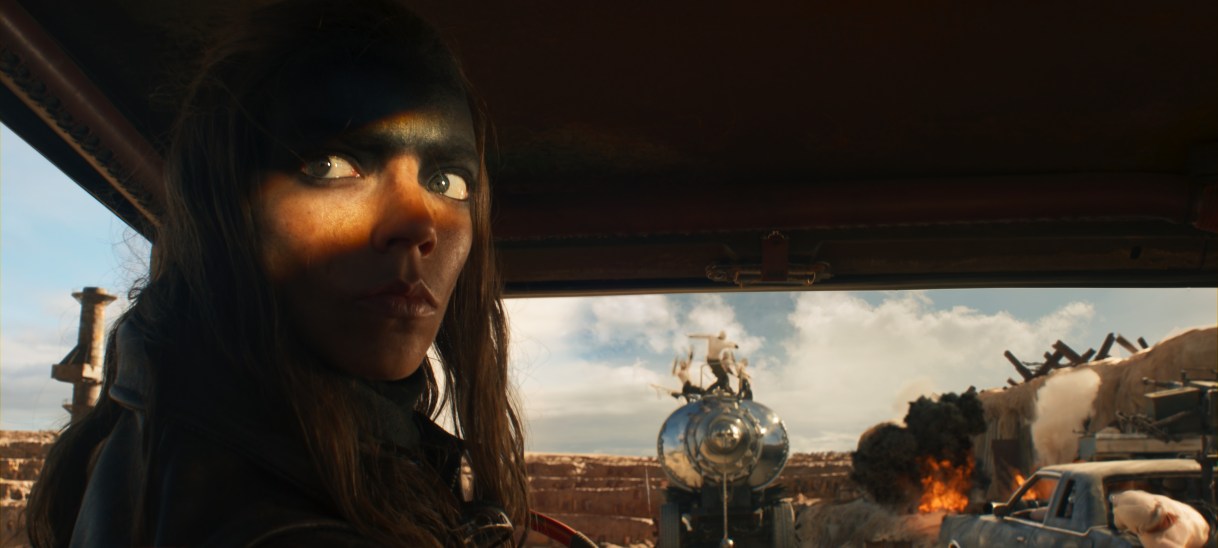
Melbourne premiere screening provided by Universal Pictures
How does one follow up one of the greatest action films of all time? In George Miller’s case, he doubles down: double the car chases, double the explosions, double the chaos, double what’s happening in the mise-en-scene, and double the fun. But Furiosa: A Mad Max Saga should not be seen as an attempt to outdo Mad Max: Fury Road (2015), even though it speaks (sometimes explicitly) to the idea of making something epic and memorable, as though that wasn’t already achieved with the sequel.
Tonally, visually and sonically, Furiosa is on par with Fury Road which makes complete sense for the simple reason that it’s a prequel that’s there to compliment, and there’s not someone else in the director’s seat to screw it up. It’s clear that Miller went with a ‘if it ain’t broke, don’t fix it’ mentality when approaching this film, and the result is all the better for it. The biggest deviation to be felt in Furiosa is that, while it lives in the universe of Mad Max, it isn’t about him. In fact, Fury Road wasn’t exactly about him either, with these two films carving out their own place as post-apocalyptic, operatic action epics with larger-than-life stakes beyond a bloke called Max. But nonetheless, Furiosa is the character we follow and the focal point that guides our understanding of where Fury Road begins and ends.
Taking place across five chapters, Furiosa opens with the titular character (played in youth by Alyla Browne) in the green haven she attempts to return to throughout Fury Road. After noticing bandits ravaging through the haven, she tries to sabotage their bikes and alert the rest of her people of their presence; unfortunately she’s captured in the process, leading her mother (Charlee Fraser) to give chase. Eventually, Furiosa is brought to the bandits leader, Dementus (Chris Hemsworth), who is looking for his own means of survival along with the rest of his pack of bikers.

It’s from here that Miller reintroduces familiar aspects from Fury Road, namely Immortan Joe (Lachy Hulme) and his goofball sons; Immortan’s white army of War Boys; and the Citadel. The first hour or so of the film focuses on Furiosa’s navigation of this space after she finds herself a captive of sorts (for reasons I won’t spoil). Alyla Browne does a fantastic job at setting the foundations of Furiosa’s arc to the point where, when Anya Taylor-Joy eventually takes the reigns after an hour, it’s not immediately apparent because of how alike the two actresses are with their pronounced blue eyes and Miller’s focus on framing them in tight close-ups.
Once Taylor-Joy is at the helm, Miller throws her into a extended chase sequence with Praetorian Jack (Tom Burke in a minor, but effective role) onboard an oil tanker, the War Rig. It echoes the chase from Fury Road where Furiosa deviates from her oil run to Gastown, but here Miller is much more interested in stretching the tension out as much as possible, almost to breaking point. It really speaks to his penchant for destruction and his eye for detail, where every nook and cranny of the truck, gears and all, is on display and pushed to the limit.
It takes some time to buy into Taylor-Joy’s performance, namely because it feels like she trying too hard to fill Charlize Theron’s boots rather than carve out her own little space for this character. Theron’s commanding screen presence, particularly the way she carries herself, is ultimately too pronounced for Taylor-Joy — she even tries to mimic her cadence of speaking — and subtlety is more effective here (which Browne brings). But Taylor-Joy does offer a level of vulnerability through her enchanting eyes; in this sense it’s easy to see why Miller might have chosen her as the lead.

Hemsworth, by contrast, steals every scene he’s in, even when he goes missing for some stretches of time. Where the Thor films misplaced his larrikin humour (often at the character’s expense), Miller gives him the freedom to lean into it in a way befitting a character with a name like Dementus. His brute physique coupled with his nasally way of speaking gives Dementus a memorable edge, especially with all of the quotable lines he’s given.
Adding to the grandiose and scale of what’s on display is the fact that the Wasteland’s harshness is felt to an equal (if not greater) degree than in the first film. The addition of locations hinted at in Fury Road, like the aforementioned Gastown and Bullettown, adds weight to the stakes at play. There isn’t just more for the sake of having more, but rather Miller deliberately leaves no stone unturned and paces his film like the War Rig barrelling down a stretch of road — there’s no room for respite, you just brace yourself and try to hold on for the ride.
For what it’s worth, it’s a gorgeous ride to be had, with the visuals once again being enveloped in this orange, grainy tinge. Where in Fury Road the colours felt less saturated, there’s a much more surreal, darker quality this time around.
This is ultimately a film about Furiosa though, and her story never feels like it’s compromised or diluted for the sake of brandishing all of the fun and games that audiences will expect. Miller is a master at knowing how to capture human plight and not let it be overshadowed by the scale of his pictures. The human element of his films and this portrayal for struggle is what intensifies every car flip, gun shot and extraordinary set-piece, which is why it’s even more commendable that in a film full of incredible moments, Furiosa never loses sight of Furiosa.
Furiosa: A Mad Max Saga opens nationally from the 23rd of May.
 Rating Frames