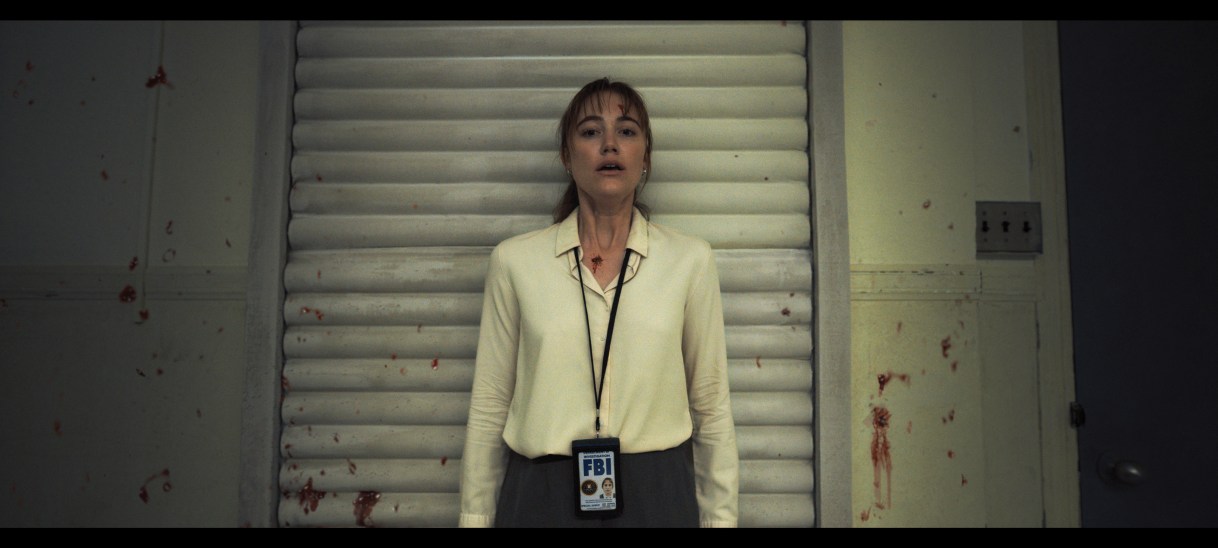
Beginning with a burn-chilling opening sequence that operates on a high level of performance, composition, and editing in only a few short minutes, Oz Perkins’ Longlegs (2024) creates an all-encompassing feeling of dread and paranoia from which there is no escape. With a claustrophobic boxed aspect ratio wielded with true maliciousness, the opening frames are the shocking jolt of electric current that flows through the rest of the film, which operates in a thrilling liminal space that will keep you destabilised.
In blending serial killer procedurals with the existential dread of an unexplainable nightmare, Perkins’ internal genre mashup will surely frustrate and bewilder those on both sides of the horror spectrum. With its uncompromising vision and style, Longlegs opens up into a compelling exploration of familial abuse that will catch up to you in the days and weeks after in ways all too rare in modern horror. As a young FBI upstart, agent Lee Harker (Maika Monroe), put on the case of a serial killer who goes by (Nicolas Cage, weaponised to incredible effect), an unidentifiable killer of young families who has operated for decades. With her new partner Carter (the terrific and unheralded Blair Underwood), Lee must uncover and decrypt a series of seemingly occult clues, some seemingly linked to her life, to catch Longlegs before he targets another family.
For the crime procedural lovers, all the serial killer staple moments are here: suspenseful walks through suburbia, a tense microfiche scene in a library, and deep dives into the cult and religiosity, Longlegs has everything you could want from a modern-day homage to Silence of the Lambs (1991) inside the overused ‘elevated horror’ branding that infers hyper-considered compositions and atmosphere over ideas.

This has been Perkins’ issue in the past, with the son of legend Anthony Perkins and Berry Berenson putting image over story and script in his previous work, Gretel and Hansel (2020) and I Am the Pretty Thing That Lives in the House (2016), but has broken through with easily his best script in Longlegs. The film is wider ranging and more compelling than recent entries in this new wave of American horror. Films that want to explore deep rooted causes of horror like child abuse and extreme religiosity but have no appetite to get into the true heart of this evil, something Perkins is keenly focused on conveying honestly and potently.
On the dread-inducing serial killer axis, Longlegs finds itself tightly drawn to David Fincher’s Seven (1995), with its internal focus on our central characters’ world and the encroaching evil building up around them. While his presence, and particularly his face is often obscured by the frame, Longlegs lingers in the psyche of its characters and the audience. Played with his customary intensity and ferociousness, Cage excels in limited time like Darth Vader’s limited but outsized presence in Star Wars (1977).
Lee is a fascinating character, played brilliantly — although is sure to be divisive, similar to how the performance of Justice Smith in I Saw the TV Glow (2024) has been judged — by modern horror stalwart Maika Monroe, who has as much anxiety meeting her partner’s daughter as encountering a horrific murder scene. The world weighs heavy on her mind, and Monroe gives her a level of dissociative tendencies that are incredibly difficult to portray on screen and in lesser hands would’ve derailed the film. This makes Longlegs‘ true beguiling mystery, and the beauty of the script comes from its ability to strip away Longlegs himself, leaving us compelled by the mystery of her story, the true engine of the film.
Longlegs as a film lingers in the corners of frames with the patient tension of a spider, as Perkins and cinematographer Andres Arochi revel in having an audience’s eyes dart from every inch of their considered and restrained frame that stretches out into eternity. Even in tense, quick-motion sequences, we cannot help but peer over the shoulder of Lee (which takes up two-thirds of the frame), expecting the worst in every moment.

Weaponising its extreme wide lens to a chilling effect, the film sucks Lee into the frame, increasing the opportunities for the menace and dread to creep in and linger. In modern horror, a tight perspective is often given to our protagonist, heightening the tension by playing with the fantasies of the audience of what lurks beyond the frame. In Longlegs, by extending the frame outwards, in both tense scenes and in standard dialogue moments, we are instead led to explore our fears head on, even as the film plays out in a more elegiac and liminal way.
With a work of mounting dread, the inevitable climax is unique but crucial to the final impact that can be felt days and weeks later. The greatest work of insidious evil and its unexplainable nature is Kiyoshi Kurosawa’s masterpiece Cure (1997), which operates in plain sight but questions what is capable within the banality of human life. With Longlegs, Perkins decides instead to spend the final moments explaining the hows and whys of the story, turning all the lights in a house we’ve been too scared to walk around at night, believing that the true lasting impact will be felt after these capital R revelations, not prior.
The closing 10 minutes are overwhelming, and the tensest you’ll feel in a theatre all year, but one can’t help but feel a more ambiguous ending with a tight grip of evil that propelled the entire experience would’ve lingered longer in the memory of its audience. This decision to enlighten that which was kept in the dark, while removing a juicy level of elusion to reward feverish rewatches, does allow the true meaning of the film in the case of Lee’s familial story and how Longlegs operates as an outsized metaphor within it. The fact this sharp decision can easily be argued on either side shows how evocative a story Perkins has been able to tell.
What we are left with is a deeply fascinating work of modern horror from an emerging artist, one that can work both inside and outside the trappings of where the genre finds itself in the 2020s. Flanked by a great ensemble of Monroe, Cage, Alicia Witt, and Underwood, with quality craftspeople across the production, Longlegs is a nightmare born into reality, with a level of tension that is overwhelming, adding to the top of what is shaping to be an excellent year in horror.
Longlegs is in theatres now.
 Rating Frames