Wolf Man preview screening provided by Universal Pictures.
It’s been nearly five years since Leigh Whannell’s Invisible Man (2020) took audiences by surprise and became an instant hit while re-imagining a classic Universal Monsters story for a modern audience. His latest film, Wolf Man (2025), written along with co-writer and partner Corbett Tuck, and based on The Wolf Man (1941), offers a fresh new spin on another classic while touching on concerns around the duality of man and beast, sickness and health.
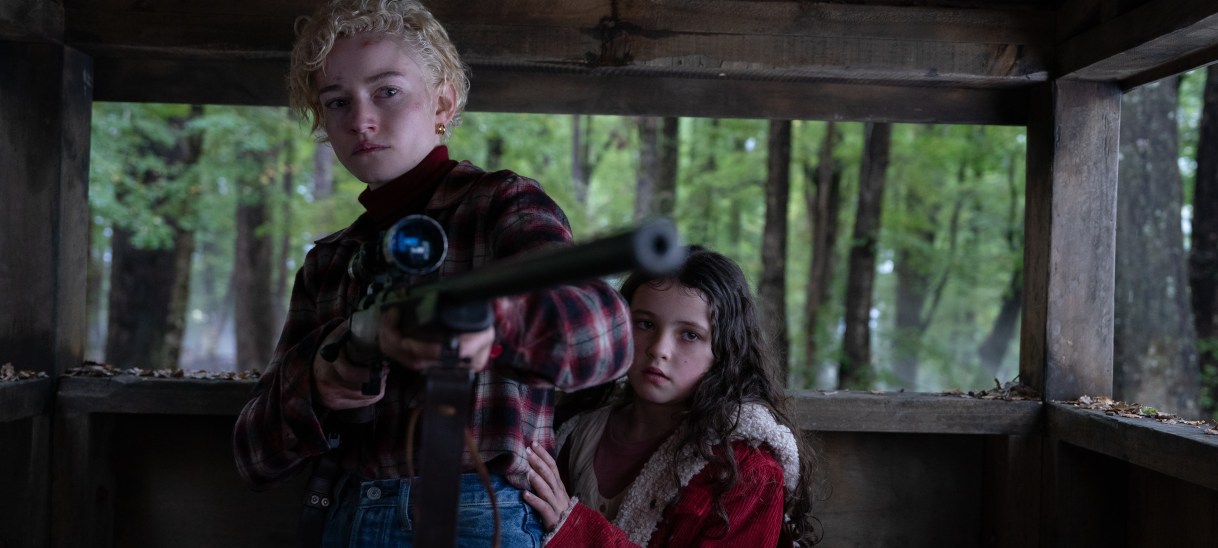
If Invisible Man was a compact horror/thriller that cleverly utilised space, subtle pans and tilts to create brewing tension, then Wolf Man scales things back even more, focusing its events around an eerie house in a grim Oregon, foresty setting where danger lurks. It’s where Blake (Christopher Abbott), his wife Charlotte (Julia Garner), and daughter Ginger (Matilda Firth), find themselves after a short New York-set introduction reveals that his father has passed away and he’s been left with the keys to his old house.
In true horror fashion, a tight strip of road with towering trees is the first sign of the unease and helplessness that awaits, sitting in stark contrast to the bustling, comfortable concrete jungle the family is used to. And it doesn’t take long for this little getaway to go south as their moving truck tumbles off the road after veering last minute from a figure in the middle of the road. A lot happens and it happens really quickly, including Blake’s gradual transformation into his wolf-esque appearance after he contracts a disease upon realising a cut he received on his arm came not from glass but from the devious figured that sent them tumbling.
In this way, Wolf Man is paced rather abruptly, with Whannell wanting to get you into the thick of the suspense as soon as possible. It’s a less daring exercise in tension compared to his last feature and feels more routine in how it hits genre beats. There’s nothing inherently wrong in this, it just feels like a return to earlier roots in that he could seemingly tackle something like Wolf Man in his sleep.
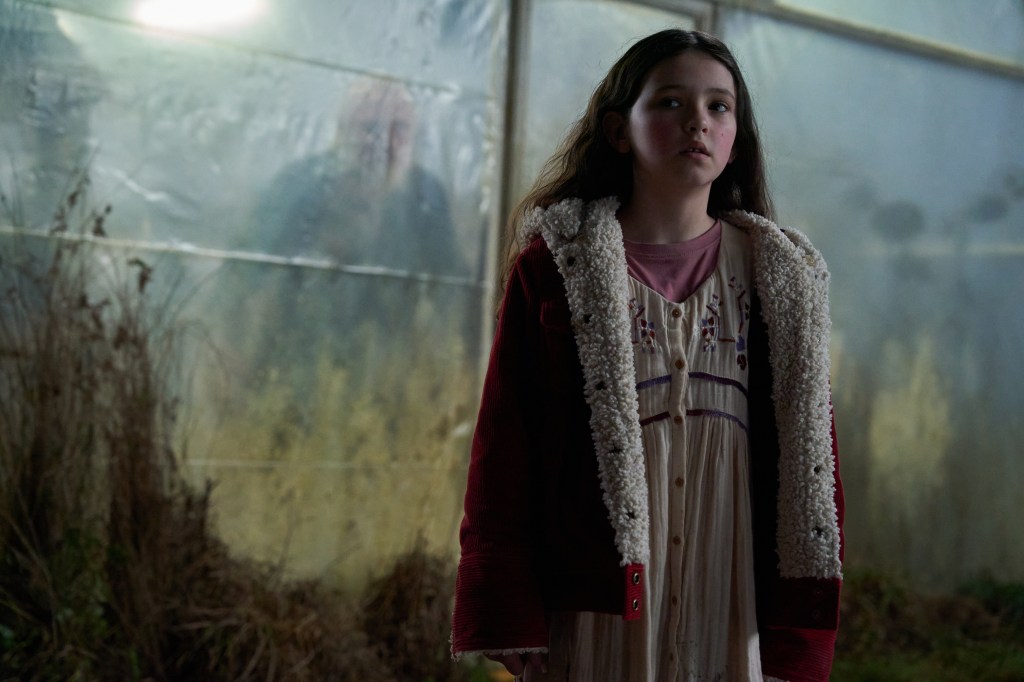
Unlike the subtly of the camerawork, which Stefan Duscio has managed to balance out quite nicely with Whannell’s stylish direction across their three film collaboration, the writing can feel on the nose at certain points like when Ginger indulges her father’s ‘guess what I’m thinking’ game at various points or the constant “daddy” and “mommy” dialogue which sticks out like a sore thumb.
Fortunately, like with Elisabeth Moss’ brilliantly grounded performance in Invisible Man, Julia Garner speaks as much through her eyes as she does through her mouth, with her signature fluttering eyelids at once conveying motherly resoluteness as she protects Ginger, while showing empathy for her husband’s deteriorating state. Her performance goes hand in hand with Whannell’s artful flourishes and Duscio’s tight camerawork, the latter of which seems to favour a more contemplative cinematic approach this time around, with shots that linger heavily before bursting to meet the frantic-ness of a chase.
There’s a few moments where the camera circles around Blake and his family and shows how his worsening state is affecting his vision, almost heightening his senses while blurring his vision to those around him; this is one of those stylistic choices that the film needed more of as it gave an extra layer to a character who might otherwise simply fall into the antagonist category.
While less horrific and more melancholic by the end, prior to the screening, Whannell revealed that part of the direction of the film was derived from a friend who had passed away after her health deteriorated, and just having that context added more weight to Blake’s rapid decline as his family try and keep him from falling out of himself. In this way, Wolf Man has a sentimentality about it and comes full circle in ways that will creep up on you as you feel the closing sequence nearing, with a final shot that will leave a mark.
Wolf Man opens nationally from today.
 Rating Frames