The history of basketball and the NBA in cinema is long and interesting, going from Julius Erving (who also cameos in Hustle) in The Fish that Saved Pittsburgh (1979), Kareem Abdul-Jabbar in Flying High! (1980), and Michael Jordan in Space Jam (1996), to more legitimate performances from players like Ray Allen in Spike Lee’s iconic He Got Game (1998), and Kevin Garnett in Uncut Gems (2019). All these films use their NBA stars to bolster the credibility of the basketball film (sans Flying High!), but very rarely has a movie been made directly about the NBA. Enter basketball super fan and walking green light Adam Sandler.
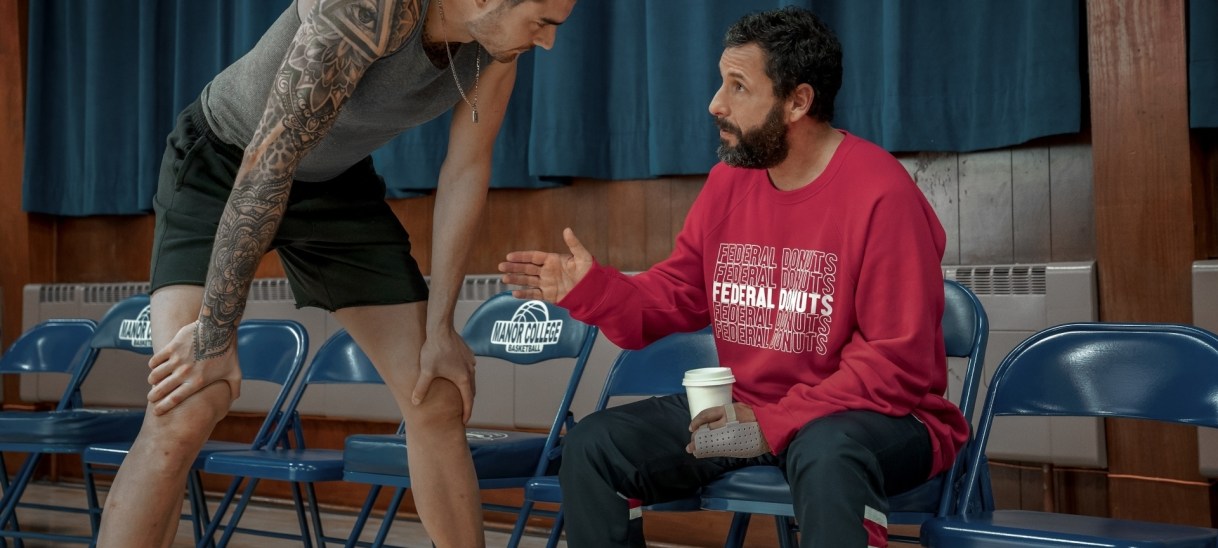
Sandler is a notorious basketball obsessive – famously setting up a net at most of his productions – with even NBA legends vouching for his skill on the court, so it’s no surprise to see him making a movie in this world. The film follows Sandler as ageing scout Stanley Sugerman for the Philadelphia 76ers, owned in this world by Robert Duvall’s Rex Merrick. After Rex’s death and ownership changes hands to his petulant son Vince (Ben Foster), Stan is forced to scout internationally to find a player, which he does in Bo Cruz, played by actual NBA player Juancho Hernangomez.
The film is ultimately a paint-by-numbers inspirational underdog sports movie, closer to Rocky (1976)than The Fish that Saved Pittsburgh, but what makes the film worthwhile is the extraordinary verisimilitude of the NBA world, as well as some truly impressive basketball set pieces that tie the film together. Zagar deploys several extended training montages—a staple in any sports film—including Cruz running up steps in Philadelphia that Sandler had to point out during the sequence. The fact that even this moment is played earnestly is an example of the tone the creators are striving towards that separates it from a suite of recent films.
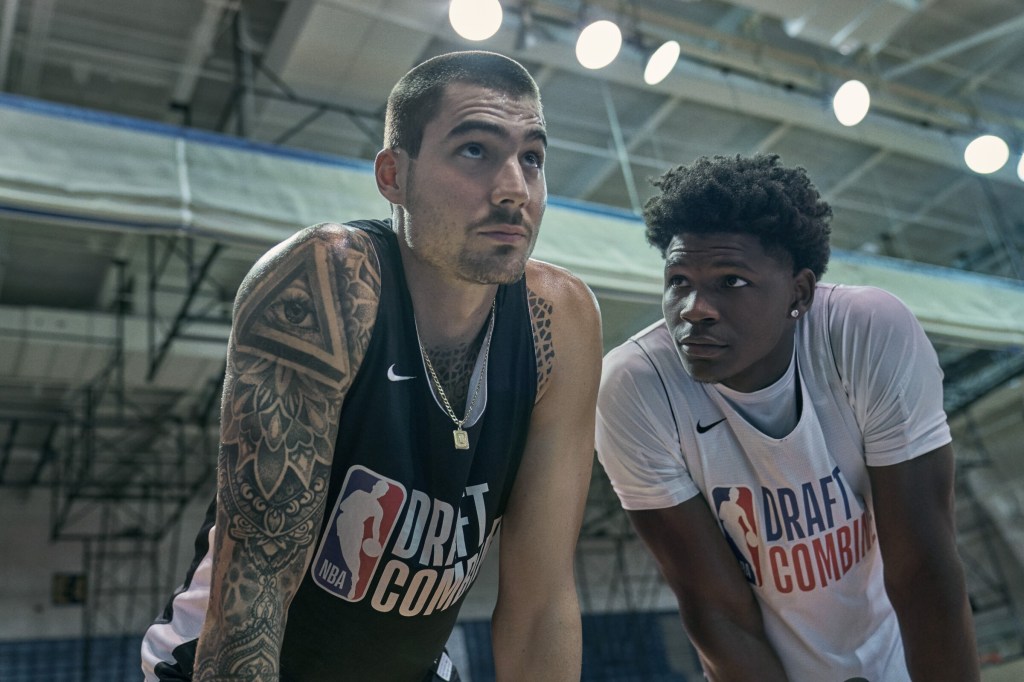
Juancho Hernangomez (left) and Anthony Edwards (right) in Hustle
Shot wonderfully on film, director Jeremiah Zagar mines intimate moments out of Hernangomez and his family that are as affecting as the high-octane basketball scenes, especially those between Kermit Wilts (played incredibly by NBA star Anthony Edwards) and Bo Cruz. Any fan of the NBA in recent years could tell you Edwards has exploded onto the scene as one of the best personalities in the sport, and Hustle uses his charm and confidence in a wonderful heel turn as Cruz’s rival leading into the draft.
Hustle is a modern sports film made with a high level of skill by Zagar, but it comes at an interesting moment in the genre. The modern sports film finds itself in a precarious position, with the dominance of sports documentary films and series crowding the market. On top of this, the only avenue for filmmakers to create a sports film or series in the 2020s seems to be the involvement of the athlete in question or as part of an athlete-led production company. Hustle is no different here with the involvement of LeBron James and Maverick Carter’s production company, Springhill Company involved, no doubt a key reason the film was able to achieve such a high level of NBA verisimilitude.
While not a terribly innovative or imaginative sports drama, Hustle continues Sandler’s recent run of more serious performances, growing into his later years as an actor that is choosing to work in more interesting and creative spaces. Die-hard NBA fans will lap this film up, while also having enough quality sports filmmaking moments to entertain the less sports averse.
By all accounts, the 80s were quite the decade for the pop culture scene with rapturous music, unique fashion, and iconic films that spoke to the sentiment of the times. It was also an era coming to terms with the aftermath of the Vietnam war which saw a plethora of action-induced, patriotic films being churned out and inspiring the youth of the time.
The most profound of those films is easily Tony Scott’s now iconic Top Gun (1986), a film that both turned Tom Cruise into the poster-boy for American patriotism, and also captured the hearts of audiences young and old with its dazzling displays of all things 80s Americana. It’s telling then that 36 years later, Joseph Kosinski’s Top Gun: Maverick (2022) has managed to surpass the awe of its predecessor, and at the same time, deliver a sequel to rival all sequels.
It might be that the last few years have left an uncertainty in their wake in the same way that the Vietnam war did in the many years after its conclusion. The state of the world today is wrought with turmoil including ever-ravaging wars, a pandemic that continues to linger, the propulsion of gun violence in the USA, and growing speculation of an incoming recession (like the early 80s Reagan-recession). Maverick feels like a response to these last few years, or at the very least, a banner of hope that audiences have embraced with open arms.
Perhaps that’s because Kosinski’s film places audiences into a two hour, jet-fuelled cockpit of escapism that pauses all the worries in one’s mind and creates an unnatural sensibility for what is being showcased. It’s a polished and daring display of practicality that sends goosebumps across one’s body as soon as Kenny Loggins’ ‘Danger Zone’ roars in the opening sequence — and that’s before any of the “out-there” moments even come to pass.
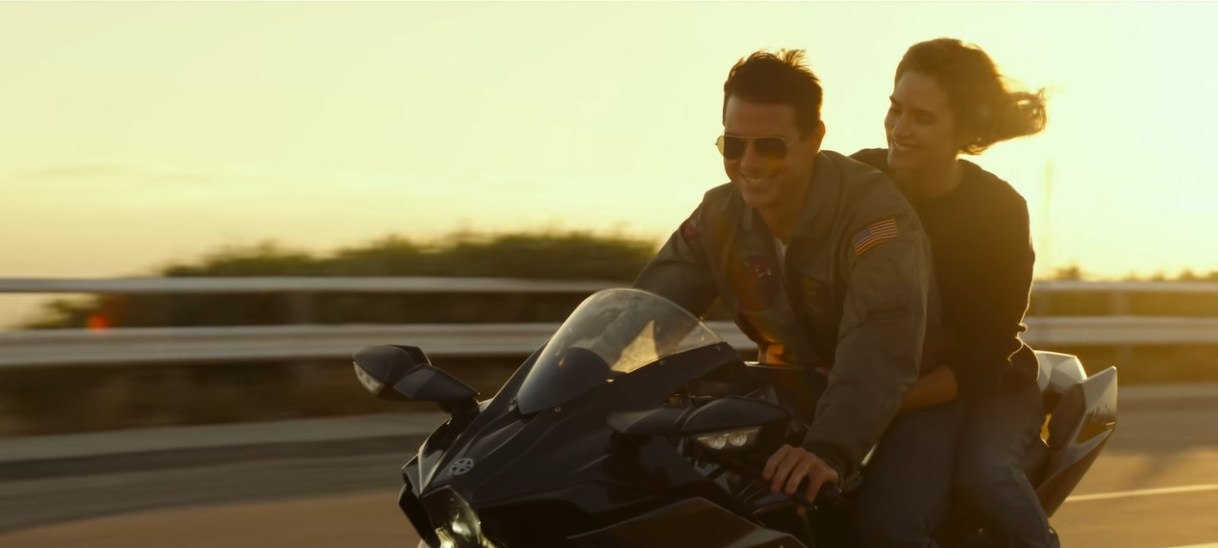
Tom Cruise in Top Gun: Maverick
Narratively speaking, Maverick follows Pete ‘Maverick’ Mitchell (Tom Cruise) in the years after his short-lived spell at the Top Gun academy for aviation. Now in his mature years, Maverick has traded dog fights for test flights, taking some of the latest aircrafts and pushing them to their limits in the sky. It’s a fitting reintroduction to the character and the direction of his arc for the remainder of the film, as he himself becomes pushed to his limits in the events that unfold.
Most of the film revolves around reconciliation, or coming to terms with the past, with the clearest example being in the death of Maverick’s wingman “Goose” that continues to plague our otherwise steadfast protagonist. It’s through Goose’s son, Bradley “Rooster” Bradshaw (Miles Teller), that we see this internal struggle and guilt of Maverick’s, surface. The film rides this wave of reconciliation for its majority, but it works because there is no throwaway dialogue here. The screenwriters, helmed by a trio comprising Ehren Kruger, Eric Warren Singer, and frequent Cruise-collaborator, Christopher McQuarrie, do a great job of balancing Maverick’s place in the world with the passing-of-the-torch to the young.
But even with all the side characters —including a short, heartfelt appearance by Val Kilmer’s Tom “Iceman” Kazansky— Maverick is still unequivocally Cruise’s. The actor has come a long way since his Risky Business (1983) days, even if there is a part of me that still craves to see more performances in the vein of Jerry Maguire (1996) or Magnolia’s (1999) Frank T.J. Mackie. Maverick feels like the first real film to see the actor come to terms with his place in cinema. For all the ‘old-timer’ and ‘relic’ lines that are thrown around, Cruise is still the biggest blockbuster name outside of the Marvel engine, and it’s no surprise that he’s being hailed as the last major Hollywood star.
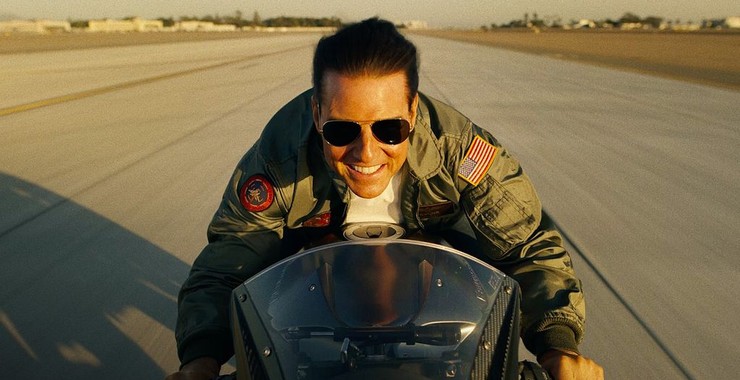
Tom Cruise in Top Gun: Maverick
The actor shows no signs of slowing down here, in fact, if his last few films are any indication, he still has some fuel left to burn. It helps that he has a young supporting cast that almost mirrors the antics of the original cast (Glen Powell’s Hangman is a spitting image of Val Kilmer’s young and cocky Iceman). He also has a new objective: to prepare these young pilots for a dangerous mission in enemy terrain.
The details of the mission aren’t nearly as important as the actual flying and shooting, or in other words, the stuff that gets you your money’s worth. The bravado of the film is nestled in the spectacle of its third act, where the cast is crammed into their F/A-18’s and made to feel the full force of the turns and hoops that ensue. Kosinski, clearly in his element here, shoots these death defying air-scapades with a desire to achieve as much realism as he can, and realism is what he gets, with heart-in-your-throat level action that makes Marvel seem like a rusty kids playground in need of a major renovation.
What’s true for Maverick is that it does feel like a polished playground of possibility, one that is set on pushing the limits of what’s possible for the cinematic medium. This has been true for anything Cruise related for years now, but with Maverick there is a bittersweetness in realising that films like this only get made because there is someone willing to push the medium to its breaking point and not play it safe — in that way, Cruise and Maverick aren’t so different.
Top Gun: Maverick is is currently screening in cinemas nationwide
Critics are fast running out of superlatives to describe the filmography of Pixar Animation Studios. Every release by the company, especially of late, has possessed a rousing soundtrack, heartfelt screenplay, top-notch voice-acting and of course, computer-generated illustrations beyond compare, almost to the point of conformity. That all changes with this production, and for the better.
Toronto resident Meilin Lee (Rosalie Chiang) is on the verge of adolescence, lusting after boys she ordinarily wouldn’t and engaging in activities that draw the disapproval of her otherwise doting mother, Ming (Sandra Oh). But puberty is not the only drastic change the youngster is having to contend with – now that she’s a teenager, Mei finds herself transforming into a giant red panda whenever her emotions are heightened, a source of embarrassment greater than any other in her life.
The driving force behind Turning Red (2022) is writer-director Domee Shi who, just like Mei, is a proud Torontonian with Chinese heritage. Shi’s career trajectory is more interesting than most, having joined Pixar as an intern before garnering widespread acclaim with her allegorical short film Bao (2018). After this success, Shi was promoted to Pixar’s “Brain Trust” and given the opportunity to craft her own feature-length production; in turn, the film-maker has concocted the most energetic, inimitable Pixar film yet.
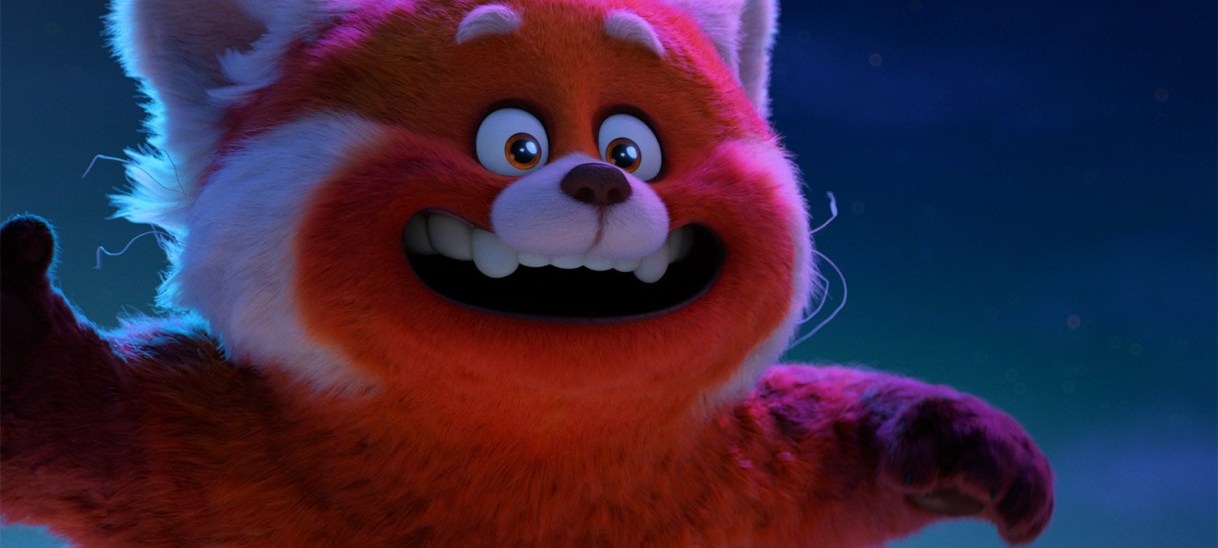
The most distinguishing element of Turning Red is the art-style. While there are shades of Pixar’s influence in the design of the characters and settings, the look of the film is distinct from any of the studio’s previous feature-length productions, a change that is most welcome. Soft colours dominate the architecture of Toronto, and clothing of those who inhabit its surroundings; humans of all sizes and body types interact with one-another, while their faces are adorned with large teeth and pupils that comically dilate or contract depending on their mood.
The animation, too, is a point of difference from other Pixar films. Where in the past, a character would move smoothly and gracefully (one could even say “realistically”), in Turning Red, the movement of the protagonists is quick and frenzied, welcomely leading to some well-timed physical gags that border on slapstick. Adding to this witty and frantic vibe is the editing, which occasionally employs some Edgar Wright-style quick cuts to further discern the picture from its contemporaries. Yet the differences go even deeper than that.
Ming Lee and daughter Meilin are often at odds in Turning Red.
Further distinctions are found in the screenwriting, which matches the vibrancy of Turning Red’s visuals. The plot is narrated in the first-person by a self-aware figure who frequently breaks the fourth wall and wears her geekiness with pride, forgoing the usual stereotype of an introverted, awkward teenager. Likewise, her friends are eccentric, outgoing and unashamedly nerdy, offering the perfect social and moral support – another rarity in coming-of-age tales. Additionally, it’s a tale that feels quite timeless, despite the film’s early-2000s setting.
Yet for all the freshness this script provides, it is stymied by the occasional flaw. One such example is the antagonistic Tyler (Tristan Allerick Chen), who is underwritten and poorly developed – efforts made by the film to complexify and soften his character are tame at best and confusing at worst. Another letdown is the third act, relinquishing the vim and momentum present elsewhere in Turning Red, slowing events to an underwhelming conclusion, and providing a left-field revelation about Tyler that bears no relevance to the conflict.
The one upside to these blemishes is that they aren’t a common sight in Pixar’s filmography, offering further proof that the team at Emeryville are no longer adhering to a formula or norm. Between this flick and Luca (2021), it looks as though Pixar is shying away from being a safe, comfortable brand and instead following the route of its fellow CGI powerhouses, DreamWorks and Sony in taking risks – they’re hiring new people, toying with different art-styles and telling more diverse stories.
Turning Red heralds a promising future for Pixar Animation Studios, providing the medium with a fresh and distinctive voice in Domee Shi. Viewers will find themselves drawn to the quirky characters, original story, lively animation and bright illustrations of a stylised Toronto, making for an entertaining and resonant experience regardless of one’s background.
Turning Red is now available on home-video and on-demand services, and streaming on Disney+.
Geoffrey Rush has hailed him as “one of the great character actors of our time, trapped in a leading man’s body” and whether you love him or hate him, there’s no denying that Johnny Depp has cashed in some of the most unique and memorable performances of the last 30 or so years. From Edward Scissorhands, Ed Wood, and Donnie Brasco right through to Captain Jack Sparrow, Willy Wonka and Sweeny Todd — there’s no shortage of the irreverent and iconic. These are Johnny Depp’s five best performances, ranked.
5. Donnie Brasco in Donnie Brasco (1997)
Johnny Depp as Donnie Brasco
Directed by Mike Newell and based on a true story (‘Donnie Brasco: My Undercover Life in the Mafia’), Donnie Brasco represents the first real instance where Depp plays a straight shooting, no nonsense character on the big screen.
Depp’s character, Joe Pistone, infiltrates the New York mafia under the guise of Donnie Brasco where he befriends Lefty Ruggiero (Al Pacino) and works undercover to expose mafia leader Sonny Black (Michael Madsen).
It is through the Depp/Pacino on-screen dynamic that this film separates itself from simply being another cliched 90s gangster, mafia type ordeal. Pacino plays a much more heartfelt character while channelling all the qualities (loud voice, edgy movements, alluring eyes) that have underpinned his performances prior.
Depp compliments Pacino’s supporting role by matching him in those qualities while also proving that he has more reach as an actor should he be offered the right role to display it. He plays the anxiousness of this character so effectively and you can sense the difficulty of his characters position as an informant through this anxiousness.
4. Ed Wood in Ed Wood (1994)
Johnny Depp as Ed Wood
The first of two Tim Burton collaborations on this list, Ed Wood is perhaps best known for Martin Landau’s Oscar winning support performance, but Johnny Depp’s portrayal as the titular cult classic filmmaker was just as profound.
Like the real Edward Wood, Depp has certain eccentricities that can come across as quite peculiar, and they have allowed him to play strange characters, like Wood, on-screen in ways that other actors would not have. Depp’s casting as Wood can be considered a “perfect fit” by Richard Dyer’s work on Star Theory, as his star image fits perfectly with all the traits of the character, and he leans into the strangeness of Tim Burton’s own unique vision to bring the character to life.
In this way, Depp’s performance as Ed Wood is the first real instance where the actor finds a balance between the humorous characteristics he would later inject into his performances to a greater extent, as well as the more heightened moments of ecstaticity.
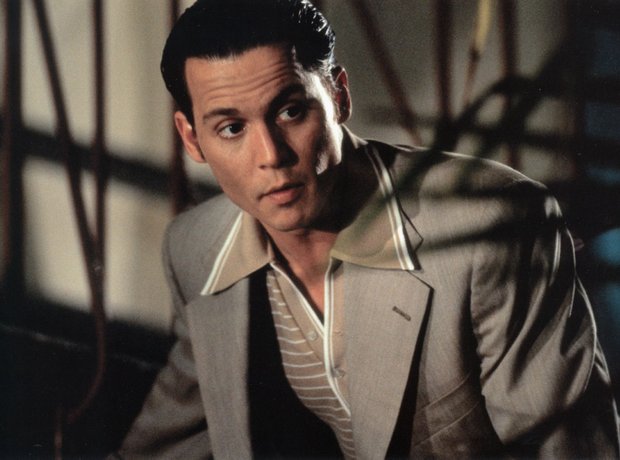
3. John Dillinger in Public Enemies (2009)
Johnny Depp as John Dillinger
Depp’s performance as the notorious American gangster/outlaw John Dillinger is perhaps the most contentious on this list. That might be due to the film in question, with Public Enemies being one of Michael Mann’s less layered works compared to say Heat (1995) or Collateral (2004), but it works because Mann is able to get the best out of his performers.
John Dillinger was evidently quite a misunderstood man by Mann’s depiction as he was more interested in taking from the state rather than from regular folk and found a certain connection to the people, and they to him. Depp can be seen as quite a misunderstood figure as well if not for his really uncanny demeanour, then definitely for the way he approaches his work and collaborations.
His performance as Dillinger is quite a strong one in that sense and it also represents a return to performances and films more akin to Donnie Brasco and a later mafia-esque film in Black Mass (2015).
2. Edward Scissorhands in Edward Scissorhands (1990)
Johnny Depp as Edward Scissorhands
Edward Scissorhands is easily one of Depp’s best performances due to how well the actor brings Tim Burton’s interest in outsiders and outcasts to light. Burton has never been shy on exploring characters who separate themselves from the public eye (like in his Batman films) or characters immersed in strange, gothic settings (like in 1988’s Beetlejuice).
A large reason why films like Edward Scissorhands and Sweeny Todd: The Demon Barber of Fleet Street (2007) work is because the synergy between Depp and Burton allows them to get to the heart of why these characters are the way they are.
There’s no doubt that Burton has nurtured Depp’s performances in ways other directors haven’t, but it’s in that very strangeness where Depp is at his best and can convince you that there could well be someone like Edward Scissorhands (figuratively speaking) out there. This performance is one of his best due to how well he uses his facial expressions, physicality and gestures, as the character rarely (if ever) actually speaks.
1. Captain Jack Sparrow in Pirates of the Caribbean (2003-2017)
Johnny Depp as Captain Jack Sparrow
It wouldn’t be a ‘best performances by Johnny Depp list’ without the iconic Captain Jack Sparrow. Aside from the fact that Gore Verbinski’s original Pirates trilogy is one of the most audacious and well worked in cinema history, it simply wouldn’t be as memorable without Depp’s very individualised performance as Captain Jack Sparrow.
Depp not only imbued Sparrow with his own signature idiosyncrasies and oddness, but he also drove a majority of the creative choices around the character. From the Pepé Le Pew and Keith Richards inspired look/feel, to the very specifics of how he walked and talked — this character went against the grain of expectation that Disney had initially wanted.
Depp subverted the image of how pirates historically acted and carried themselves by playing the role in a very caricature like manner. He injected Sparrow with a certain flamboyance courtesy of his gestures, and gave him a drunken demeanour even when Sparrow was at his most sober. Depp went as far as to suggest that the character should walk normally when he is on the ship, while being off-kilter and erratic when on land.
All of these choices alongside the bravado with which Depp delivered them through his performative toolkit are what gave the Pirates franchise such clear bearings. There is no Pirates of the Caribbean without Jack Sparrow and there is no Jack Sparrow without Johnny Depp.
Notable omissions: Sweeny Todd in Sweeny Todd: The Demon Barber of Fleet Street (2007), William Blake in Dead Man (1995), and Ichabod Crane in Sleepy Hollow (1999).
From the moment a young Harry Potter received his first letter from Hogwarts School of Witchcraft and Wizardry two decades ago, filmgoers have been rapt by the magical universe of J.K. Rowling and the characters that inhabit it. But ever since the launch of the Fantastic Beasts film series, that admiration has waned, a trend that looks set to continue with the release of an underwhelming third movie.
Several months after the events of The Crimes of Grindelwald (2018), Albus Dumbledore (Jude Law) is recruiting a small group of wizards and witches to defend against the dark forces of his childhood friend and now adversary, Gellert Grindelwald (Mads Mikkelsen) who is preparing for a war with the non-magical world. Knowing that his foe can see into the future, Dumbledore has devised a cunning plan to win the battle: confuse Grindelwald by sending his allies on illogical quests.
Perplexing though this plot may seem, it is truthfully one of the better elements of The Secrets of Dumbledore (2022). The script on this occasion is co-penned by Steve Kloves, who previously adapted six of Rowling’s seven Harry Potter novels for the screen, and his nous is more than apparent here – gone is the depressing atmosphere and the lazy setting-up of sequels, with both elements replaced by an ever-so-slightly hopeful tone and satisfying resolution to the conflict.
On the subject of replacements, there is none better in the third Fantastic Beasts than Danish actor Mads Mikkelsen. Unlike his predecessor Johnny Depp, who appeared bored and disinterested in the role, Mikkelsen appears to relish playing Grindelwald, with a wry smile and twinkle in his eye apparent every time he carries out a devilish deed. More to the point, there’s a charisma to his performance that was lacking in Depp’s portrayal of the antagonist, providing a reason as to why his followers are drawn to him, as well as Dumbledore’s love.
And that, unfortunately, is where the praise ends.
Although there are certain areas where it improves over the first Fantastic Beasts (2016) and its sequel, The Secrets of Dumbledore is a tepid affair, doing little to build upon the Harry Potter legacy. This is largely the fault of director David Yates, who has once again failed to imbue this world with any sense of majesty, and likewise proved incapable of adding a sense of flair to distinguish his work from all others. Knowing this, one must wonder why the producers continue to believe he is the best person to inspire a new generation of Potterheads.
Gellert Grindelwald (Mads Mikkelsen) is the lone bright-spot of Fantastic Beasts: The Secrets of Dumbledore
Perhaps Yates’ biggest misstep is his inability to manage tone, which is best exemplified in a sequence where Newt Scamander (Eddie Redmayne) must break his brother Theseus (Callum Turner) out of prison. In one moment, Newt must bypass a group of vicious creatures by imitating their crablike walk, complete with a corny, screwball soundtrack; the next, a vicious beast is spewing magma at the escaping siblings. So disparate are these changes that this author suspects studio interference may have played a role.
The issues extend beyond the monotonous direction of Yates, since The Secrets of Dumbledore is riddled with them in all other departments, too. Even with the involvement of Kloves, the screenplay is not great, being heavy on exposition and rather bloated; the visual effects are neither special nor convincing, even by the standards set twenty years ago; and the soundtrack of James Newton Howard lazily references the Harry Potter motifs of old, presumably in a desperate bid to generate nostalgia.
None of this bodes well for the future of the Fantastic Beasts series, which is already reeling from the aggressively transphobic views of Rowling, and looks to be dented further after its dismal box-office returns. If this franchise is to continue with a fourth and fifth instalment as originally planned – which seems unlikely, if the ending is any indication – then Warner Bros. should consider hiring a fresh set of eyes, a new team who can rekindle the magic of the early Harry Potter films and provide the sort of wide-eyed wonder that it sorely needs.
Yet the fact remains that after three attempts, any flaws this franchise held should have been rectified by this point, which quite simply isn’t the case. Fantastic Beasts: The Secrets of Dumbledore is blockbuster film-making at its laziest, being monotonous, remote, and possessing only the palest hint of cheer. Not even the presence of Mads Mikkelsen can save this picture from being a stinker.
Fantastic Beasts: The Secrets of Dumbledore is currently screening in cinemas nationwide.
So rarely will a group of people in a theatre howl with glee and terror in equal measure while watching a film, but that is the reaction that directing duo Daniel’s (Dan Kwan and Daniel Scheinert) newest feature Everything Everywhere All at Once elicits throughout its 144-minute runtime.
The film follows the Wang family, helmed by matriarch Evelyn (the legendary Michelle Yeoh), who is preparing for an audit from the IRS, full-time work in her struggling laundromat, Evelyn’s father Gong Gong (James Hong) arriving that morning from China, her husband Waymond (Ke Huy Quan) trying to give her divorce papers, and her daughter Joy (Stephanie Hsu) trying to get her mother to accept her girlfriend Becky (Tallie Medel). Everything is happening everywhere all at once for Evelyn, and this is all before the threat of the multiverse collapsing has entered their lives. Shock and extremity is the name of the game for Daniels so I won’t be spoiling any moment here as they would lessen the impact.
It would be so simple for Daniel’s to toss aside this opening act to get into the zany adventures in the centre of the film, but it is clear from the jump that the entire emotional weight is set up at the beginning and is allowed to mature over the runtime. This is what makes the great weird films like Back to the Future (1984) work for audiences, a clear goal and set of stakes for the story being told that is established in the opening 20-minutes, working as the firm ground to stand on as a hurricane of madness whirs around you for the rest of the film.
Those unfamiliar with the directing duo’s previous film Swiss Army Man (2016) will be taken aback by the pair’s slapstick and crude humour, as well as their frenetic pace between visually creative moments. Daniel’s crashed into the scene with their work in music videos – a common pathway for some of the industry’s best visual stylists (Michael Bay and David Fincher to name a few) – with the iconic Turn Down for What by DJ Snake and Lil Jon, one of the most-watched music videos ever. While it’s clear in their previous works the directing pair have filmmaking chops to spare, they achieve a greater scope and emotional weight in Everything Everywhere that matches with their visual creativity, a balancing act that is quite astounding.
Stephanie Hsu (left) as Joy, Michelle Yeoh (centre) as Evelyn, and Ke Huy Quan (right) as Waymond in Everything Everywhere All at Once
Floating along a constant stream of intertextuality, self-referentiality, and reverence to the films that paved the way to gift this film into audiences’ laps (The Matrix (1999), In The Mood for Love (2000), any Charlie Kaufman film), Everything Everywhere feels like a cinematic miracle that is at risk of breaking at any point. We’ve all made food (let’s say, a bagel) that we’ve overstuffed with nothing but things we enjoy eating, not realising until it’s too late that the meal has tipped over the edge into being inedible, or at the very least a meal spoilt by clashing ingredients. Like tastebuds, every person will respond to the film’s propulsive mania in different ways which are exciting, making the viewing experience with a packed audience all the more rewarding.
Everything Everywhere is a technical marvel of small budget filmmaking, from its mind-blowing costume and production design to its sound design and visual effects, but the real hero of the film is editor Paul Rogers. Rogers’ work here is nothing short of miraculous. Tasked with building a feverish momentum for over two hours while having each individual emotional moment land as impact-fully as each comedic or absurdist one. Rogers moulds the filmmaking duo’s creative madness into a deeply resonant and enjoyable film, not just another overly ambitious indie that feels more like a creative dare than a work of art with deep truths.
The film also wouldn’t work as well as it does without a perfect collection of onscreen talent that is all game for the absurdity being thrown at them. Whether it’s with IRS agent Jamie-Lee Curtis who is up for all manner of madness here and is having a blast, to Stephanie Hsu as Joy, who quickly becomes the emotional and narrative crux of the narrative, elevating an already entertaining film to transcendent levels. I am deeply looking forward to what else Hsu and Daniels can achieve together.
The film works similarly to the hyper pop genre in modern music. Both Everything Everywhere and hyper pop are mining pure emotion within the heart of excess and artifice. The movement is a direct response to the nihilism and despair of the 90s and 00s with artists like Charli XCX and the PC Music label paving the way. This form of hyper-aware, hyper-stylised emotive filmmaking operates just like a Charli XCX album; bouncing around multiple ideas with youthful energy, whilst never losing its heart and emotion. It is truly thrilling to see a similar approach made in cinema.
Some may call this film exhausting, and perhaps on a different day I may agree, so I can’t guarantee how you will feel until you witness what Daniels are doing here. But, I would stress to anyone who has seen the film and felt it exhausting, please see it again as your mood at the time you see this will heavily influence what you think of it, and it is definitely worth your time.
The Everything Everywhere All at Once is in theatres now.
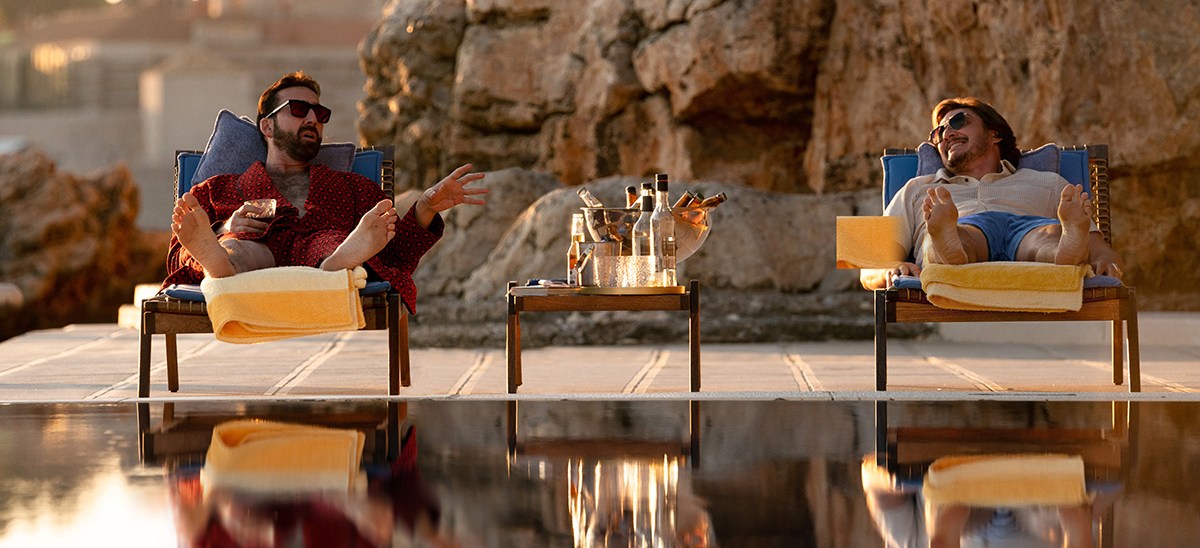
There are actors and then there are actors, but there’s also Nicolas Cage, a thespian unlike any other who has long been swimming in his own pool of creativity, films and the characters left in their wake. The Unbearable Weight of Massive Talent (2022) represents a celebration of all things Nic Cage, serving as its own museum that displays (quite literally) some of Nic’s most iconic on-screen moments, characters and artifacts while at the same time offering an enjoyable buddy-up action comedy.
Out of all the odd and unique actors throughout cinema history, it seems fitting that it would be Nicolas Cage who would play a hyper-fictionalised version of himself to such an extent. The actor’s unrivalled commitment to exploring all aspects of his craft has seen him play some of the most craze-filled (Red in 2019’s Mandy, Caster Troy/Sean Archer in 1997’s Face/Off) and heartfelt (Robin in 2021’s Pig, Joe Ransom in 2013’s Joe) characters of all time.
What Director Tom Gormican has provided with The Unbearable Weight of Massive Talent is a service to all fans of Cage. With Nick Cage (Nicolas Cage) running short on money and struggling to balance his work and home life, he decides to take his agent’s (Neil Patrick Harris) advice to attend a birthday party for Cage superfan Javi Gutierrez (Pedro Pascal) and get paid $1 million. What Nick doesn’t realise is that behind the lovey-dovey, Cage-admiring Javi, is a drug kingpin, crime family and a missing girl. Unbeknownst to Nick, CIA agent Vivian (Tiffany Haddish) plants a tracking device on him and soon informs him of Javi’s dangerous side. It is up to Cage to find the truth of it all by channelling his most iconic screen characters to save himself and those around him.
The film plays out like a pastiche on the body of Cage’s work while also offering something new in the way of performance. Cage has often spoken of his “nouveau shamanic” neologism as an approach to performance that tries to get to the essence of a character through a deeper engagement with one’s imagination — ultimately enabling a performance that is as true as can be. He has also said in a recent Reddit AMA (ask me anything) that playing Nick Cage was the most challenging role he has taken on, with the need to “protect a person named Nick Cage” and make sure that he “facilitated the director’s absurdist vision of so-called Nick Cage”.
Nicolas Cage in The Unbearable Weight of Massive Talent (2022)
It’s no surprise then that even for an actor of Cage’s calibre, it would take more than a “nouveau shamanic” approach to performance to truly play Nick Cage. But play Cage, Nicolas Cage does, as he brings all of his signature idiosyncrasies to the table: explosive moments of rage, overzealous mannerisms, signature one liners and so forth. There is a level of self-awareness here that never borders on excessiveness as Cage plays into these idiosyncrasies in a way that would speak to Gormican’s absurdist vision of what a hyper-fictionalised version of the actor and his life would look and feel like.
It’s easy for films to poke too much fun at their source material to the point where they overdo it — like in This is the End (2013). Ultimately, there is a still a need to provide a plot that brings everything together and serves a purpose beyond the gimmicks, and fortunately Gormican manages to keep a level head amongst the excitement of it all. Gormican uses the situation that Nick finds himself in to prompt the action that follows while at the same time managing to bring it all back to the crux that is Cage. The fact that Javi isn’t an unlikable antagonist (or an antagonist at all really) also helps to keep it light hearted and grounded, even with the tonal shift that happens around the second act.
It is quite fitting that, out of all the moments of overblown absurdity, the most striking moment —Nick Cage French-kissing a young, Wild at Heart (1990) era Cage— would come from the mind of Cage himself. The film pays homage to outlandish moments like this from the actor’s career and yet the process of making this film has brought another intrinsically “Nicolas Cage” moment; this moment hits like the smell of sea salt as you make your way to the beach for the first time in the summer, and it’s a beautiful feeling.
Never short on pop culture references (any mention of 2017’s Paddington 2 is always welcome) and always set on celebrating the cultural significance of its star lead, The Unbearable Weight of Massive Talent is everything fans of Nicolas Cage will have wanted it to be and more. While having massive talent might be unbearable, a film with Nicolas Cage playing Nick Cage is anything but unbearable — it might just be what cinema and the world has been missing.
The Unbearable Weight of Massive Talent opens nationally from the 21st of April, 2022
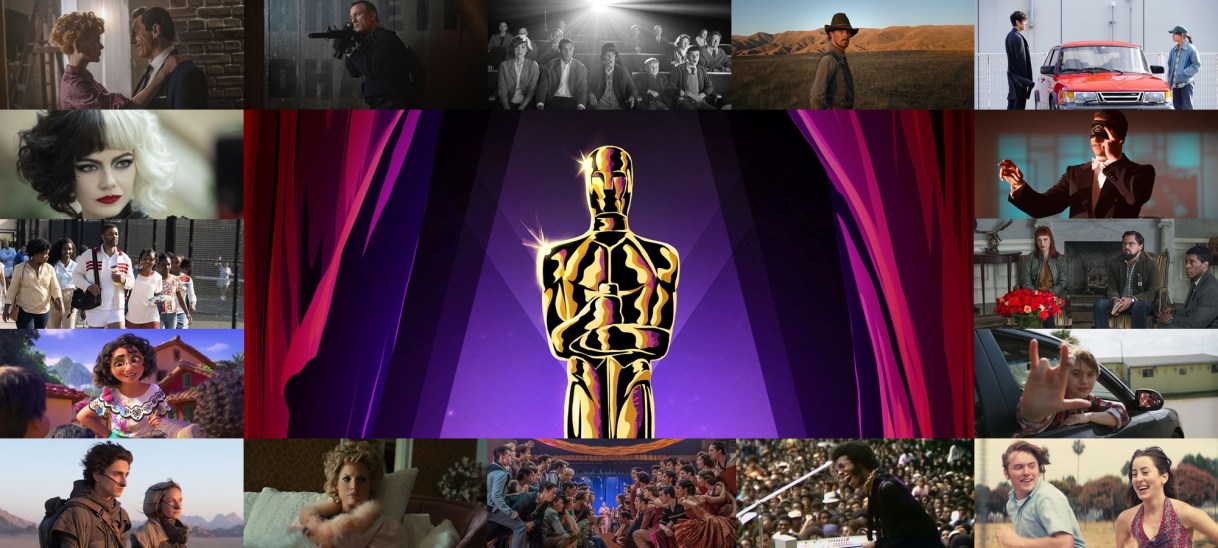
Arnie, Darcy and Tom discuss all the highs and lows from the 94th Academy Awards. From that controversial slap, to Dune’s technical awards sweep, right through to CODA’s Best Picture win, we have it all.
There are just a few mere hours until this year’s Oscars ceremony, and the team at Rating Frames are feeling more excited than ever, eagerly awaiting the live telecast and yearning to see who will be victorious.
As with most cinephiles, the three resident writers at this site have been making their prognostications as to what, or who, will win in each category, and will be putting them to the test come Monday morning, when the ceremony is scheduled to begin Melbourne time.
Below are the films that Arnel, Darcy and Tom are predicting will walk away with a coveted statuette at the 94th Academy Awards, and their personal vote, in each category.
In an age dominated by IP acquisitions in cinema, the art of the adaptation has seemingly narrowed and expanded in equal measure. Whether it’s adapting a recent YA novel series or the countless comic book blockbusters adapted from stories told in print from a half-century ago, cinema has leaned heavily on interpreting pre-existing literary works with established audiences to tell its stories.
But the art of adaptation is not solely a monetary endeavour in modern moviemaking. There are opportunities to explore older works to uncover deeper truths in an artist to achieve newly interesting films. Two such examples are the recent critical darlings Burning (2018), and Drive My Car (2021), both based on the Murakami short stories Barn Burning and Drive My Car respectively.
Both films share many similarities; interpreting sub-50 page Murakami stories into films epic in length (148m for Burning, 179m for Drive My Car), exploring the interpersonal relationships that were only suggested within the source text, and exploring a place and time unique to their works. Lee Chang-dong shifted the story of Barn Burning from Japan to South Korea, whilst Ryûsuke Hamaguchi and co-writer Takamasa Oe shifted the story of Drive My Car from Tokyo to Hiroshima.
Exploring works of adaptation in cinema is a rewarding experience in understanding both works and creators better, and is worth comparing these two excellent films in tandem with Murakami’s short stories.
Drive My Car
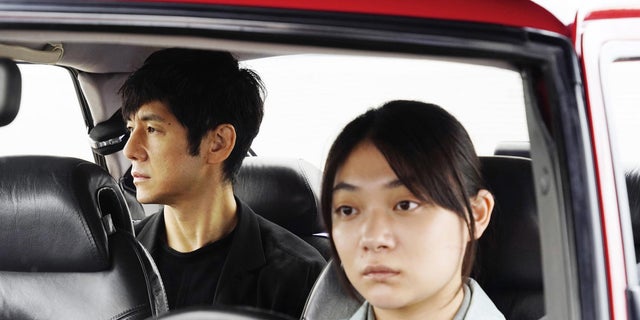
Hidetoshi Nishijima (left) and Tôko Miura in Drive My Car
“Murakami’s writing is wonderful at expressing inner emotions, and I think that’s why people want to adapt them. But it’s really difficult to re-create those inner feelings in film.” – Ryûsuke Hamaguchi
Fresh off multiple Oscar nominations including best adapted screenplay, Ryûsuke Hamaguchi’s masterpiece expands on every moment from Murakami’s short story while introducing his own fresh moments that truly thrive within the three-hour romantic drama epic.
So much is added to the story within the 40-minute prologue Hamaguchi and Oe create in the film. In literary fiction, the absence of a character is much easier to express to an audience. But in film, it is much harder for an audience to garner a relationship to a character that is only referenced. Imagine Up (2009) without its opening montage. The absence of Ellie through the rest of the film is profoundly felt by both Carl and the audience because of the impact the character had on us at the beginning of the story. Hamaguchi makes a crucial decision to further explore the intimate relationship between Yûsuke (Hidetoshi Nishijima) and Oto (Reika Kirishima) during the prologue, deepening our relationship with the couple. Oto’s absence casts a deep shadow that hangs over the entire film in a profound and moving way.
Where the adaptation feels closest to Murakami is surprisingly in an original scene, where Yûsuke goes to dinner with Gong Yoon-su (Jin Dae-yeon), Lee Yoon-a (Park Yu-rim), and the driver Misaki (Tôko Miura). It is here that Yûsuke feels comfortable enough to compliment Misaki’s driving, stating, “I hardly feel gravity. Sometimes I forget I’m in a car.” This explanation of a seemingly mundane skill perfectly executed is described so beautifully, the surrounding world feels overwhelmed with character. This is a style that Murakami has perfected in his writing and this sequence is Hamaguchi’s nod to the story’s original writer.
In the short story, Murakami uses Misaki’s driving and its mundane grace to explore Yûsuke’s unexplored feelings and memories of his wife, writing, “for some reason, he recalled her (Oto) more frequently now that Misaki was doing the driving.” Hamaguchi follows this evolution of Yûsuke opening up about his feelings while Misaki is driving in a similar graceful manner, something he also explored in his other wonderful 2021 release, Wheel of Fortune and Fantasy.
Sonia Yuan (left) and Park Yu-rim in Drive My Car
Murakami’s one gripe with the film was the change from the car being a yellow convertible Saab to a red sun-roofed Saab, a change he ultimately accepted. The red of the Saab cuts through the stark whites and navy blues of the environments Hamaguchi places it in. In a film built on the foundations of its long dialogue sequences, the simple visual style of the film is constantly engaging. By adding a roof to the now-iconic car, Hamaguchi creates a secluded space that creates a vacuum for the characters to enter. Whilst not as visually appealing as a convertible, the red Saab is a more striking cinematic object, gliding through the concrete labyrinth of Tokyo and Hiroshima.
A fascinating alteration to the original text is the character of Takatsuki, the young actor who has an affair with Oto in the film. In Murakami’s short story, the actor is in his early 40s and doesn’t share the same troubled past as a former star like his film counterpart. Through this change, the infidelity of Oto feels less connected to Yûsuke in terms of being a romantic stand-in, and more of an individual character decision, opening up the character to being more realised than in the short story. This change also deepens the conversations Yûsuke has with Takatsuki throughout the story – an element that takes up large portions of Murakami’s original text – as it creates a more interesting power dynamic between the pair as they search for a connection through Oto’s absence.
Hidetoshi Nishijima (left) and Tôko Miura in Drive My Car
Murakami’s short story focuses heavily on the theme of performance and acting, often citing, “we’re all acting aren’t we?”. Hamaguchi both explores these ideas deeper through the Uncle Vanya play while also obscuring Yûsuke’s ideas on acting by focusing the story more on his directing profession than his acting career, no doubt an area the director is more personally invested in.
One of the lasting images of the film is actually a profound moment in the short story too, of Yûsuke allowing Misaki to smoke in the car, which she accepts but also has too much respect for Yûsuke, but more importantly the car, as she smokes out the window.
Hamaguchi and Oe received an Academy Award nomination for Adapted Screenplay (an award most likely to be given to the outstanding Power of the Dog) and is everything the award should recognise. The film is a masterclass in extrapolating and personalising another writer’s story into the film medium, one that doesn’t overshadow the original, but mines new elements out of it to craft something truly special.
Burning
Yoo Ah-in (left), Jeon Jong-seo (centre), and Steven Yeun (right) in Burning
Murakami’s writing in the short story is most compelling in between sentences. Burning works wonderfully as a work of adaptation as it is constructed to explore and expand on these silences on the page, without ever feeling pressured to over-explain.
The time spent between Hae-mi in Africa and returning is expressed with a single space on Murakami’s page, whereas in the film, Lee uses this time to explore our protagonist in this period of extended isolation.
“Are you going to come back to Japan?” I asked her, jokingly.
“Of course I am,” she replied.
Three months later she was back, …
Barn Burning pg.2
This sequence runs for 10 minutes, showing him masturbating in Hae-mi’s room multiple times as well as going to his father’s assault trial. By adding these new layers to the character, the film adaptation seeks to expand both the Jung-su character as well as emphasise the absence Hae-mi leaves in his life.
A key scene taken straight from the short story is Hae-mi and Jung-su’s first night drinking together at a bar, where Hae-mi pantomimes eating an orange. This reads intriguingly in the Murakami story, introducing this charming and compelling character that both our protagonist and audience are unsure of. In Burning, we can see the scene performed, which greatly adds to the character’s performance of the pantomime and seeing Jung-su’s completely engrossed face as it is occurring.
A crucial thematic element to Lee’s film is the story of the African Bushmen’s two hungry people; Little Hunger, those who are physically hungry, and Great Hunger, those who are hungry for life’s meaning. It is clear even with Murakami’s short story that the female character of Hae-mi is looking for a purpose in the world that is soon to envelop her, ideas that are expanded and stretched further in Lee’s adaptation.
Lee foreshadows Ben’s speech on burning barns in a restaurant scene between the three characters. Ben says he wants to “tell his story” to Jung-su, as he is a writer. Both the short story and the film characterise Ben as being interested in our protagonist as he is a writer. By foreshadowing this story instead of it appearing spontaneously like in the original text, Lee introduces a feeling of suspense and unease surrounding the mysterious Ben, for both Jong-su and the audience.
Jeon Jong-seo in Burning
The film’s most iconic scene is the dance sequence set to Miles Davis’ Generique, a powerfully solemn and introspective piece written for the Louis Malle film Ascenseur pour l’échafaud (1958). Burning and Drive My Car both follow a lot of Murakami’s western influences into their adaptations, an aspect which no doubt endeared itself to a wider audience.
Murakami does not specify which Davis song is heard in the short story, allowing Lee to add a layer of artistic decision-making to his adaptation. Using Generique, Lee is layering the groundwork for a dreamlike sequence not unlike something you’d see in a Malick or Lynch film, particularly the red room in Twin Peaks (1990-91); a dream-state environment where key characters’ subconscious expresses itself openly.
What makes Lee’s adaptation so entertaining is his willingness to explore the subtext of Ben’s unnerving nature through genre tropes of a psychological thriller. By expanding these notes of Ben’s character from Murakami’s original story, Lee is able to lure both the protagonist and the audience into the story before it culminates in the farm sequence where Ben describes his barn burning hobby, the launching point of the short story’s narrative.
An important and oftentimes overlooked element of the literary adaptation is to have well defined visual and sonic components. If there is no visual or audible interest in the adaptation, then the filmmaker is not using the advantages of the medium to full effect. Burning has a distinct visual and audible style which Lee uses throughout his adaptation to emphasise the mood of the film. Whether it be the thriller-tinged score by Mowg, or the sapphire soaked sky during Jong-su’s daily runs in the second half of the film, Lee is creating a world that is unique to Murakami’s original text, exploring new depths to the short story while still maintaining a connected through-line.
Steven Yeun in Burning
What makes both of Murakami’s short stories so compelling and rich for adaptation is his ability to create compelling characters in remarkably succinct ways. There is a deftness in its layered character work to be mined within 20-40 pages like in Barn Burning and Drive My Car that leaves Lee and Hamaguchi a groundwork to adapt to the screen, while also crafting characters an audience would want to explore more deeply in film.
Much has been made of these two successful adaptations being long compared to the source text, displaying how much depth can be uncovered from Murakami’s short pieces. Both Lee and Hamaguchi seem keenly interested in the genre elements of his stories (detective noirs in Burning, domestic melodramas and theatre as subtext stories in Drive My Car), while also wanting to deeply explore these rich characters over the course of their adaptations.
A common criticism of Murakami is his lack of female characters, something we see in both of these short stories. Perhaps the greatest inclusion Lee and Hamaguchi make to these stories are the two female characters that haunt both Burning and Drive My Car. By making both Hae-mi and Oto not just real characters, but truly charming people that an audience can get engrossed in, the directors are able to lay the groundwork for the narrative momentum of the stories. Just as Jung-su and Yûsuke are obsessed and entranced by these characters, so too are the audience, making their eventual absences create a cavity within the film that will not be filled.
Both films ask interesting questions on the art of adaptation. By exploring a short piece of writing by a revered writer, both Lee and Hamaguchi are able to create layered, dense dramas that extend far beyond their original text. Would these films have worked nearly as well without Murakami’s imprint on key moments? Or is it the duet of writer and interpreter, an overriding theme of Hamaguchi’s film, that gives these stories such powerful meaning?










 Rating Frames