Disney’s Jungle Cruise is a Ride to Be Forgotten

There’s a prestige and heritage to the Disney brand that other studios can only envy – it’s a fact the corporation itself recognises, having produced a new picture that plays to its traditions. An initial glance suggests that said picture is primed for success; one viewing is enough to prove otherwise.

At the height of the First World War, Dr Lily Houghton (Emily Blunt) is venturing to the Amazonian rainforests of South America, where she hopes to locate a rare flower with fabled healing properties in the name of science. Upon arrival, she engages the services of tour guide Frank Wolff (Dwayne Johnson), who offers to pilot Lily – and her accompanying, neurotic brother MacGregor (Jack Whitehall) – in his own boat along the Amazon’s many tributaries.

Their journey is one that will be fraught with the deadliest of dangers, including carnivorous beasts, turbulent rapids, and native tribespeople who are unwelcoming to outsiders; yet the greatest threat of all is a pursuing German officer, Prince Joachim (Jesse Plemons) who seeks the flower for his own warped, egocentric benefit as much as his beloved Vaterland.

Jungle Cruise is the latest blockbuster to be adapted from a Disneyland attraction, joining the likes of the Pirates of the Caribbean films, as well as less popular efforts such as The Haunted Mansion and Tomorrowland. Of these releases, it’s the Pirates franchise that Jungle Cruise most closely aligns with, hoping to emulate the former’s box-office success – a feat that looks unlikely, not just because of recent outbreaks of a certain strain of virus, but also the sheer mediocrity of the picture.

One advantage that Jungle Cruise does possess is a talented cast, including two leads who are familiar to the Disney faithful. Emily Blunt is the top-billed female, having previously fronted the cameras for Into the Woods and Mary Poppins Returns, albeit with more singing; her male counterpart, Dwayne “The Rock” Johnson is no stranger to the studio either, with starring roles in The Game Plan, Race to Witch Mountain and Moana.

Undoubtedly, Blunt and Johnson’s historic involvement with Disney is what endeared them to the producers, and perhaps why both actors perform with a laidback confidence – their respective characters seem more an extension of their own charming selves than a transformation. This is particularly evident when the two personalities share the screen, demonstrating the kind of chemistry that is usually found in more seasoned duos, not a pair who are sharing their first credit together.

The villainous Prince Joachim (Jesse Plemons) as seen in Jungle Cruise

One performer who has taken the transformative approach, and played against type in the process, is Jesse Plemons. Where in other roles he would be understated with only a hint of menace, here Plemons gleefully portrays the antagonistic Prince Joachim with a fitting level of camp, eccentricity and accented speech. It’s yet another delightful performance from Plemons, who by now is well on his way to conquering Hollywood.

Sadly, that praise does not extend to the secondary villains of Jungle Cruise: a group of zombified Spanish conquistadors who are clearly inspired by Captain Barbossa’s crew. Despite their unique appearances – the men take their physical form with the help of rainforest features such as vines, snakes and hornets – there’s nothing remotely interesting nor memorable about these foes, who lack the personality and wickedness necessary for this kind of role.

Matters are made worse by the substandard visual effects, which look as though they were rendered two decades ago; the comedic elements, which barely incite so much as a chuckle; and the underwhelming soundtrack from James Newton Howard, which lacks a rousing theme a la the Pirates movies. Yet these problems are minor when compared to the biggest issue of all: the confusing action sequences.

By most measures, the thrills of Jungle Cruise are pretty serviceable, with decent choreography and stunt-work; but they are made difficult to appreciate due to the shaky camerawork and frantic editing. Such techniques have been utilised by many a Hollywood blockbuster in recent times, proving just as annoying here as they do elsewhere – it’s high time producers learned that they don’t make the action any more exciting.

It’s baffling to think that a film with six producers and the backing of the world’s largest studio could be so mediocre. Despite having some gifted actors at its disposal, Jungle Cruise serves only as a passing distraction, with most of its other attributes being adequate at best. If this film is to herald a new Disney franchise, it’s not a promising start.

Jungle Cruise is screening in cinemas nationally where open, and available for streaming with Premium Access on Disney+.

MIFF ’21: Notturno Forces us to Face the Realities of War that we Often Ignore

Rating: 3 out of 5.

With colonisation comes a struggle for independence and identity; oftentimes war ensues, and people are either left with less than they had before, or nothing at all. Gianfranco Rosi’s documentary, Notturno (2020), paints a perplexing picture of what life after war looks like. The Oscar-nominated documentarian lets his camera do the talking as he traverses the war ravaged Syria, Iraq, Kurdistan, and Lebanon over the course of three years. The result is a film that captures the aftermath of war ravaged lands, and the people left to endure the mess made by others.

Rosi is no stranger to focusing on people facing hardship as a result of injustice and corrupt systems. His Golden Bear winning film, Fire at Sea (2016), explores the European migrant crisis and some of the people at the centre of the migrant landings at Sicilian island, Lampedusa. While Notturno isn’t as specific in its focus as Fire at Sea, it serves to remind audiences of the realities that people on the other side are living.

In Notturno, Rosi captures the sprawling and almost barren wasteland’s of some of the aforementioned Middle-Eastern countries, and his cinematography is comprised of an array of wide shots that give the land itself an added layer of complexity. There is almost no life in Rosi’s shots, with the environment seeming akin to that of Frank Herbert’s fictional Arrakis (or Dune) — there is a desert-like openness, structures are left behind from ISIS raids, and minimal life exists save for birds that are hunted. The purpose here is to reinforce what many of the people in the film already voice — these people’s homeland has been taken from them and losing their identity is at risk as well. Subsequently, the camera serves as this invisible observer in motion.

Unfortunately, Rosi isn’t as interested in providing more context on the people in the film, with many of them going about their lives without us ever gaining a sense of who they are. There is an instance where some children draw and describe horrific pictures from experiences they’ve had with ISIS, but that’s about as close as we come to an emotional investment beyond the shots themselves.

A mother grieving for her son in Notturno

The film seems more concerned with allowing the setting to nurture our understanding of the people who occupy it rather than through the people themselves. These people enter the frame and the nothingness around them in order to reinforce just how little this land is actually theirs — it isn’t welcoming or even supportive of its occupants. In this sense, the land and Rosi’s shots of it is being used to demonstrate the governments (or lack thereof) failure to provide for its people.

One of the subjects in the film is a boy, Ali, who supports his mother and his many siblings by hunting for birds with various unknowns. When observed outside of the long and mid shots of his home where there is a sense of control and identity, he is often framed as a spec in the wider vastness of Rosi’s wide-shots. It’s a clever approach on Rosi’s part, but it provides the bare minimum in terms of understanding Ali’s situation and how he and his family make sense of the world around them.

The most profound aspect of the film, however, is Rosi’s ability to let the land speak for itself. There is little to no dialogue which creates an eerie sensation given that the countries in question are known for the violence and chaos that eschews the normalcy that otherwise exists. The only real sounds that continually penetrate the film are those natural ambient noises (birds chirping, water rushing, wind breezing etc.). When something other than natures sounds begins to present itself, it tends to be in the form of guns clocking and war trucks rolling. For what it’s worth, Rosi juxtaposes that aspect really well and leaves an uneasiness in one’s stomach.

Perhaps now more than ever, Notturno reminds audiences that colonisation and external interference in a once functioning nation, only does more harm than good — with the current situation in Afghanistan exacerbating that claim. Sure Rosi could have done with a greater engagement with his subjects, but it’s easy to see that his camera and the setting it captures are there to do the talking. While not as moving as Fire at Sea is during its best moments, Notturno is an essential viewing if not for its contemplative look on the countries at the centre of it, then for its relevance at this very point in time.

Notturno is currently streaming on MIFF Play until the 22nd of August.

MIFF ’21: Indie Darling Freshman Year is an Unassuming Charmer

If Hollywood is to be believed, college is one big, endless party rife with booze, drugs and sexual encounters. What’s needed is an exploration of the minutiae of tertiary education, those quieter moments that prove just as key to the experience – a void this indie feature has just filled.

Having moved from his family home in Texas, teenager Alex (Cooper Raiff) is struggling in his first year of university in California, feeling isolated physically and emotionally with only his dog plush for company. That loneliness eases upon a chance encounter with Maggie (Dylan Gelula), a fellow dweller in his dormitory, who Alex falls in love with over the course of one night, only to be rejected by her the very next morning.

Freshman Year is the directorial debut of Cooper Raiff, who also wrote the screenplay in addition to starring. His picture first garnered attention last year on the festival circuit under the title of Shithouse, earning near-unanimous praise and securing Raiff as a film-maker to watch in the months and years ahead. Those are some pretty lofty ambitions to meet, especially when one considers that Raiff’s film is quite modest in its presentation.

Raiff impresses as both an actor and director – fronting the camera, he looks assured and comfortable in the role of Alex, keeping his emotions restrained and never resorting to melodrama; likewise, his helmsmanship is solid, with the film having steady pacing, clean cinematography, and mise-en-scene that’s perfectly suited to an indie feature. What’s here certainly doesn’t break new ground, but it demonstrates that Raiff does have a firm understanding of his craft.

Where Freshman Year differs from other indie, coming-of-age or college movies is in its fly-on-the-wall depictions of dorm life. There are no rowdy frat-houses or wild riots to be witnessed in Raiff’s picture, which is more preoccupied with discussing the ennui of university, hypothesising that living on-campus is not the endless thrill that others proclaim it to be. In that sense, one could consider the film as the antithesis to the likes of Animal House and Bad Neighbours.

Freshman Year is best appreciated though as a sweet, humble tale of two lovers. Raiff and Gelula’s chemistry is palpable throughout, their endearing nature swiftly ensured by their soft, amicable conversations in the first act, and further cemented by a cathartic night-time walk. In these moments, both Alex and Maggie prove so likeable that one can forgive the awkward, cliched moments they share in the latter half of the film. Well, almost.

While far from a revelation, Freshman Year is a respectable first effort from writer-director Cooper Raiff, who does well to reflect the experiences of a disaffected student, yet also proves adept at delivering a romance that viewers yearn for. It’ll be interesting to see what he crafts next.

Freshman Year is currently streaming on MIFF Play until August the 22nd.

MIFF ’21: Japan’s Volleyballers Get Their Due in The Witches of the Orient

History is littered with sporting dynasties – in basketball, Phil Jackson’s Chicago Bulls are often touted as one of the all-time greats; in rugby, it’s New Zealand’s fearsome All Blacks who reign supreme. Of equal significance to both is a group of female volleyballers from the East, whose exploits have sadly been underreported in recent years.

In the early 1960s, the world of women’s volleyball was dominated by the Nichibo Kaizuka team, consisting largely of textile workers from the outskirts of Osaka. Under the rigorous training regime of coach Hirofumi “The Demon” Diamatsu, this band of young women annihilated their domestic opponents, eventually being selected to represent Japan internationally against other, higher-ranked teams.

Diamatsu’s team would go on to be dubbed the “Oriental Witches” by the foreign press, owing to their athletic prowess and unparalleled succession of victories – 258, to be exact. This extraordinary feat saw the Japanese players become celebrities at home and abroad, inspiring cartoons, comics, and documentaries such as this one, albeit without the same levels of artistry and reflection.

The Witches of the Orient comes from French documentarian Julien Faraut, who three years ago examined the psyche of tennis player John McEnroe in another MIFF entry, In the Realm of Perfection. Much of Faraut’s narrative is composited of existing footage – including the aforementioned cartoons, plus material of the team competing in Eastern Europe – which is then paired with electronic music, an eclectic combination that leaves the viewer in a trance.

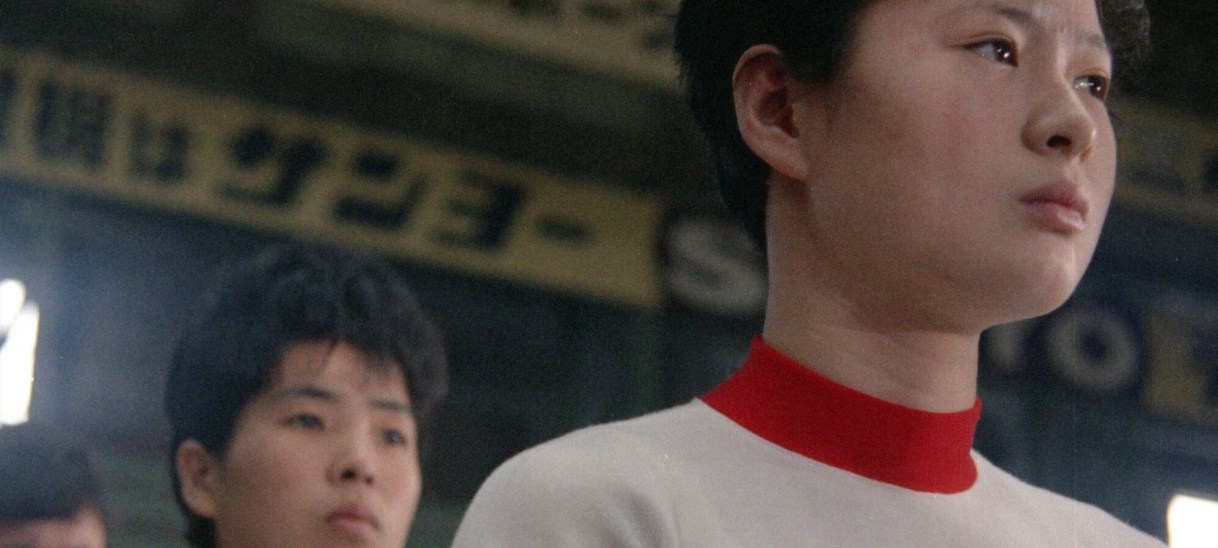
Perhaps the most mesmerising sequence of Witches is the archival film of the women training in Kaizuka. In this footage, coach Diamatsu can be seen relentlessly spiking balls at his players to ostensibly improve their return serve, forcing them to sprint and roll across the court until they are all but exhausted of energy. While Diamatsu’s arduous techniques are somewhat mortifying to witness, they do provide an indication as to why the Witches were so competitive.

Archival footage, such as the Gold Medal match at the 1964 Tokyo Olympics, makes up a significant portion of The Witches of the Orient

Faraut’s story also draws upon interviews with Nichibo Kaizuka’s surviving members, who provide rare, exclusive access to their lives. The women never speak directly to the camera, instead providing voice-overs that are matched to their daily routines – the earliest example being Katsumi Chiba and her morning workout at a local gym – as well as a discussion between them over dinner.

There are some real gems offered in the ladies’ narration and B-roll of their activities. Yoshido Kanda speaks most candidly of all the former players, reflecting upon her status as a substitute player and why the women were so drawn to Diamatsu despite his gruelling nature; meanwhile, Yoko Tamura’s footage has a lifestyle to be envied, shown playing a game of memory with her grandchildren and watching volleyball anime with her family.

Although the narrative is transfixing, Witches would benefit from some tighter editing – the montages are too long at times, and there’s a sequence about the players’ nicknames that adds nothing to the story. There are some questionable stylistic choices too, with Faraut keeping a tight 4:3 frame throughout – even in contemporary settings – only to inexplicably transfer to a widescreen ratio in the third act.

Watching The Witches of the Orient, it’s difficult to fathom why their achievements have been so muted in contemporary media. The Nichibo Kaizuka story may not possess the drama or excitement of other sporting dynasties, but their winning streak is yet to be matched by any other volleyball team, as is the level of fame and fervour they generated overseas. Surely those facts alone are worth a place in sporting folklore.

Crafted with an element of idiosyncrasy, Julien Faraut’s The Witches of the Orient is a beguiling story about a group of women whose triumphs ought to be celebrated more. The openness and humility of the subjects is what charms most, though the mesmeric visuals play their part too.

The Witches of the Orient is currently streaming as part of the Melbourne International Film Festival on MIFF Play until August 22nd.

MIFF ’21: All Light, Everywhere Conjures Deep and Thought-Provoking Questions on Surveillance

“The optic nerve receives no visual information. It’s a blind spot. At the exact point where the world meets the seeing of the world. We’re blind.”

This statement delivered by unspoken subtitles captures both the intent and tone of the cerebral documentary feature All Light, Everywhere by Baltimore-based filmmaker Theo Anthony. The film is a meditation on surveillance, observation, police technology, privacy, and the relationship between filmmaker – which in this case extends to police and their body cameras – and subject.

Over the course of its 109-minute run time, the documentary deeply explores unique and interesting areas that link thematically to the notion of surveillance and the role of the observer in the process, from a factory tour of Axon Technologies (formally Taser) who created the police body cameras used today, the history of the moving picture and how its conception ties in deeply with policing, and a Baltimore community meeting on the prospect of being surveilled by a drone in an attempt to reduce crime that delivers some of the most poignant moments of the film.

This is not a film with answers or any sort of declarative statement at the conclusion. This is a documentary whose primary goal is to provoke thought in a complicated but necessary subject, while also weaving in more philosophical questions about the purpose of surveillance and the questions of bias in all things, and on this front, the film succeeds.

A lot of credit should be given to Anthony and cinematographer Corey Hughes, as they are acutely aware of the power they hold scene to scene with their camera and wield it in a more contemplative and wandering way that really captures the tone of the documentary. 

This tone is further illuminated through the score of the terrific electronic artist and composer Dan Deacon, also from Baltimore. Deacon’s synth-heavy score is equally haunting and sweeping, accompanying the more poetic and cerebral aspects of the documentary in a humanistic way, albeit while occasionally overwhelming the scenes that could’ve used a softer hand.

The film uses narration and unspoken subtitles as a form of contemplative fact-checking, prompting the audience to ask questions about what they are seeing, reminding us of the biases that naturally occur in seemingly unnatural things like drone footage and security footage. In the example of police body cameras, something which is pitched to society as an unbiased recording of events as they occur, narrator Keaver Brenai asserts that “the wide-angle is used to document as much space as possible, but the angle also exaggerates motion.”

A small child stares at the approaching solar eclipse in All Light, Everywhere

As is the case with a growing number of modern documentaries, the filmmakers themselves are as much a focus as the subjects. While this is usually a grating aspect to non-fiction storytelling, here it is necessary and Anthony and Hughes understand that their film is centred on the relationship and biases the observer has with what is being observed.

As the documentary format is explored and interrogated more deeply – especially post documentary boom thanks in large part to streaming – the ideas of bias and intent have been given more importance, and the form appears to be reacting to that interrogation by involving the filmmakers more often in front of and around the camera, as well as through moments of candidness where we are shown moments before or after scenes in an attempt to strip away the artifice of the film. These are techniques used often in All Light, Everywhere, even going to the lengths to show us the Adobe Premiere screen of the film’s edit, which is less capable hands may come off as a cheap and exploitative trick to create a sense of authenticity so that the audience can trust what is shown in front of the camera is coming from an honest place. 

Documentaries from others in recent years deploy these techniques to create an aura of authenticity, while Anthony here uses these same techniques to force the audience to question his own biases, something he clearly had to grapple with through the making of this film.

There are a thousand interesting threads to pull in this poignant, thought-provoking documentary, which is something the filmmakers clearly also found in the creation of this project, with an epilogue showing us footage of Anthony and Hughes documenting a filmmaking course at a Baltimore high school that was meant to feature prominently in the film but couldn’t find the thematic links to the rest of the piece. It is disappointing we were unable to view this film with a large audience as it absolutely deserved the sensation of walking out of a film into a packed foyer bustling with people wanting to discuss their thoughts and feelings on what they just saw.

All Light, Everywhere is streaming as part of the Melbourne International Film Festival on MIFF Play until August 22nd.

MIFF ’21: Riders of Justice Subverts the Revenge Thriller for a Truly Unique Experience

When tragedy strikes, our instinct is to seek out how something so monstrous could happen. We try to understand the actions that led to this point, a chain of causality that will answer what, or who, is responsible. This is at the heart of Anders Thomas Jensen’s new film Riders of Justice. Working with frequent collaborators Nikolaj Lie Kaas and the extraordinary Mads Mikkelson, this revenge thriller cleverly deconstructs the genre while weaving Jensen’s penchant for pitch-black humour that we’ve seen in his previous films Men & Chicken and Adam’s Apple.

After his wife is tragically killed, Mikkelson’s still deployed soldier Markus returns home to his daughter Mathilde (Andrea Heick Gadeberg), as they come to terms with their loss. Markus wants to move past the tragedy, seemingly accepting the freak nature of the accident, much to the dismay of his daughter who is in denial, wanting to believe it to be an of act of god. Markus’s mind is quickly changed however, when statistician Otto (Nikolaj Lie Kaas) shows up at his door and tells Markus exactly what he wants to hear; that there is a person responsible for his wife’s death.

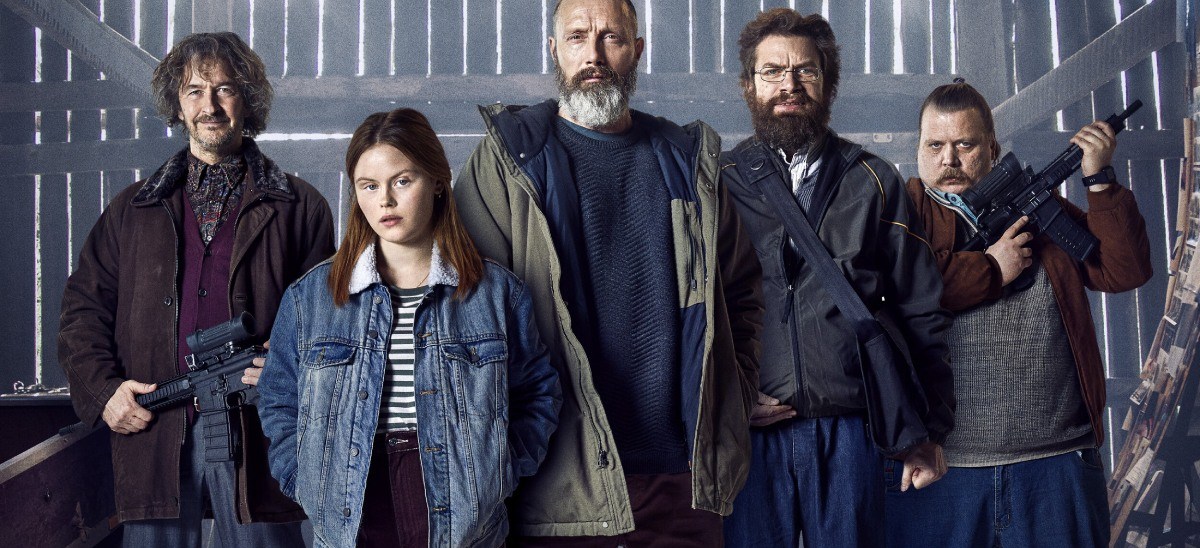
In most revenge thrillers, the target of vengeance is almost always a gang leader or secret cabal that messed with the wrong man’s family, like notable revenge films Taken and Death Wish, and on the surface Riders of Justice is no different with the titular biker gang Riders of Justice. What separates this film from the others in the genre however, is the lack of focus given to the characters we should be viewing as villains, the targets of Markus’s vengeance. By focusing solely on Markus and his oddball group of friends, Jensen is telling us these villains are merely surrogates for these men as they deal with their grief, guilt, and loss of control. 

Riders of Justice also subverts the revenge genre by focusing heavily on the emotion toll of the central characters actions. A staple of the revenge thriller is to quickly establish why the only action the protagonist can take is to go on a no holds barred, guilt-free rampage through the city, as we revel in the carnage catharsis alongside our hero. What Riders of Justice achieves through grounding the narrative in Markus’ home life, especially his relationship with violence through his life as a soldier, as well as his daughter’s relationship with his violence, is that we have to decide for ourselves whether the feeling we are left with is one of catharsis or sadness at the path taken by our heroes as they tear through the Riders of Justice.

Nikolaj Lie Kaas (left to right), Lars Brygmann, and Mads Mikkelson in Riders of Justice

This is a difficult film to categorise and that is evident through the trailers and marketing of the film, which focuses around either the black humour or the Taken-esque plot, but what makes this film truly singular is its pathos and sadness, and how it attempts to balance all these elements while maintaining the humanity at its core.

None of this would be possible without the driving force of Mikkelson who, even in his most restrained moments, is a comet oftentimes at risk of overshadowing the rest of the cast and the film as a whole. Jensen’s crucial writing decision to give all of his dark humour dialogue to the characters surrounding Markus is an important one, as it allows him to simmer under the surface until he is ready to blow, without undercutting his character’s nature by joking at the situation they find themselves in.

It’s impossible not to compare the film to the Oscar-winning film Another Round with its connection to Mikkelson, Danish cinema, and their close releases. Both films are centred around a certain type of middle-aged male pathos and sadness, with unique but similar feelings of estrangement with the world around them. Both films are similar in their use of academic reasoning in an attempt to explain the feelings they are having. In Another Round, the high-school teachers seek to explain the emptiness they feel as being a result of their blood alcohol level not being high enough, while in Riders of Justice, Otto seeks to explain away the guilt he is feeling for this tragedy by proving the sheer impossibility of the events occurring purely through chance.

Mikkelson’s performances in both films are wildly different and truly displays his versatility as an actor and what separates him as one of the best in the business. He is a must-see in any project.

Riders of Justice is streaming on MIFF Play until August 22.

Pixar’s Luca is The Beachside Getaway We All Need

The medium of animation has advanced greatly in the past few years, having gifted audiences with mature, compelling stories that put their live-action counterparts to shame. Pixar Animation Studios has long been at the forefront of this movement; here though, they’ve reneged on their recent form and produced a picture that’s decidedly lowkey, yet palatable all the same. 

On the sea floor, not far from the coast of Italy lives a family of amphibious monsters, among them the bright, curious Luca (Jacob Tremblay) who longs to know what lies above. Luca’s inquisitive nature eventually gets the better of him, as he joins a fellow creature of the marine, Alberto (Jack Dylan Grazer) in venturing to the surface, there discovering that his colourful, scaly body can morph into that of a human being.

Luca and Alberto make the most of their land-based forms, journeying to the coastal village of Portorosso where they befriend Giulia (Emma Berman), the daughter of a local fisherman, Massimo (Marco Barricelli). With Giulia’s guidance, the two ocean-farers interact with the town’s residents, sample Italian delicacies, and learn about the world beyond; yet they also face many perils, including teenage bullies, a cantankerous feline, and the populace’s unyielding prejudice against aquatic lifeforms.

As with Soul, Pixar’s previous feature-length film, Luca has shunned a “traditional” cinema-first release to appear exclusively on the Disney+ streaming service. Some have viewed this move as a devaluing of the Pixar brand; others still consider it to be undermining the theatrical experience. Whatever the case, it’s a decision that showed great foresight on Disney’s part, since a surge of coronavirus cases and lockdowns here in Australia means that theatrical releases are now untenable, leaving streaming as the only viable option.

Protagonists Luca (left) and Alberto in the town of Portorosso

Just as well too, because Luca is ideally suited for the kind of escapism that everybody so desperately craves right now. Like every Pixar release, the animation and rendering are flawless, with a quaintness to the designs of Portorosso, and its surrounds looking particularly beautiful. More mesmerising still are the scenes of Alberto and Luca enjoying typical seaside activities, with their cliff-jumping and swims in the ocean being fun and surprisingly cathartic – it’s almost like being on holiday.

That easy-going nature is present throughout, for Luca is unusually succinct, breezy and straightforward for a Pixar film; the screenplay lacks complexity, the conflict between the protagonists is rather trite, the main antagonist is little more than a cliché, and the stakes are quite low for all involved. Mundane though this approach is, it does allow Luca to be a sweet, gentle alternative to the rest of Emeryville’s output, offering a respite from the existential discussions that viewers may well be fatigued by.

The atypical nature of Luca extends to the designs and illustrations, which again are unlike any other Pixar production – note the characters with their bulbous heads, and round eyes with wide irises. According to director Enrico Casarosa, the visuals are wholly inspired by the works of Hayao Miyazaki, a fact which is most evident when seeing Giulia’s cat Machiavelli, who certainly wouldn’t look out-of-place in a Studio Ghibli film. It’s a welcome change from the norm, and one that hopefully finds its way into future releases from Pixar.

Although light on story and innovation, Luca is a warm, joyous excursion that refreshingly breaks free of the Pixar mould. Enrico Casarosa’s feature endears through its distinctive visuals, mellow tone and sense of adventure, proving an ideal escape for viewers of all ages – and the perfect film for pandemic viewing.

Luca is streaming worldwide now on Disney+.