Stop Making Sense is Better Than it Ever Was

Rating: 5 out of 5.

Across four nights in 1983, one of the most indelible acts in America turned the Pantages Theatre on Hollywood Boulevard into the greatest party on Earth. Luckily for the rest of the world, these performances were immortalised by one of the greatest filmmakers of his generation, Jonathan Demme. Forty years on, Stop Making Sense (1984) lives long in the minds of fans old and new of the Talking Heads. The original is to this day still consistently embraced in repertory theatres around the world on a yearly basis with the same level of cult appreciation as Rocky Horror Picture Show (1975) and The Room (2003). Now, one of cinema’s great achievements is coming to theatres visually and sonically enhanced by A24, bringing us closer inside the walls of the Pantages Theatre without removing any of the original’s charms. The power of this eternal classic flows from both the incredible music and extraordinary filmmaking and stagecraft that cannot be taken for granted.

Even the highest quality concert films don’t have the scope of emotionality that Demme achieves throughout Stop Making Sense, to the same level he executes in Philadelphia (1993) and Rachel’s Getting Married (2008). Demme’s cinematic superpower has always been in finding an impossibly deep well of humanity and emotion in a short, single frame, a feat that is perfect for the theatrical production David Byrne has crafted for these performances.

With the humble beginnings of David Byrne entering from stage right, with a boombox and acoustic guitar to perform “Psycho Killer” solo, we are folded into this simple but compelling setting for what has become the band’s biggest track. As the band trickles in one by one, the first act is complete and the concert can launch from street busking art kids into the best nightclub band in town. With an all-killer no-filler set (I won’t hear a bad word about the Tom Tom Club), Stop Making Sense has a more potent propulsion from scene to scene than almost any film you’ll see. What allows it to flow as gloriously and seamlessly through its four performances is the collaboration between editor Lisa Day and Blade Runner (1982) cinematographer Jordan Cronenweth alongside Demme, finding the perfect moments for each song without the camera obstructing the band.

David Byrne in Stop Making Sense

Talking Heads’ acrimonious disbandment has created an aura of profound scarcity with the legendary band which has allowed both this film and the live album (impeccably recorded and produced for a live album) to live on across multiple generations. “Psycho Killer” and “Once in a Lifetime” were always going to be iconic American art anthems, but the way they are captured here by the band and Demme make them immortal.

With the characters established and location set, we are vaulted into as big a cinematic moment as you’ll find this year with “Burning Down The House”, a triumphant detonation of everything that has made the Talking Heads iconoclastic. Communal choruses, a joyous blend of new wave, funk, and pop rock, and a buoyancy of enthusiasm beaming from the whole band, with Byrne’s body movements a lightning rod of motion tapped directly into the frequency of the music. The serotonin spike this moment achieves is profound, connecting as deeply to a live band as you’ll find in person, no matter the regularity with which you watch this film. Stop Making Sense has a serious case to be made as the most rewatchable film ever made.

Stop Making Sense has had a long tail on the genre of concert films in the forty years since its release. However, it is still one of the only performance films that focus on the performer’s excitement and joy instead of a glorified document of the difficulty of pulling off a large concert. The great humanist filmmaker Jonathan Demme is a rare auteur who is able to imprint his own style into a concert film whilst never detracting from the artist and the moment being captured. Demme keenly focused this concert film on the small human moments between band members, displaying the pure joy and excitement of performing together, allowing all of Stop Making Sense to transcend into the near consensus place as the Michael Jordan of concert films it arrived at quickly. 

David Byrne and Tina Weymouth in Stop Making Sense

The other key decision Demme makes in the film that continues to be a rarity in the genre is the importance given to the crew members building the set during the show. The 4k restoration only heightens these human moments, with its greater emphasis on clarity in viewing the crew in motion. The team restoring this masterpiece are clearly operating on the wavelength in which Stop Making Sense is operating. A great restoration operates similarly to a work of honest adaptation, with the creators needing to be keyed into why the work resonates and lives on in the audience’s minds for decades, something that is proudly achieved here.

Indelible moments like the lamp dance in “This Must Be the Place” and the emergence of David’s enormous suit in “Girlfriend is Better” after the Tom Tom Club reprieve play with a renewed verve in the remaster, particularly sonically. The powerful synth duo performance from Tiny Weymouth and the legend Bernie Worrell of Parliament-Funkadelic pulses throughout the cinema, with your eyes locked on Byrne at the centre, commanding a uniquely transfixing allure that’s not easily quantified. The oversized suit quickly became the icon of the film, a humorous and strange cultural object that will be the lasting image of a film full of iconography. 

David Byrne in Stop Making Sense

Uniquely, Demme avoids showing the audience, concealing them until this enormous explosion of joy when they are shown during the conclusion of “Take Me to the River” and into “Crosseyed and Painless”. Demme arrives at the moment after Byrne has introduced the entire extended band like the audience is the final member of this incredible performance. After that point, the lid is off and Demme is unable to stop the powerful geyser from erupting. The audience’s excitement is so overwhelming for the final tracks of the concert that Demme shifts the atmosphere of the Pantages Theatre from an intimate warehouse soundcheck to an almost religious exuberance with the Talking Heads as our saviour.

There is an emotive religiosity to the whole performance, with Byrne donning the energy of a pastor in fleeting moments of “Life During Wartime” and “Once in a Lifetime” that compels you forward. Demme’s decision to frame this iconic performance as a near single take of Byrne having this near-religious experience an hour into the film is electric, highlighted by a sharp spotlight on the frontman’s right side. In a song about the existential insecurities of life itself, Demme and the Talking Heads combine to create a powerfully emotional moment inside this already overwhelming cinematic experience.

In what could’ve been an easy cash grab with minimal effort, this remaster has improved upon a perfect film that is genuinely life-changing. With crisper contrasts that never feel artificially enhanced like is the case with poorer quality restorations, A24’s 4k update is an improvement on a perfect film, becoming a new definitive version of a true masterpiece. To have one of my ten favourite films remastered with this level of care, as well as having it return to theatres again, is something I will treasure forever.

Stop Making Sense is in select theatres now.

Pearl Stands on Her Own

Rating: 3 out of 5.

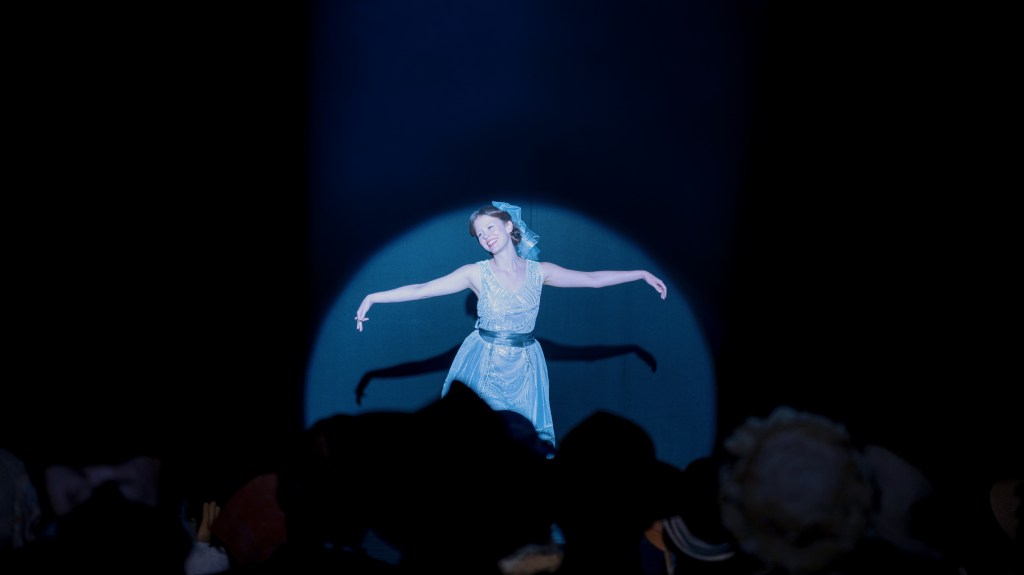
“Please lord, make me the biggest star the world has ever seen”, our heroine Pearl (Mia Goth) pleads each night before bed, accompanied by a garish string accompaniment that draws immediate comparisons to the early colour cinema. A skilled director of pastiche, Ti West has crafted a Douglas Sirk-styled film within the dark and gory world he has created with muse Goth, that is sure to thrill old and new fans alike. Immediately following the release of one of 2022’s best horror films, X, it was announced West and Goth will be creating a trilogy surrounding these characters, here with the prequel Pearl (2022), and concluding with MaXXXine (2023), all following Goth’s characters.

Set in 1918 Texas during the Influenza pandemic, Pearl is the only child of a German immigrant family. Pearl’s father (Matthew Sunderland) is infirm, laying the burden of survival in a trying time with Ruth (Tandi Wright), Pearl’s domineering mother who needs to get her daughter to help out around the farm. Pearl, however, is desperate to become a silent film star and dancer, sneaking off to the picture house every opportunity she gets.

Pearl’s love of cinema and desire to be a star is established in X, something that ties her to Goth’s other character Maxine in that film, which is deepened here. Pearl is never more joyful than when she is at the picture house, watching the newest dancing features. Goth and West craft such an empathetic and archetypal image of a budding star hoping to break out, that her budding malevolence is allowed to boil under the surface.

Mia Goth in Pearl

The film is aware its greatest strength is a close-up of Goth’s expressive face, a cinematic world into itself. Enough can’t be said about Goth’s commitment to the performance of this character, beginning in X but truly flowering here to create a singular horror cinema performance. You can immediately feel Goth’s co-writing credit in the character, similar to Hunter Schaeffer’s co-writing credit in the Euphoria (2019) Covid special, Fuck Anyone Who’s Not a Sea Blob (the artistic peak of the show), where a performer has a psychic connection to their role that tears through the screen.

The saturated, Wizard of Oz (1939) inspired-yet-repressed world that Pearl inhabits can grow tiring at stages, but the final act is such a showcase for Goth’s magnetism as a performer and writer, that the film leaves you satisfied. West’s films often have an issue of peaking early through his deft skill at creating tension and dread compared to his bloody finales, an issue absent in Pearl.

The film’s setting within the Influenza pandemic whilst being a Covid-produced film has a simple charm to it, with all crowds in masks and characters bemoaning the difficulties of recognising people in them. Pearl’s yearning to be out of the isolation of her farm during this pandemic is a more relatable experience than you’d expect to come out of this film.

Mia Goth in Pearl

Pearl is a unique prequel in that it has the potential to be viewed before the original film, X, due to its focused character study of Pearl, a character you leave the first film aching for more details on. West and Goth feel acutely aware of the aspects audiences were craving more from in X, namely the Pearl character and a further relishing of Goth’s unique screen presence.

Where X focuses on its wide ensemble and 70s environment, Pearl is very much a character study. Aside from a compelling performance by Tandi Wright as Ruth, Pearl’s mother, we are not given many deeply written side characters, allowing the audience to narrow their attention to our star. Wright and Goth have a similar dynamic to Spacek and Laurie in Carrie (1976), a foundational text for the film, particularly in its latter stages. While West is focusing on the juxtaposition of the Cinemascope aesthetic with the gore, the true dynamism is achieved through Goth’s varied performance that gets stymied by Wright’s hard-lined determination to survive their struggling lives. The real climax of the film is not a gory showstopper like in X, but the culmination of Pearl and Ruth’s resentments colliding at a family dinner.

The West trilogy is soon to be completed with the upcoming MaXXXine (2023), the first A24 trilogy. Following on from the events of X, this second entry in this quickly produced franchise is a unique world that has been crafted by a pair of oddball filmmakers in West and Goth that is refreshing in the world of IP drudgery we find ourselves in the never-ending middle of.

Pearl is in theatres from March 16th.

Everything Everywhere All at Once is a Sensory Overload

Rating: 4.5 out of 5.

So rarely will a group of people in a theatre howl with glee and terror in equal measure while watching a film, but that is the reaction that directing duo Daniel’s (Dan Kwan and Daniel Scheinert) newest feature Everything Everywhere All at Once elicits throughout its 144-minute runtime.

The film follows the Wang family, helmed by matriarch Evelyn (the legendary Michelle Yeoh), who is preparing for an audit from the IRS, full-time work in her struggling laundromat, Evelyn’s father Gong Gong (James Hong) arriving that morning from China, her husband Waymond (Ke Huy Quan) trying to give her divorce papers, and her daughter Joy (Stephanie Hsu) trying to get her mother to accept her girlfriend Becky (Tallie Medel). Everything is happening everywhere all at once for Evelyn, and this is all before the threat of the multiverse collapsing has entered their lives. Shock and extremity is the name of the game for Daniels so I won’t be spoiling any moment here as they would lessen the impact.

It would be so simple for Daniel’s to toss aside this opening act to get into the zany adventures in the centre of the film, but it is clear from the jump that the entire emotional weight is set up at the beginning and is allowed to mature over the runtime. This is what makes the great weird films like Back to the Future (1984) work for audiences, a clear goal and set of stakes for the story being told that is established in the opening 20-minutes, working as the firm ground to stand on as a hurricane of madness whirs around you for the rest of the film.

Those unfamiliar with the directing duo’s previous film Swiss Army Man (2016) will be taken aback by the pair’s slapstick and crude humour, as well as their frenetic pace between visually creative moments. Daniel’s crashed into the scene with their work in music videos – a common pathway for some of the industry’s best visual stylists (Michael Bay and David Fincher to name a few) – with the iconic Turn Down for What by DJ Snake and Lil Jon, one of the most-watched music videos ever. While it’s clear in their previous works the directing pair have filmmaking chops to spare, they achieve a greater scope and emotional weight in Everything Everywhere that matches with their visual creativity, a balancing act that is quite astounding.

Stephanie Hsu (left) as Joy, Michelle Yeoh (centre) as Evelyn, and Ke Huy Quan (right) as Waymond in Everything Everywhere All at Once

Floating along a constant stream of intertextuality, self-referentiality, and reverence to the films that paved the way to gift this film into audiences’ laps (The Matrix (1999), In The Mood for Love (2000), any Charlie Kaufman film), Everything Everywhere feels like a cinematic miracle that is at risk of breaking at any point. We’ve all made food (let’s say, a bagel) that we’ve overstuffed with nothing but things we enjoy eating, not realising until it’s too late that the meal has tipped over the edge into being inedible, or at the very least a meal spoilt by clashing ingredients. Like tastebuds, every person will respond to the film’s propulsive mania in different ways which are exciting, making the viewing experience with a packed audience all the more rewarding.

Everything Everywhere is a technical marvel of small budget filmmaking, from its mind-blowing costume and production design to its sound design and visual effects, but the real hero of the film is editor Paul Rogers. Rogers’ work here is nothing short of miraculous. Tasked with building a feverish momentum for over two hours while having each individual emotional moment land as impact-fully as each comedic or absurdist one. Rogers moulds the filmmaking duo’s creative madness into a deeply resonant and enjoyable film, not just another overly ambitious indie that feels more like a creative dare than a work of art with deep truths.

The film also wouldn’t work as well as it does without a perfect collection of onscreen talent that is all game for the absurdity being thrown at them. Whether it’s with IRS agent Jamie-Lee Curtis who is up for all manner of madness here and is having a blast, to Stephanie Hsu as Joy, who quickly becomes the emotional and narrative crux of the narrative, elevating an already entertaining film to transcendent levels. I am deeply looking forward to what else Hsu and Daniels can achieve together. 

The film works similarly to the hyper pop genre in modern music. Both Everything Everywhere and hyper pop are mining pure emotion within the heart of excess and artifice. The movement is a direct response to the nihilism and despair of the 90s and 00s with artists like Charli XCX and the PC Music label paving the way. This form of hyper-aware, hyper-stylised emotive filmmaking operates just like a Charli XCX album; bouncing around multiple ideas with youthful energy, whilst never losing its heart and emotion. It is truly thrilling to see a similar approach made in cinema.

Some may call this film exhausting, and perhaps on a different day I may agree, so I can’t guarantee how you will feel until you witness what Daniels are doing here. But, I would stress to anyone who has seen the film and felt it exhausting, please see it again as your mood at the time you see this will heavily influence what you think of it, and it is definitely worth your time.

The Everything Everywhere All at Once is in theatres now.