Dune: Part Two preview screening provided by Universal Pictures
Few working directors have the capacity to deliver such audacious tentpole features like George Lucas and Sir Peter Jackson, and even fewer are able to do so authentically while ensuring that the end result is nothing short of spectacular. But that’s exactly what Denis Villeneuve has done with Dune: Part Two, his sequel to 2021’s Oscar winning Dune: Part One.
To call Dune: Part Two anything other than a generation defining Sci-Fi would be to undersell just how monumental an achievement the director has on his hands. Where Part One focused more on methodical world-building and planting the narrative seeds of Frank Herbert’s iconic novel (some might say in a much more trimmed down, thin fashion than expected), Part Two is all about scale and upping the ante.
And it picks up almost immediately after the first film, where Paul Atreides (Timothee Chalamet) has found his way to the Fremen and is working towards building their trust, learning to assimilate in their ways, and realising his potential as a Messiah. There is seemingly more pandering this time around, with the first film having the skeleton of what is sure to become a trilogy, established, but lacking that extra flesh for why we should care about these characters, the Kwisatz Haderach or any of the novel’s deeper lore.
The care for those aspects all starts with Paul though, with his plight becoming increasingly refined by screenwriters Villeneuve and Jon Spaihts, who inject more oomph into the script. Paul is much more nuanced here, having had to grow up faster than he would have liked, especially now that the Harkonnens have reoccupied Arrakis (or Dune) and are actively pursuing spice. In turn, time is of the essence for Paul and the Fremen, especially as the Harkonnens edge closer to their hidden locations.
(L-R JOSH BROLIN as Gurney Halleck and JAVIER BARDEM as Stilgar in Warner Bros. Pictures and Legendary Pictures’ action adventure “DUNE: PART TWO,” a Warner Bros. Pictures release. (PRESS KIT)
As a result the film places greater attention on the interplay between Paul and the Fremen. Fremen leader Stilgar (Javier Bardem) has become the guiding voice of reason who echoes the idea that the chosen one has arrived. He puts Paul through his paces via a series of trials that test out whether he truly lives up to all that was foretold. Whether that’s venturing out into the desert to overcome its harshness, battling the Harkonnens as they attempt to harvest spice, or riding a Shai-Hulud without guidance —there’s not shortage of incredible individual moments that both propel the narrative forward but also leave one in awe every time.
It’s in these moments that Part Two really shines and speaks to Villeneuve’s eye for detail and scale. It helps that the returning Greig Fraser (who won an Oscar for his cinematography for the first film) once again captures Dune’s deceptively beautiful vistas on a macro level, which allows that scale to shine through. Everything on Dune looks blown up in size which works to its advantage in creating this look of endlessness and enormity, a creative decision that speaks to the gravitas of the journey awaiting Paul. It’s all the more crystallised in the vibrancy of the desert colours, which further evoke that deceptive beauty of a world that will show you no mercy and swallow you whole.
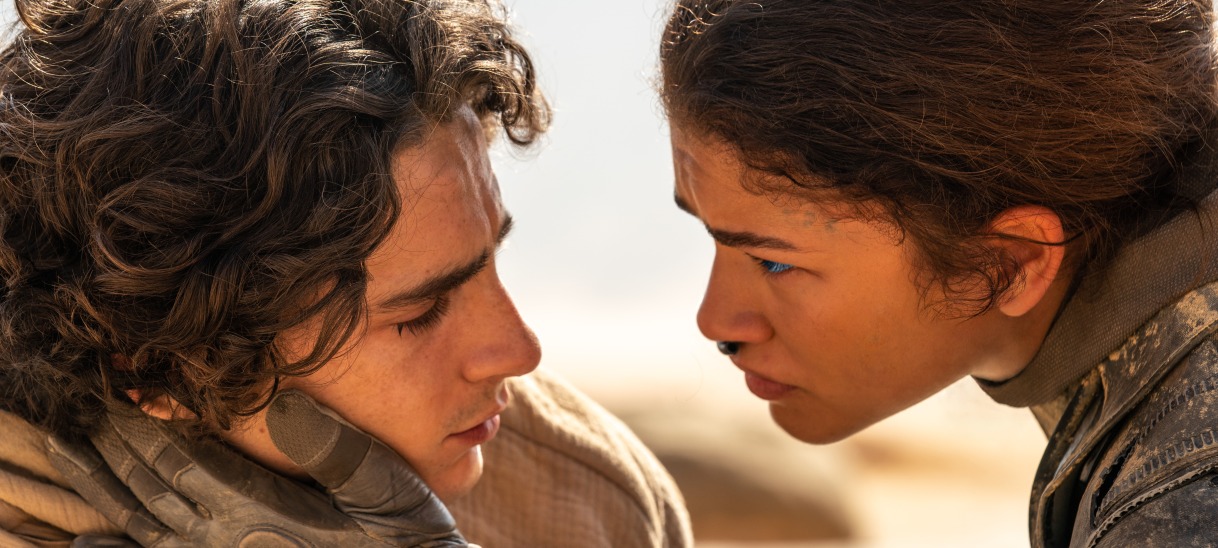
For Paul, the only beauty that isn’t deceptive is that of young Fremen warrior, Chani (Zendaya). She helps him through his series of trials while continuing to hold her own as a character of interest that isn’t just sidelined to play second fiddle as a muse. Often she claps back against the popular opinion of Stilgar, and refuses to fall privy to what she sees as a cause that doesn’t exactly serve the interests of her people.
In fact, most of the female characters in Part Two play crucial roles in the film’s events, with Paul’s mother Jessica (Rebecca Ferguson) embracing her destiny as the Fremen’s Reverend Mother. Princess Irulan (Florence Pugh) has a much smaller part in proceedings as the Emperor’s (Christopher Walken) daughter, serving more as a springboard for the plot and entry point to its politics rather than anything else, which isn’t a problem per se.
A scene from Warner Bros. Pictures and Legendary Pictures’ action adventure “DUNE: PART TWO,” a Warner Bros. Pictures release.
On the flip side are the Harkonnens, with the Baron (Stellan Skarsgård) returning in his hauntingly enlarged state alongside his incompetent nephew Rabban (Dave Bautista) who is continually being outsmarted by the Fremen as he tries to gather spice on Arrakis. But it’s Austin Butler’s portrayal as the Baron’s nephew, Feyd-Rautha, that is a particular standout; he comes across across as both raw and subtle, at once menacingly distant yet eerily close.
When the Fremen do lock horns with the Harkonnens, the result is always jaw-dropping set pieces with well choreographed fights that are supported rather than supplanted by those unique visual effects. The battles are also much easier on the eye compared to a majority of recent blockbusters, in that the action is discernible rather than messy. To top it off, Hans Zimmer’s score is also complimentary rather than excessive, with his use of drums and sharp crescendos aptly suiting the various cultures and moments (I had literal goosebumps at moments as the soundscape reverberated through my seat and being).
If there was to be a shortcoming it would be that the closing sequence rounds off rather abruptly. At various points throughout the film I couldn’t help but wonder how Villeneuve would bring everything together as the finish line was becoming clearer and closer to the end. However, he had always said that this was a continuation rather than a direct sequel, and that aspect is felt, even though audiences might be left wondering by the end —with some threads left hanging.
That said, there are few directors who can create a spectacle at such a scale while leaving their own mark and remaining faithful to the source material. Dune: Part Two takes the best parts of the second half of Herbert’s novel —allegory and all— and serves them up in a digestible, refined and spectacular result that is reminiscent of some of the best sequels (or continuations) in cinema history.
Dune: Part Two opens nationally from the 29th of February.
In an age dominated by IP acquisitions in cinema, the art of the adaptation has seemingly narrowed and expanded in equal measure. Whether it’s adapting a recent YA novel series or the countless comic book blockbusters adapted from stories told in print from a half-century ago, cinema has leaned heavily on interpreting pre-existing literary works with established audiences to tell its stories.
But the art of adaptation is not solely a monetary endeavour in modern moviemaking. There are opportunities to explore older works to uncover deeper truths in an artist to achieve newly interesting films. Two such examples are the recent critical darlings Burning (2018), and Drive My Car (2021), both based on the Murakami short stories Barn Burning and Drive My Car respectively.
Both films share many similarities; interpreting sub-50 page Murakami stories into films epic in length (148m for Burning, 179m for Drive My Car), exploring the interpersonal relationships that were only suggested within the source text, and exploring a place and time unique to their works. Lee Chang-dong shifted the story of Barn Burning from Japan to South Korea, whilst Ryûsuke Hamaguchi and co-writer Takamasa Oe shifted the story of Drive My Car from Tokyo to Hiroshima.
Exploring works of adaptation in cinema is a rewarding experience in understanding both works and creators better, and is worth comparing these two excellent films in tandem with Murakami’s short stories.
Drive My Car
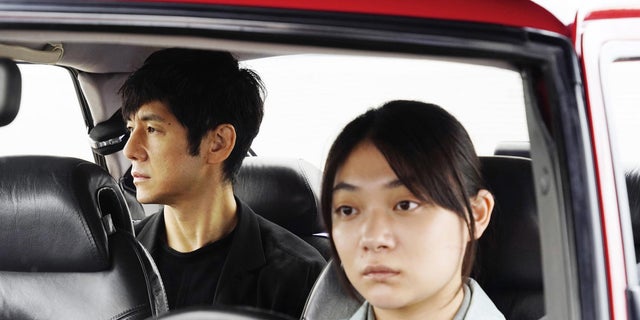
Hidetoshi Nishijima (left) and Tôko Miura in Drive My Car
“Murakami’s writing is wonderful at expressing inner emotions, and I think that’s why people want to adapt them. But it’s really difficult to re-create those inner feelings in film.” – Ryûsuke Hamaguchi
Fresh off multiple Oscar nominations including best adapted screenplay, Ryûsuke Hamaguchi’s masterpiece expands on every moment from Murakami’s short story while introducing his own fresh moments that truly thrive within the three-hour romantic drama epic.
So much is added to the story within the 40-minute prologue Hamaguchi and Oe create in the film. In literary fiction, the absence of a character is much easier to express to an audience. But in film, it is much harder for an audience to garner a relationship to a character that is only referenced. Imagine Up (2009) without its opening montage. The absence of Ellie through the rest of the film is profoundly felt by both Carl and the audience because of the impact the character had on us at the beginning of the story. Hamaguchi makes a crucial decision to further explore the intimate relationship between Yûsuke (Hidetoshi Nishijima) and Oto (Reika Kirishima) during the prologue, deepening our relationship with the couple. Oto’s absence casts a deep shadow that hangs over the entire film in a profound and moving way.
Where the adaptation feels closest to Murakami is surprisingly in an original scene, where Yûsuke goes to dinner with Gong Yoon-su (Jin Dae-yeon), Lee Yoon-a (Park Yu-rim), and the driver Misaki (Tôko Miura). It is here that Yûsuke feels comfortable enough to compliment Misaki’s driving, stating, “I hardly feel gravity. Sometimes I forget I’m in a car.” This explanation of a seemingly mundane skill perfectly executed is described so beautifully, the surrounding world feels overwhelmed with character. This is a style that Murakami has perfected in his writing and this sequence is Hamaguchi’s nod to the story’s original writer.
In the short story, Murakami uses Misaki’s driving and its mundane grace to explore Yûsuke’s unexplored feelings and memories of his wife, writing, “for some reason, he recalled her (Oto) more frequently now that Misaki was doing the driving.” Hamaguchi follows this evolution of Yûsuke opening up about his feelings while Misaki is driving in a similar graceful manner, something he also explored in his other wonderful 2021 release, Wheel of Fortune and Fantasy.
Sonia Yuan (left) and Park Yu-rim in Drive My Car
Murakami’s one gripe with the film was the change from the car being a yellow convertible Saab to a red sun-roofed Saab, a change he ultimately accepted. The red of the Saab cuts through the stark whites and navy blues of the environments Hamaguchi places it in. In a film built on the foundations of its long dialogue sequences, the simple visual style of the film is constantly engaging. By adding a roof to the now-iconic car, Hamaguchi creates a secluded space that creates a vacuum for the characters to enter. Whilst not as visually appealing as a convertible, the red Saab is a more striking cinematic object, gliding through the concrete labyrinth of Tokyo and Hiroshima.
A fascinating alteration to the original text is the character of Takatsuki, the young actor who has an affair with Oto in the film. In Murakami’s short story, the actor is in his early 40s and doesn’t share the same troubled past as a former star like his film counterpart. Through this change, the infidelity of Oto feels less connected to Yûsuke in terms of being a romantic stand-in, and more of an individual character decision, opening up the character to being more realised than in the short story. This change also deepens the conversations Yûsuke has with Takatsuki throughout the story – an element that takes up large portions of Murakami’s original text – as it creates a more interesting power dynamic between the pair as they search for a connection through Oto’s absence.
Hidetoshi Nishijima (left) and Tôko Miura in Drive My Car
Murakami’s short story focuses heavily on the theme of performance and acting, often citing, “we’re all acting aren’t we?”. Hamaguchi both explores these ideas deeper through the Uncle Vanya play while also obscuring Yûsuke’s ideas on acting by focusing the story more on his directing profession than his acting career, no doubt an area the director is more personally invested in.
One of the lasting images of the film is actually a profound moment in the short story too, of Yûsuke allowing Misaki to smoke in the car, which she accepts but also has too much respect for Yûsuke, but more importantly the car, as she smokes out the window.
Hamaguchi and Oe received an Academy Award nomination for Adapted Screenplay (an award most likely to be given to the outstanding Power of the Dog) and is everything the award should recognise. The film is a masterclass in extrapolating and personalising another writer’s story into the film medium, one that doesn’t overshadow the original, but mines new elements out of it to craft something truly special.
Burning
Yoo Ah-in (left), Jeon Jong-seo (centre), and Steven Yeun (right) in Burning
Murakami’s writing in the short story is most compelling in between sentences. Burning works wonderfully as a work of adaptation as it is constructed to explore and expand on these silences on the page, without ever feeling pressured to over-explain.
The time spent between Hae-mi in Africa and returning is expressed with a single space on Murakami’s page, whereas in the film, Lee uses this time to explore our protagonist in this period of extended isolation.
“Are you going to come back to Japan?” I asked her, jokingly.
“Of course I am,” she replied.
Three months later she was back, …
Barn Burning pg.2
This sequence runs for 10 minutes, showing him masturbating in Hae-mi’s room multiple times as well as going to his father’s assault trial. By adding these new layers to the character, the film adaptation seeks to expand both the Jung-su character as well as emphasise the absence Hae-mi leaves in his life.
A key scene taken straight from the short story is Hae-mi and Jung-su’s first night drinking together at a bar, where Hae-mi pantomimes eating an orange. This reads intriguingly in the Murakami story, introducing this charming and compelling character that both our protagonist and audience are unsure of. In Burning, we can see the scene performed, which greatly adds to the character’s performance of the pantomime and seeing Jung-su’s completely engrossed face as it is occurring.
A crucial thematic element to Lee’s film is the story of the African Bushmen’s two hungry people; Little Hunger, those who are physically hungry, and Great Hunger, those who are hungry for life’s meaning. It is clear even with Murakami’s short story that the female character of Hae-mi is looking for a purpose in the world that is soon to envelop her, ideas that are expanded and stretched further in Lee’s adaptation.
Lee foreshadows Ben’s speech on burning barns in a restaurant scene between the three characters. Ben says he wants to “tell his story” to Jung-su, as he is a writer. Both the short story and the film characterise Ben as being interested in our protagonist as he is a writer. By foreshadowing this story instead of it appearing spontaneously like in the original text, Lee introduces a feeling of suspense and unease surrounding the mysterious Ben, for both Jong-su and the audience.
Jeon Jong-seo in Burning
The film’s most iconic scene is the dance sequence set to Miles Davis’ Generique, a powerfully solemn and introspective piece written for the Louis Malle film Ascenseur pour l’échafaud (1958). Burning and Drive My Car both follow a lot of Murakami’s western influences into their adaptations, an aspect which no doubt endeared itself to a wider audience.
Murakami does not specify which Davis song is heard in the short story, allowing Lee to add a layer of artistic decision-making to his adaptation. Using Generique, Lee is layering the groundwork for a dreamlike sequence not unlike something you’d see in a Malick or Lynch film, particularly the red room in Twin Peaks (1990-91); a dream-state environment where key characters’ subconscious expresses itself openly.
What makes Lee’s adaptation so entertaining is his willingness to explore the subtext of Ben’s unnerving nature through genre tropes of a psychological thriller. By expanding these notes of Ben’s character from Murakami’s original story, Lee is able to lure both the protagonist and the audience into the story before it culminates in the farm sequence where Ben describes his barn burning hobby, the launching point of the short story’s narrative.
An important and oftentimes overlooked element of the literary adaptation is to have well defined visual and sonic components. If there is no visual or audible interest in the adaptation, then the filmmaker is not using the advantages of the medium to full effect. Burning has a distinct visual and audible style which Lee uses throughout his adaptation to emphasise the mood of the film. Whether it be the thriller-tinged score by Mowg, or the sapphire soaked sky during Jong-su’s daily runs in the second half of the film, Lee is creating a world that is unique to Murakami’s original text, exploring new depths to the short story while still maintaining a connected through-line.
Steven Yeun in Burning
What makes both of Murakami’s short stories so compelling and rich for adaptation is his ability to create compelling characters in remarkably succinct ways. There is a deftness in its layered character work to be mined within 20-40 pages like in Barn Burning and Drive My Car that leaves Lee and Hamaguchi a groundwork to adapt to the screen, while also crafting characters an audience would want to explore more deeply in film.
Much has been made of these two successful adaptations being long compared to the source text, displaying how much depth can be uncovered from Murakami’s short pieces. Both Lee and Hamaguchi seem keenly interested in the genre elements of his stories (detective noirs in Burning, domestic melodramas and theatre as subtext stories in Drive My Car), while also wanting to deeply explore these rich characters over the course of their adaptations.
A common criticism of Murakami is his lack of female characters, something we see in both of these short stories. Perhaps the greatest inclusion Lee and Hamaguchi make to these stories are the two female characters that haunt both Burning and Drive My Car. By making both Hae-mi and Oto not just real characters, but truly charming people that an audience can get engrossed in, the directors are able to lay the groundwork for the narrative momentum of the stories. Just as Jung-su and Yûsuke are obsessed and entranced by these characters, so too are the audience, making their eventual absences create a cavity within the film that will not be filled.
Both films ask interesting questions on the art of adaptation. By exploring a short piece of writing by a revered writer, both Lee and Hamaguchi are able to create layered, dense dramas that extend far beyond their original text. Would these films have worked nearly as well without Murakami’s imprint on key moments? Or is it the duet of writer and interpreter, an overriding theme of Hamaguchi’s film, that gives these stories such powerful meaning?
There’s never been a crime writer quite like Agatha Christie. Her countless novels about pompous aristocrats meeting grisly ends have captivated millions of readers, and become the template for all murder-mysteries that have followed, ensuring her the undisputed Queen of the Whodunit. Christie’s legacy is further cemented by the multiple adaptations of her work, with this picture being one of the poorer examples.
Famed Belgian detective Hercule Poirot (Kenneth Branagh) is sightseeing in Egypt when he encounters Bouc (Tom Bateman), an acquaintance from a previous case. Guy tells Poirot that he is in Northern Africa to attend a wedding between the wealthy heiress Linnet Ridgeway (Gal Gadot) and her working-class fiancé Simon Doyle (Armie Hammer) who met only a matter of weeks prior in a London club – a meeting which, coincidentally, Poirot himself happened to observe.
The moustachioed sleuth is promptly invited by Guy to join the festivities, only for the celebrations to be dampened by the arrival of Jacqueline de Bellefort (Emma Mackey), the ex-partner of Simon. Wanting to avoid the scornful gaze of his former lover, Simon and Linnet hire a paddle-steamer for the wedding party, Poirot included, to cruise the River Nile; but the danger is just as great on-board, because there are several guests who also have their grievances with the newlywedded couple.
Death on the Nile (2022) is the second of Christie’s mysteries to be adapted by Kenneth Branagh, who previously helmed and starred-in Murder on the Orient Express (2017). The director once again plays the lead role of Poirot, and is joined by an ensemble cast of comedians (Russell Brand, Dawn French), young thespians (Ali Fazal, Rose Leslie), Britons playing American characters (Letitia Wright, Sophie Okonedo, Jennifer Saunders) and, weirdly, Americans portraying British characters (Annette Benning, plus the aforementioned Hammer).
Like Orient Express, it’s a rather strange mix of talent that Branagh has opted to work with, and some of those choices are more peculiar than most. Chief among that cohort is Benning, who gives a decent performance as Bouc’s mother Euphemia, yet does so with a wavering, semi-convincing accent that proves a constant distraction – surely, she’d be better suited to playing the Marie Van Schuyler, as that character is an American; but instead, that role is inhabited by Britain’s own Jennifer Saunders, whose own accent is nothing to write home about.
Gal Gadot, Emma Mackey and Armie Hammer in Kenneth Branagh’s Death on the Nile
Nor, for that matter, is the remainder of Nile, which pales when compared to its precursor in most respects. The warmth, quirkiness and verve present in Orient Express is lacking here, replaced with an overly-serious tone that allows no room for amusement; the pacing is woefully slow, with too many minutes spent delivering exposition; and the orchestral soundtrack of returning composer – and Branagh’s favoured collaborator – Patrick Doyle is even more bland and less inspiring than last time.
Yet by far the biggest grievance to be had with Death on the Nile is the awful digital effects. Oftentimes, on-location shoots in the natural beauty of Egypt are eschewed in favour of studios and a green-screen backdrop, with computer-generated environments added in post-production and zero effort made to disguise this fact. It’s not just the landscapes that are animated with computers, but the steam-boat too, its visuals rendered with such low quality that they rival the sweeping shots of the ill-fated cruiser in James Cameron’s Titanic (1997) for realism.
Blessedly, not all of Nile is appalling to witness. The costume designs of Paco Delgado are great, with the men looking particularly dapper in their colourful three-piece suits; the set design is reasonably attractive too, particularly the construction of the paddle-steamer’s interior. In terms of the narrative, Michael Green’s screenplay is mostly faithful to Christie’s book and remains absorbing, but the outcome will be obvious even to those who aren’t familiar with the story.
Although not without its pleasures, Death on the Nile is a rather insipid adaptation of a beloved Agatha Christie text. Kenneth Branagh’s sequel is marred by odd directorial choices, below-par effects and a general sense of dullness, stifling what should be an otherwise gripping tale. Cinemagoers are best advised to save their money and wait for the inevitable television screening, or arrival on Disney+.
Death on the Nile is currently screening in cinemas nationwide.




 Rating Frames