Dad, Larrikin, Friend, Genius, Icon, Documentary Subject But Also John Clarke

Rating: 4.5 out of 5.

“Life could be pretty boring if we didn’t make it funnier.”

Eight years have passed since Australia, and the world lost legendary satirist John Clarke, a New Zealander whose comedic alter-ego made him a national celebrity, before he made the trip across the Tasman, called Melbourne home and delighted another whole country with his distinct brand of humour. His death in 2017 was met with the kind of despair our brethren generally reserve for athletes, movie stars or royalty; praise came forth from all quarters – journalists, thespians, second-rate critics and the very individuals he so often lampooned, politicians, all effusively praising his wit and drawing attention to his huge body of work in written, aural and visual formats.

No figure is better placed to tell the story of this Kiwi multihyphenate than his eldest daughter Lorin, who emulates his diverse artistic talents by performing the manifold roles of director, producer, writer, interviewer and narrator of the very documentary that bares his name: But Also John Clarke (2025). Through monologues, conversations, anecdotes and a treasure-trove of archival footage – including home-videos, and Lorin’s own conversations with her father before his untimely death – viewers are presented with a captivating and amusing portrait that cordially pays homage to its eponymous focal point.

Much of the narrative’s first half is spent (as is often the case with stories of a biographical nature) exploring Clarke’s younger days in his mother-country, detailing a tumultuous upbringing that saw his creative spirit very nearly stymied by an oppressive boarding school, and a court blame him for the failed marriage of his parents rather than the more logical explanations of “irreconcilable differences” or “emotional trauma stemming from the horrors experienced in the Second World War”. Such torment would have broken an ordinary man, but not John Clarke, who overcame this animosity by way of several failed university courses, a brief sojourn to Europe and applying himself to the scene of theatre. This, of course, begat the persona we know as Fred Dagg.

Our attention is soon diverted to happenings in Australia, where John raised his family, refined his craft and began making allegorical waves via supporting roles on ABC Radio’s Science Show – despite having virtually no knowledge of any scientific pursuits – and ABC TV’s The Gillies Report, on the latter programme earning recognition as the globe’s foremost authority on farnarkeling. Then came sketches with Bryan Dawe on A Current Affair, in which Clarke masterfully impersonated political dignitaries and those of a comparable persuasion through the simple act of bearing their name and emulating their mannerisms, followed by the equally-innovative mockumentary series The Games.

Shaun Micallef (left) is one of several talking-heads acquiesced for But Also John Clarke

Parties from Clarke’s homeland and adopted nation lend their voices to the film on a pro rata basis, ranging from his theatrical contemporaries to the funnymen he himself would go on to inspire, and some fellow NZ expatriate by the name of Sam Neill (we’re told he’s quite famous). As director, editor et al, Lorin utilises their insights to craft a story warm and moving without succumbing to the egregious crime of saccharinity that all too often befalls personality-driven documentaries. More impressive still is her compelling argument put forward that Fred Dagg, and by extension John not only gave birth to New Zealand’s comedy scene, but also helped to foster an irreverent, self-deprecating sense of national pride.

Faults in the picture are few and far between, especially when viewed on a cinema screen via digital projection. A more discerning eye may be saddened by the lack of consideration given to Clarke’s international standing, with an opening remark from Britain’s Stephen Fry being the only moment to suggest he had any influence outside of the Antipodes; others will be left to ponder why nothing is said of him providing his vocal talents to Wal in the Footrot Flats movie, The Dog’s Tail Tale (1986).

One element certainly not lacking is a steady provision of humorous clips from John’s frequent and plentiful appearances on the stage and screen during his lifetime. Some of these extracts are four or even five decades in age, yet timeless in terms of their amusement value – at the Melbourne International Film Festival screening this reviewer attended, hearty laughs were often elicited from audience members young and old. Most hilarious of all proved to be a very early sketch involving a Fred Dagg precursor named Farmer Brown, the punchline of which had yours truly succumbing to fits of tittering long after the credits had rolled.

Countless luminaries have dreamed of being the subject of a critically-acclaimed documentary that bears their name in years gone by; now, they’ll be hoping such a production is as earnest, mirthful and brilliantly told as what Lorin Clarke has put together in honour of her forebear. But Also John Clarke is a more-than-fitting tribute to a man of infinite jest who meant so much to so many people, not least his ever-talented daughter.

But Also John Clarke is screening in limited release now.
Three Mad Max Theories that Change How You See the Franchise

Of all the cultural exports to emerge from Australia, arguably none is more widely recognised or celebrated than the Mad Max film series. These post-apocalyptic, dystopian tales have inspired praise and enthusiastic fan-bases the world over, from Asia to the Americas, all enamoured by the franchise’s idiosyncratic characters, punk-like aesthetics, and high-octane action sequences.

This popularity is quite remarkable when one considers the franchise’s humble origins. The initial Mad Max (1979) was conceived by its director, George Miller — a qualified surgeon — as a means of highlighting the impacts of road trauma, with the hallmarks for which the series is most-widely known not being introduced until its sequel, two years later. And even then, it is never directly stated nor explained why, or how, Max’s world operates the way it does.

This mystique has led to several theories from cinephiles, some of which help explain discrepancies that have emerged in the franchise’s four-picture, five-decade history. With the latest film in the long-running saga, Furiosa set to reach our screens this week, we’re sharing three of our favourites. Spoilers follow!

Max is Dreaming
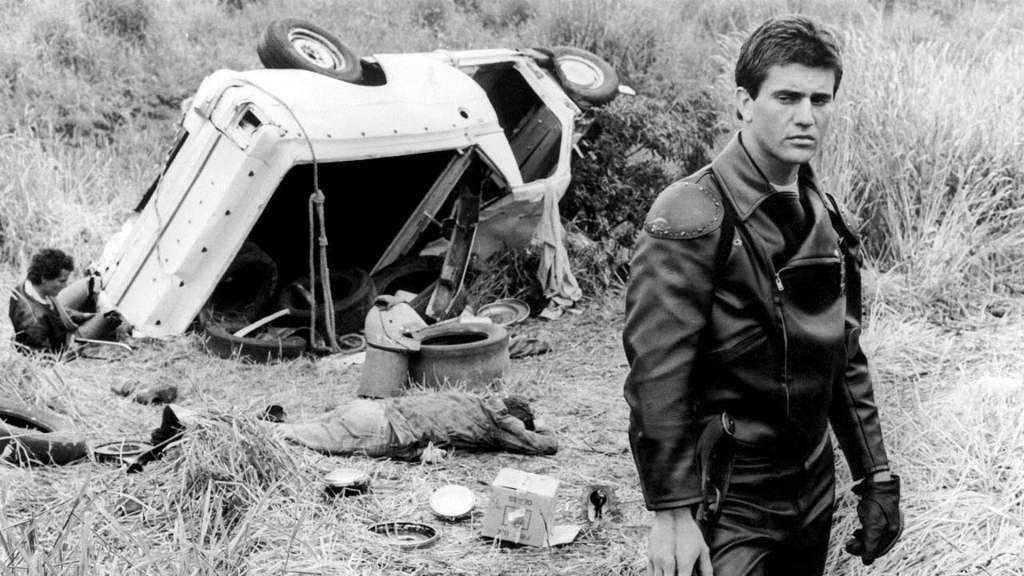
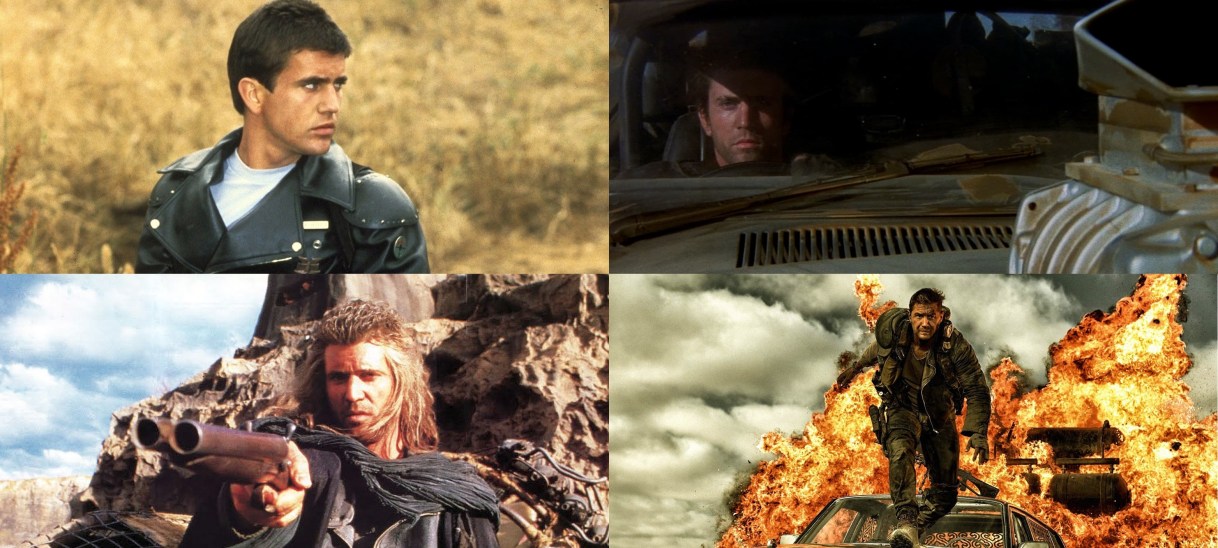
Max Rockatansky (Mel Gibson) as he appears in the final moments of the first Mad Max

This first theory postulates that our main protagonist, Max Rockatansky is imagining the events which occur in the second, third and fourth entries in the series, and stems from what transpires in the first picture. As a reminder: Max (Mel Gibson) loses his best mate, Jim “Goose” Rains (Steve Bisley), wife Jessie (Joanne Samuel) and infant son Sprog (Brendan Heath) to the violent hands of a rogue biker gang, led by The Toecutter (Hugh Keays-Byrne).

The argument here is that Max, having been distressed by the loss of those closest to him, becomes listless and descends into madness — hence the title — by entering a fantasy world of his own creation, one where he gets his revenge on Toecutter and his minions. From there, he visualises himself as a champion of the oppressed, committing vengeance against those who dare to stymie the peaceful will of others.

Applying the Caligari-esque mentality of it all being a dream may appear juvenile, but there are some elements which help provide credence to this belief. Note how, for instance, the respective plots of Mad Max 2: The Road Warrior (1981), Mad Max: Beyond Thunderdome (1985) and Mad Max: Fury Road (2015) all have Max entering a cult as an outsider, becoming their leader in all but name, and defeating their oppressors in a climactic chase sequence.

The theory also explains the use of certain actors in more than one film. Bruce Spence is a prime example — he plays the Gyro-Captain in The Road Warrior, and then appears as an amateur pilot in Beyond Thunderdome, both times assisting Max and his allies as they escape tyranny. Then there’s Max Fairchild, who appears in supporting roles in the first and second instalments; and Toecutter himself, Hugh Keays-Byrne, who portrays Fury Road’s antagonistic Immortan Joe over three decades after his first casting as a villain.

Max is a Legend
Max (Mel Gibson, again) with The Ones Left Behind in Mad Max: Beyond Thunderdome

By that, we mean he’s a mythical figure, akin to the Roman or Greek gods written about centuries ago. A couple of the examples used above could also be utilised as evidence for this second theory — the appearance of thespians as different characters in multiple films; the vaguely similar narratives of the three sequels — and more besides.

The Road Warrior is the entry which most readily identifies with Max Rockatansky being a myth. From the outset, it’s made clear the story is set in the future, with an elderly man (voiced by Harold Baigent) recounting the events of his past, who by story’s end reveals himself to be one of Max’s allies: the Feral Kid (Emil Minty).

More proof comes from the end of Beyond Thunderdome, where an adult Savannah Nix (Helen Buday) is seen recounting the tale of how she and her fellow tribespeople were rescued by Max. And then, there’s this quote which appears at the end of Fury Road:

“Where must we go… we who wander this Wasteland in search of our better selves?”

That line is attributed to “The First History Man”, and unknown and unwitnessed figure who, we can assume, is responsible for telling Max’s story.

Also indicative of this theory is the demise and unexplained return of Max’s iconic car, The Interceptor. This heavily-modified Ford XB Falcon Hardtop was stolen by Rockatansky in the third act of the original film, and destroyed in Mad Max 2, only to miraculously appear in the opening scenes of Fury Road (though in fairness, Miller circumvents this plot-hole by describing the latter picture as a “revisiting” of the franchise).

There’s More than One Max
Max (Tom Hardy) strapped to the front of a War Boy’s car in Mad Max: Fury Road

In the days and weeks following the release of Fury Road, there were certain netizens who hypothesised that this particular Max is, in fact, the aforementioned Feral Kid from Mad Max 2, owing to his long hair, the return of The Interceptor, him being played by a different actor, and the character reluctantly sharing his name.

Miller himself entertained this idea when queried by IGN, labelling it “interesting” but ultimately dismissing it, pointing to The Road Warrior’s end narration. Other factors that work against the premise include Tom Hardy being directly credited as “Max Rockatansky” in Fury Road’s opening, and his voice-over where he directly states:

“Once I was a cop, a Road Warrior searching for a righteous cause.”

But, tying into the theory that Max is a fable, it is possible that he is not the only “Max” in this universe. Again, The Interceptor helps provide weight to this theory — if this is the same Max we saw in Road Warrior and Thunderdome, how is it that “the last of the V8s” (as the car is labelled in the first and second chapters) is still in his possession after being lost?

There’s the matter of his name, too. Rockatansky only says his name twice in Fury Road — in the initial voice-over, and in the third act when he saves Furiosa’s life; he shares it about as often in Mad Max 2, and doesn’t utter it even once in Thunderdome, where he’s instead called “the Raggedy Man” or “the Man with No Name”. Perhaps our History Folk are telling of several figures who came to the aid of others, and just so happen to have named their hero “Max” in each tale.

Furiosa: A Mad Max Saga is screening in theatres nationwide from this Thursday, May 23rd. The other four Mad Max films are available via home-video, streaming and on-demand services.

David Gulpilil: Ten Defining Performances

Content Warning: First Nations readers are advised that the following article contains the name and likeness of a person who has died. Both are respectfully used with the permission of the deceased’s family.

Last week, Australia and the world mourned the loss of an eminent, indelible fixture in the medium of cinema. The artist, David Gulpilil Ridjimiralil Dalaithngu, was born and raised in the Mandhalpuyngu clan, plucked from obscurity to appear in a motion-picture, and later became an informal ambassador for his Indigenous culture through his traditional dance, painting and public speaking.

But of course, David Gulpilil (as he’s most often credited in projects) is best recognised as an actor, having appeared in some of the most iconic Australian movies and delivered one fantastic performance after another. In honour of his memory, Rating Frames has put together a list of the ten roles that best shaped and defined his career, all of which are essential viewing for anybody who considers themselves a fan of Australian cinema.

Walkabout (1971)

In his debut role, filmed when he was just a teenager, Gulpilil plays an Aborigine on “Walkabout”, an adolescent ritual where a boy must traverse the bush alone in order to achieve manhood; on his journey, the teenager happens across a white girl the same age as he (played by Jenny Agutter) and her younger brother (Luc Roeg, the director’s son) both of whom come to rely on him for survival.

Walkabout is often cited, wrongly, as the first picture to star a First Nations actor; and the first to have a Black performer in the role of an Aborigine, rather than in blackface – it’s beaten to each milestone by Jedda (1955) and The Overlanders (1946) respectively. But, it is the first known instance of Indigenous Australian culture being accurately and respectfully represented in a feature-length film, which Gulpilil does almost effortlessly.

Storm Boy (1976)

Gulpilil’s next feature-length role came five years later, a picture based on Colin Thiele’s junior novel of the same name. This crowd-pleasing affair centres on Mike (Greg Rowe), a boy who lives with his reclusive father Tom (Peter Cummins) on the Coorong – the wetlands that separate the Murray River from the Southern Ocean – and his friendship with a pelican he names Mr Percival.

The character that Gulpilil portrays here is Fingerbone Bill, a local Aborigine who befriends young Mike and becomes his mentor. His performance is more energetic and upbeat when compared to that in Walkabout, and yet, the actor demonstrates the same relaxed and natural presence in front of the camera. (Incidentally, Storm Boy would be adapted again in 2019, with Gulpilil quite fittingly playing the father to Fingerbone Bill.)

Mad Dog Morgan (1976)

The same year that Gulpilil appeared in the family-friendly Storm Boy, he also starred – alongside Dennis Hopper (pictured above, right) – in a violent, confronting biopic set during Australia’s colonial era. In said biopic, Gulpilil plays an accomplice and confidant to the titular bushranger, guiding him through unfamiliar terrain and abetting his crimes.

Mad Dog Morgan is an example of the “Meat Pie Western”, a term affectionately given to an Australian production that utilises the tropes of a Hollywood Western. Its success, both at home and internationally, helped spur the New Wave of antipodean cinema and gave rise to numerous imitations in the decades that followed; one such example is The Proposition (2005), which featured Gulpilil in a minor role as an interpreter.

Crocodile Dundee (1986)

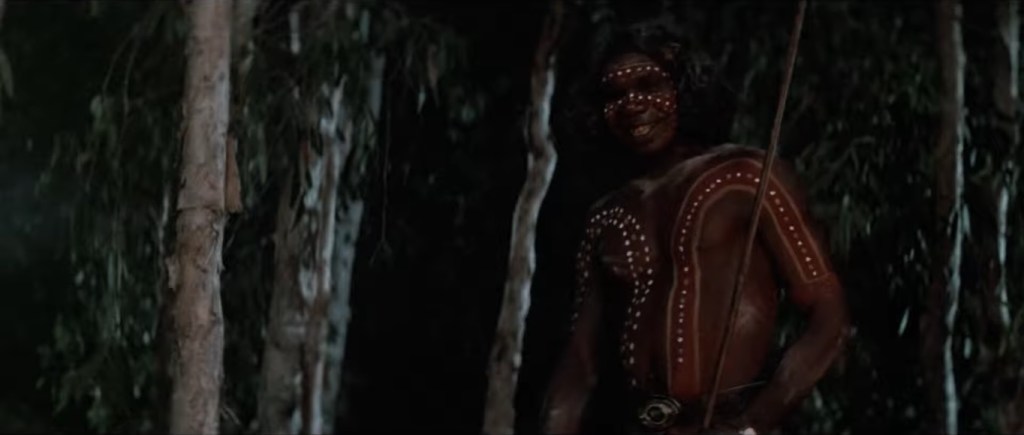
Here’s a movie that needs no introduction. It’s the worldwide box-office smash that made Kakadu a top holiday destination for tourists locally and abroad, renewed interest in Australia and its culture, and transformed Paul Hogan from a TV larrikin to an international star. Neville is the character Gulpilil plays here, who meets with friend Mick Dundee (Hogan) and American journalist Sue Charlton (Linda Kozlowski) on his way to a Corroboree – a ceremonial gathering of First Nations peoples.

The briefest of Gulpilil’s roles on this list, and possibly the one he’s recognised most-widely for, Neville is viewed as the embodiment of modern Indigenous culture; caught between modernity and tradition, practising the ways of his ancestors while also adhering to the white man’s norms – it’s most evident in his appearance, with Neville seen wearing traditional face-paint with jeans and a wristwatch.

The Tracker (2002)

The first film to credit Gulpilil as a lead performer, this low-budget drama tells of an Indigenous man tasked, at the behest of the white authorities, with locating a fellow Aborigine accused of murder. Ironically, the actor performed in a very similar role for Phillip Noyce’s Rabbit-Proof Fence (also 2002) albeit as a supporting player with less screen-time – and hence, is never given the opportunity to truly flex his acting chops.

The Tracker marked Gulpilil’s first collaboration with director Rolf de Heer, and netted him an AFI Award for Best Actor. It’s an accolade that’s rightfully deserved, for he does well to convey the conflicted emotions of his character – the apprehension, fear, guilt and anger, sometimes all at once – and does so with an unflinching ease, outshining all of his co-stars in the process.

Ten Canoes (2006)

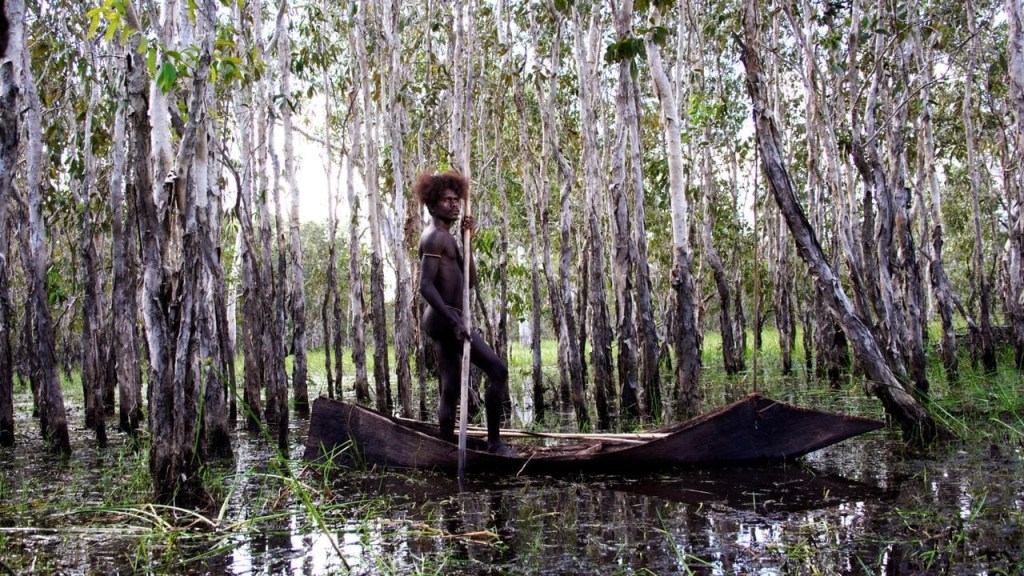
Following the success of The Tracker, Gulpilil and de Heer reunited for another narrative, and a particularly ground-breaking one at that. It’s a tale of sacrifice, leadership, covetousness and warfare that takes place before European settlement, is spoken in the Yolngu Matha language and features a cast of First Nations actors in traditional dress. As a result, Ten Canoes is the most authentic representation of a nomadic, tribal lifestyle ever put to film.

Unlike his two other partnerships with de Heer, Gulpilil doesn’t make a physical appearance on this occasion, with his son Jamie (pictured above) playing the lead instead. But the elder Gulpilil still has a presence in Ten Canoes, taking on the role of narrator in both the English and Yolngu Matha versions of the picture, complete with his trademark energy and dry wit.

Australia (2008)

Baz Luhrmann’s Northern Territory-set epic was much-hyped at the time of its release, stirring the emotions of many an Australian with its allusions to the Stolen Generations and re-enactment of the World War II bombing of Darwin. Also generating hype was a star-laden cast that included the two biggest Australian thespians of the day, Hugh Jackman and Nicole Kidman, in addition to David Wenham, Bryan Brown, Ben Mendelsohn, Jack Thompson and, of course, Gulpilil.

The latter plays an Indigenous elder known to the white settlers as King George, who’s also the grandfather of Nullah (Brandon Walters), the half-caste child adopted by Lady Sarah Ashley (Kidman). ‘Tis a more restrained and mostly silent performance from the venerable actor, one that doesn’t make full use of his abilities; but his presence in this big-budget, Hollywood-backed blockbuster did, at least, immortalise him as a legend of the Australian screen.

Charlie’s Country (2014)

The years that followed Luhrmann’s Australia were some of the most turbulent for Gulpilil, who spent time in jail for physical assault and as such, failed to find work. His experience in prison, and in poverty, would eventually inform his third collaboration with de Heer, in which he plays a semi-fictionalised version of himself named Charlie. It’s a deeply personal narrative, yet one that resonates widely, for his story is reflected in First Nations communities across Australia.

Charlie’s Country had its premiere at the Cannes Film Festival, with the lead winning an award for his performance as part of the Un Certain Regard program; this feat would later be replicated at that year’s AACTA Awards, with Gulpilil winning Best Actor for a second time. More importantly though, the film revived Gulpilil’s dormant career, ensuring that audiences hadn’t seen the last of his talents.

Goldstone (2016)

A contemporary take on the Meat Pie Western, Goldstone is a sequel to Ivan Sen’s excellent Mystery Road (2013) and sees journalist-turned-actor Aaron Pedersen return to the role of Detective Jay Swan. This story has Swan working undercover, attempting to locate a missing person in a remote mining community; and, just like its precursor, examines issues of prejudice and corruption in regional townships.

Harking back to his roles in Mad Dog Morgan and Storm Boy, here Gulpilil plays a sage elder who guides Jay through the landscape and tells legends of his ancestors. The part is rather unassuming, but nevertheless, Gulpilil lends it a gravitas that only a performer of his calibre can, being a charming and welcome presence as per usual.

My Name is Gulpilil (2021)

“This is my story, of my story,” says a gravel-voiced Gulpilil as he fixes his eyes on the viewer, wearily but warmly. Produced and narrated by its very subject, this tender, intimate documentary recounts the significant events in Gulpilil’s life, observes his routine as a cancer patient and ponders what his legacy will be once he departs this world.

Even before his untimely death, this was always intended to be Gulpilil’s final on-screen role, but is no less impressive, leaving the viewer transfixed throughout. Gulpilil is at his most vulnerable, physically and emotionally, yet still manages to deliver an insightful, compelling tale about himself, a testament to his abilities as a storyteller. For those reasons, this raw portrait has earned a place as one of the greatest performances of David Gulpilil’s fifty-year career.

Port Arthur Gets the Snowtown Treatment in Nitram

Rating: 4 out of 5.

Australia has long had difficulty reconciling with its past, whether it be pertaining to its colonial practices, its treatment of First Nations peoples, or its storied xenophobia. This biographical picture explores a more recent chapter in the country’s dark history, one that’s bound to provoke discomfort, yet is worth sitting through all the same.

A disaffected young man (Caleb Landry Jones) lives in the outer suburbs of Hobart, Tasmania with his cold, domineering mother (Judy Davis) and lackadaisical father (Anthony LaPaglia), ostracised by society and dependent on others to care for him. His only source of compassion is Helen (Essie Davis), an older woman whose fondness for him is eclipsed only by her passion for Gilbert & Sullivan operas; but like everybody else, she has limits for his eccentric behaviour.

Nitram (2021) is a veiled portrait of Martin Bryant, who is infamously and inextricably linked with the slaughtering of innocent people at the historical Port Arthur convict settlement in 1996. Interestingly, although Bryant is the narrative’s central figure, at no point does the film refer to him by name, nor does it mention where the atrocity he committed took place, with the focus instead being placed on the moments leading up to the event in hope of understanding the perpetrator’s mindset.

Material of this sort is not new to director Justin Kurzel, who previously helmed the picture Snowtown (2011) to critical acclaim. Said picture is a semi-fictionalised retelling of the Snowtown murders – so-named because of the South Australian locale where the bodies were hidden – that centres on an assailant to the crimes, detailing his troubled upbringing as a reason for his actions. This level of sympathy is somewhat absent in Nitram, since the film is non-committal in deciding who is at fault for the main character’s behaviour.

Similar levels of caution are applied throughout Nitram, being more delicate and poised than its subject matter would suggest – viewers are never shown instances of graphic violence at the hands of the characters, and likewise are spared having to witness the horrific bloodshed inflicted upon people at Port Arthur, ensuring that the picture is respectful to Bryant’s victims. And yet, although instances of violent behaviour are few, they are nonetheless terrifying when they do occur.

Judy Davis, as she appears in Nitram

Another peculiar facet of Nitram is how the story never seems to reach its climax. Like a powder-keg that never ignites, tension slowly and steadily builds throughout, yet that tension is never released, with the conclusion arriving just as the pressure reaches its peak. Amazingly, these last moments prove to be the most eerie and affecting part of the entire picture, with pointed intertitles referencing the proliferation of gun violence, followed by credits that roll to absolute silence.

Of greater fascination are the astounding performances from the main players, including Caleb Landry Jones. The Texan actor’s commitment cannot be faulted, for he speaks with a seemingly-natural Strine, and conveys his character’s vulnerability and underlying cruelty with considerable ease – qualities that rightfully won him Best Actor at this year’s Cannes Film Festival, where Nitram had its world premiere. His brilliance is equalled by industry veteran Judy Davis, whose baleful matriarch is sure to earn the scorn of audiences.

Regrettably, the excellence of Nitram is devalued by a poor choice in filming locations, with the Victorian city of Geelong acting as an unconvincing stand-in for Hobart and its surrounds. Aside from one aerial shot of tree-laden hills surrounding an undisclosed body of water, none of the scenery inhabited by the characters shares so much as a resemblance with southern Tasmania, being flat, arid and most unflattering to the eye; what’s more, there’s even a blatant disregard for continuity – at one point, a V/Line train can be seen travelling in the background.

Ignore this laziness though, and what’s left is unequivocally the best Australian production of the year, bar none. Guided meticulously by Justin Kurzel, Nitram doubles as both a gripping biography of a disturbed soul and an effective slow-burn thriller, further bolstered by the phenomenal acting of the leads.

Nitram is currently screening in select cinemas, and will be streaming on Stan from this Wednesday, November 24th.

Rating Frames Podcast Episode 1

Arnie, Darcy, and Tom return with a new podcast for their brand new site Rating Frames! On our first episode, we dive into the latest film news including a rundown on the planned IATSE strikes, how Metro and Regional Victoria have been impacted by Covid restrictions, and all of the upcoming releases we’re most excited to see when cinemas reopen at the end of the month!