A showman like no other, Korean visionary Park Chan Wook elicits more joy and wonder out of an audience from a perfectly timed cross-dissolve than most car chases filmed this decade. A filmmaker who is constantly looking to find the tipping point of extremity without falling into the world of camp, Park has cultivated a devoted fanbase that expands with each new entry, especially in recent years, with his fearlessness to work in the grime of modern life
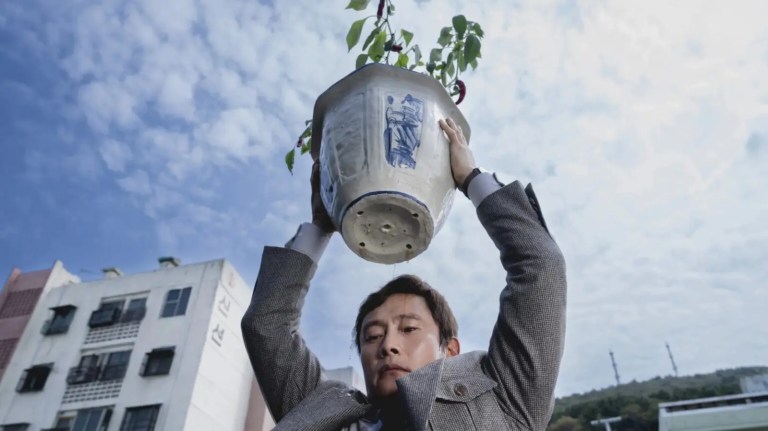
Upon exiting No Other Choice (2025) in a delirium, it is clear that Park is the greatest modern visual stylist. While his stories can vary in interest and quality, as a filmmaker who is obsessed with the power of the art of editing, you will always leave his films satisfied. Adapted from the legend Donald Westlake’s The Ax from 1997, Park’s screenplay makes the key decision to maintain the protagonist’s occupation and narrative arc, showing how, as time passes, the crushing weight of modern capitalism has only increased. Centring a literal paper pusher, we walk hand in ham-fisted hand, gliding on the back of whip pans and transitions that will make film students furiously scribbling notes.
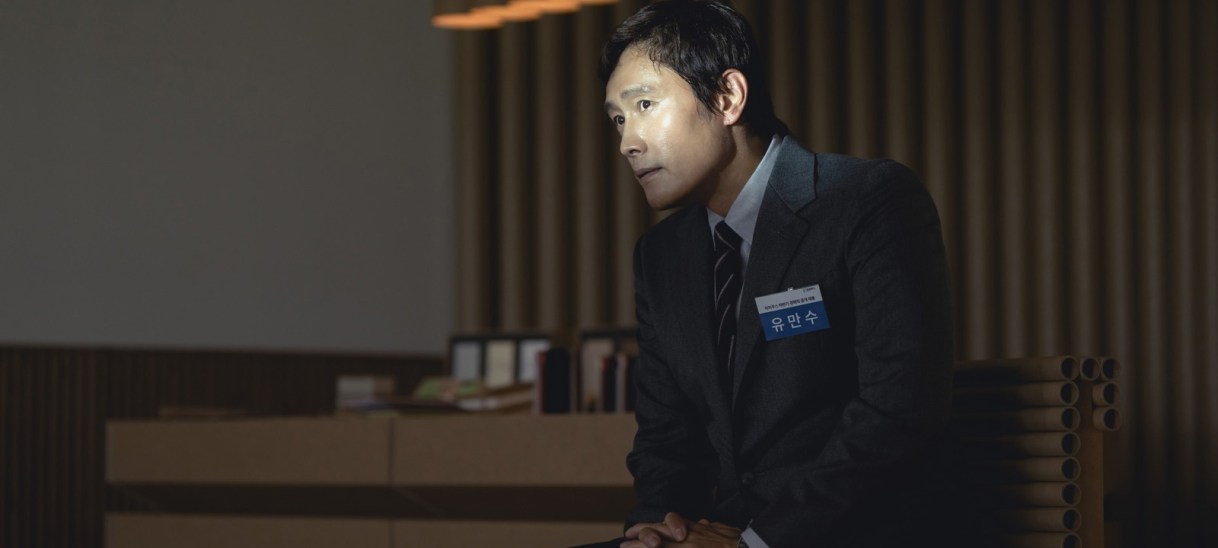
After being made redundant after the acquisition of the paper company by an American conglomerate, Man-su (Lee Byung-hun) is sent to a support group for the newly unemployed, selling self-worth and virtue as its own reward. But, after tasting mild success and a bountiful life with his family, Man-su is after a return to cold, hard reward.
Built on the late capitalist mindset that success can only be achieved through the pain of another, Man-su’s plan ultimately lands in Park’s wheelhouse, getting rid of the more hireable paper men in town, so he is all that remains. Amongst all the extremity and chaotic joy gushing out of wild filmmaking choices, the story elicits an overwhelming sense of pain as we see a group of men that should be in community with one another, forced to compete for what will ultimately be a hollow prize.
Lee Byung-hun as Man-Su in No Other Choice.
Sitting somewhere between Kiyoshi Kurosawa’s Cloud (2024) and Tokyo Sonata (2008) as modern tales on the devolving psyche of work culture and living under the cruel thumb of capitalism. That Neon in a marketing push sent an open invite to the fortune 500 company CEO’s says everything about how pointed the film aims to be at its primary villain.
Lee’s performance holds down the film’s extremity, preventing it from turning into a circus. His desperation exudes from him as a flop sweat, gritting his teeth through every moment, anxious that the moment he stops to consider the repercussions, it will all crash down. In moments where the world appears to react based on Man-su’s emotions, anything seems possible in this farcical satire that moves with a feverish pace. There is a fleeting moment when a potential final victim offers a job that we feel an unexpected glimmer of hope that we can get off the road. But as is the case with most Park Chan Wook films, that road, once entered, is one-way.
Park is in a tier above all when it comes to pushing the visual medium forward with a fever pitch and an unmatched style. Like his idol Alfred Hitchcock, Park sees his role as both old school entertainer and cinematic visionary who asks what is possible in the medium they have devoted their life to. In his recent work, Park has devoted an enormous amount of time to uncovering ways to use the reflective world of phone and computer screens to tell a story that is still compelled by the characters holding them. When we see Man-su’s reflected face alongside his screen as he drives himself further and further into his doomscroll, we so easily see ourselves. These scenes are comedic but intensely revealing, and make almost all contemporary filmmakers look like cowards for hiding in period filmmaking.
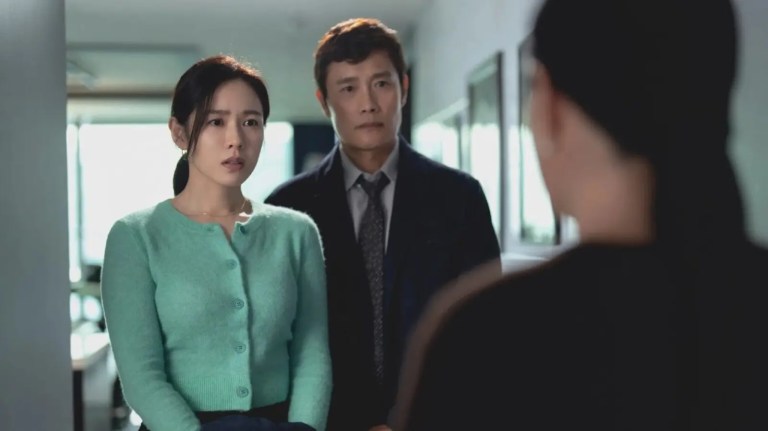
(From left) Son Ye-Jin as Miri and Lee Byung-hun as Man-Su in No Other Choice.
Always veering into doing too much, Park hides as much in its maximalist frames as he shows. Many have criticised the filmmaker for over-directing his screenplays, never allowing the writing to gleam through the forest of his craft, which I believe to be a false and overly simplistic reading of his work. In his very best films, whether original scripts or adaptations like in No Other Choice, he highlights the power and potency of the writing by its sheer ability to stand alongside some of the most visionary filmmaking this century through iconic characters and set pieces. It is only in his films like Stoker, with lesser scripts, that become mostly known for a scene transition (show hair transition scene from YouTube).
What allows Park to ride so close to the edge of camp absurdism without toppling over is his ability to play to a crowd, both in enjoyment and the collective experience of being surrounded by strangers, all uncertain of what will happen next, which makes live sports an enduring event. With all respect to the perfect chase scene at the conclusion of One BattleAfter Another (2025), the legend of the final act, Park Chan Wook’s No Other Choice, has the finale of the year. A glorious send-up of modern late-stage capitalism as a ‘be careful what you wish for’ fairy tale that blends melodrama into a living nightmare into the best satire in years. It is a farcical screed of capitalism that gloriously blooms into something unexpectedly transcendent in its conclusion.
The poetic irony in its final moments play like the deterministic singularity point that all modern art about the crushing weight of capitalism arrives at, there is literally no other choice. How Park doesn’t arrive at a place of crippling nihilism in its final moments but of cruel irony and humanity is nothing short of astounding. His revenge fables are without equal in modern storytelling, with No Other Choice arriving into this extended canon in surprising ways.
An anxious romance with a pair of actors in total lockstep with the filmmakers, the impressionistic Die My Love (2025) aims to rattle your cage, making you uneasy and unguarded to the emotionality of a world unable to contain the breadth of human emotion. Lynne Ramsay is a visual poet with a scorpion’s tail. A middle ground between the Terrences, Malick and Davies, that sees the world clearly but is in constant search of its beauty through its humanity. After bursting onto the scene with one of the best modern debuts in Ratcatcher (1999), Ramsay has struggled in an industry that seems incapable of turning her one-of-a-kind visual poeticism into a marketable arthouse name. With the star-driven Die My Love, the world might finally be ready to catch up to her greatness.
How does one begin to describe the indescribable with this film. In a sense, Die My Love is a character study and an exploration in doomed romance, through a dissolving inevitability that does not ache with the sadness of a love soon to be lost. At the heart of it all is Grace, a true lightning-in-a-bottle cinematic character, embodied by never-better Jennifer Lawrence. A bipolar, feverish writer with an animalistic charm moves out of New York to the Montana wilderness with her partner Jackson (a layered and defeated Robert Pattinson), and quickly gives birth, expanding her family and her responsibilities while dissociating herself from the world.
This film is many things, just don’t call it a movie solely about postpartum depression (although the best writing on the film will come from great female writers). Grace is a great many things, but to narrow her down to a collection of symptoms would be reductive to the potency of Ramsay’s storytelling and ability to craft complex characters across a large screen. Her balance of poetry and clarity allows familiar story beats of Grace’s post-pregnancy malaise and outbursts to overwhelm with a sharp and violent energy.
Jennifer Lawrence and Robert Pattinson in Die My Love (2025).
The film owes a great deal to John Cassavetes’ film A Woman Under the Influence (1974), particularly the relationship between the central pair as they attempt to coexist alongside mental illness while living in constant fear of saying its name. It stands wholly on its own, however, through Ramsay’s singular eye and perspective on people, which have been consistent throughout her work. She is a filmmaker who builds a narrative through a single earth-shattering moment that fundamentally changes the characters. While at first glance the inciting incident is Grace’s pregnancy and birth, the more ground-shifting moment is the passing of Jackson’s uncle and the couple’s acquisition of his house in the Montana woods, allowing him to ease into a domesticity through convenience he secretly craves, even as he (and the audience) are enthralled by Grace’s charm and energy.
Enough cannot be said for Lawrence’s performance here. Her rapturous, physical energy quickly becomes the film’s energy, establishing its roaming camera into something out of a nature documentary. It is a rare thing for a lead performance like this to not completely overwhelm and ultimately topple the film, but Lawrence and Ramsay are in sync with the narrative’s unique rhythm. In a film that focuses on isolation and boredom for a character incapable of becoming listless, Die My Love uses Lawrence’s charm and screen presence to drag us from one impulsive thought to another.
Pattinson’s hangdog expression is used effectively here as an inoculating agent against the charming roars of Lawrence’s primal energy. Even as he is introduced, seemingly moving out of the city to the countryside to write music, and Lawrence’s character to write, Ramsey’s camera feels flippant and uninspired by his artistic dreams. As we are locked onto this old, decaying house highlighted by a fallen light fixture in the centre of the room, we are quietly told how to view the pair’s doomed environment and artistic goals.
Jennifer Lawrence in Die My Love.
What allows that rhythm to glide from scene to scene is the tremendous weight given to linear storytelling, while never losing its ethereal, dreamlike temperament. Some moments feel like dreamscapes or whiplash flashbacks, but with its continued linear narrative, we become rooted to Grace’s interiority in a radical way. This high-wire act is a rare feat that will frustrate some viewers, but will deeply reward those who stay on the path.
Alongside her tremendous use of camera and editing, Ramsay uses music like the tip of a knife, sometimes in sight, ratcheting tension with its mere presence, or as a shocking stab seemingly out of the smoke. While Die My Love is an intimate, mental health family drama, the rapturous music alone requires the film to be seen in a cinema. With familiar story beats executed through her unique perspective as a visual stylist, Ramsay has reemerged after 8 long years without a film with a clear-eyed and emotive exploration of mental illness, with a powerful performance from Lawrence. While not a traditional star vehicle for an awards push, Ramsay and Lawrence have come together to craft one of the year’s best character studies and artistic statements.
Another year, another chaotic year of MIFF. With some dizzying heights and impressive debuts, cinema feels in good hands as we march headfirst into the tail end of the 2020s (a wild thought). The festival is the highlight of the cinematic calendar for the city, defining the landscape as it shifts towards awards season, with a tremendous work of curation and bold decisions as addressed below that make August the best month of the year.
Twinless (2025) – James Sweeney
⭐⭐⭐⭐
Rating: 3.5 out of 5.
A proper dramedy with a complicated but compelling pair at its core, Twinless is a charming and confident debut not weighed down by its writer, director James Sweeney’s decision to also star in the film. Following a pair of twins who have recently lost their other half and meet at a support group, Dylan O’Brien’s Roman (and Rocky) and Sweeney’s Dennis fall into a quick friendship as they look to fill the void.
Would make an interesting double feature with Andrew DeYoung’s Friendship (2024) as a perceptive and darkly funny look at the pursuit of modern male friendship, with many screwball moments in Sweeney’s film feeling like I Think You Should Leave (2019) pitches. Sweeney excels in wrongfooting the audience into a charming dramedy that gives space to both sides of the genre mash.
The Mastermind (2025) – Kelly Reichardt
⭐⭐⭐⭐
Rating: 4 out of 5.
No one is operating on Kelly Reichardt’s small but vital level. With an autumnal romp that makes way for a surprisingly poignant introspection into one’s relationship to political change, Reichardt’s period heist mood piece captures you in a breathing world, and will linger on you long after you leave like the smell of last night’s smoke break.
Josh O’Connor’s niche as a dirtbag charmer continues with his best Elliot Gould here (absolute cinematic catnip for me) as an art school washout living in suburbia with a wife (an underused Alana Haim) and two kids who have a side hustle-slash-obsession with art heists. While not on the level of O’Connor’s recent classic La Chimera (2023), this cool, warm-hued hangout film will only expand as the months go on, where I would not be surprised if it lands on end-of-year lists and amongst Reichardt’s most beloved films.
Blue Moon (2025) – Richard Linklater
⭐⭐⭐⭐
Rating: 3.5 out of 5.
A frenetic script by novelist Robert Kaplow and a high-level performance from Ethan Hawke allow Richard Linklater’s Blue Moon to shine through its humble boundaries as a film that should’ve been a play. Set against the background of the opening night of Oklahoma! On Broadway in 1943, Hawke plays the famed but troubled songwriter Lorenz Hart, who is stewing at Sardi’s, the bar soon to be the venue for the show’s party.
Hawke is flanked by a terrific cast who bounce off and counter his manic energy wonderfully, including Bobby Cannavale, Margaret Qualley, Andrew Scott, and Patrick Kennedy as an array of famous names the film nods to. Thankfully, Linklater’s love and curiosity for these artists and individuals dance energetically around the screen, allowing even those with no Broadway knowledge to understand and appreciate the film.
Sirât (2025) – Oliver Laxe
⭐⭐⭐⭐
Rating: 4 out of 5.
In a year of great horror and thrillers, there is no more visceral or dire theatre going experience than Óliver Laxe’s Cannes Jury Prize winning film Sirāt. Aided by the festival’s bold decision to screen this anxiety ridden, grim family nightmare at IMAX. We follow father and son Luis (Sergi López) and Esteban (Bruno Núñez Arjona) into the Moroccan desert in search of their daughter and sister Mar, leading them into an EDM festival where they are briefly liberated from the bounds of society. With its pounding techno score and 16mm film stock, Sirāt is a sensory marvel that pulls you into its world and commands you to walk desperately into the desert and into the unknown.
With a political undercurrent and bare-boned family drama, Sirāt uses the visual language of the immortal William Friedkin fever dream Sorcerer (1977) to illustrate an Odyssey-like adventure in a world quickly becoming unrecognisable. This is a film that will take days to process, asking unique questions of yourself and to what extent you’ll chase exhilaration in your own life and in an experience on screen.
Exit 8 (2025) – Genki Kawamura
⭐⭐⭐⭐
Rating: 3.5 out of 5.
No experience illustrates the power the festival has over the city than the sold-out IMAX screening of Genki Kawamura’s Exit 8, a chaotic and mesmerising Escher painting of a horror film about being trapped in a loop in Shinjuku station. With a dozen references to The Shining (1980), Kawamura focuses on mood and engagement with a game audience to draw us along its short and concise runtime. We are given just enough narrative to fill a feature, trapped in a propulsive active viewing experience, a wonderful feeling in a sold-out crowd. In a great year for horror, this is not one to miss when it enters theatres.
Resurrection (2025) – Bi Gan
⭐⭐⭐⭐
Rating: 3.5 out of 5.
What to say about the film that has everything. Bursting at the seams with plots in miniature and arthouse bravura, Bi Gan’s follow-up to the extraordinary Long Days Journey into Night (2018) is the cinematic odyssey Resurrection. An undefinable tapestry that wears many genre hats as a sci monster powered like a projected as the line dreamer in a world that has learnt the secret to eternal life, so long as they don’t dream. Or something like that. While Gan’s previous film is expansive but intimate in its storytelling scope, Resurrection operates as basically six short genre pieces that have the density and plot to inhabit for its entire 160-minute run-time. That is a testament to Gan’s visual style and conceptual scope, even if he can get caught up in its own luxuriating to succeed as a narrative.
An interesting film to compare this expansive odyssey with is Bertrand Bonello’s The Beast (2023). Both grand-scale odysseys following a pair of characters that can’t help but pursue one another, across time or across cinematic dreams. The key distinction is that Resurrection is a work of sentiment told across cinematic history, akin to Babylon (2022), whereas Bonello’s film operates as an incisive look at relationships through the lens of their pair.
With wonderful performances by Jackson Yee and Shu Qi, played across many genres including silent film, noir, and a gangster vampire romance shot as a 30 minute oner on New Years’ Eve 1999, Resurrection can and will show you its whole heart if you’ll let it, overwhelming you with ideas and concepts rooted in the undeniable truth that the cinematic dream is irreplaceable.
Dreams (Sex Love) (2025) – Dag Johan Haugerud
⭐⭐⭐
Rating: 3 out of 5.
A delicate exploration of teenage love and obsession that treats it with sensuality and respect, while allowing space for realism and reflection. The third part of Norwegian Dag Johan Haugerud’s collection of films on love and desire made in quick succession, Dreams (Sex Love) centres on a teenage art student Johanne (Ella Øverbye) who pines for her new teacher Johanna (Selome Emnetu), eventually pouring her feelings and desires into a book she gives to her poet grandmother.
The film shifts in unexpected ways while still following Johanne’s emotional journey that resonates with the fresh wisdom of a good teen romance novel. The prolific nature of Haugerud’s work does not diminish the literary quality of his films, which leave room for many poignant interpersonal conversations that span generations. I was only able to catch this single entry in the collection, but I will endeavour to complete the trilogy by year’s end.
BLKNWS: Terms & Conditions (2024) – Kahlil Joseph
⭐⭐⭐⭐⭐
Rating: 4.5 out of 5.
Kahlil Joseph did not set out to make a documentary. Expanding on his two screen art installations of the same name, Joseph explodes his vision of an intertwining Black past and future through an extravagant reimagining of history and form with a frenetic energy that bounces from lush Afrofuturist narratives with some of the best production design of the year to reaction memes.
With cinematography from the great Bradford Young and a pulsating score by experimental artist Klein, BLKNWS: Terms & Conditions sees beauty in the interplay between sweeping science fiction storytelling with dense, academic dialogue and modern internet culture, something rarely seen projected on a large screen. While not an easy film to grasp or comprehend in real-time, Joseph and his writing collective have crafted a dizzying piece of art that will hopefully inspire new nonfiction visual artists to explore their craft in inventive and genre-breaking ways. The film of the festival for me.
Cloud (2024) – Kiyoshi Kurosawa
⭐⭐⭐⭐
Rating: 3.5 out of 5.
A cynical master storyteller returning to the twisty world of revenge cinema through the lens of a modern huckster dirtbag trying to turn a quick buck as an online reseller, Kiyoshi Kurosawa’s Cloud forces us to confront our relationship to ground-level late-stage capitalism in unexpected and darkly comedic ways. Unaware of the mild carnage he leaves behind him as he attempts to secure a comfortable life on his own terms, Masaki Soda’s Ryôsuke Yoshii is just smart enough to spot an opportunity to coldly swindle desperate people out of their undervalued goods, but not smart enough to avoid danger and risk.
There’s no greater feeling in the theatre than when Kurosawa is moving through his spider web plots with the tension of a vintage paranoia thriller. When a true master of form and craft is still interested in the modern world and can critique and perceive it in compelling ways, we can’t afford to ignore it. Especially when they’re this enjoyable in a crowd.
Brand New Landscape (2025) – Yuiga Danzuka
⭐⭐⭐
Rating: 3 out of 5.
Danzuka’s debut feature made waves as the youngest Japanese director ever to be featured in the Directors’ Fortnight at Cannes, beginning with an extended Ozu-like exploration of a family in quiet crisis. Brand New Landscape wears its compelling, if slightly clouded themes proudly of a shifting Tokyo, and more specifically Shibuya, as a space aimed to accommodate a younger generation, even if it harms its current occupants.
The film displays the ripple effects from an unimaginable event that fractures a familiar family structure alongside the construction and evolution of several key spaces in the famous Tokyo area. Brand New Landscape never reaches a triumphant peak of dramatic storytelling, but it does leave you with both a unique perspective of Tokyo and of your own experiences in your own city and neighbourhood. A rather remarkable feat for a young filmmaker to garner.
Sorry, Baby (2025) – Eva Victor
⭐⭐⭐⭐
Rating: 4 out of 5.
The most assured and confident debut of the year, Eva Victor writes, directs, and stars in a playful yet poignant dramedy on the lasting impacts of trauma that finds new ground in the familiar lane of modern storytelling. As a liberal arts grad still living near campus and on the verge of starting a full-time teaching position while still processing and working through deep trauma, Agnes (Victor) feels stuck while her closest friend Lydie (Naomie Ackie) returns to tell her she’s pregnant.
A film about the adult anxiety of never being sure of the right thing to do or feel in any situation, Victor is perceptive with a sharp eye for when to be kind and when to be cutting. Sorry, Baby has such a strong command of a difficult tone throughout that the audience quickly settles into the hands of a commanding filmmaker, a rare feat in a first feature. There may be no better scene in indie cinema this year than the jury duty scene in this film with its ability to float between wry humour, female camaraderie in unlikely situations, and quiet character storytelling that announced Victor as am impressive filmmaker and performer.
The End (2024) – Joshua Oppenheimer
⭐⭐⭐⭐
Rating: 3.5 out of 5.
A film about a family resolute in their self delusion, unflinching in their avoidance of personal reckoning after a climate apocalypse they helped create, played out as a musical, the genre defined by its characters constantly reckoning with their own feelings and decisions through song.
A remarkable ensemble that elevates the film above an impressive academic genre experiment, particularly George Mackay, who, after starring in Bonello’s The Beast (wow, two nods in one festival for this film), has more than proven his bona fides as a young star able to breathe life into some art cinema trappings. Oppenheimer clearly has a lot on his mind with the ability of the most powerful people in the world to craft self-delusions to survive within and what happens when others encounter and potentially destabilise those delusions, a throughline that ties his totemic documentary films to The End. The decision to mine new thematic ground in a wildly different way may go down as a defining cinematic decision of the decade, and while this film does not reach some of the transcendent moments of The Act of Killing (2012) or The Look of Silence (2014), The End is certainly worth your time and hopefully not a final foray into narrative film.





 Rating Frames