The Secret Agent is a Biting and Playful Political Thriller

Rating: 4.5 out of 5.

Set in the Northeast of Brazil in the city of Recife in 1977, just as the country’s military dictatorship rounds third base, Kleber Mendonça Filho’s relaxed but probing political film The Secret Agent (2025) is like nothing else you’ll encounter in a cinema this year. Able to open a double feature with either Dazed and Confused (1993) or Army of Shadows (1969), the film wears many hats that in less assured hands would appear frayed and confused. Thankfully, Filho has levelled up as a filmmaker and storyteller, letting his playful tendencies heighten the moments of potent tension and violence that in less capable hands would beguile an audience.

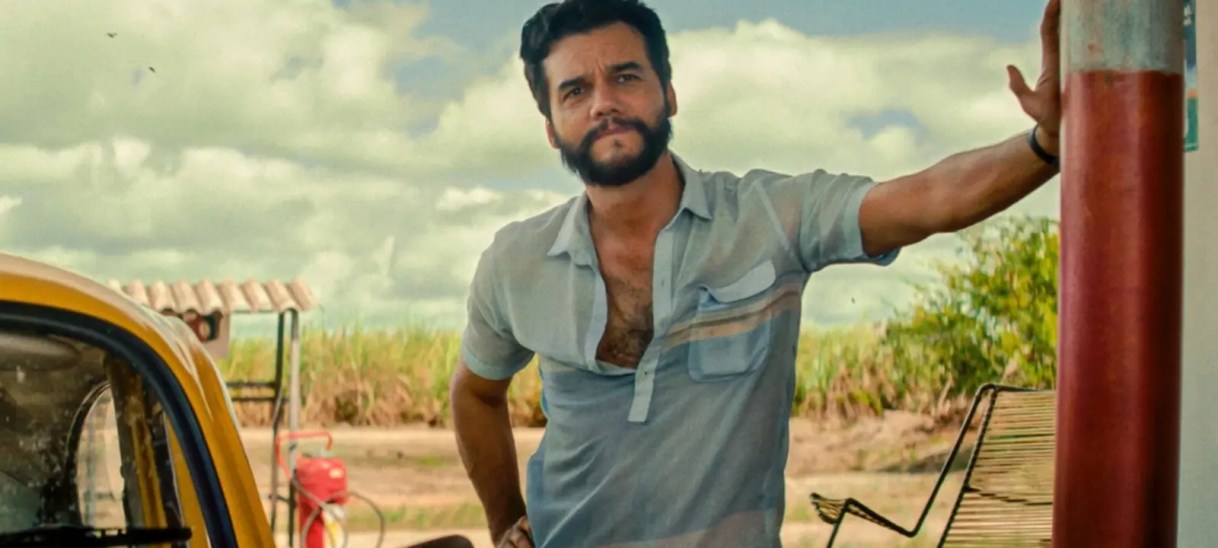
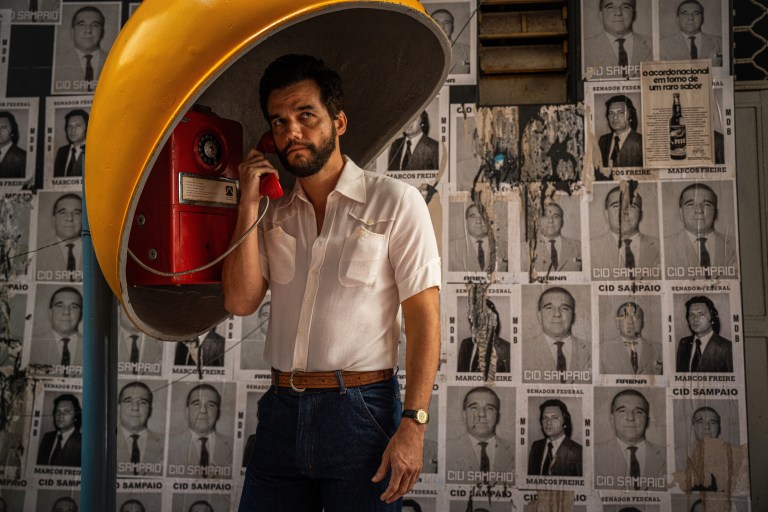
Centring a former professor and widower with a political target on his back, Armando (an exceptional Wagner Moura) returns to Recife to collect his son from his in-laws, seeking refuge in the warm embrace of a small community of political refugees helmed by Dona Sebastiana, in one of the year’s best supporting performances by Tânia Maria that feels achingly real.

Wagner Moura’s work shifts elusively from room to room as Armando quickly surveys his surroundings to uncover how he needs to respond to each interaction. The highly regarded actor is given the role of a lifetime and is set to acquire several awards, as a man with a committed goal, but never stops living his elusive life, even as the violence around the corner draws nearer.

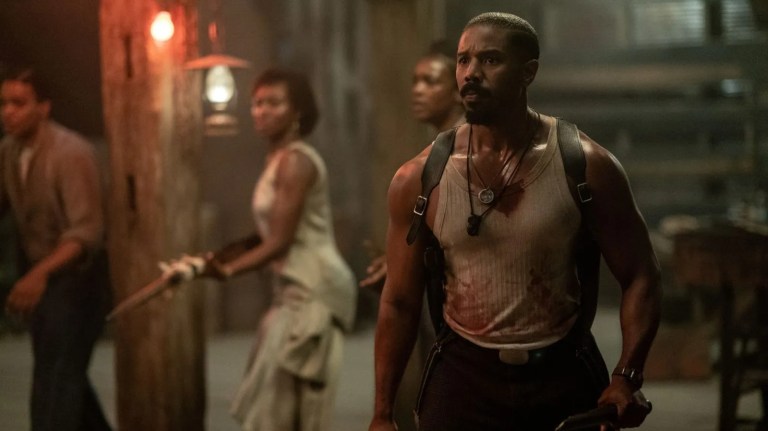
Wagner Moura as Armando in The Secret Agent (2025).

By placing this political and community-based struggle in the veins of a hangout film, Filho supports Moira’s performance with an outstanding cast that gives life to the past by giving a beating heart to this community of political refugees of his own country.

Echoes ripple through buildings, but the truth in history is something that must be searched for. Filho explores his country’s past and the people who inhabit those histories not as vessels for political tropes and ideologies, but as human beings who pass away long before their heroism is uncovered. The secondary narrative device of university students seeking to uncover the truth through tape recordings of our central story is surprising when it first appears, but it allows a dense exploration of ideas to occur. Filho’s way of shooting these scenes gives what could’ve been a contrived narrative crutch a potent level of emotional intimacy, allowing the film’s final sequence to sing.

In voicing The Secret Agent in the language of De Palma and Pakula, masters of the genre and time period the film is based, Filho is placing his film in conversation with the genre of political thrillers that most audiences are familiar with, allowing a discourse to occur across the screen between time and continents, ideas that are very much at the heart of the narrative. Alongside this, the film is a Cinema Paradiso (1988) level love affair with cinema itself, playing out in large swathes at a theatre, set against the backdrop of the sweltering summer backdrop of Jaws (1975) and the way it took the world by storm. Opening the film is the beguiling discovery of a leg inside a shark being studied at a local university, sweeping us up in the strange and playful mode Filho builds the world around, all while leading us down deeper and deeper with an unnerving sense of impending violence.

Like his previous film, Bacurau (2019), a rhythmic playfulness quickly sweeps an audience into a story, but a moment of visceral violence and aggression can pierce through that world like a stray bullet. With The Secret Agent, Filho’s eye is sharper and more directed, but playfulness is still the engine that drives his work. People do not stop living as the plots of his films take place; everything and everyone is transient, a poignant concept to maintain in a political thriller of this kind. 

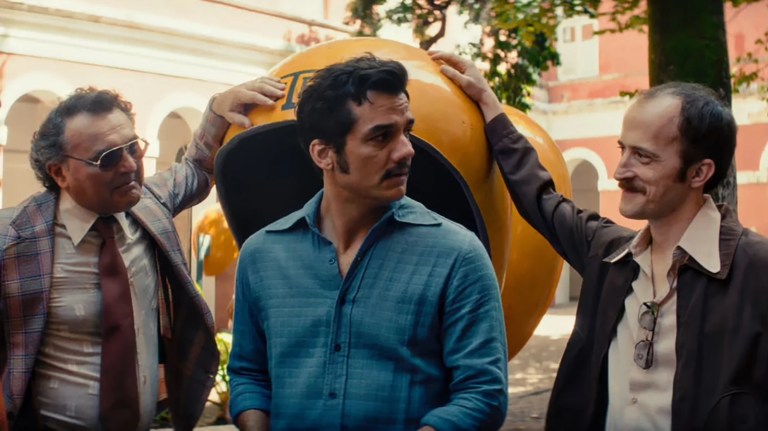
(From left) Robério Diógenes, Wagner Moura, and Igor de Araújo in The Secret Agent.

While the political thriller genre is defined by American filmmakers like De Palma and Pakula, peaking in the conspiratorial aftermath of Watergate and the Nixon administration, in recent years, the genre has been defined by international cinema. The Secret Agent asks much of its audience in terms of prior knowledge of Brazil’s military dictatorship, but in a modern climate of authoritarian spot fires around the globe, many audiences will see themselves in the images Filho shows us. Scenes of political refugees commenting on the limited groceries that are handed by a local farmer trying to assist them are as keenly observed as the moments of shocking violence.

Returning to the present day with the students weaving themselves into the stories of the past, we are in a constant meditation with ideas of bearing witness through aural recollection and the intimate but limited way of history being investigated. A pivotal scene in the film’s movement towards the thriller genre plays out when Armando and Elza (Maria Fernanda Cândido) discuss getting his family out of the country and the hit being put on his head, all while recording the conversation. This gripping scene is shown alongside Flavia (Laura Lufési), a heavily invested student, probing the moments we are shown, trying to glean insight into this moment and what may have occurred in that room outside of the captured audio.

What does it mean to tell a story of such darkness with this level of lightness? The film’s Godardian level of bounce and freedom activates a unique form of scene-to-scene tension not often seen in the political skin that Filho’s film wears. But, while the tension of these genre moments is usually played for excitement, The Secret Agent conditions us to find these moments profoundly reflective, peering into these lives with an open heart and a wry smirk of the absurdity of buffoonish political violence. A high-wire act that appears shockingly relaxed.

The Secret Agent is in select theatres now.

No Other Choice is the Work of a Master

Rating: 4.5 out of 5.

A showman like no other, Korean visionary Park Chan Wook elicits more joy and wonder out of an audience from a perfectly timed cross-dissolve than most car chases filmed this decade. A filmmaker who is constantly looking to find the tipping point of extremity without falling into the world of camp, Park has cultivated a devoted fanbase that expands with each new entry, especially in recent years, with his fearlessness to work in the grime of modern life 

Upon exiting No Other Choice (2025) in a delirium, it is clear that Park is the greatest modern visual stylist. While his stories can vary in interest and quality, as a filmmaker who is obsessed with the power of the art of editing, you will always leave his films satisfied. Adapted from the legend Donald Westlake’s The Ax from 1997, Park’s screenplay makes the key decision to maintain the protagonist’s occupation and narrative arc, showing how, as time passes, the crushing weight of modern capitalism has only increased. Centring a literal paper pusher, we walk hand in ham-fisted hand, gliding on the back of whip pans and transitions that will make film students furiously scribbling notes. 

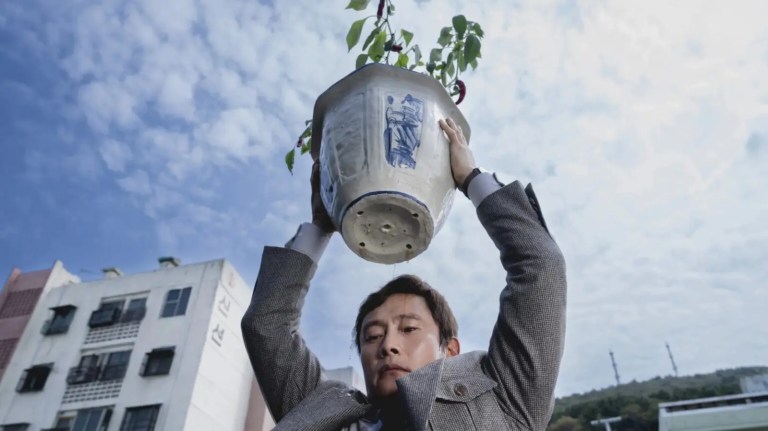
After being made redundant after the acquisition of the paper company by an American conglomerate, Man-su (Lee Byung-hun) is sent to a support group for the newly unemployed, selling self-worth and virtue as its own reward. But, after tasting mild success and a bountiful life with his family, Man-su is after a return to cold, hard reward.

Built on the late capitalist mindset that success can only be achieved through the pain of another, Man-su’s plan ultimately lands in Park’s wheelhouse, getting rid of the more hireable paper men in town, so he is all that remains. Amongst all the extremity and chaotic joy gushing out of wild filmmaking choices, the story elicits an overwhelming sense of pain as we see a group of men that should be in community with one another, forced to compete for what will ultimately be a hollow prize.

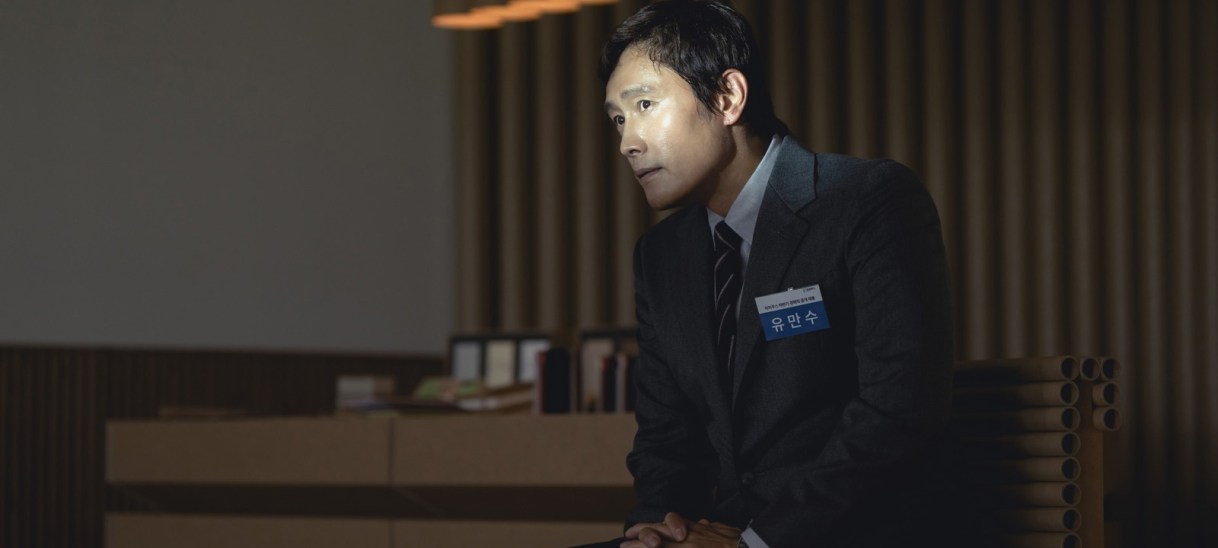
Lee Byung-hun as Man-Su in No Other Choice.

Sitting somewhere between Kiyoshi Kurosawa’s Cloud (2024) and Tokyo Sonata (2008) as modern tales on the devolving psyche of work culture and living under the cruel thumb of capitalism. That Neon in a marketing push sent an open invite to the fortune 500 company CEO’s says everything about how pointed the film aims to be at its primary villain.

Lee’s performance holds down the film’s extremity, preventing it from turning into a circus. His desperation exudes from him as a flop sweat, gritting his teeth through every moment, anxious that the moment he stops to consider the repercussions, it will all crash down. In moments where the world appears to react based on Man-su’s emotions, anything seems possible in this farcical satire that moves with a feverish pace. There is a fleeting moment when a potential final victim offers a job that we feel an unexpected glimmer of hope that we can get off the road. But as is the case with most Park Chan Wook films, that road, once entered, is one-way.

Park is in a tier above all when it comes to pushing the visual medium forward with a fever pitch and an unmatched style. Like his idol Alfred Hitchcock, Park sees his role as both old school entertainer and cinematic visionary who asks what is possible in the medium they have devoted their life to. In his recent work, Park has devoted an enormous amount of time to uncovering ways to use the reflective world of phone and computer screens to tell a story that is still compelled by the characters holding them. When we see Man-su’s reflected face alongside his screen as he drives himself further and further into his doomscroll, we so easily see ourselves. These scenes are comedic but intensely revealing, and make almost all contemporary filmmakers look like cowards for hiding in period filmmaking.

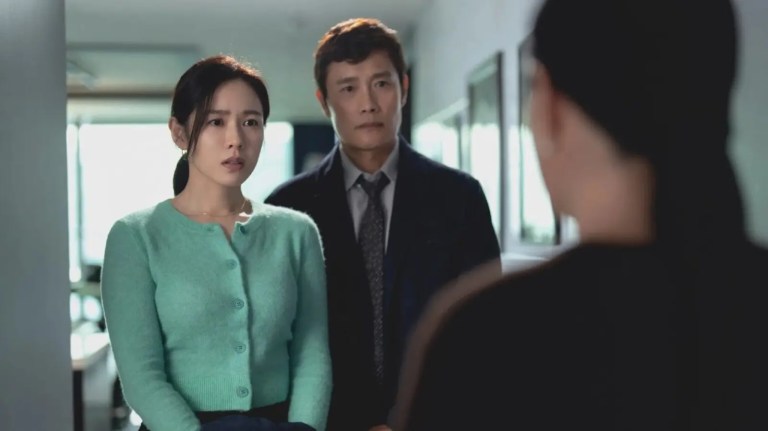
(From left) Son Ye-Jin as Miri and Lee Byung-hun as Man-Su in No Other Choice.

Always veering into doing too much, Park hides as much in its maximalist frames as he shows. Many have criticised the filmmaker for over-directing his screenplays, never allowing the writing to gleam through the forest of his craft, which I believe to be a false and overly simplistic reading of his work. In his very best films, whether original scripts or adaptations like in No Other Choice, he highlights the power and potency of the writing by its sheer ability to stand alongside some of the most visionary filmmaking this century through iconic characters and set pieces. It is only in his films like Stoker, with lesser scripts, that become mostly known for a scene transition (show hair transition scene from YouTube). 

What allows Park to ride so close to the edge of camp absurdism without toppling over is his ability to play to a crowd, both in enjoyment and the collective experience of being surrounded by strangers, all uncertain of what will happen next, which makes live sports an enduring event. With all respect to the perfect chase scene at the conclusion of One Battle After Another (2025), the legend of the final act, Park Chan Wook’s No Other Choice, has the finale of the year. A glorious send-up of modern late-stage capitalism as a ‘be careful what you wish for’ fairy tale that blends melodrama into a living nightmare into the best satire in years. It is a farcical screed of capitalism that gloriously blooms into something unexpectedly transcendent in its conclusion. 

The poetic irony in its final moments play like the deterministic singularity point that all modern art about the crushing weight of capitalism arrives at, there is literally no other choice. How Park doesn’t arrive at a place of crippling nihilism in its final moments but of cruel irony and humanity is nothing short of astounding. His revenge fables are without equal in modern storytelling, with No Other Choice arriving into this extended canon in surprising ways.

No Other Choice is in select theatres now.
Best of 2025: Darcy’s Picks

With 2025 having drawn to a close, Rating Frames is looking back at the past twelve months of cinema and streaming releases that have come our way. In the second of our series of articles, Darcy is taking a look at his ten favourite films of the year that was.

The medium is the message of films in 2025. In a time where feature filmmaking has to, in some form or another, justify its existence on the screen in comparison to TV or internet slop fed through an infinite reel, the best work to come out this year weaponises the stranglehold a great long-form story can have on an audience. A mixture of old masters and bright new talents across genres and styles, the top of a terrific year in film was all improved by viewing them in a packed theatre, demonstrating that cinema is still at its best as a communal experience, from incisive documentaries and quiet family dramas to a provocative action spectacle that invites an audience to question its worldview.

10. The Perfect Neighbor

So much of good documentary work comes down to access and editing, and Geeta Gandbhir’s heartbreaking portrait of a Ajike Owens’ Florida community and the very active role racism can take in someone’s life has both in droves. Using almost exclusively bodycam footage, police station security tapes, and 911 calls, Gandbhir and editor Viridiana Lieberman weave a poignant and incisive story of the state’s Stand Your Ground laws and the reality of how they are abused. No other film this year will make your blood boil and your heart sink.

9. 28 Years Later

Returning 18 years later with a supposed three screenplays in hand, Alex Garland (a personal favourite writer) wanted to tell the story of the UK in recent years in a franchise that has defined a lot of 21st Century English cinema, with a remarkable and unexpectedly emotional film. Centring on a young family led by an impressive newcomer in Alfie Williams, the rich level of depth and commentary in 28 Years Later allows what could’ve easily been a quick money grab by Garland and Danny Boyle to become an instant Brexit classic. With its exploration of community and isolationism with the backdrop of a widespread outbreak, 28 Years Later places itself at the forefront of art in conversation with the world in the 2020s.

8. The Mastermind

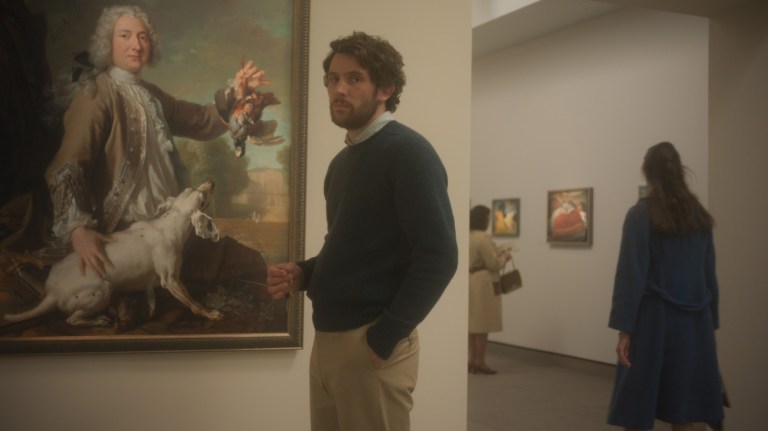
A sleepy political heist hangout with the actor of the moment, Kelly Reichardt’s 70s whisper-of-a-film will leave a long tail that may define the year in the future. Starring Josh O’Connor in his best performance to date as an uninspired suburban dad wanting to pull off an art heist, The Mastermind glides through its own world with a protagonist who believes himself smart and savvy enough to pull off the crime. Reichardt’s hidden sharp blade of focusing on someone causing chaos through their quiet ego of knowing better than those around them allows the world around O’Connor to build from gentle embers to a raging fire.

7. Sorry, Baby

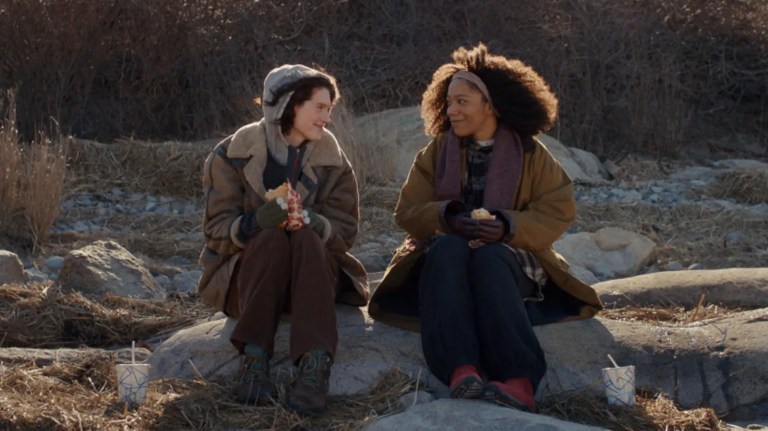
A wonderfully modern dramedy, Sorry, Baby may just usher in a new era of 2020s mumblecore with a shining new voice in Eva Victor. A story that easily could’ve landed on television and overextended, Victor, who wrote, directed, and starred in this thorny comedy of unsurety, loves cinema enough to operate and thrive within the condensed medium. As a young, depressed literary professor, Victor’s Agnes is one of the best cinematic characters of the year, a charming and thorny person you can’t help but connect with. A film that handles heavy subjects with grace and clarity, Victor has emerged as one of the brightest emerging filmmakers and performers in years.

6. Sirât

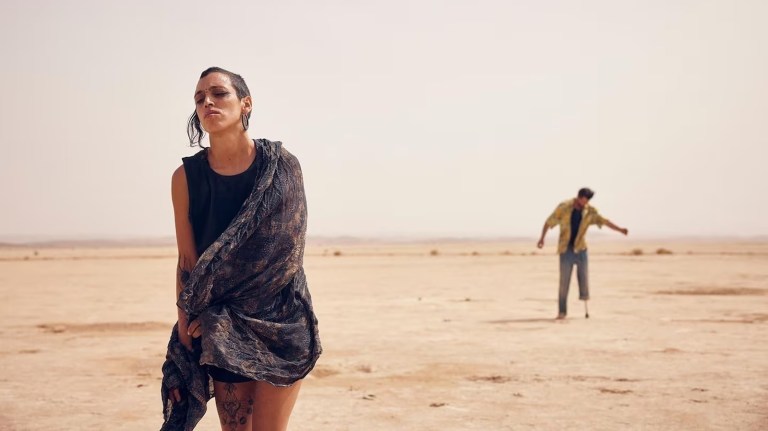
A modern experiential travel saga akin to William Friedkin’s Sorcerer (1977), Oliver Laxe’s Sirât must be seen to be believed, with several earth-shaking moments that will dig into your bones and leave scars. A shocking cinematic experience, Sirât follows a father and son as they search through an underground Moroccan desert rave scene to find their daughter and sister. The film explores community and connection, propelling you forward in line with Kangding Ray’s incredible music soundscapes.

5. Sinners

The future promise of exciting blockbuster cinema is also one of the most enjoyable and prickly films of the year. Ryan Coogler’s exploration into race, music, and history is tied to an explosive vampire action film that proves adults will still show up if given some real meat to sink their teeth into. With a terrific ensemble and a remarkable breakout by Miles Caton (so good you do not question his future self played by Buddy Guy), Coogler’s musical knows how to entertain a crowd while still provoking thoughts about how culture and music are consumed.

4. BLKNWS: Terms & Conditions

My most anticipated film experience of the year delivers and beguiles like no other. Perhaps the greatest music video director around, working with Beyonce, Kendrick Lamar, FKA Twigs, and Flying Lotus, Kahlil Joseph has a visual eye that blends hyper-modern documentary styles — which includes YouTube clips and memes — with his love and influence from the legendary Thai director Apichatpong Weerasethakul. Debuting the first iteration of BLKNWS at the Venice Biennale in 2019 as a video installation, Joseph and A24 collaborated to expand the work into a feature-length experience like no other. The film will be hard to track down, but it is as essential a watch in 2025 as any film on this list. BLKNWS: Terms & Conditions is a dense yet enjoyable work that will have you asking more from documentary and experiential cinema for the rest of the decade.

3. Sentimental Value

A tremendous follow up to Joachim Trier’s millennial classic The Worst Person in the World (2021), Sentimental Value pulses and ripples through generations of familial connection and disconnection with grace and power that feels open and inviting even in its thorniest moments. Trier and all his creative collaborators understand that to create is to bridge an ocean of the unsaid, even if that means building a replica of your generational family home on a soundstage, only to have it hidden on the 18th page of the Netflix arthouse section. Trier and Vogt understand deeply how, even through that artifice, true openness and connection can be translated into a final, powerful image of understanding but not resolution.

2. No Other Choice

With all respect to the perfect chase scene at the conclusion of the film at the top of my list, the master of the final act, Park Chan Wook’s No Other Choice, has the finale of the year. A glorious send-up of modern late-stage capitalism as a ‘be careful what you wish for’ fairy tale that blends melodrama into a living nightmare into the best satire in years. How Park doesn’t arrive at a place of crippling nihilism in its final moments but of cruel irony and humanity is nothing short of astounding. His revenge fables are without equal in modern storytelling, with No Other Choice entering this extended canon in surprising ways. No one is pushing the language of cinematic storytelling more than Park with his visualisations of doomscrolling as a uniquely modern debilitation.

1. One Battle After Another

A film that leaps off the screen in an instant, One Battle After Another works the way most immediately immortal films do. And much like many of the great immortal films, I find myself reading rather than writing about Paul Thomas Anderson’s incisive work of contemporary revolutionary cinema that even when it pulls punches, compels you forward. I’m not surprised a new PTA film that finally delves into contemporary life is my favourite film to be released in its 2020s, as his deeply humanist approach to writing over the last 30 years has defined so much of my taste in art. Combine that with subject matter I find endlessly compelling as a modern look at the humanity and personhood of revolutionaries that is fuelled by the past but never backwards-looking, and you have a film that will be the yardstick all other films will be measured against.

Honourable mentions: Black Bag, Caught By The Tides, Eephus.

Sentimental Value is The Moving Family Drama to See

Rating: 4.5 out of 5.

Arriving on Australian shores on Christmas Day, Joachim Trier’s follow-up to the Millennial instant classic The Worst Person in the World (2021) follows a family collision of artists that may be the perfect film for the holiday. Sentimental Value (2025) is a film about artists unable to articulate their feelings but are able to embody them and translate it to a captive audience. Trier and frequent collaborator Eskil Vogt have moved from dense single-character explorations into a wider canvas of a family, allowing their humanist writing style to weave between the said and unsaid.

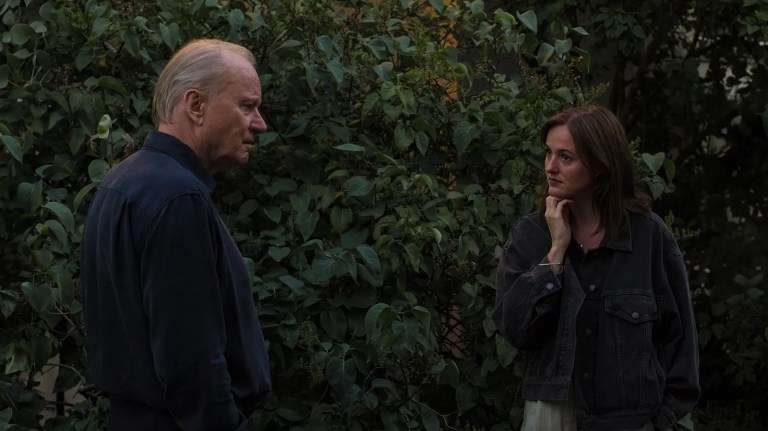
Centred is Nora Borg, played by another frequent collaborator in Renate Reinsve, a respected theatre actor suffering from immense stage fright; Agnes (a remarkable Inga Ibsdotter Lilleaas), her younger sister who has escaped the arts to make a more grounded life for herself; Gustav (a tremendous Stellan Starsgård), a well respected arthouse director and their distant father; and Rachel (Elle Fanning), an American star who aches to work on more meaningful work.

The film focuses on the return of Gustav, who has written a script that explores the past and present of the family’s history, set in the old family home, most of where Sentimental Value is set. He believes this script will launch him out of the retrospective tour space and back into the forefront of modern cinema; he just needs his estranged daughter, Nora, to agree to collaborate with him and star in the film. When she refuses to work with her father on the film, Gustav, after a chance encounter at a film festival, asks the young star Rachel to perform the role instead.

The act of writing a lead role for a loved one is something the film does not take lightly, whilst never allowing the work to unfold into a navel-gazing melodrama. A shaggy family drama about the film business and artistry would quickly implode, but Trier and Vogt’s script has a dedication to the central three family members that always feels generous. 

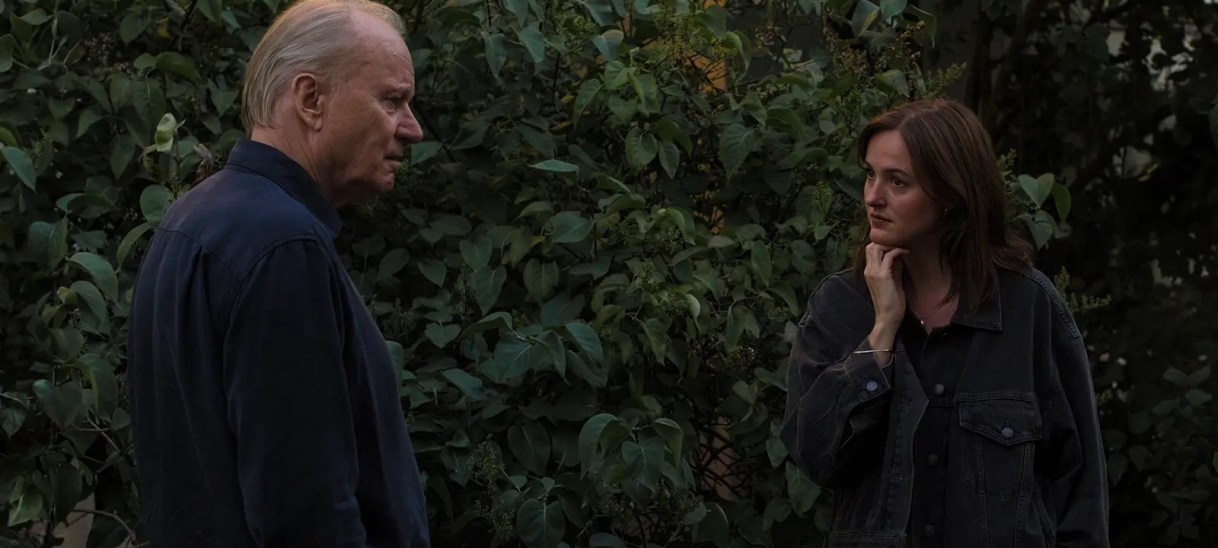
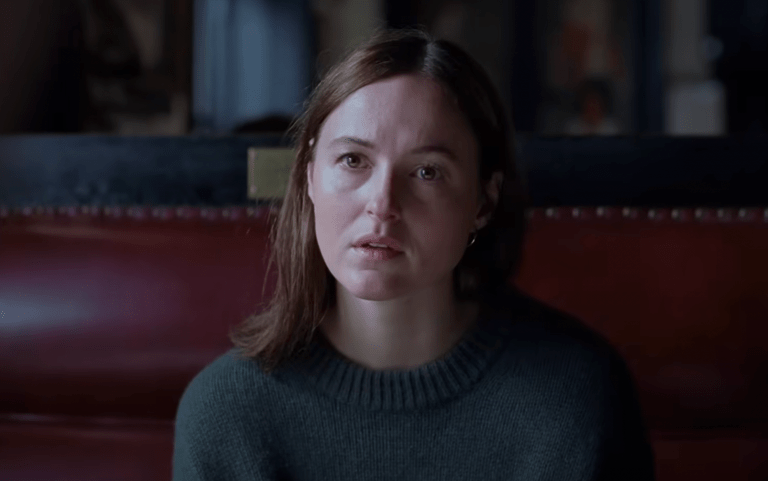
Renate Reinsve in Sentimental Value (2025.)

While a gut punch on first viewing, upon multiple viewings, it becomes clear that this is a generational performance by Skarsgård. This is made all the more extraordinary due to his health and his inability to memorise lines post-stroke. It is too rare where a character and performer to become as intrinsically linked as Skarsgård and Gustav do here, as an aging artist looking to the past, present, and future of their family line to understand themselves and those around them.

Bergman is always on the mind while interpersonal scenes float from moment to moment. The film dances between influences in Persona (1966) and Vertigo (1958) with Fanning’s character Rachel, arriving at an equal power through a balance of influences. While Hitchcock’s complicated masterpiece wields the weight of comedically heightened mirroring and Bergman’s film of duality that revel in never fully eliding its meaning to the characters, Trier’s mirroring achieves its power through its late decision to voice itself clearly and openly. 

A key scene of mirroring occurs in a pair of scenes that opens up the film into a world of collective humanity that is often the goal of Trier’s films. On one side of the glass is a monologue rehearsal scene with Rachel (after dying her hair to more closely resemble Nora) and Gustav, who is struggling to reach the impossible place he is searching for. On the other, a gorgeous scene where Nora finally reads the script after being given it by her sister, after she also finally reads it. After finally reading the script and releasing the intimacy that Gustav is pouring onto the page — something he would never articulate to them personally — the sisters are profoundly moved, and a point of familial understanding overwhelms them. 

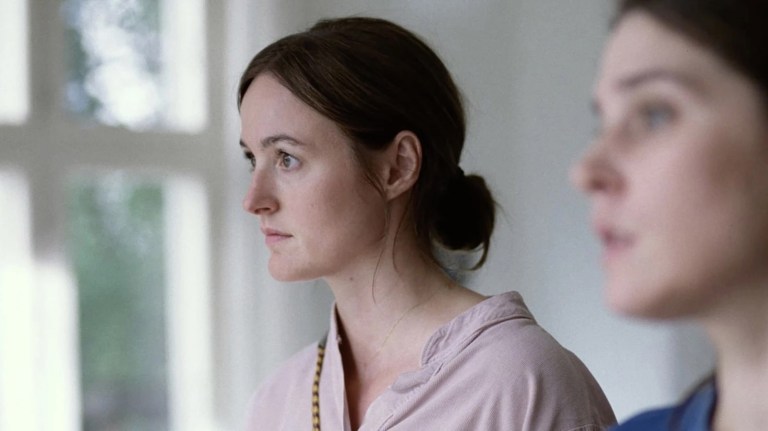
(from left) Renate Reinsve and Inga Ibsdotter Lilleaas in Sentimental Value (2025.)

Whether the film too neatly arrives at its climaxes is up to personal taste, but much needs to be credited to Trier and Vogt for the level of clarity and emotional weight they give to the struggle artists have with connecting to those they love without using their art. And the exploration Gustav has in writing extends as an olive branch to Nora, to tell her he sees her struggles, but gives her the medium of her art to explore them together.

It is in these moments of generous openness and charged, yet elided, dialogue that Sentimental Value becomes a beautifully emotive family drama. Trier and all his creative collaborators understand that to create is to bridge an ocean of the unsaid, even if that means building a replica of your generational family home on a soundstage, only to have it hidden on the 18th page of the Netflix arthouse section. Trier and Vogt understand deeply how, even through that artifice, true openness and connection can be translated into a final, powerful image of understanding but not resolution.

Sentimental Value is in select theatres now.