Dad, Larrikin, Friend, Genius, Icon, Documentary Subject But Also John Clarke

Rating: 4.5 out of 5.

“Life could be pretty boring if we didn’t make it funnier.”

Eight years have passed since Australia, and the world lost legendary satirist John Clarke, a New Zealander whose comedic alter-ego made him a national celebrity, before he made the trip across the Tasman, called Melbourne home and delighted another whole country with his distinct brand of humour. His death in 2017 was met with the kind of despair our brethren generally reserve for athletes, movie stars or royalty; praise came forth from all quarters – journalists, thespians, second-rate critics and the very individuals he so often lampooned, politicians, all effusively praising his wit and drawing attention to his huge body of work in written, aural and visual formats.

No figure is better placed to tell the story of this Kiwi multihyphenate than his eldest daughter Lorin, who emulates his diverse artistic talents by performing the manifold roles of director, producer, writer, interviewer and narrator of the very documentary that bares his name: But Also John Clarke (2025). Through monologues, conversations, anecdotes and a treasure-trove of archival footage – including home-videos, and Lorin’s own conversations with her father before his untimely death – viewers are presented with a captivating and amusing portrait that cordially pays homage to its eponymous focal point.

Much of the narrative’s first half is spent (as is often the case with stories of a biographical nature) exploring Clarke’s younger days in his mother-country, detailing a tumultuous upbringing that saw his creative spirit very nearly stymied by an oppressive boarding school, and a court blame him for the failed marriage of his parents rather than the more logical explanations of “irreconcilable differences” or “emotional trauma stemming from the horrors experienced in the Second World War”. Such torment would have broken an ordinary man, but not John Clarke, who overcame this animosity by way of several failed university courses, a brief sojourn to Europe and applying himself to the scene of theatre. This, of course, begat the persona we know as Fred Dagg.

Our attention is soon diverted to happenings in Australia, where John raised his family, refined his craft and began making allegorical waves via supporting roles on ABC Radio’s Science Show – despite having virtually no knowledge of any scientific pursuits – and ABC TV’s The Gillies Report, on the latter programme earning recognition as the globe’s foremost authority on farnarkeling. Then came sketches with Bryan Dawe on A Current Affair, in which Clarke masterfully impersonated political dignitaries and those of a comparable persuasion through the simple act of bearing their name and emulating their mannerisms, followed by the equally-innovative mockumentary series The Games.

Shaun Micallef (left) is one of several talking-heads acquiesced for But Also John Clarke

Parties from Clarke’s homeland and adopted nation lend their voices to the film on a pro rata basis, ranging from his theatrical contemporaries to the funnymen he himself would go on to inspire, and some fellow NZ expatriate by the name of Sam Neill (we’re told he’s quite famous). As director, editor et al, Lorin utilises their insights to craft a story warm and moving without succumbing to the egregious crime of saccharinity that all too often befalls personality-driven documentaries. More impressive still is her compelling argument put forward that Fred Dagg, and by extension John not only gave birth to New Zealand’s comedy scene, but also helped to foster an irreverent, self-deprecating sense of national pride.

Faults in the picture are few and far between, especially when viewed on a cinema screen via digital projection. A more discerning eye may be saddened by the lack of consideration given to Clarke’s international standing, with an opening remark from Britain’s Stephen Fry being the only moment to suggest he had any influence outside of the Antipodes; others will be left to ponder why nothing is said of him providing his vocal talents to Wal in the Footrot Flats movie, The Dog’s Tail Tale (1986).

One element certainly not lacking is a steady provision of humorous clips from John’s frequent and plentiful appearances on the stage and screen during his lifetime. Some of these extracts are four or even five decades in age, yet timeless in terms of their amusement value – at the Melbourne International Film Festival screening this reviewer attended, hearty laughs were often elicited from audience members young and old. Most hilarious of all proved to be a very early sketch involving a Fred Dagg precursor named Farmer Brown, the punchline of which had yours truly succumbing to fits of tittering long after the credits had rolled.

Countless luminaries have dreamed of being the subject of a critically-acclaimed documentary that bears their name in years gone by; now, they’ll be hoping such a production is as earnest, mirthful and brilliantly told as what Lorin Clarke has put together in honour of her forebear. But Also John Clarke is a more-than-fitting tribute to a man of infinite jest who meant so much to so many people, not least his ever-talented daughter.

But Also John Clarke is screening in limited release now.
The Last Duel Captivates, Though Only In Parts

Rating: 3.5 out of 5.

There are very few directors whose name alone is a drawcard for the masses, but Ridley Scott is one who can be considered among that company. Most recently, Scott’s touch has been applied to this medieval-set picture, drawing upon his wealth of experience to form a reasonably engrossing, if imperfect movie.

In 14th Century France, a squire and solider of the King is accused of sexual assault by a noblewoman, an act he empathically denies. The lady’s husband, a knight, supports her claims and demands justice, challenging the accused to a trial by combat – a duel to the death. Should the knight win, his wife’s accusations shall be seen as true to the eyes of God and her honour restored; should the squire win, he shall be deemed innocent, and his accuser punished for dishonesty.

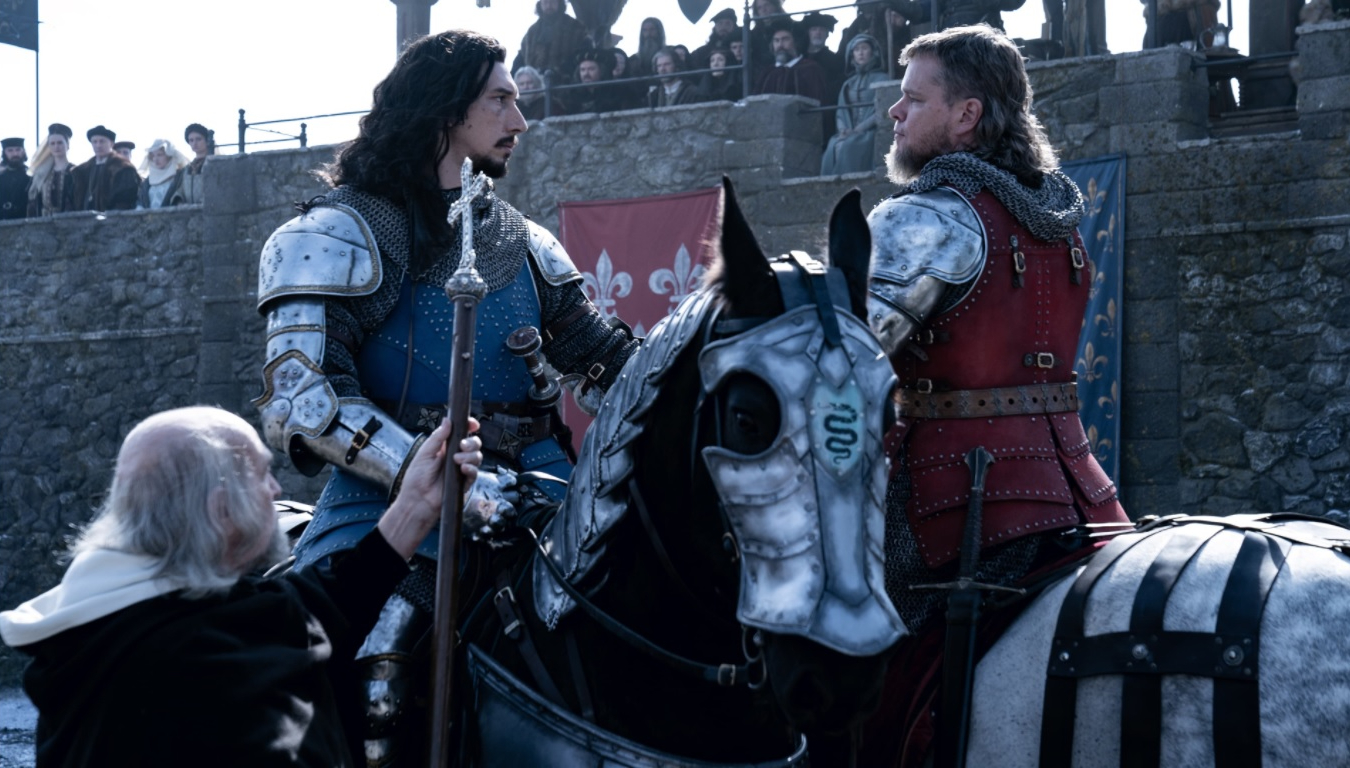
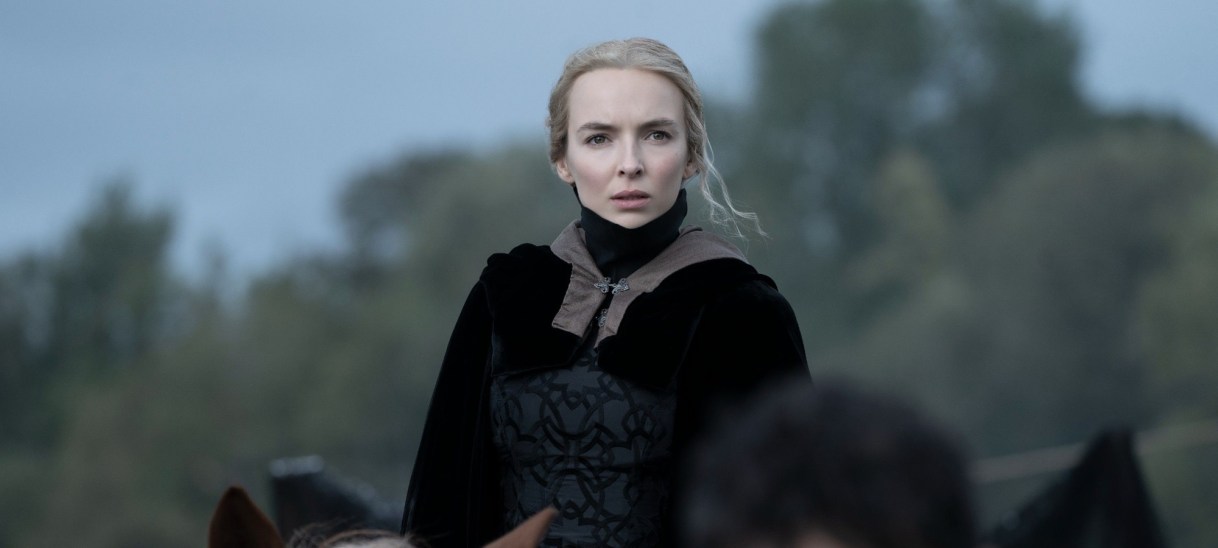
Although the premise of The Last Duel (2021) is straightforward, its narrative structure wishes to be anything but, being non-linear in manner and split into three chapters, each focused on a different character. The first chapter’s subject is Sir Jean de Carrouges (Matt Damon), the accuser’s husband; the second Jacques Le Gris (Adam Driver), the alleged perpetrator and estranged friend of Sir Jean; and the third Marguerite de Carrouges (Jodie Comer), the alleged victim.

In each of these three parts, the story is told from the perspective of the subject and what they deem to be “The Truth”. It’s a noble and rather interesting approach, yet one that’s ultimately pointless, since the film is more or less convinced that Lady Marguerite’s account is absolute fact; thus, the perspectives of the other two men are rendered null and void, an unnecessary distraction from the main conflict. Had it dispensed of its all-sides-considered angle, and instead stuck with a singular, cohesive plot, The Last Duel would be just as compelling, if not more so.

Adding to woes, the picture devotes an inordinate amount of time to establishing the relationship between Jacques and Sir Jean, which does little to advance the plot – watching these chivalrous exchanges, viewers get the sense that Lady Marguerite’s assault is an event of secondary importance to the narrative, despite it being billed as the main conflict. Admittedly, there is some appeal in listening to their eloquent, well-spoken dialogue, but this soon becomes tiresome, paling in comparison to the film’s other merits.

Jacques Le Gris (Adam Driver, left) and Sir Jean de Carrouges (Matt Damon) prepare for their battle in The Last Duel.

One such merit is its world-building, with The Last Duel having fashioned a vast, enchanting and rather accurate medieval setting for its characters to inhabit. There’s no shortage of beautiful scenery, with the feature having been shot on-location in Ireland and France; the meticulous set design adds further to the realism, as do the costume designs of Janty Yates – a regular collaborator of Scott’s – who adorns the characters in era-appropriate fabrics and all other manner of regalia. Truly, this is the closest a Hollywood production can come to being an authentic recreation of the feudal era.

It’s a view that’s further enforced by the knightly battles that Sir Jean and Jacques partake in. These action sequences of clashing swords and armour-clad soldiers on horseback are littered throughout The Last Duel, evoking Scott’s work on Gladiator (2000) and warranting praise for being tense, brutal and expertly choreographed. Yet more excitement is generated through the close-up cinematography and terrific sound editing in these scenes, allowing viewers to feel that they are very much part of these violent encounters.

Eliciting just as much satisfaction are the performances of the leads, both the young and not-so-young. Adam Driver and Jodie Comer are their usual luminous, unflappable selves, once again providing turns that belie their age and experience; Matt Damon is also solid, though the same cannot be said for his impression of a British accent. Surprisingly, the highlight is actually Damon’s producing partner and real-life buddy Ben Affleck, whose carefree, amusing and somewhat irreverent effort as Count Pierre d’Alençon constantly brings a smile to the face.

Through its acting, direction and vivid replication of the medieval era, The Last Duel manages to be an intriguing drama with serviceable thrills. Ridley Scott’s film is not a masterpiece by any means – the male characters are given too much focus, and the plot’s chaptered structure is somewhat pointless – but nonetheless is a reminder of why he’s considered one of the industry’s greats.

The Last Duel is currently screening in select cinemas.

Port Arthur Gets the Snowtown Treatment in Nitram

Rating: 4 out of 5.

Australia has long had difficulty reconciling with its past, whether it be pertaining to its colonial practices, its treatment of First Nations peoples, or its storied xenophobia. This biographical picture explores a more recent chapter in the country’s dark history, one that’s bound to provoke discomfort, yet is worth sitting through all the same.

A disaffected young man (Caleb Landry Jones) lives in the outer suburbs of Hobart, Tasmania with his cold, domineering mother (Judy Davis) and lackadaisical father (Anthony LaPaglia), ostracised by society and dependent on others to care for him. His only source of compassion is Helen (Essie Davis), an older woman whose fondness for him is eclipsed only by her passion for Gilbert & Sullivan operas; but like everybody else, she has limits for his eccentric behaviour.

Nitram (2021) is a veiled portrait of Martin Bryant, who is infamously and inextricably linked with the slaughtering of innocent people at the historical Port Arthur convict settlement in 1996. Interestingly, although Bryant is the narrative’s central figure, at no point does the film refer to him by name, nor does it mention where the atrocity he committed took place, with the focus instead being placed on the moments leading up to the event in hope of understanding the perpetrator’s mindset.

Material of this sort is not new to director Justin Kurzel, who previously helmed the picture Snowtown (2011) to critical acclaim. Said picture is a semi-fictionalised retelling of the Snowtown murders – so-named because of the South Australian locale where the bodies were hidden – that centres on an assailant to the crimes, detailing his troubled upbringing as a reason for his actions. This level of sympathy is somewhat absent in Nitram, since the film is non-committal in deciding who is at fault for the main character’s behaviour.

Similar levels of caution are applied throughout Nitram, being more delicate and poised than its subject matter would suggest – viewers are never shown instances of graphic violence at the hands of the characters, and likewise are spared having to witness the horrific bloodshed inflicted upon people at Port Arthur, ensuring that the picture is respectful to Bryant’s victims. And yet, although instances of violent behaviour are few, they are nonetheless terrifying when they do occur.

Judy Davis, as she appears in Nitram

Another peculiar facet of Nitram is how the story never seems to reach its climax. Like a powder-keg that never ignites, tension slowly and steadily builds throughout, yet that tension is never released, with the conclusion arriving just as the pressure reaches its peak. Amazingly, these last moments prove to be the most eerie and affecting part of the entire picture, with pointed intertitles referencing the proliferation of gun violence, followed by credits that roll to absolute silence.

Of greater fascination are the astounding performances from the main players, including Caleb Landry Jones. The Texan actor’s commitment cannot be faulted, for he speaks with a seemingly-natural Strine, and conveys his character’s vulnerability and underlying cruelty with considerable ease – qualities that rightfully won him Best Actor at this year’s Cannes Film Festival, where Nitram had its world premiere. His brilliance is equalled by industry veteran Judy Davis, whose baleful matriarch is sure to earn the scorn of audiences.

Regrettably, the excellence of Nitram is devalued by a poor choice in filming locations, with the Victorian city of Geelong acting as an unconvincing stand-in for Hobart and its surrounds. Aside from one aerial shot of tree-laden hills surrounding an undisclosed body of water, none of the scenery inhabited by the characters shares so much as a resemblance with southern Tasmania, being flat, arid and most unflattering to the eye; what’s more, there’s even a blatant disregard for continuity – at one point, a V/Line train can be seen travelling in the background.

Ignore this laziness though, and what’s left is unequivocally the best Australian production of the year, bar none. Guided meticulously by Justin Kurzel, Nitram doubles as both a gripping biography of a disturbed soul and an effective slow-burn thriller, further bolstered by the phenomenal acting of the leads.

Nitram is currently screening in select cinemas, and will be streaming on Stan from this Wednesday, November 24th.