Melbourne premiere screening provided by Universal Pictures
How does one follow up one of the greatest action films of all time? In George Miller’s case, he doubles down: double the car chases, double the explosions, double the chaos, double what’s happening in the mise-en-scene, and double the fun. But Furiosa: A Mad Max Saga should not be seen as an attempt to outdo Mad Max: Fury Road (2015), even though it speaks (sometimes explicitly) to the idea of making something epic and memorable, as though that wasn’t already achieved with the sequel.
Tonally, visually and sonically, Furiosa is on par with Fury Road which makes complete sense for the simple reason that it’s a prequel that’s there to compliment, and there’s not someone else in the director’s seat to screw it up. It’s clear that Miller went with a ‘if it ain’t broke, don’t fix it’ mentality when approaching this film, and the result is all the better for it. The biggest deviation to be felt in Furiosa is that, while it lives in the universe of Mad Max, it isn’t about him. In fact, Fury Road wasn’t exactly about him either, with these two films carving out their own place as post-apocalyptic, operatic action epics with larger-than-life stakes beyond a bloke called Max. But nonetheless, Furiosa is the character we follow and the focal point that guides our understanding of where Fury Road begins and ends.
Taking place across five chapters, Furiosa opens with the titular character (played in youth by Alyla Browne) in the green haven she attempts to return to throughout Fury Road. After noticing bandits ravaging through the haven, she tries to sabotage their bikes and alert the rest of her people of their presence; unfortunately she’s captured in the process, leading her mother (Charlee Fraser) to give chase. Eventually, Furiosa is brought to the bandits leader, Dementus (Chris Hemsworth), who is looking for his own means of survival along with the rest of his pack of bikers.
Chris Hemsworth in Warner Bros. Pictures’ action adventure “FURIOSA: A MAD MAX SAGA,” a Warner Bros. Pictures release.
It’s from here that Miller reintroduces familiar aspects from Fury Road, namely Immortan Joe (Lachy Hulme) and his goofball sons; Immortan’s white army of War Boys; and the Citadel. The first hour or so of the film focuses on Furiosa’s navigation of this space after she finds herself a captive of sorts (for reasons I won’t spoil). Alyla Browne does a fantastic job at setting the foundations of Furiosa’s arc to the point where, when Anya Taylor-Joy eventually takes the reigns after an hour, it’s not immediately apparent because of how alike the two actresses are with their pronounced blue eyes and Miller’s focus on framing them in tight close-ups.
Once Taylor-Joy is at the helm, Miller throws her into a extended chase sequence with Praetorian Jack (Tom Burke in a minor, but effective role) onboard an oil tanker, the War Rig. It echoes the chase from Fury Road where Furiosa deviates from her oil run to Gastown, but here Miller is much more interested in stretching the tension out as much as possible, almost to breaking point. It really speaks to his penchant for destruction and his eye for detail, where every nook and cranny of the truck, gears and all, is on display and pushed to the limit.
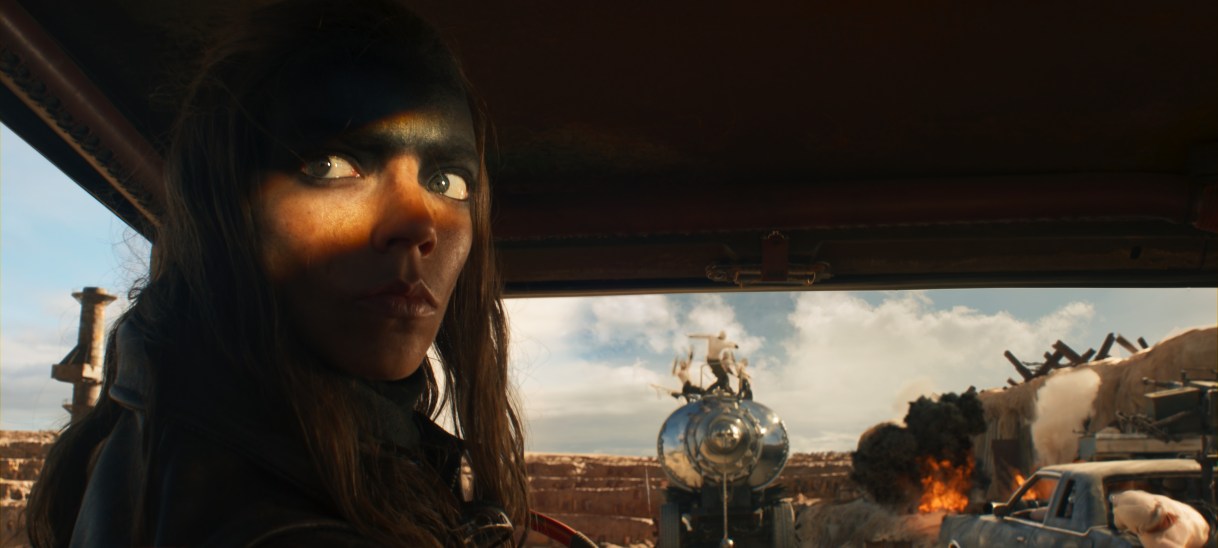
It takes some time to buy into Taylor-Joy’s performance, namely because it feels like she trying too hard to fill Charlize Theron’s boots rather than carve out her own little space for this character. Theron’s commanding screen presence, particularly the way she carries herself, is ultimately too pronounced for Taylor-Joy — she even tries to mimic her cadence of speaking — and subtlety is more effective here (which Browne brings). But Taylor-Joy does offer a level of vulnerability through her enchanting eyes; in this sense it’s easy to see why Miller might have chosen her as the lead.
Tom Burke as Praetorian Jack and Anya Taylor-Joy as Furiosa in Warner Bros. Pictures’ action adventure “FURIOSA: A MAD MAX SAGA,” a Warner Bros. Pictures release.
Hemsworth, by contrast, steals every scene he’s in, even when he goes missing for some stretches of time. Where the Thor films misplaced his larrikin humour (often at the character’s expense), Miller gives him the freedom to lean into it in a way befitting a character with a name like Dementus. His brute physique coupled with his nasally way of speaking gives Dementus a memorable edge, especially with all of the quotable lines he’s given.
Adding to the grandiose and scale of what’s on display is the fact that the Wasteland’s harshness is felt to an equal (if not greater) degree than in the first film. The addition of locations hinted at in Fury Road, like the aforementioned Gastown and Bullettown, adds weight to the stakes at play. There isn’t just more for the sake of having more, but rather Miller deliberately leaves no stone unturned and paces his film like the War Rig barrelling down a stretch of road — there’s no room for respite, you just brace yourself and try to hold on for the ride.
For what it’s worth, it’s a gorgeous ride to be had, with the visuals once again being enveloped in this orange, grainy tinge. Where in Fury Road the colours felt less saturated, there’s a much more surreal, darker quality this time around.
This is ultimately a film about Furiosa though, and her story never feels like it’s compromised or diluted for the sake of brandishing all of the fun and games that audiences will expect. Miller is a master at knowing how to capture human plight and not let it be overshadowed by the scale of his pictures. The human element of his films and this portrayal for struggle is what intensifies every car flip, gun shot and extraordinary set-piece, which is why it’s even more commendable that in a film full of incredible moments, Furiosa never loses sight of Furiosa.
Furiosa: A Mad Max Saga opens nationally from the 23rd of May.
No one manages to blend crime and action on the big screen quite like Michael Mann. From the sprawling cityscapes that act as their own character, to the attention-to-detail with each and every aspect of production, Mann’s films are distinctively his own. It seems fitting then to look back on his stellar oeuvre and try and rank his titles based on my sentiment towards them at this moment in time. This is especially the case following his recent novel and sequel to the iconic Heat (1995), which he co-wrote with Meg Gardiner, and leading up to his Adam Driver-led, Enzo Ferrari biopic, Ferrari (2023).
Of course, like with any list, opinions are different and feelings towards films change as time goes by and depending on where in your life you find yourself. But for now, these are his films ranked from worst (if you can call them that) to best:
11. The Keep (1983)
The Keep
Whether it’s due to the fact that large chunks of this film were cut out, or because it’s the least Mann-esque title on the list, The Keep is what I like to call Mann’s brain fart.
His second feature following the brilliant Thief (1981) represents his first and clearest (as there are elements of this in his true crime thrillers) foray into the horror genre. It’s a film plagued by bland and uninspired performances; a nonsensical narrative involving Nazis, a devilish entity, a supernatural Scott Glenn and one of the strangest but best sex-scenes you’re likely to see in a Mann film or otherwise; an interesting production design; and a pretty neat synthy score by Tangerine Dream.
Given Mann has disowned the film because of Paramount’s treatment of it, one can only imagine what the unreleased director’s cut had in store — we can only hope it graces out screens someday.
10. Manhunter (1986)
Manhunter
Many might find my ranking of Manhunter to be completely against the grain, but this thriller revolving around capturing a psychotic serial killer just never resonated with me on a narrative level like some of the other titles on this list (and I still gave it 3.5/5).
Manhunter focuses on FBI agent Will Graham (William Peterson), a detective who’s come out of retirement to help locate an elusive serial-killer with strange motives. His past experiences hunting figures like Hannibal Lecter (a subtle performance by Brian Cox) means he’s the perfect guy for the job.
Manhunter uses Will and the serial killer he’s hunting to create an interesting parallel between the mind of a psychotic man and the man capable of catching him. Its use of home video and the focus on truly seeing almost posits that these two men aren’t so different in how they see the world, but to different ends and outcomes.
Whether or not I was expecting a more conventional voyeuristic mystery-thriller in the way that Se7en (1995) or Rear Window (1954) are —where the killer feels like they’re an arm’s length away, only for the satisfaction of catching them to be snatched from you— is difficult to say (perhaps that’s what people love about this?), but I found myself at a crossroads by the third act. I hope my opinion changes on a second viewing.
9. Ali (2001)
Ali
On the surface, a film about Muhammad Ali seems like the farthest thing from a Michael Mann joint. There’s no mesmerising cityscape, no sirens or gunfire, no real suspense in the way that his crime films create suspense, and the subject matter doesn’t exactly scream ‘Michael Mann’.
But this film about the greatest boxer of all time works because of Mann’s interest in figures that don’t play by the rules. Specifically, Ali focuses on the period of time between Ali’s (Will Smith) first major heavyweight bout, the court case filed against him for refusing conscription for the Vietnam War, and his famous win against George Foreman to reclaim the heavyweight title.
Ali’s unilateral decision to not be conscripted was momentous for the fact that he was the heavyweight champion of the world, and making such a decision could affect his ability to box in his prime (which it did). He also reinvented who he was by changing his name and living on his own terms — a staple of Mann characters, but for different reasons. Often his characters are trying to protect others from who they truly are whereas Ali was trying to break away from the branding that others (white slavers) had given him and his people centuries ago.
The opening 15 or so minutes are also arguably Mann’s most compelling in the way that he establishes character, creates purpose and builds tension. At times there’s a suddenness to proceedings where the film makes abrupt leaps in time between the court case announcement, the Joe Frazier fight, and the George Foreman fight, but overall Ali is a portrait of one man’s journey to becoming in the face of adversary.
8. The Last of the Mohicans (1992)
The Last of the Mohicans
Along with The Keep, The Last of the Mohicans represents a different sort of Mann.
Like with Peter Jackson’s first film experience with the classic King Kong (1933) and his eventual reimagining of that classic on his own terms in King Kong (2005), Mann’s first vivid film memory was of 1936’s The Last of the Mohicans.
Helmed by Daniel Day-Lewis as the adopted Mohican, Hawkeye, this period piece about everything from the damning effects of bureaucracy to the Tarzan-esque romanticism of the love affair between Hawkeye and Cora Munro (Madeleine Stowe), is the first Mann film to create a sense of scale that would have greatly shaped the way he approached his later films.
By that I mean Mann finds a balance between showcasing the wide and beautiful terrain of a primeval America against the harshness of the looming modernisation that threatens its existence. This translates onto how the characters react to each other, whether it be through Magua (a mesmerising Wes Studi) and his desire for revenge against the British (for what they took from him) as well as his forward thinking to help his tribe, or through the loud and rampant battle at Fort William Henry that threatens the peace of the land.
Guided by one of the greatest scores of any film ever by Trevor Jones and Randy Edelman which at once evokes hope and sadness, picturesque vistas, and gripping direction that never falters, this Mann-epic is Mann at his most untethered.
7. Public Enemies (2009)
Public Enemies
When it comes to famous outlaws, there are few that are as iconic as John Dillinger, especially given he was a man who wasn’t interested in stealing from regular people, but the state itself.
That’s partly why he’s the perfect historical figure for a Michael Mann film given his self-defined approach to life.
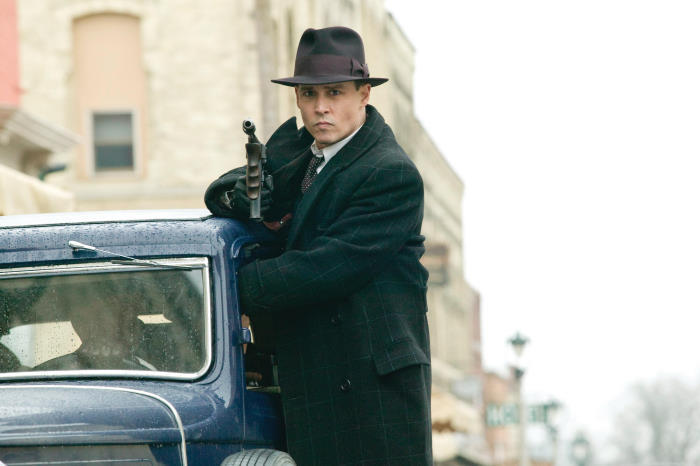
Public Enemies follows Dillinger (Johnny Depp) as he makes prison escape after prison escape, continuously evading capture and robbing banks before finding an added purpose in life in the form of one French-American, Billie Frechette (Marion Cotillard).
Like all of Mann’s anti-heroes, Depp’s Dillinger is charming and elusive all at once. He’s a character infused with an aura of mystique that Depp delivers with the casual suave that his own image beyond the screen has maintained.
But it’s in the reimagining of the period through a digital lens where Public Enemies really excels. The moody greys, dark passages and almost colourless world are so striking here that it creates a more profound hyper-realism — almost bringing the 1930s to life in a way that shooting on film wouldn’t.
6. The Insider (1999)
The Insider
A film about a man’s grapple with doing what’s morally right or being forced into silence by forces greater than him; The Insider, in true Mann-style, is an exercise in patience — in waiting for the right moment to make a move before it’s too late.
Unlike Mann’s other thrillers though, The Insider doesn’t have vans of heavily armed forces hiding around the corner, but it instead puts its faith in the truth overcoming the odds. That truth is in the form of former tobacco chemical scientist, Jeffrey Wigand (Russell Crowe) and the 60 Minutes producer looking to help bring his story to light, Lowell Bergman (Al Pacino). The odds are the Brown and Williamson Tobacco Company who are trying to keep Jeffrey, and this story around what really happens to tobacco, silent.
Guided by Mann’s brilliant direction, a well-crafted script by Mann and Eric Roth, and a standout performance from Al Pacino in an unfamiliar but equally familiar performance, The Insider paints a perplexing portrait of the lengths to which vindictive multi-billion dollar organisations will go to in order to supress information. It brings various parties with differing interests together, and creates a wide web of uncertainty for all involved — with no clear contingencies, but everything to lose for everyone involved.
5. Blackhat (2015)
Blackhat
Michael Mann’s most recent film feels like a sum of all of his best parts (it’s also been eight years since it was released!).
The film follows hacker Nicholas Hathaway (a career-best performance from Chris Hemsworth) who, after a series of awry events happen by an unknown source, is released from prison for the purpose of helping discover the person behind these events.
Blackhat is where ideas meet, characters converge, and where the tangible coalesces with the intangible.
In a similar way to Manhunter (but without the straining of classic thriller conventions) and Heat, this film once again depicts two sides of the same coin — Hathaway as the hacker-turned-FBI collaborator, and the unknown hacker blowing up coolant pipes and infiltrating wall-street. One is front and centre for the audience, while the other is kept faceless. While their intentions are different, they occupy a similar space like almost all of Mann’s characters do, but Blackhat is different to his past films because of how it bridges the characters worlds together and carries and communicates messages.
Mann uses modern technology to create a divide (the intangible), and forces his characters to embrace human interaction and connection (the tangible) if they are to overcome this threat.
His portrayal of the L.A. and Hong Kong maze of buildings and their bright lights speaks to the lack of personality or distinguished features in these settings, which fizzles down to the people who fade into each other like ones and zeros. It’s a wider critique on getting lost in the masses at a macro level, and getting lost in the code on a micro level.
Hathaway is the vessel Mann uses here to try and break through the code and by extension, this front that a world lacking real connections, has maintained — with Hemsworth using his size and stature to brilliant avail.
The closing sequence sees Hathaway concoct weapons and armour out of everyday tools, as though Mann is returning man to a primitive state before the world of data and technology became the guiding force. Hathaway gets the upper hand, and walks away in perhaps Mann’s most optimistic ending.
4. Thief (1981)
Thief
The OG Mann, Thief introduced audiences to this true-crime loving director who focuses on characters that take pride in the work they do, sometimes fall in love in the process, and live life on their own terms.
For expert safe-cracker and straight-talker, Frank (James Caan), he embodies the above perhaps more than any other character in Mann’s oeuvre. It might be because this is Mann’s most contained film in that it isn’t made up of major set pieces and crowded settings, but instead allows Caan to revel in the dialogue and the weight behind his words.
Thief is about a man on a mission to tick off his checklist of wants before cashing out. It’s also about a man refusing to bow down to the interests of others, instead taking it upon himself to shape his own destiny at any cost.
3. Collateral (2004)
Collateral
Two guys in a car, strangers to each other, both operating on a routine, a structure that they rarely break from, moving as one through the luminous L.A. night but to different ends.
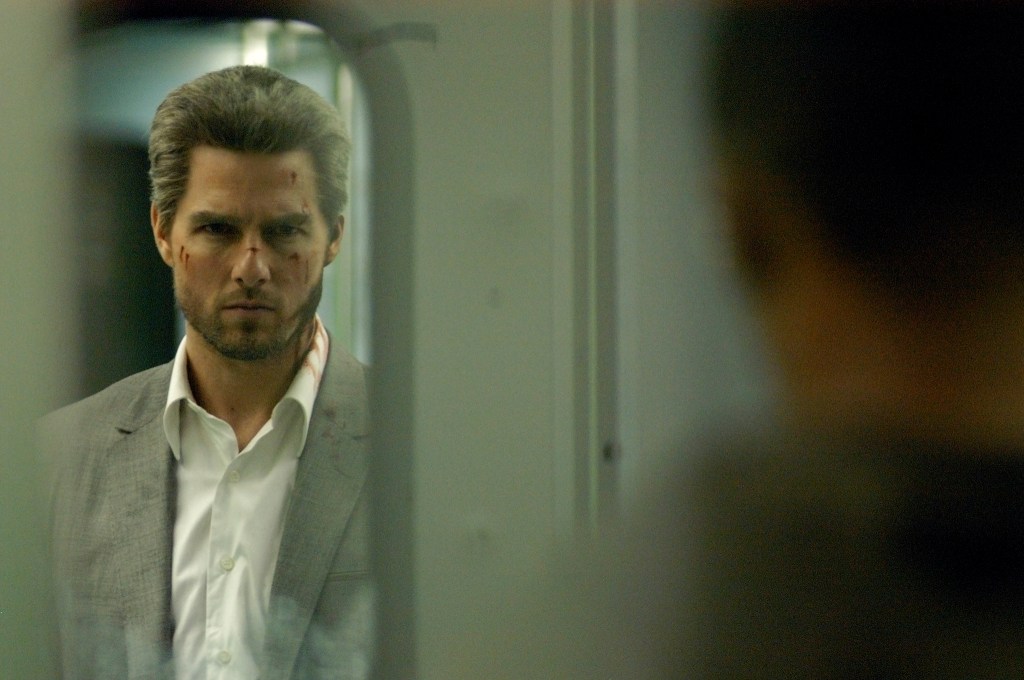
Collateral is a wonderous neo-noir that pivots two men with differing moral compasses against each other: Max (Jamie Foxx), a slave to his inhibition, to his failure to act and make a difference to his life; and Vincent (Tom Cruise), a man untethered, a multi-faceted nihilistic hitman who gets in, gets out, and keeps moving forward.
Much has already been written on Collateral, from its vivid imagery to the rawness of its digitised look — at once enticing and haunting. Vincent poses a threat to Max’s idealised vision of tomorrow, but also an opportunity to start making things happen and not idle by.
2. Heat (1995)
Heat
What does one even say about what, in the eyes of many, is Mann’s magnum-opus?
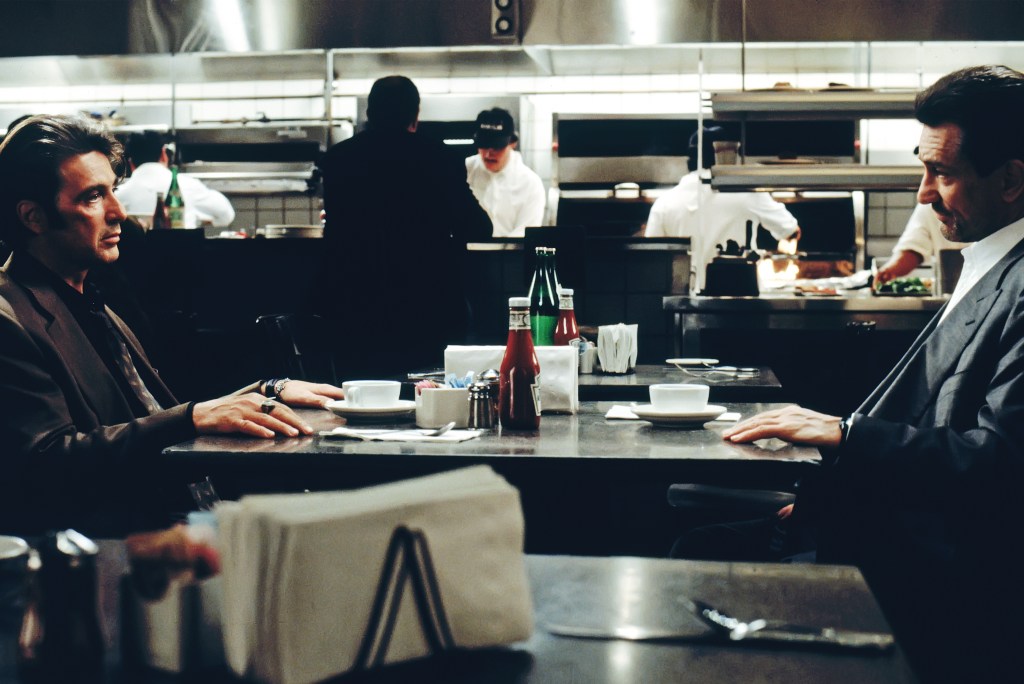
Heat is the sum of many parts, but it doesn’t work without its two key pieces: Al Pacino and Robert de Niro. The duo, reunited together on a feature for the first time (and for the first time ever in the same scene/s) since The Godfather Part II (1974), Pacino and de Niro are two sides of the same coin.
Vincent Hanna and Neil McCauley are like yin and yang — they don’t mix but they can’t function without one another. This speaks to Mann’s wider commentary on good vs evil, crime vs order which has been the focal point for 90% of his oeuvre. In Heat, Pacino and de Niro accentuate Mann’s fascination with these binary opposites to their full extent.
It’s as though these characters revel in the chase, of being the hunter and the prey, and they treat it like a drug that supersedes everything else in life. Mann brilliantly captures this through bright neon lights and the wider city which acts as its own sanctum that gives weight to the chase. Nothing is as beautiful as the city lights in a Mann film where cop cars race down the freeway in a storm of intensity.
But Heat is also made up of moments: the diner scene between Neil and Vincent is one of the greatest moments of character interaction in cinema history as these two men come face to face, pause the chase, and acknowledge each other; the downtown LA shootout where Mann shut down multiple blocks to shoot one of the most jaw-dropping scenes in any film ever; and the poignant finale where the two leads lock horns for the last time.
Without Heat, we may never have had The Dark Knight (2008), and that’s just one extra reason to watch this if you haven’t.
1. Miami Vice (2006)
Miami Vice
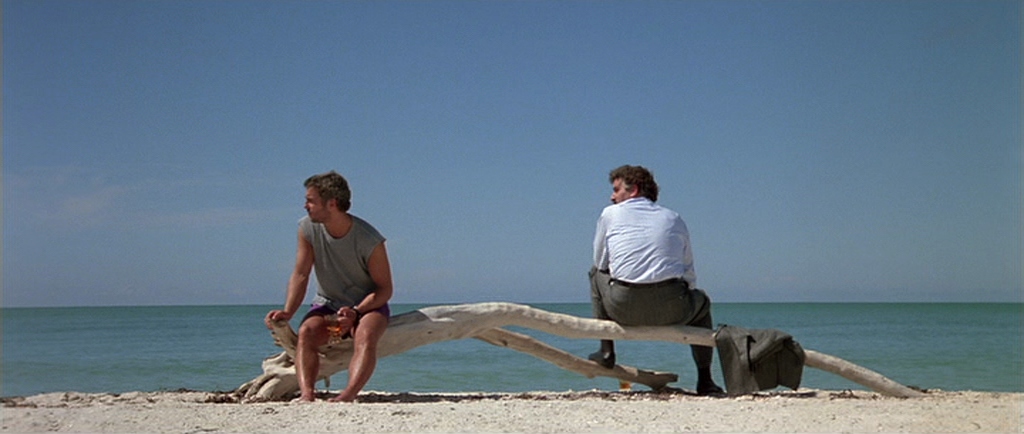
I’m sure Miami Vice is a top-three Mann on anyone’s ranking of his work, but this bustling neo-noir about two under-cover detectives goes beyond the 80s show of the same name to become a gripping tale of people accepting that they’re living on borrowed time and learning how to manage the time they have left.
On the surface, Miami Vice is a buddy-cop thriller about two detectives infiltrating an offshore drug operation where they act as the middle-man between the international supplier and the local Miami buyer. Their mission is to find out who the buyer is, but the deeper they find themselves in the operation, the more they realise they’ll never have an opportunity like this again.
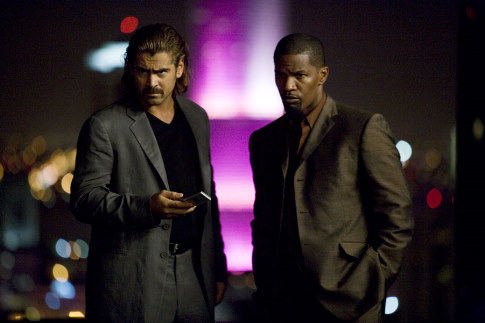
Jamie Foxx and Colin Farrell are the two leads here and (while already the case with Foxx) they instantly fit the Mann-model of characters who don’t always play by the books, are good at what they do, and sometimes make rash, emotionally led decisions.
But it’s through Mann’s ability to capture the fleeting nature of life, the suddenness of a bust and the shootouts that ensue, where Miami Vice makes a case for his best film. There’s a dream-like tranquillity to the use of digital footage here that might just be the best example of creating evocative images in the digital format. From the bright hues of the nightlife and its clubs to the more intimate sensual moments, there’s a sense of liveliness and temporality mixed together in the film’s visual language.
Mann’s growing fascination with the commodification and expendability of the human body really started gaining momentum here as well. Whether it be in the film’s final shootout where bodies drop at a whim or the use of people as shields for getting what you want (drugs, cash, obedience), it’s an aspect of his films that really does speak to how precious those moments of human interaction are for his characters when they do have them.






 Rating Frames