DC’s cinematic output has been rather disparate of late, to say the least, with their releases range in quality from good to woeful, and most being mediocre at best. Now comes another blockbuster branded with the DC moniker, this one outshining everything that has come before it – especially its 2016 namesake.
Task Force X is a secretive branch of the United States government that oversees military operations deemed too dangerous, or too sensitive, for America’s heroes to be involved in. Their agents are inmates of the Belle Reve Correctional Centre – home to the evilest of supervillains – who are recruited in exchange for reduced sentences, provided they comply with their commands; should they not, the agents will be killed by their superiors.
The organisation’s newest recruit is Robert “Bloodsport” DuBois (Idris Elba) who has been sought by the director of Task Force X, Amanda Waller (Viola Davis) to lead an operation on the despotic island-state of Corto Maltese. DuBois has no desire to be involved whatsoever, until Waller threatens the safety of his teenage daughter, thereby forcing his hand into joining and reluctantly leading the mission.
The entity of Task Force X previously made its cinematic debut in David Ayer’s Suicide Squad (2016), which found commercial success despite being widely panned by critics for its appalling direction, unfunny humour and jarring, inconsistent tone. In developing the sequel, Warner Bros. ditched Ayer and handed directorial duties to James Gunn – who had just been fired from Marvel Studio for a series of tasteless posts on social media – and gave him complete creative freedom.
As a result of said freedom, Gunn’s new film bares next to no correlation with its Ayer-helmed precursor, despite sharing a similar title in The Suicide Squad. The extended cast serves as the only discernible connection between the two movies, with the abovementioned Davis reprising her role, in addition to Joel Kinnaman as Colonel Rick Flag; Australia’s own Margot Robbie as the squeaky-voiced jester, Harley Quinn; and fellow Australian Jai Courtney as the intensely ocker Captain Boomerang.

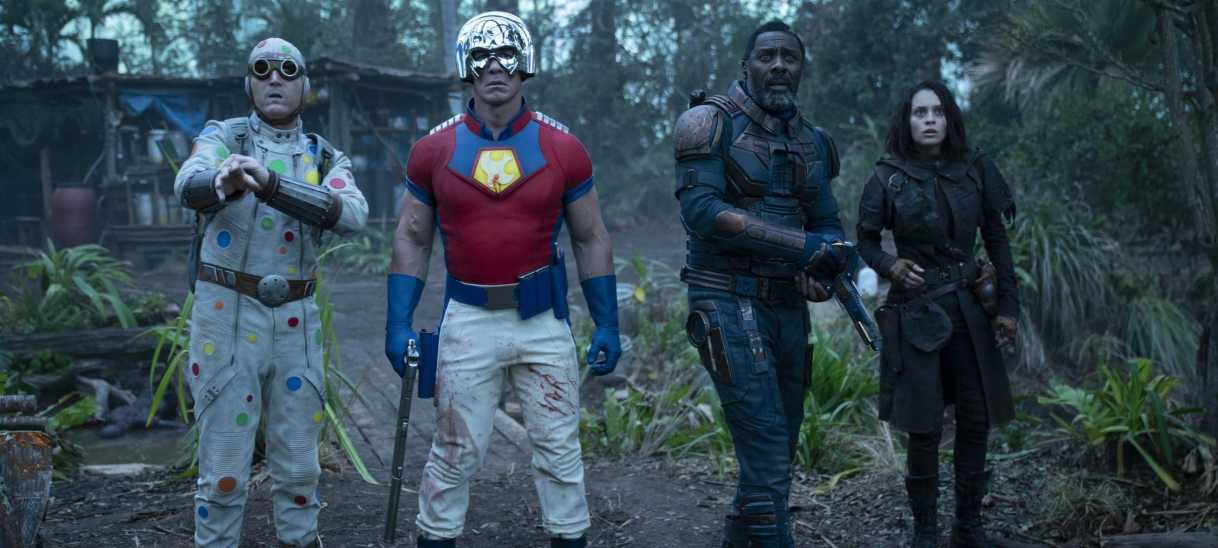
Joining them are a bunch of fresh recruits who operate under Bloodsport’s command, including macho gunman Christopher “Peacemaker” Smith (John Cena); a man who can conjure explosive polka-dots, Abner Krill (David Dastmalchian); an anthropomorphic shark named Nanaue (voiced by Sylvester Stallone); a young woman who can summon and control rats, Cleo Cazo (Daniela Melchior); and finally, Cleo’s pet rat Sebastian (voiced by animal impressionist Dee Bradley Baker).
The Suicide Squad spends the majority of its time focused on the latter group of characters, and rightly so, because they’re nothing but a charm. This appeal is fuelled largely by the performers who play them, with all the newcomers looking poised and relaxed, and each gifting their respective roles with a distinct personality. Through their efforts alone, these actors have turned a group of obscure antagonists into loveable rogues who deserve to lead every sequel and spin-off that follows.
Just as admirable is the film’s screenplay, solely and cleverly written by Gunn. In addition to the main conflict, each character is gifted with their own story-arc that pertains to a troubled backstory, developing and maturing as they seek to address it. Although these struggles are relatively minor, they do aid in further humanising the protagonists; what’s more, their arcs prove just as gripping as the central plot without ever distracting from it, nor overwhelming the audience with narrative.
The screenplay’s strength doesn’t just lie in its ability to fuse multiple storylines into a coherent package, for it is equally adept at toying with the viewer’s expectations. Gunn sets the stakes of his picture high from the outset, showing characters being killed left, right and centre with little regard for how established they are, and even less for the celebrities chosen to portray them. After the first few minutes, there’s no knowing where the film is heading, nor if anybody will survive the climactic showdown.
As much a part of The Suicide Squad’s appeal is the mature content, being more vulgar and graphic than the average superhero blockbuster, courtesy of the profanity-ridden dialogue, sporadic glimpses of nudity and gratuitous levels of violence. Blood and gore are abundant in Gunn’s picture, with all manner of body parts bursting open whenever a character is slaughtered, and the majority of those deaths being played for laughs.
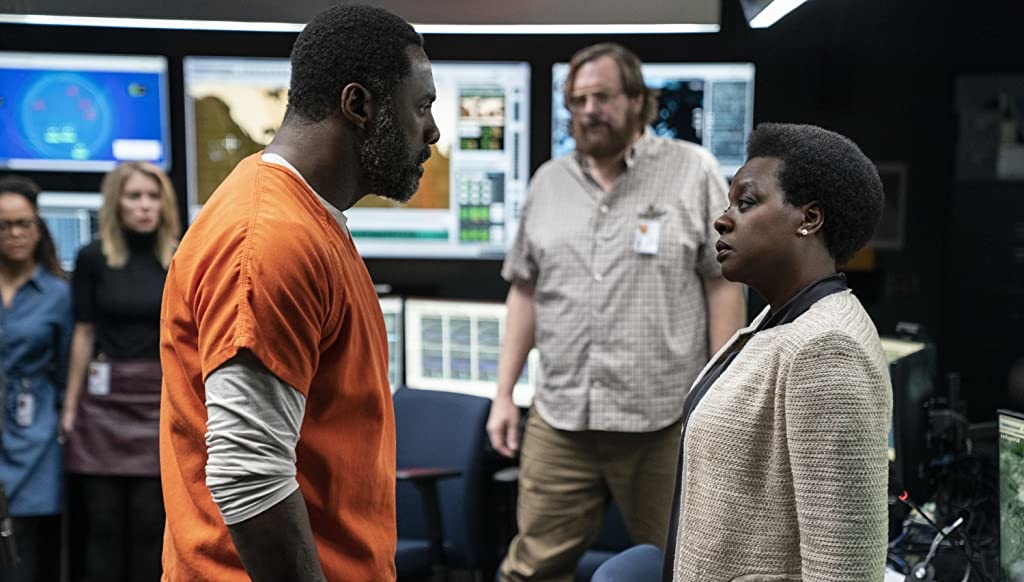
On the subject of laughs, there’s some pretty decent ones to be had throughout, with frequent, fast-paced quips coming from every character, as well as the occasional slapstick gag; yet the best comedy is mined from the desk-bound bureaucrats of Task Force X – played by Steve Agee, Tinashe Kajese-Bolden and Jennifer Holland, among others – who utter the funniest one-liners of the entire movie, very nearly outmatching the likeability of the main characters.
Amusingly impish though The Suicide Squad is, there are some aspects in which it falls short. One such aspect is the characterisation of Bloodsport who, despite the film’s best efforts, cannot shake the fact that he is practically identical to Deadshot from the other Suicide Squad film – both are played by black actors, both wear silly masks, both are sharpshooters with impeccable aim, and both are absent fathers wanting to do right by their respective daughters. Were it not for Elba’s British accent, there would be nothing to distinguish between them.
Another disappointment is the music that accompanies proceedings. As per his work on the Guardians of the Galaxy movies (2014, 2017), Gunn has personally curated a soundtrack of retro songs to pair with events, but this one doesn’t have the same appeal, for it lacks the catchy, kitschy tunes of his Marvel Studios playlists. The result is a soundtrack that pales not only to Gunn’s previous features, but even to a picture like Cruella (2021), which demonstrated a far better utilisation of classic hits.
Those grievances notwithstanding, The Suicide Squad is unequivocally the wittiest, warmest and most gratifying DC film to date, and an irreverent alternative to the superhero genre’s usual offerings. Idiosyncratic characters, fantastic performances, gory action sequences and some hearty chuckles solidify the picture as a winner, all but atoning for the sins of its predecessor.
The Suicide Squad is currently screening in cinemas where open, and available for digital download through select services.


