Turning Red is a Bold, Welcome Deviation

Rating: 4 out of 5.

Critics are fast running out of superlatives to describe the filmography of Pixar Animation Studios. Every release by the company, especially of late, has possessed a rousing soundtrack, heartfelt screenplay, top-notch voice-acting and of course, computer-generated illustrations beyond compare, almost to the point of conformity. That all changes with this production, and for the better.

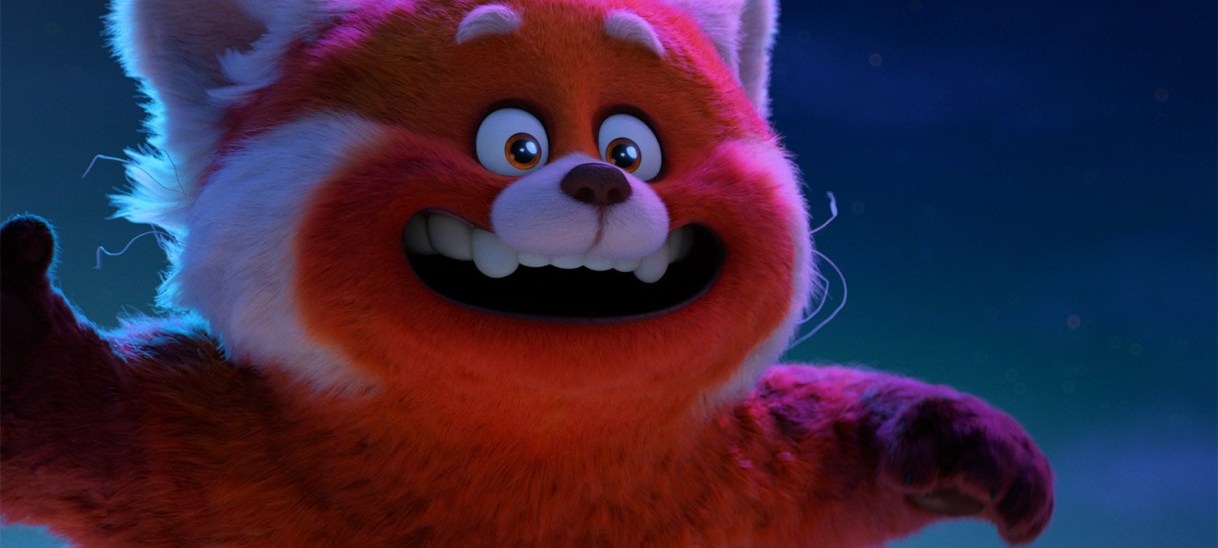
Toronto resident Meilin Lee (Rosalie Chiang) is on the verge of adolescence, lusting after boys she ordinarily wouldn’t and engaging in activities that draw the disapproval of her otherwise doting mother, Ming (Sandra Oh). But puberty is not the only drastic change the youngster is having to contend with – now that she’s a teenager, Mei finds herself transforming into a giant red panda whenever her emotions are heightened, a source of embarrassment greater than any other in her life.

The driving force behind Turning Red (2022) is writer-director Domee Shi who, just like Mei, is a proud Torontonian with Chinese heritage. Shi’s career trajectory is more interesting than most, having joined Pixar as an intern before garnering widespread acclaim with her allegorical short film Bao (2018). After this success, Shi was promoted to Pixar’s “Brain Trust” and given the opportunity to craft her own feature-length production; in turn, the film-maker has concocted the most energetic, inimitable Pixar film yet.

The most distinguishing element of Turning Red is the art-style. While there are shades of Pixar’s influence in the design of the characters and settings, the look of the film is distinct from any of the studio’s previous feature-length productions, a change that is most welcome. Soft colours dominate the architecture of Toronto, and clothing of those who inhabit its surroundings; humans of all sizes and body types interact with one-another, while their faces are adorned with large teeth and pupils that comically dilate or contract depending on their mood.

The animation, too, is a point of difference from other Pixar films. Where in the past, a character would move smoothly and gracefully (one could even say “realistically”), in Turning Red, the movement of the protagonists is quick and frenzied, welcomely leading to some well-timed physical gags that border on slapstick. Adding to this witty and frantic vibe is the editing, which occasionally employs some Edgar Wright-style quick cuts to further discern the picture from its contemporaries. Yet the differences go even deeper than that.

Ming Lee and daughter Meilin are often at odds in Turning Red.

Further distinctions are found in the screenwriting, which matches the vibrancy of Turning Red’s visuals. The plot is narrated in the first-person by a self-aware figure who frequently breaks the fourth wall and wears her geekiness with pride, forgoing the usual stereotype of an introverted, awkward teenager. Likewise, her friends are eccentric, outgoing and unashamedly nerdy, offering the perfect social and moral support – another rarity in coming-of-age tales. Additionally, it’s a tale that feels quite timeless, despite the film’s early-2000s setting.

Yet for all the freshness this script provides, it is stymied by the occasional flaw. One such example is the antagonistic Tyler (Tristan Allerick Chen), who is underwritten and poorly developed – efforts made by the film to complexify and soften his character are tame at best and confusing at worst. Another letdown is the third act, relinquishing the vim and momentum present elsewhere in Turning Red, slowing events to an underwhelming conclusion, and providing a left-field revelation about Tyler that bears no relevance to the conflict.

The one upside to these blemishes is that they aren’t a common sight in Pixar’s filmography, offering further proof that the team at Emeryville are no longer adhering to a formula or norm. Between this flick and Luca (2021), it looks as though Pixar is shying away from being a safe, comfortable brand and instead following the route of its fellow CGI powerhouses, DreamWorks and Sony in taking risks – they’re hiring new people, toying with different art-styles and telling more diverse stories.

Turning Red heralds a promising future for Pixar Animation Studios, providing the medium with a fresh and distinctive voice in Domee Shi. Viewers will find themselves drawn to the quirky characters, original story, lively animation and bright illustrations of a stylised Toronto, making for an entertaining and resonant experience regardless of one’s background.

Turning Red is now available on home-video and on-demand services, and streaming on Disney+.

Disney’s Jungle Cruise is a Ride to Be Forgotten

There’s a prestige and heritage to the Disney brand that other studios can only envy – it’s a fact the corporation itself recognises, having produced a new picture that plays to its traditions. An initial glance suggests that said picture is primed for success; one viewing is enough to prove otherwise.

At the height of the First World War, Dr Lily Houghton (Emily Blunt) is venturing to the Amazonian rainforests of South America, where she hopes to locate a rare flower with fabled healing properties in the name of science. Upon arrival, she engages the services of tour guide Frank Wolff (Dwayne Johnson), who offers to pilot Lily – and her accompanying, neurotic brother MacGregor (Jack Whitehall) – in his own boat along the Amazon’s many tributaries.

Their journey is one that will be fraught with the deadliest of dangers, including carnivorous beasts, turbulent rapids, and native tribespeople who are unwelcoming to outsiders; yet the greatest threat of all is a pursuing German officer, Prince Joachim (Jesse Plemons) who seeks the flower for his own warped, egocentric benefit as much as his beloved Vaterland.

Jungle Cruise is the latest blockbuster to be adapted from a Disneyland attraction, joining the likes of the Pirates of the Caribbean films, as well as less popular efforts such as The Haunted Mansion and Tomorrowland. Of these releases, it’s the Pirates franchise that Jungle Cruise most closely aligns with, hoping to emulate the former’s box-office success – a feat that looks unlikely, not just because of recent outbreaks of a certain strain of virus, but also the sheer mediocrity of the picture.

One advantage that Jungle Cruise does possess is a talented cast, including two leads who are familiar to the Disney faithful. Emily Blunt is the top-billed female, having previously fronted the cameras for Into the Woods and Mary Poppins Returns, albeit with more singing; her male counterpart, Dwayne “The Rock” Johnson is no stranger to the studio either, with starring roles in The Game Plan, Race to Witch Mountain and Moana.

Undoubtedly, Blunt and Johnson’s historic involvement with Disney is what endeared them to the producers, and perhaps why both actors perform with a laidback confidence – their respective characters seem more an extension of their own charming selves than a transformation. This is particularly evident when the two personalities share the screen, demonstrating the kind of chemistry that is usually found in more seasoned duos, not a pair who are sharing their first credit together.

The villainous Prince Joachim (Jesse Plemons) as seen in Jungle Cruise

One performer who has taken the transformative approach, and played against type in the process, is Jesse Plemons. Where in other roles he would be understated with only a hint of menace, here Plemons gleefully portrays the antagonistic Prince Joachim with a fitting level of camp, eccentricity and accented speech. It’s yet another delightful performance from Plemons, who by now is well on his way to conquering Hollywood.

Sadly, that praise does not extend to the secondary villains of Jungle Cruise: a group of zombified Spanish conquistadors who are clearly inspired by Captain Barbossa’s crew. Despite their unique appearances – the men take their physical form with the help of rainforest features such as vines, snakes and hornets – there’s nothing remotely interesting nor memorable about these foes, who lack the personality and wickedness necessary for this kind of role.

Matters are made worse by the substandard visual effects, which look as though they were rendered two decades ago; the comedic elements, which barely incite so much as a chuckle; and the underwhelming soundtrack from James Newton Howard, which lacks a rousing theme a la the Pirates movies. Yet these problems are minor when compared to the biggest issue of all: the confusing action sequences.

By most measures, the thrills of Jungle Cruise are pretty serviceable, with decent choreography and stunt-work; but they are made difficult to appreciate due to the shaky camerawork and frantic editing. Such techniques have been utilised by many a Hollywood blockbuster in recent times, proving just as annoying here as they do elsewhere – it’s high time producers learned that they don’t make the action any more exciting.

It’s baffling to think that a film with six producers and the backing of the world’s largest studio could be so mediocre. Despite having some gifted actors at its disposal, Jungle Cruise serves only as a passing distraction, with most of its other attributes being adequate at best. If this film is to herald a new Disney franchise, it’s not a promising start.

Jungle Cruise is screening in cinemas nationally where open, and available for streaming with Premium Access on Disney+.

Pixar’s Luca is The Beachside Getaway We All Need

The medium of animation has advanced greatly in the past few years, having gifted audiences with mature, compelling stories that put their live-action counterparts to shame. Pixar Animation Studios has long been at the forefront of this movement; here though, they’ve reneged on their recent form and produced a picture that’s decidedly lowkey, yet palatable all the same. 

On the sea floor, not far from the coast of Italy lives a family of amphibious monsters, among them the bright, curious Luca (Jacob Tremblay) who longs to know what lies above. Luca’s inquisitive nature eventually gets the better of him, as he joins a fellow creature of the marine, Alberto (Jack Dylan Grazer) in venturing to the surface, there discovering that his colourful, scaly body can morph into that of a human being.

Luca and Alberto make the most of their land-based forms, journeying to the coastal village of Portorosso where they befriend Giulia (Emma Berman), the daughter of a local fisherman, Massimo (Marco Barricelli). With Giulia’s guidance, the two ocean-farers interact with the town’s residents, sample Italian delicacies, and learn about the world beyond; yet they also face many perils, including teenage bullies, a cantankerous feline, and the populace’s unyielding prejudice against aquatic lifeforms.

As with Soul, Pixar’s previous feature-length film, Luca has shunned a “traditional” cinema-first release to appear exclusively on the Disney+ streaming service. Some have viewed this move as a devaluing of the Pixar brand; others still consider it to be undermining the theatrical experience. Whatever the case, it’s a decision that showed great foresight on Disney’s part, since a surge of coronavirus cases and lockdowns here in Australia means that theatrical releases are now untenable, leaving streaming as the only viable option.

Protagonists Luca (left) and Alberto in the town of Portorosso

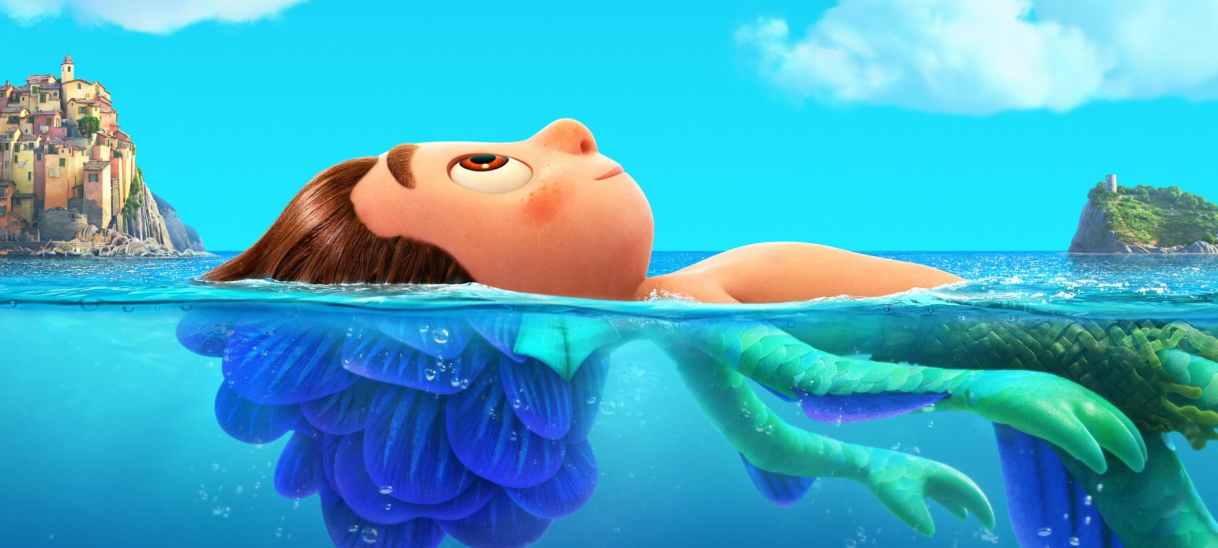
Just as well too, because Luca is ideally suited for the kind of escapism that everybody so desperately craves right now. Like every Pixar release, the animation and rendering are flawless, with a quaintness to the designs of Portorosso, and its surrounds looking particularly beautiful. More mesmerising still are the scenes of Alberto and Luca enjoying typical seaside activities, with their cliff-jumping and swims in the ocean being fun and surprisingly cathartic – it’s almost like being on holiday.

That easy-going nature is present throughout, for Luca is unusually succinct, breezy and straightforward for a Pixar film; the screenplay lacks complexity, the conflict between the protagonists is rather trite, the main antagonist is little more than a cliché, and the stakes are quite low for all involved. Mundane though this approach is, it does allow Luca to be a sweet, gentle alternative to the rest of Emeryville’s output, offering a respite from the existential discussions that viewers may well be fatigued by.

The atypical nature of Luca extends to the designs and illustrations, which again are unlike any other Pixar production – note the characters with their bulbous heads, and round eyes with wide irises. According to director Enrico Casarosa, the visuals are wholly inspired by the works of Hayao Miyazaki, a fact which is most evident when seeing Giulia’s cat Machiavelli, who certainly wouldn’t look out-of-place in a Studio Ghibli film. It’s a welcome change from the norm, and one that hopefully finds its way into future releases from Pixar.

Although light on story and innovation, Luca is a warm, joyous excursion that refreshingly breaks free of the Pixar mould. Enrico Casarosa’s feature endears through its distinctive visuals, mellow tone and sense of adventure, proving an ideal escape for viewers of all ages – and the perfect film for pandemic viewing.

Luca is streaming worldwide now on Disney+.