Sentimental Value is The Moving Family Drama to See

Rating: 4.5 out of 5.

Arriving on Australian shores on Christmas Day, Joachim Trier’s follow-up to the Millennial instant classic The Worst Person in the World (2021) follows a family collision of artists that may be the perfect film for the holiday. Sentimental Value (2025) is a film about artists unable to articulate their feelings but are able to embody them and translate it to a captive audience. Trier and frequent collaborator Eskil Vogt have moved from dense single-character explorations into a wider canvas of a family, allowing their humanist writing style to weave between the said and unsaid.

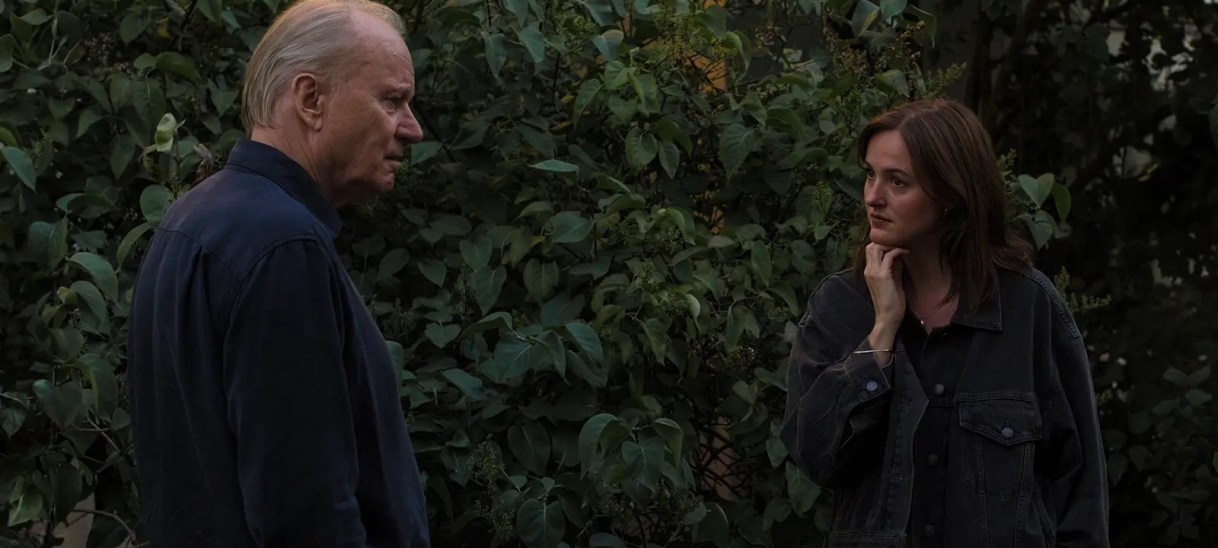
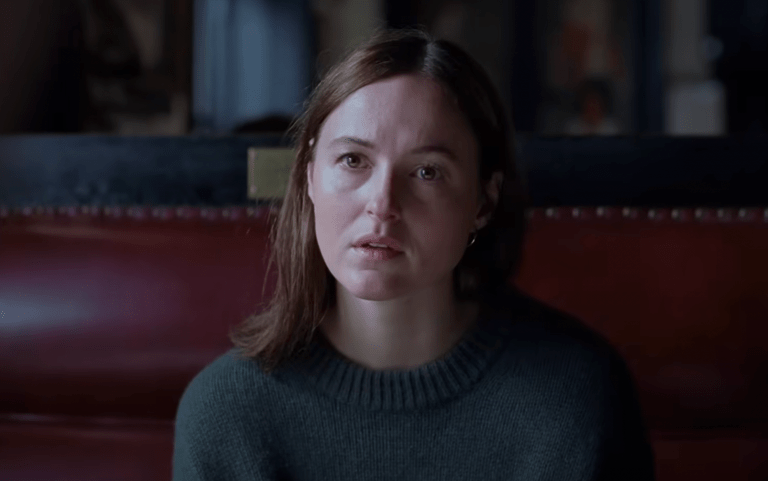
Centred is Nora Borg, played by another frequent collaborator in Renate Reinsve, a respected theatre actor suffering from immense stage fright; Agnes (a remarkable Inga Ibsdotter Lilleaas), her younger sister who has escaped the arts to make a more grounded life for herself; Gustav (a tremendous Stellan Starsgård), a well respected arthouse director and their distant father; and Rachel (Elle Fanning), an American star who aches to work on more meaningful work.

The film focuses on the return of Gustav, who has written a script that explores the past and present of the family’s history, set in the old family home, most of where Sentimental Value is set. He believes this script will launch him out of the retrospective tour space and back into the forefront of modern cinema; he just needs his estranged daughter, Nora, to agree to collaborate with him and star in the film. When she refuses to work with her father on the film, Gustav, after a chance encounter at a film festival, asks the young star Rachel to perform the role instead.

The act of writing a lead role for a loved one is something the film does not take lightly, whilst never allowing the work to unfold into a navel-gazing melodrama. A shaggy family drama about the film business and artistry would quickly implode, but Trier and Vogt’s script has a dedication to the central three family members that always feels generous. 
Renate Reinsve in Sentimental Value (2025.)

While a gut punch on first viewing, upon multiple viewings, it becomes clear that this is a generational performance by Skarsgård. This is made all the more extraordinary due to his health and his inability to memorise lines post-stroke. It is too rare where a character and performer to become as intrinsically linked as Skarsgård and Gustav do here, as an aging artist looking to the past, present, and future of their family line to understand themselves and those around them.

Bergman is always on the mind while interpersonal scenes float from moment to moment. The film dances between influences in Persona (1966) and Vertigo (1958) with Fanning’s character Rachel, arriving at an equal power through a balance of influences. While Hitchcock’s complicated masterpiece wields the weight of comedically heightened mirroring and Bergman’s film of duality that revel in never fully eliding its meaning to the characters, Trier’s mirroring achieves its power through its late decision to voice itself clearly and openly. 

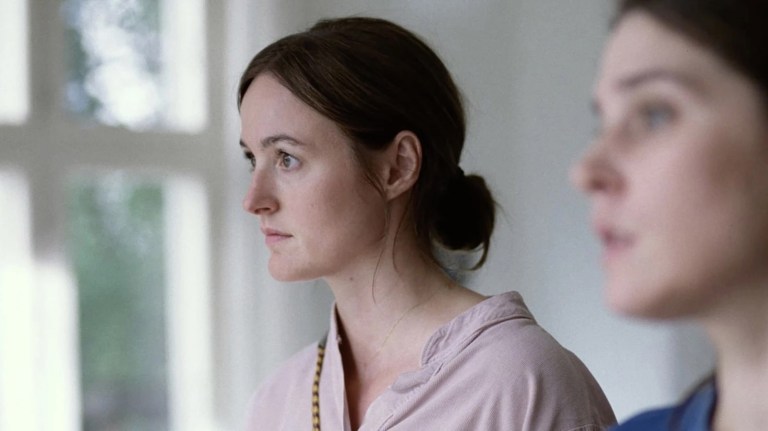
A key scene of mirroring occurs in a pair of scenes that opens up the film into a world of collective humanity that is often the goal of Trier’s films. On one side of the glass is a monologue rehearsal scene with Rachel (after dying her hair to more closely resemble Nora) and Gustav, who is struggling to reach the impossible place he is searching for. On the other, a gorgeous scene where Nora finally reads the script after being given it by her sister, after she also finally reads it. After finally reading the script and releasing the intimacy that Gustav is pouring onto the page — something he would never articulate to them personally — the sisters are profoundly moved, and a point of familial understanding overwhelms them. 
(from left) Renate Reinsve and Inga Ibsdotter Lilleaas in Sentimental Value (2025.)

Whether the film too neatly arrives at its climaxes is up to personal taste, but much needs to be credited to Trier and Vogt for the level of clarity and emotional weight they give to the struggle artists have with connecting to those they love without using their art. And the exploration Gustav has in writing extends as an olive branch to Nora, to tell her he sees her struggles, but gives her the medium of her art to explore them together.

It is in these moments of generous openness and charged, yet elided, dialogue that Sentimental Value becomes a beautifully emotive family drama. Trier and all his creative collaborators understand that to create is to bridge an ocean of the unsaid, even if that means building a replica of your generational family home on a soundstage, only to have it hidden on the 18th page of the Netflix arthouse section. Trier and Vogt understand deeply how, even through that artifice, true openness and connection can be translated into a final, powerful image of understanding but not resolution.

Sentimental Value is in select theatres now.

Predator: Badlands Breathes New Life Into the Franchise

Rating: 3.5 out of 5.

With a powerful battle sequence between brothers on the Predator home world of Yautja Prime, Predator Badlands (2025) starts with an operatic bang. The two brothers, Dek (Dimitrius Schuster-Koloamatangi), and the older Kwei (Mike Homik), are training relentlessly. Dek, much smaller than the standard warriors we see in these films, is desperate to prove himself to the clan, and his brother is desperate to help him survive their ruthless culture. After a dramatic confrontation between the brothers and their father, Dek escapes with a quest to hunt the Kalisk, a rumoured unkillable monster on the unforgiving planet of Genna.

Like a live-action version of Scavengers Reign (one of the best shows of the decade), Badlands is all about the environment and the evolutionary marvel of a stranger crash landing on a new planet. With its unique plant and animal kinds that Dek must learn to understand to survive, director and now franchise steward Dan Trachtenberg has developed the first Predator film that actually puts the shoe on the other foot of the Yautja. What allows the film to thrive and stand alongside the John McTiernan original is its exploration of the dense planet of Genna, which brings the story’s intimacy into focus.

Quickly into Dek’s journey through Genna, he stumbles onto and is rescued by Thia, a severed Weyland-Yutani synth played by the effortlessly charming Elle Fanning. Through the overly chatty Thia and the attempting brooding of Dek, the familiar trappings of the mismatched adventure duo, laid on top of the familiar story of the runt of the litter in search of validation from the clan, ground the storytelling. This allows the simple charms and filmmaking craft to flourish inside a franchise that never settled on anything outside of its central figures’ iconic imagery.

Elle Fanning, surrounded by cute and fascinating creatures, has the charm and humour to sustain an entire film herself. A longtime actor who has recently become one of the most in-demand actors in the industry, Fanning pulls double shifts here as Thia and Tessa, two synths exploring the planet and also seeking the Kalisk. Her boundless energy, as Thia, is played in stark contrast to her “sister,” Tessa, a cold and driven synth that plays the role of a killing machine, typically reserved for the film’s resident predator. 

Elle Fanning as Thia in Predator: Badlands.

But this is not just a Fanning showcase. For too long, the Predator franchise has fallen flat in its characterisation of its iconic hunter. Until Dek and Kwei, we had not had a real conversation between Yautja, an outrageous failure of a franchise that never seemed invested in the science fiction genre that has allowed the Alien franchise to expand and evolve. By opening up the role of the predator as Dek finds his place amongst an unfamiliar world, Badlands is allowed a freedom to morph and change at will. Dimitrius Schuster-Koloamatangi does not have much facial real estate to exude personality to an audience, but the deep focus on him allows his fear and uncertainty to ground his journey in a familiarity rarely seen in the franchise.

Never before has the cultural bloodsport that is the heart of the Predator franchise been more sharply critiqued and illuminated as it is here, becoming quickly apparent why Trachtenberg felt there was so much left to say to rapidly pen a trilogy of feature films. A species of hyper-intelligent, hyper-athletic and advanced warriors so uninspired by their own cultural wealth that only the pursuit of a galaxy-spanning hunt can give them purpose. With a simple turn to have a Predator film centre a familiar narrative of the runt of the litter goes out to prove themselves to the pack, we finally see ourselves in the eyes of these once mythical, feeling creatures.

What allows the film to thrive is its cinematic integrity, focusing on a Yautja as a protagonist, staring intently at its face and eyes. Through those eyes, Badlands probes deeper into the worlds and cultures so rarely seen in a franchise a mile long and an inch deep. For too long, filmmakers have focused on the Yautja as an invisible hunter stalking prey, never probing into their real thoughts or struggles, or even giving them a language to communicate.

By striving for incremental IP world-building and narrative exploration over cinematic iconography, Badlands, like Prey (2022) before it, has quiet goals that it easily achieves. With a fully game duo in Fanning and newcomer Schuster-Koloamatangi, Trachtenberg, in a suite of films, takes his place as steward of the once flailing franchise. That he has achieved this not through IP management or navel gazing but by finding a unique balance between narrative exploration and genre entertainment is no small feat, something that should make fans, young and old, stand up and applaud.

Predator Badlands is in theatres now.