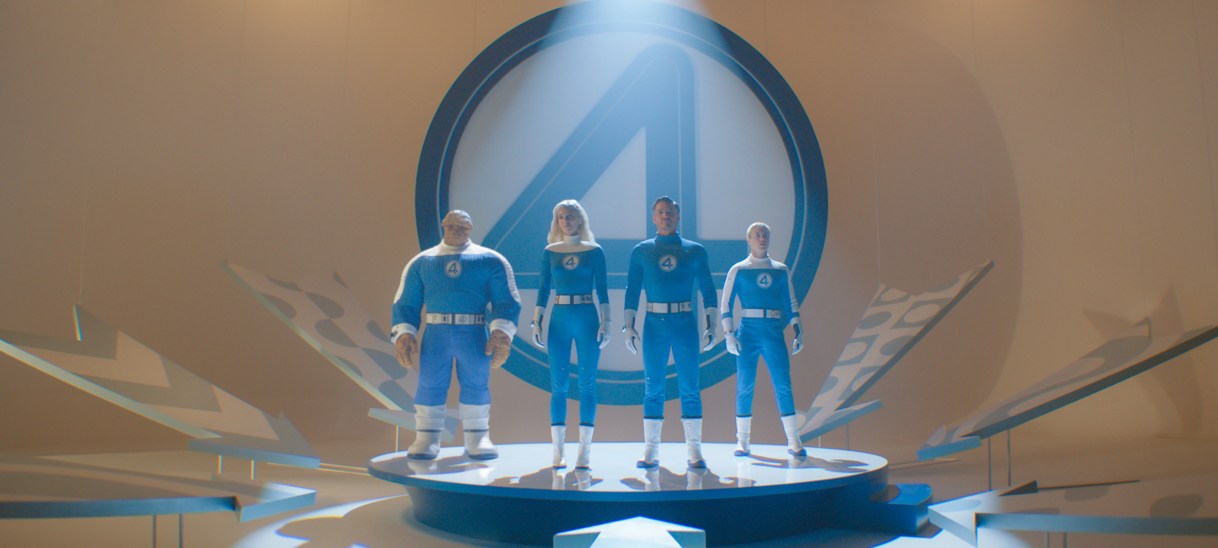
It can be daunting being the first. The first people in space. The first superheroes in the world, uncertain of the responsibility their power demands. The first child. Crossing that uneasy bridge from the familiar into the depths of the unknown. This was once a core aspect of superhero storytelling, but after thirty-seven entries in the compounding Marvel enterprise, it feels impossible to return to. Even the recent release of James Gunn’s Superman (2025) — a new frontier on the DC side of larger storytelling building blocks, while successful in its storytelling — had notes of this and still couldn’t help itself surround their central figure with larger but unnecessary chatter.
But this is where The Fantastic Four: First Steps (2025) succeeds and earns its colonised titling and a real throwback to why the MCU has built a legacy on quality films. Set in an alternate Earth from the familiar stomping ground of the MCU, and heavily focused on its famous foursome and not its larger worldbuilding, director Matt Shackman has crafted a brisk and entertaining sci-fi-focused ride that will leave you wholly satisfied; a feeling Marvel films used to give us.
the Fantastic Four, led by Reed Richards and Sue Storm, brought to life better than ever by Pedro Pascal and Venessa Kirby, and flanked by Ben Grimm (Ebon Moss-Bachrach) and Johnny Storm (Joseph Quinn), arrive on screens in an Jetsons-themed alternate reality giving them the freedom of not needing less compelling super friends to give passing screen time too. Portrayed with enthusiasm and sincerity that reflects outwards into the whole film while still avoiding a saccharine mawkishness, making this Fantastic Four entry feel like a delightful throwback.
Four years into their journey, that is just settling in until the unexpected arrives both in-house and extra-terrestrially; the surprising pregnancy of Sue and the arrival of the Herald of Galactus (Ralph Ineson), The Silver Surfer (played with a pride and melancholy by the great Julia Garner), spelling doom for the Earth.

Building a competent film around these four characters has proved difficult in the past (this is the fourth go around for the crew in cinema, maybe they needed the luck?), but writers Eric Pearson, Josh Friedman, Jeff Kaplan, and Ian Springer have found success by properly centering the four actors, allowing plot and CGI battles to whizz past their family sci-fi soap opera. Told with sincerity and a deep love of the characters strengths and weaknesses, Shackman is allowed to stretch out and tell a full story, showing the potential from his directorial work on WandaVision (2021), perhaps the only successful Marvel TV show post Daredevil, even if it relied on a lazy final battle to conclude its story.
By centring two terrific performers who have shown the ability to operate in an old Hollywood mode, Pedro Pascal (in full Clark Gable mode) and Venessa Kirby jump off the screen with a chemistry and guile built from the characters out. Even as the world around them monumentally shifts with the arrival of a new child and a new Earth-destroying threat, we constantly see them lock eyes and respond to each other with a depth of understanding and empathy that wouldn’t be amiss in an awards season marriage drama. Pascal is at his best as a supportive scene partner, an invisible hand that allows others to shine instead of absorbing the audience’s attention.
Rounding out the team is Ebon Moss-Bachrach and Joseph Quinn who have an easy banter built on warmth and care that adds to scenes. Quinn in particular is given a full story that is surprising and compelling, improving on the reductive framing we often see of the Human Torch.
A refreshing turn in the superhero genre that is potentially in its death throes, The Fantastic Four: First Steps focuses on an older sci-fi genre package with longer dialogue scenes, fewer action moments with a passing amount of care and attention to story, and a visual language that mostly grounds itself in its own reality (several scenes still feel deeply 2020s which the film seemed intent on avoiding in its first hour).

With special effects that actually looked like the VFX team was given time to fully render and actualise ideas from scratch, The Fantastic Four: First Steps withheld the action at the centre of the story in place for a simple but emotive narrative built on a new, emerging family. Even Galactus, once portrayed as a large cloud in a film too embarrassed by its own sci-fi story, is given a tactile nature and a quality performance by Ineson, perhaps the best voice in the industry. In few words, Ineson displays a menace to his words but a clarity in character motivation one wouldn’t expect from an enormous villain desperate to consume planets. It’s not just that Shackman found space for the key six characters to show dimension and character through considered relationship work within a sci-fi framework; it’s that we could achieve this while wrapping up the film in under two hours.
The Fantastic Four: First Steps is a fast-moving train that has a real destination in mind, an aspect of American genre storytelling we took for granted and allowed to bloat and stagnate, too satisfied with its own navel-gazing to realise they were left as the only people looking. With a recent run of superhero films, Thunderbolts* (2025), Superman, and The Fantastic Four: First Steps, we are potentially rounding the corner into the enjoyment and craft that built this genre into the cinematic tentpole that it strives to hold onto.
By giving these characters a fully rounded narrative that satisfies more than stringing you along with the promise of a larger experience in the future, Shackman and co have achieved what was supposed to be the goal of cinematic genre storytelling; something familiar and something new, contained in an entertaining and sometimes emotional time at the movies. Where James Gunn’s Superman stretched far and wide to populate his emerging franchise venture, making for a fun but frustrating experience, The Fantastic Four: First Steps focuses on a small collection of characters where the biggest spectacle is the arrival of a new family member, the largest event in most audience members’ lives as well.
The Fantastic Four: First Steps is in theatres now.


 Rating Frames