Revisiting Your Name, Makoto Shinkai’s Blessing for a Disaffected World

Every so often, there comes a film that transcends boundaries to find mainstream success. Such an example is this feature-length animation from 2016, a narrative that spans multiple genres and subverts expectations to be one of the artform’s most beautiful, original and compelling offerings, leagues above anything else from that same period.

Teenagers Mitsuha and Taki lead very different lives – the former is an introverted girl who resides in the Japanese countryside with her grandmother and younger sister; the latter has no siblings and shares an apartment with his father in Tokyo. Over the course of several months, these two strangers will awake in each other’s bodies, altering and manipulating their usual routines to the point where they become different people entirely.

As its manga-style designs make obvious, Your Name (or Kimi no Na Wa) is a feature-length anime, being one of several released in its home country of Japan every year; yet despite their ubiquity, very few of these pictures make their way into the Western hemisphere, and fewer still attain any semblance of popularity – arguably, only the releases of Studio Ghibli have managed to do so. This fact alone is enough to make the prominence of Your Name noteworthy, but what makes it all the more extraordinary is knowing who directed the feature-length production.

Responsible for helming Your Name is Makoto Shinkai, who had developed a modest following with his oeuvre in the years prior. Many of the themes in Shinkai’s previous films are rekindled in his 2016 effort, including adolescence, time and companionship, as are the fantasy elements that he so often incorporates. Think of it less as somebody lazily applying the same old tropes, and more an auteur utilising his motifs, like Hayao Miyazaki and his recurring morals of environmentalism and pacifism.

One of the greatest strengths of Your Name is how fluidly it morphs between genres, dabbling in fantasy, science-fiction, romance and drama without tying itself to any one in particular. Just when the picture looks to have settled on a tone – just when the viewer thinks they’ve worked out where the screenplay is heading – along comes an unexpected turn that sees it transform, almost into an entirely different narrative. Impressively, these transitions are never jarring or bewildering, but rather a smooth, natural progression of the story.

Mitsuha scribbles on her face in Your Name

Just as investing is the development of the protagonists, who become more likeable as the movie progresses. From the outset, audiences will find themselves relating to the struggles of Mitsuha and Taki, but their naivety and timidness are evident; as the plot continues, both characters mature and gain confidence through their body-swapping experiences, changing from archetypal youths to well-rounded adults. As a result, the viewer grows so attached to Mitsuha and Taki that the film’s emotional moments are made absolutely heart-wrenching.

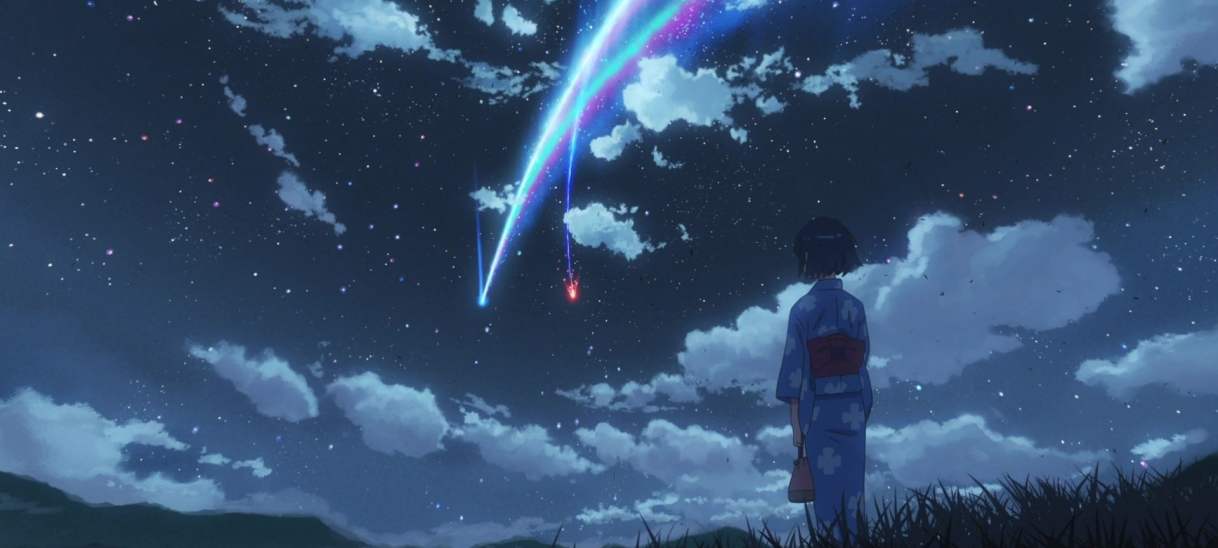
Another reason to love Your Name is the animation, which is of a quality seldom witnessed in a Japanese production. All of the illustrations, be they the character designs, landscapes, vehicles or otherwise, are superbly detailed and splashed with colour, with the highlight being an ethereal, dreamlike sequence that sees Taki transported through time. This is Ghibli-levels of artistry on display here, with images so gorgeous that they deserve to be placed on the walls of a museum.

Although there’s plenty to distinguish this picture from its anime brethren, Your Name still ties itself firmly to the medium. Frequent references are made to Japanese culture and tradition, tropes of the artform appear every so often, and there’s an upbeat J-pop soundtrack provided by Radwimps that’s surprisingly pleasant to the ear. That’s the beauty of Your Name – clichés that would detract from the experience in another feature prove nothing but endearing here.

Unfortunately, there is one drawback to Your Name, and that’s the epilogue. While touching and by no means bad, these last few minutes feel like an eternity, needlessly delaying the inevitable outcome to the point where the film overstays its welcome. In fairness though, this is only a minor criticism that in no way frustrates, nor does it sour the rest of Your Name, which is as close to faultless as any feature-length anime has come in the past decade.
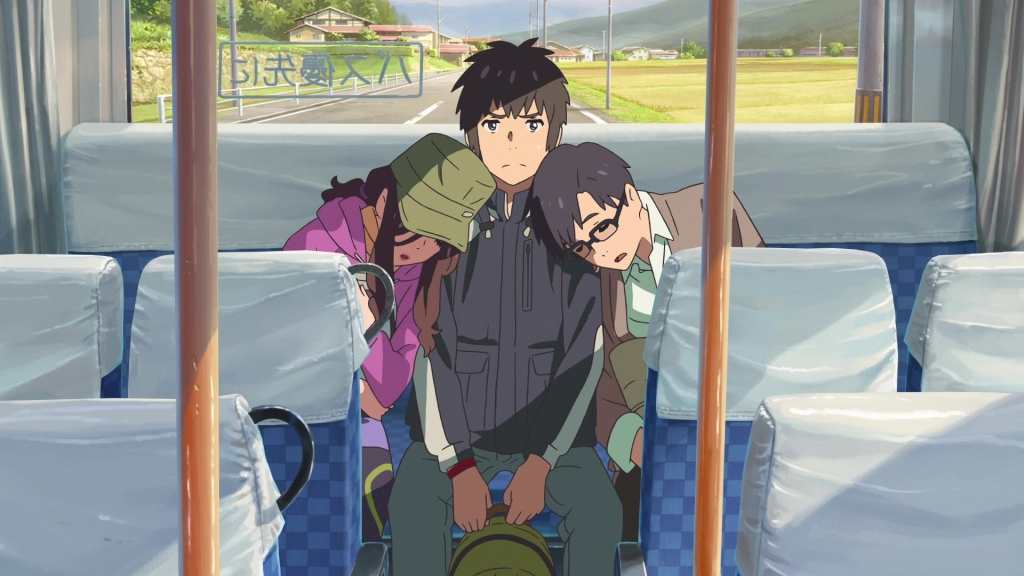
Taki (centre) with friends Miki and Tsukasa in Your Name

That consensus is one that’s widely shared by critics and cinemagoers – Your Name earned rave reviews in Japan upon its theatrical release and shattered records at the domestic box-office, being the highest-earning film of 2016 by a considerable margin and becoming the second highest-grossing anime film of all-time, behind Miyazaki’s Spirited Away. (It’s now in third position, with Demon Slayer: Mugen Train having usurped the top spot.) Those accomplishments were later mirrored in the West, where the movie generated far more interest than usual for a Japanese release.

Your Name’s unexpected success in the Anglosphere can be attributed to two factors. One is the releases it performed against: a myriad of ordinary blockbusters that did squat to innovate the medium, and just as little to appease cinephiles. The second factor is the downbeat period in which the picture was released – remember, 2016 was a particularly miserable time for many people, owing to Trump, Brexit, and a swathe of beloved celebrities passing away, among other things. What this movie provided wasn’t just an alternative to its lacklustre contemporaries, but an escape from the glum realities of life.

Three years after Your Name, Shinkai would attempt to capitalise on his global triumph with the release of Weathering With You, a film that shares many of the same attributes. In addition to utilising the plot mechanics from his prior works, Shinkai’s follow-up boasts beautiful illustrations, charming protagonists and an accompanying Radwimps-penned soundtrack; yet it also suffers from the identical problem of a prolonged third act. One thing Weathering fails to capture though is the magic of its predecessor, lacking that sense of wonder – but then again, there a few other films that do possess such wonder.

Placing in the top tier of animation and eclipsing most live-action productions, Your Name is a disarming, spellbinding feature with beautiful illustrations, loveable characters and a fresh screenplay that is unpredictable in the best possible way. It’s essential viewing for anybody who calls themselves an anime fan, and an ideal entry-point for those wanting to immerse themselves in the artform.

Your Name is currently streaming on Netflix.
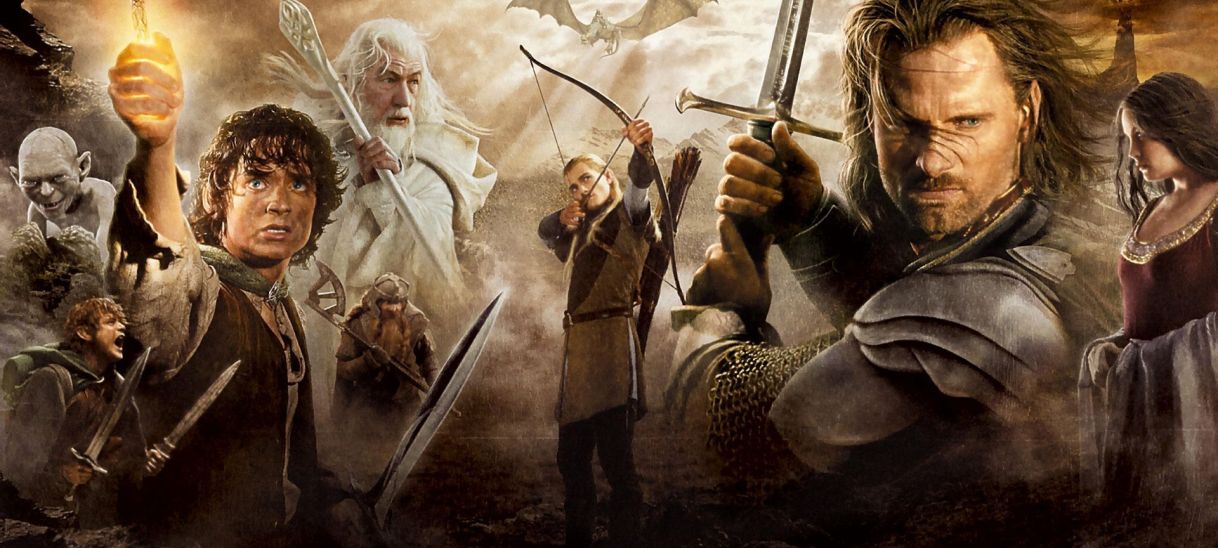
Peter Jackson’s The Lord of the Rings Revisited, 20 Years On

It’s been almost 20 years since Sir Peter Jackson introduced audiences — both new and familiar — to the world of Middle Earth, on the big screen. In those 20 years since The Lord of the Rings: The Fellowship of the Ring (2001), nothing, save for the sequels to The Fellowship of the Ring, has managed to capture the awe and bravado of Jackson’s Middle Earth. Franchises have come and gone, and Jackson has also adapted The Hobbit (2012 – 2014) for the big screen, but The Lord of the Rings continues to inspire as well as keep audiences coming back for more as the years roll on. Much has been said and written about the trilogy, but I believe it’s important to remind audiences why this trilogy has remained a staple in cinema history. What follows is an analysis of why Jackson’s adaptation of The Lord of the Rings has continued to permeate film culture, how it redefined the Fantasy genre, and what made the franchise as celebrated as it is.

The Lord of the Rings Trilogy Before the Acclaim

Before delving into the aforementioned concerns of the piece, it is important to first outline the trajectory of The Lord of the Rings in cinema culture — from its inception, up until Jackson’s adaptation. In the years before Jackson’s The Lord of the Rings adaptation came to fruition, there had been an animation adaptation in 1978 by Ralph Bakshi, which opened to a fair reception, and the Beatles had apparently wanted to star in a live-action adaptation of the books, with Stanley Kubrick said to have been their choice to direct. Kubrick allegedly turned down the offer to direct the planned film after saying that it was unfilmable (at least in terms of the technology not being there yet). As J.R.R Tolkien owned the rights to his work, he also turned the proposed Beatles film down as he didn’t want his work to be taken by the band and turned into something outlandish for the big screen.

It wasn’t until sometime in the mid-90s that the idea of a Jackson-led The Lord of the Rings adaptation began to circulate in the media. With Jackson’s earlier films like Bad Taste (1987) and Braindead (1992) being the epitome of schlock horror — films characterised by their absurd plots, quirky characters, campy humour, and so forth — it was no surprise that doubts were raised over the announcement that Jackson was to adapt the work of beloved and trailblazing author, J.R.R Tolkien.

Jackson had come off of directing a decently received, The Frighteners (1996), before pitching the idea of turning The Lord of the Rings into a live-action trilogy, to Miramax. Miramax said that they would be able to make two films instead of the proposed three, with the cost of the films driving their decision. However, Miramax eventually decided that that they were unable to fund the making of two films at the scale proposed. Subsequently, Jackson was allowed to pitch the idea for the films to other studios, and was eventually able to bring New Line Cinema on board to finance the film.

With New Line greenlighting the proposal for an adaptation helmed by Jackson, the next big hurdle came with the budget increase for each film. New Line had reportedly agreed to spend around US $60 million on each film, but that budget proved unrealistic with how audacious and large each film ended up becoming. Instead, New Line ended up spending around US $120 million on each film, with that eventual sum being agreed upon through much deliberation and even heat between Jackson and film executive Michael Lynne. It wasn’t until a 20 minute preview screening at Cannes in 2001 that the studio’s fears regarding the increase in budgeting, were alleviated. This was primarily due to the positive reception the footage of The Fellowship of the Ring received, and the realisation that the money invested into the film was paying off (with the Balrog scene being one that was shown).

With The Fellowship of the Ring eventually being made, and its sequels releasing within the next two years, the trilogy had officially survived the struggles of pre-production, production, and Harvey Weinstein. The trilogy would go on to become one of the highest grossing and consistently well received franchises of all time.

Hugo Weaving, Peter Jackson, and Ian Mckellen on the set of The Lord of the Rings

What Made the Trilogy as Influential and Beloved as it is?

Trying to provide a single answer to why Jackson’s The Lord of the Rings is as iconic and influential as it is, simply cannot be done. Therefore, I will break down some of the key aspects of the trilogy and why they’ve seen the trilogy continue to enjoy the success that it has.

For starters, one of the biggest issues Jackson faced was trying to transpose such a well regarded and nuanced piece of fantasy literature as faithfully as he could, and in the time he had. Tolkien’s writing is renowned for its ability to capture the minutiae of any given aspect of the world of Middle Earth — whether that be a blade of grass or a trickle of water. In saying that, Jackson was fortunate that he had a lot to work with from Tolkien’s writing, particularly because the drawn out descriptions Tolkien provides, ultimately led to a level of clarity that Jackson simply moulded for a modern audience. Sure there was no Tom Bombadil or the battle for the Shire or the character of Gildor Inglorian, but given the scale of Tolkien’s world (those who have read The Silmarillion will know the struggle of making sense of everyone and everything being described), Jackson was able to focus on the fundamentals of the book in order to guide audiences through the three films.

A major factor that contributed to the trilogy’s acclaim and success is the fact that all facets of production aligned and worked to support each other for the entirety of the three films. There were two units that worked on the film: one that was helmed by Peter Jackson, and the other, by John Mahaffie (Second Unit Director). Both units were well equipped with resources to traverse the New Zealand landscape and country side (which is explored more in the exquisite documentary-like, behind the scenes), and Weta Workshop went above and beyond to produce sets, costumes, armour, weapons, creatures and miniatures. What this all means is that there was a sense of totality and scale unlike anything seen before or since, in a blockbuster or film of any kind. The result is one that led to the record breaking Oscars sweep for The Return of the King (2003) which won all 11 Oscars it was nominated for, and is tied with Ben-Hur (1959) and Titanic (1997) for most award wins in Oscars history.

But aside from the recognition from award wins and box office success, Jackson’s trilogy has continued to amaze viewers (included yours truly) across multiple viewings in the 20 years since. Some of the reasons why include the thematic consistency as the films went on; the largely practical approach to making the films; Howard Shore’s mesmerising score that speaks to various scenes and characters; the epic battle sequences both large and small; the memorable performances from each and every actor involved; and how the trilogy paved the way for fantasy films (and shows) to be taken as seriously as they are today.

The way in which Jackson developed a sense of forwardness from the first film to the last meant that the pacing always felt consistent, and audiences were given ample time to spend with various side characters and events, while never losing sight of the primary goal of The Fellowship. For instance, The Fellowship itself and its eventual separation, serves to engage the audience with the likes of Theoden (Bernard Hill), Eowyn (Miranda Otto), Emoer (Karl Urban), Arwen (Liv Tyler), Galadriel (Cate Blanchett), Faramir (David Wenham) and so forth. All of these characters have role to play in The Fellowship’s quest, but they also bring to surface the lore of Middle Earth that cannot be wholly accounted for.

The battle sequences also stand out, particularly due to how practical they were and how little they relied on CGI in contrast to blockbusters being released today. Ridley Scott’s Gladiator (2000) is another film that comes to mind in terms of being remembered for the amount of choreography it had and the lack of CGI it used. Rarely are modern blockbusters as hands on in their approach to large scale battles as The Lord of the Rings was, and that’s another big drawcard for revisiting the trilogy — the action strived to create an out-of-body experience that sucked audiences into the world.

Another major aspect that contributed to the ongoing success of The Lord of the Rings is the way in which the show put the fantasy genre in the limelight for film and television. The point here is simply to highlight how Jackson’s films have paved the way for the fantasy genre to be taken more seriously as a form of art. A show like HBO’s Game of Thrones has won multiple Emmy awards and has been compared to The Lord of the Rings (and rightfully so given that George R.R. Martin is greatly inspired by Tolkien). Netflix’s The Witcher show has also emerged in the last couple of years and has quickly become a fan favourite. So essentially, Jackson and his first trilogy of films have brought as much attention to the fantasy genre as George Lucas and his first Star Wars trilogy did for the Sci-Fi genre.

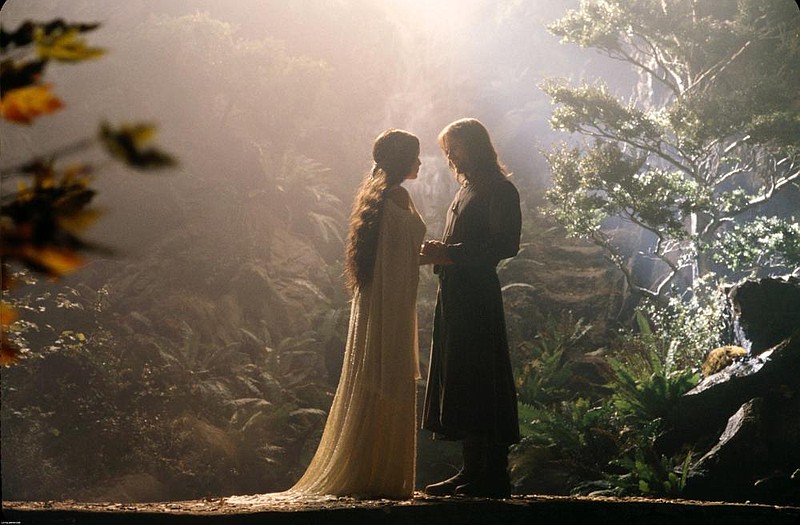
Liv Tyler and Viggo Mortensen in The Lord of the Rings

Closing Thoughts

In the 20 years since The Fellowship of the Ring, the trilogy continues to be shown in cinemas worldwide and has had a successful shelf life (with a 4K remastering having been overseen by Jackson and released last year). With a Lord of the Rings show coming to Amazon Prime in late 2022 (supposedly exploring an earlier part of the Second Age of Middle Earth), now is the perfect time to begin revisiting Middle Earth and Jackson’s trilogy. Whether or not the show will capture the hearts of audiences and critics alike is yet to be seen, but judging by a recently released still from the show, it’s anyone’s guess. What is known is that Tolkien’s The Lord of the Rings and Jackson’s adaptation of the book are just as influential today as they were during their inception, and will continue to be in another 20 years.

Sources Consulted:

  1. https://screenrant.com/lotr-everything-know-kubrick-beatles-unproduced-adaptation/
  2. https://www.nytimes.com/2001/12/12/movies/gambling-film-fantasy-lord-rings-shows-new-line-cinema-s-value-aol.html
  3. https://www.thethings.com/how-harvey-weinstein-almost-ruined-the-lord-of-the-rings/
  4. https://www.indiewire.com/2021/07/peter-jackson-screamed-studio-lord-of-the-rings-budget-battle-1234649369/

Pixar’s Luca is The Beachside Getaway We All Need

The medium of animation has advanced greatly in the past few years, having gifted audiences with mature, compelling stories that put their live-action counterparts to shame. Pixar Animation Studios has long been at the forefront of this movement; here though, they’ve reneged on their recent form and produced a picture that’s decidedly lowkey, yet palatable all the same. 

On the sea floor, not far from the coast of Italy lives a family of amphibious monsters, among them the bright, curious Luca (Jacob Tremblay) who longs to know what lies above. Luca’s inquisitive nature eventually gets the better of him, as he joins a fellow creature of the marine, Alberto (Jack Dylan Grazer) in venturing to the surface, there discovering that his colourful, scaly body can morph into that of a human being.

Luca and Alberto make the most of their land-based forms, journeying to the coastal village of Portorosso where they befriend Giulia (Emma Berman), the daughter of a local fisherman, Massimo (Marco Barricelli). With Giulia’s guidance, the two ocean-farers interact with the town’s residents, sample Italian delicacies, and learn about the world beyond; yet they also face many perils, including teenage bullies, a cantankerous feline, and the populace’s unyielding prejudice against aquatic lifeforms.

As with Soul, Pixar’s previous feature-length film, Luca has shunned a “traditional” cinema-first release to appear exclusively on the Disney+ streaming service. Some have viewed this move as a devaluing of the Pixar brand; others still consider it to be undermining the theatrical experience. Whatever the case, it’s a decision that showed great foresight on Disney’s part, since a surge of coronavirus cases and lockdowns here in Australia means that theatrical releases are now untenable, leaving streaming as the only viable option.

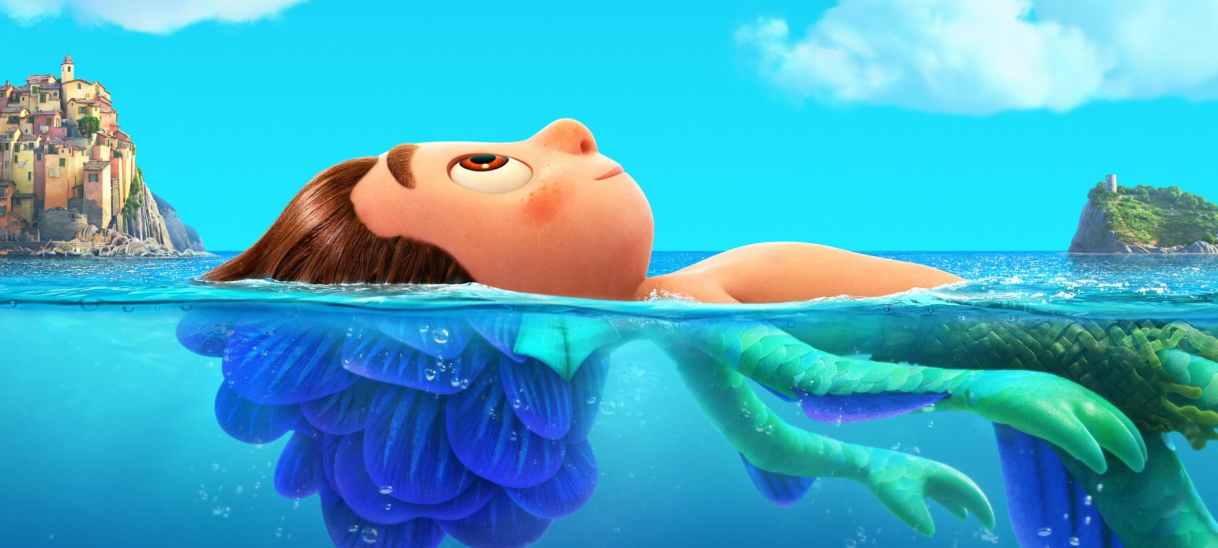
Protagonists Luca (left) and Alberto in the town of Portorosso

Just as well too, because Luca is ideally suited for the kind of escapism that everybody so desperately craves right now. Like every Pixar release, the animation and rendering are flawless, with a quaintness to the designs of Portorosso, and its surrounds looking particularly beautiful. More mesmerising still are the scenes of Alberto and Luca enjoying typical seaside activities, with their cliff-jumping and swims in the ocean being fun and surprisingly cathartic – it’s almost like being on holiday.

That easy-going nature is present throughout, for Luca is unusually succinct, breezy and straightforward for a Pixar film; the screenplay lacks complexity, the conflict between the protagonists is rather trite, the main antagonist is little more than a cliché, and the stakes are quite low for all involved. Mundane though this approach is, it does allow Luca to be a sweet, gentle alternative to the rest of Emeryville’s output, offering a respite from the existential discussions that viewers may well be fatigued by.

The atypical nature of Luca extends to the designs and illustrations, which again are unlike any other Pixar production – note the characters with their bulbous heads, and round eyes with wide irises. According to director Enrico Casarosa, the visuals are wholly inspired by the works of Hayao Miyazaki, a fact which is most evident when seeing Giulia’s cat Machiavelli, who certainly wouldn’t look out-of-place in a Studio Ghibli film. It’s a welcome change from the norm, and one that hopefully finds its way into future releases from Pixar.

Although light on story and innovation, Luca is a warm, joyous excursion that refreshingly breaks free of the Pixar mould. Enrico Casarosa’s feature endears through its distinctive visuals, mellow tone and sense of adventure, proving an ideal escape for viewers of all ages – and the perfect film for pandemic viewing.

Luca is streaming worldwide now on Disney+.