Longlegs is Your New Horror Obsession 

Rating: 4 out of 5.

Beginning with a burn-chilling opening sequence that operates on a high level of performance, composition, and editing in only a few short minutes, Oz Perkins’ Longlegs (2024) creates an all-encompassing feeling of dread and paranoia from which there is no escape. With a claustrophobic boxed aspect ratio wielded with true maliciousness, the opening frames are the shocking jolt of electric current that flows through the rest of the film, which operates in a thrilling liminal space that will keep you destabilised.

In blending serial killer procedurals with the existential dread of an unexplainable nightmare, Perkins’ internal genre mashup will surely frustrate and bewilder those on both sides of the horror spectrum. With its uncompromising vision and style, Longlegs opens up into a compelling exploration of familial abuse that will catch up to you in the days and weeks after in ways all too rare in modern horror. As a young FBI upstart, agent Lee Harker (Maika Monroe), put on the case of a serial killer who goes by (Nicolas Cage, weaponised to incredible effect), an unidentifiable killer of young families who has operated for decades. With her new partner Carter (the terrific and unheralded Blair Underwood), Lee must uncover and decrypt a series of seemingly occult clues, some seemingly linked to her life, to catch Longlegs before he targets another family.

For the crime procedural lovers, all the serial killer staple moments are here: suspenseful walks through suburbia, a tense microfiche scene in a library, and deep dives into the cult and religiosity, Longlegs has everything you could want from a modern-day homage to Silence of the Lambs (1991) inside the overused ‘elevated horror’ branding that infers hyper-considered compositions and atmosphere over ideas. 

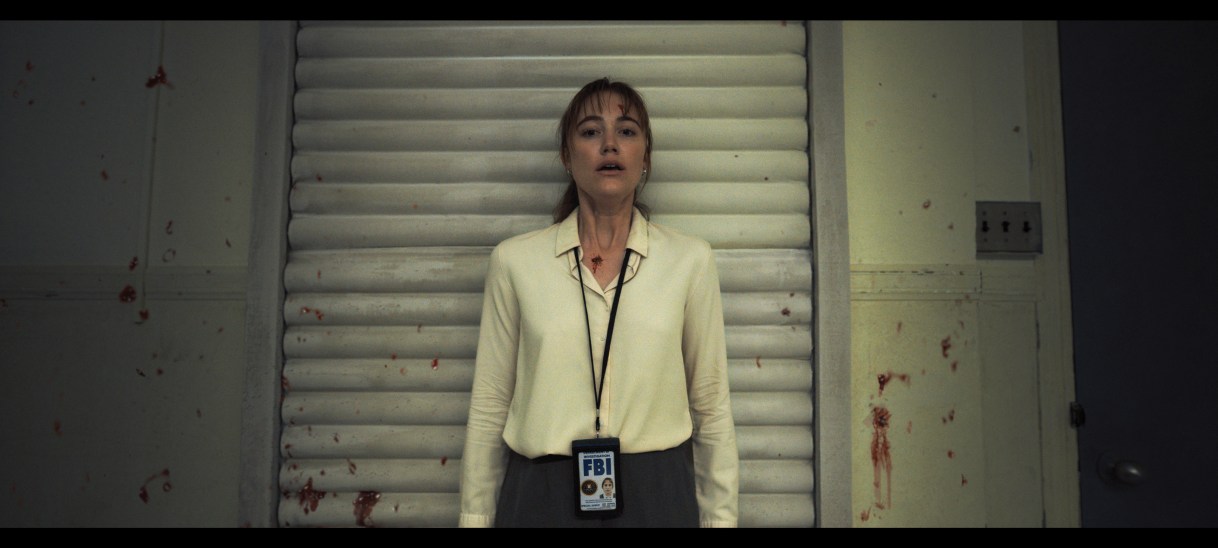
Maika Monroe in Longlegs.

This has been Perkins’ issue in the past, with the son of legend Anthony Perkins and Berry Berenson putting image over story and script in his previous work, Gretel and Hansel (2020) and I Am the Pretty Thing That Lives in the House (2016), but has broken through with easily his best script in Longlegs. The film is wider ranging and more compelling than recent entries in this new wave of American horror. Films that want to explore deep rooted causes of horror like child abuse and extreme religiosity but have no appetite to get into the true heart of this evil, something Perkins is keenly focused on conveying honestly and potently.

On the dread-inducing serial killer axis, Longlegs finds itself tightly drawn to David Fincher’s Seven (1995), with its internal focus on our central characters’ world and the encroaching evil building up around them. While his presence, and particularly his face is often obscured by the frame, Longlegs lingers in the psyche of its characters and the audience. Played with his customary intensity and ferociousness, Cage excels in limited time like Darth Vader’s limited but outsized presence in Star Wars (1977).

Lee is a fascinating character, played brilliantly — although is sure to be divisive, similar to how the performance of Justice Smith in I Saw the TV Glow (2024) has been judged — by modern horror stalwart Maika Monroe, who has as much anxiety meeting her partner’s daughter as encountering a horrific murder scene. The world weighs heavy on her mind, and Monroe gives her a level of dissociative tendencies that are incredibly difficult to portray on screen and in lesser hands would’ve derailed the film. This makes Longlegs‘ true beguiling mystery, and the beauty of the script comes from its ability to strip away Longlegs himself, leaving us compelled by the mystery of her story, the true engine of the film. 

Longlegs as a film lingers in the corners of frames with the patient tension of a spider, as Perkins and cinematographer Andres Arochi revel in having an audience’s eyes dart from every inch of their considered and restrained frame that stretches out into eternity. Even in tense, quick-motion sequences, we cannot help but peer over the shoulder of Lee (which takes up two-thirds of the frame), expecting the worst in every moment.

Maika Monroe in Longlegs.

Weaponising its extreme wide lens to a chilling effect, the film sucks Lee into the frame, increasing the opportunities for the menace and dread to creep in and linger. In modern horror, a tight perspective is often given to our protagonist, heightening the tension by playing with the fantasies of the audience of what lurks beyond the frame. In Longlegs, by extending the frame outwards, in both tense scenes and in standard dialogue moments, we are instead led to explore our fears head on, even as the film plays out in a more elegiac and liminal way.

With a work of mounting dread, the inevitable climax is unique but crucial to the final impact that can be felt days and weeks later. The greatest work of insidious evil and its unexplainable nature is Kiyoshi Kurosawa’s masterpiece Cure (1997), which operates in plain sight but questions what is capable within the banality of human life. With Longlegs, Perkins decides instead to spend the final moments explaining the hows and whys of the story, turning all the lights in a house we’ve been too scared to walk around at night, believing that the true lasting impact will be felt after these capital R revelations, not prior. 

The closing 10 minutes are overwhelming, and the tensest you’ll feel in a theatre all year, but one can’t help but feel a more ambiguous ending with a tight grip of evil that propelled the entire experience would’ve lingered longer in the memory of its audience. This decision to enlighten that which was kept in the dark, while removing a juicy level of elusion to reward feverish rewatches, does allow the true meaning of the film in the case of Lee’s familial story and how Longlegs operates as an outsized metaphor within it. The fact this sharp decision can easily be argued on either side shows how evocative a story Perkins has been able to tell.

What we are left with is a deeply fascinating work of modern horror from an emerging artist, one that can work both inside and outside the trappings of where the genre finds itself in the 2020s. Flanked by a great ensemble of Monroe, Cage, Alicia Witt, and Underwood, with quality craftspeople across the production, Longlegs is a nightmare born into reality, with a level of tension that is overwhelming, adding to the top of what is shaping to be an excellent year in horror.

Longlegs is in theatres now.

The Unbearable Weight of Massive Talent Celebrates Nicolas Cage

Rating: 4 out of 5.

There are actors and then there are actors, but there’s also Nicolas Cage, a thespian unlike any other who has long been swimming in his own pool of creativity, films and the characters left in their wake. The Unbearable Weight of Massive Talent (2022) represents a celebration of all things Nic Cage, serving as its own museum that displays (quite literally) some of Nic’s most iconic on-screen moments, characters and artifacts while at the same time offering an enjoyable buddy-up action comedy.

Out of all the odd and unique actors throughout cinema history, it seems fitting that it would be Nicolas Cage who would play a hyper-fictionalised version of himself to such an extent. The actor’s unrivalled commitment to exploring all aspects of his craft has seen him play some of the most craze-filled (Red in 2019’s Mandy, Caster Troy/Sean Archer in 1997’s Face/Off) and heartfelt (Robin in 2021’s Pig, Joe Ransom in 2013’s Joe) characters of all time.

What Director Tom Gormican has provided with The Unbearable Weight of Massive Talent is a service to all fans of Cage. With Nick Cage (Nicolas Cage) running short on money and struggling to balance his work and home life, he decides to take his agent’s (Neil Patrick Harris) advice to attend a birthday party for Cage superfan Javi Gutierrez (Pedro Pascal) and get paid $1 million. What Nick doesn’t realise is that behind the lovey-dovey, Cage-admiring Javi, is a drug kingpin, crime family and a missing girl. Unbeknownst to Nick, CIA agent Vivian (Tiffany Haddish) plants a tracking device on him and soon informs him of Javi’s dangerous side. It is up to Cage to find the truth of it all by channelling his most iconic screen characters to save himself and those around him.

The film plays out like a pastiche on the body of Cage’s work while also offering something new in the way of performance. Cage has often spoken of his “nouveau shamanic” neologism as an approach to performance that tries to get to the essence of a character through a deeper engagement with one’s imagination — ultimately enabling a performance that is as true as can be. He has also said in a recent Reddit AMA (ask me anything) that playing Nick Cage was the most challenging role he has taken on, with the need to “protect a person named Nick Cage” and make sure that he “facilitated the director’s absurdist vision of so-called Nick Cage”.

Nicolas Cage in The Unbearable Weight of Massive Talent (2022)

It’s no surprise then that even for an actor of Cage’s calibre, it would take more than a “nouveau shamanic” approach to performance to truly play Nick Cage. But play Cage, Nicolas Cage does, as he brings all of his signature idiosyncrasies to the table: explosive moments of rage, overzealous mannerisms, signature one liners and so forth. There is a level of self-awareness here that never borders on excessiveness as Cage plays into these idiosyncrasies in a way that would speak to Gormican’s absurdist vision of what a hyper-fictionalised version of the actor and his life would look and feel like.

It’s easy for films to poke too much fun at their source material to the point where they overdo it — like in This is the End (2013). Ultimately, there is a still a need to provide a plot that brings everything together and serves a purpose beyond the gimmicks, and fortunately Gormican manages to keep a level head amongst the excitement of it all. Gormican uses the situation that Nick finds himself in to prompt the action that follows while at the same time managing to bring it all back to the crux that is Cage. The fact that Javi isn’t an unlikable antagonist (or an antagonist at all really) also helps to keep it light hearted and grounded, even with the tonal shift that happens around the second act.

It is quite fitting that, out of all the moments of overblown absurdity, the most striking moment —Nick Cage French-kissing a young, Wild at Heart (1990) era Cage— would come from the mind of Cage himself. The film pays homage to outlandish moments like this from the actor’s career and yet the process of making this film has brought another intrinsically “Nicolas Cage” moment; this moment hits like the smell of sea salt as you make your way to the beach for the first time in the summer, and it’s a beautiful feeling.

Never short on pop culture references (any mention of 2017’s Paddington 2 is always welcome) and always set on celebrating the cultural significance of its star lead, The Unbearable Weight of Massive Talent is everything fans of Nicolas Cage will have wanted it to be and more. While having massive talent might be unbearable, a film with Nicolas Cage playing Nick Cage is anything but unbearable — it might just be what cinema and the world has been missing.

The Unbearable Weight of Massive Talent opens nationally from the 21st of April, 2022

Pig Sees Nicolas Cage Shine in One of the Year’s Best Films

Rating: 4.5 out of 5.

There seems to be a trend of films and film titles revolving around farm animals in the last 18 or so months. From Kelly Reichardt’s First Cow (2019/2020) to Valdmiar Johansson’s Lamb (2021) and Michael Sarnoski’s Pig (2021); each of these films places these animals at the forefront, but each one tells a vastly different story and to different avail.

Pig is a film that centres on themes of grief and loss, but it is also about acceptance and surviving. It sees a truffle hunter, Robin (played by the unsurprisingly great Nicolas Cage) have his pig companion stolen in the middle of the night while living off-grid in some cabin. This results in him setting out to find his pig with the help of Amir (Alex Wolff) who pays Robin for his truffle work.

For what it’s worth, the premise is deceptively simple as it plays on audience expectations that Robin will go out on a killing spree until his pig is found. This deception is particularly true given that the man playing Robin is Cage, who audiences almost expect will go on a killing frenzy comprised of outbursts and sadistic rage like in Mandy (2018), Color Out of Space (2019), or Vengeance: A Love Story (2017), to name a few.

While there are moments of rage bubbling beneath the surface (with the most extreme outburst seeing Cage kick the crap out of a yellow Camaro’s door), Sarnoski never goes down that predictable rabbit hole (which would be a great name for another animal film). Rather, Sarnoski uses Robin’s loss and grief as a catalyst for exploring how sometimes we can’t control what happens to us — sometimes our efforts are in vain even if we think there is a silver lining at the end of the tunnel.  

What is especially interesting to note is that Robin isn’t just some weirdo who drew the short straw and is now out to exact revenge, but he is a renowned former chef whose name is uttered like a long lost legend. He’s had his share of fortune, has mingled with the city folk, and has lived under the false pretences of success that capitalism masquerades as — ultimately seeing him swap city lights for green bushland. What this approach allows Sarnoski to do is to paint capitalism as a grotesque construct that can tear down even the most successful people if they aren’t willing to adapt to the changing world around them.

Nicolas Cage in Pig

There’s a particular scene in a high end restaurant where Robin — in his rugged, beat-up state — calmy rips into the chef of the restaurant (who happens to be a former intern of his) for allowing himself to forgo his dreams and settle for a world built around falsity and conformity. It is one of the many profoundly moving scenes in the film that gets to the heart of selling ones soul and settling — ultimately forgetting about what it is that we really care about. Robin asserts to that chef that “we don’t get a lot of things to really care about”; In essence, the pig and the lengths Robin goes to in order to find it, represents that pursuit for what we really care about, which is often quashed by settling.

In a sense, you’d be forgiven for thinking this film plays out somewhat semi-biographically for Cage where he sees his own past mistakes and strives to protect and salvage what he cares about, but may have ignored in the past. There’s the whole ‘fall from grace’ type approach where Robin is an esteemed chef (Cage is an esteemed actor) who disappeared from the spotlight only to re-emerge out of nowhere and still cook (act) like a pro. Heck, a character asserts to Robin that “I remember a time when your name meant something to people, Robin”.

It makes for a resounding 90 minutes that gives Cage a platform to showcase why he is among the top 10 actors of all time. Cage himself asserted in recent interviews that the acting came easy for him here because he didn’t need to act as much due to having dreams and thoughts about losing his cat — which he channelled into Robin. In this sense, Cage plays Robin with a degree of verisimilitude that many (including yours truly) will be able to relate to. Whether someone has lost an animal, a loved one, or just an inherent desire — it’s about finding what you care about and protecting it at all costs, no matter the outcome.

The comparisons between John Wick and Pig have been plentiful due to the nature of messing with one’s animal companion and then hunting down the perpetrators. However, Sarnoski’s take on the revenge storyline plays out in a resoundingly different light. Robin is the one that gets beat down (physically and mentally) throughout the whole film without so much as throwing a punch. It’s a unique take on what we might expect to have happened, but it adds a level of humanism and honesty that captures how things don’t always end up the way we want them to.

The film is a masterclass in exploring how we deal with grief and how we learn to live with it in a system that encourages people to forget about what they truly care for and move on. Nicolas Cage delivers one of his most subtle and sublime performances ever, and the result is one of the most touching, sombre and best films of the year.

Pig is streaming on Palace Home Cinema