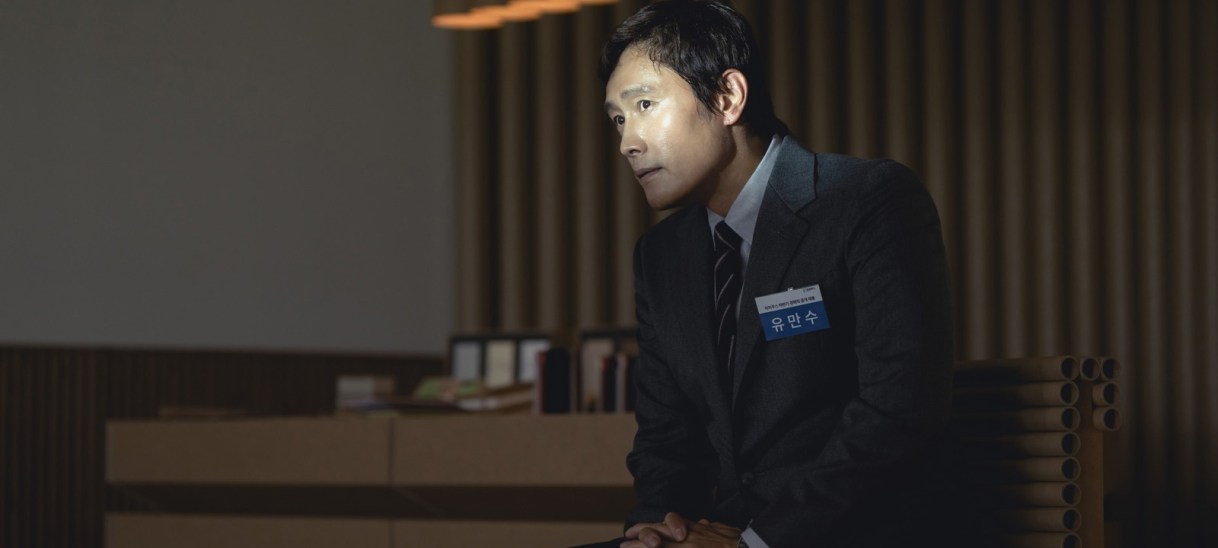
No Other Choice is the Work of a Master

Rating: 4.5 out of 5.

A showman like no other, Korean visionary Park Chan Wook elicits more joy and wonder out of an audience from a perfectly timed cross-dissolve than most car chases filmed this decade. A filmmaker who is constantly looking to find the tipping point of extremity without falling into the world of camp, Park has cultivated a devoted fanbase that expands with each new entry, especially in recent years, with his fearlessness to work in the grime of modern life 

Upon exiting No Other Choice (2025) in a delirium, it is clear that Park is the greatest modern visual stylist. While his stories can vary in interest and quality, as a filmmaker who is obsessed with the power of the art of editing, you will always leave his films satisfied. Adapted from the legend Donald Westlake’s The Ax from 1997, Park’s screenplay makes the key decision to maintain the protagonist’s occupation and narrative arc, showing how, as time passes, the crushing weight of modern capitalism has only increased. Centring a literal paper pusher, we walk hand in ham-fisted hand, gliding on the back of whip pans and transitions that will make film students furiously scribbling notes. 

After being made redundant after the acquisition of the paper company by an American conglomerate, Man-su (Lee Byung-hun) is sent to a support group for the newly unemployed, selling self-worth and virtue as its own reward. But, after tasting mild success and a bountiful life with his family, Man-su is after a return to cold, hard reward.

Built on the late capitalist mindset that success can only be achieved through the pain of another, Man-su’s plan ultimately lands in Park’s wheelhouse, getting rid of the more hireable paper men in town, so he is all that remains. Amongst all the extremity and chaotic joy gushing out of wild filmmaking choices, the story elicits an overwhelming sense of pain as we see a group of men that should be in community with one another, forced to compete for what will ultimately be a hollow prize.
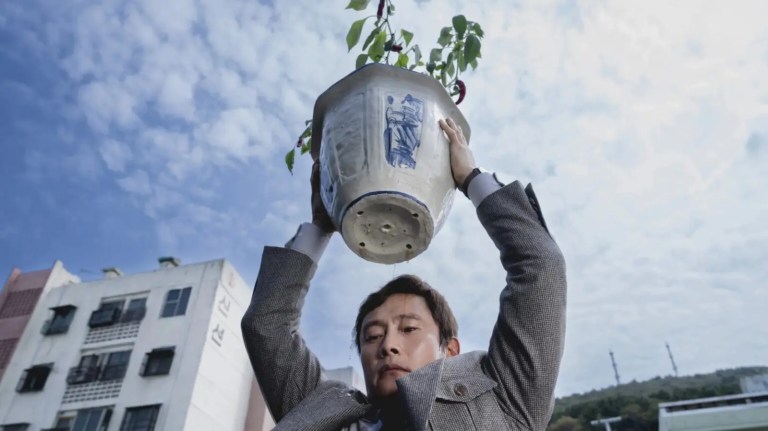
Lee Byung-hun as Man-Su in No Other Choice.

Sitting somewhere between Kiyoshi Kurosawa’s Cloud (2024) and Tokyo Sonata (2008) as modern tales on the devolving psyche of work culture and living under the cruel thumb of capitalism. That Neon in a marketing push sent an open invite to the fortune 500 company CEO’s says everything about how pointed the film aims to be at its primary villain.

Lee’s performance holds down the film’s extremity, preventing it from turning into a circus. His desperation exudes from him as a flop sweat, gritting his teeth through every moment, anxious that the moment he stops to consider the repercussions, it will all crash down. In moments where the world appears to react based on Man-su’s emotions, anything seems possible in this farcical satire that moves with a feverish pace. There is a fleeting moment when a potential final victim offers a job that we feel an unexpected glimmer of hope that we can get off the road. But as is the case with most Park Chan Wook films, that road, once entered, is one-way.

Park is in a tier above all when it comes to pushing the visual medium forward with a fever pitch and an unmatched style. Like his idol Alfred Hitchcock, Park sees his role as both old school entertainer and cinematic visionary who asks what is possible in the medium they have devoted their life to. In his recent work, Park has devoted an enormous amount of time to uncovering ways to use the reflective world of phone and computer screens to tell a story that is still compelled by the characters holding them. When we see Man-su’s reflected face alongside his screen as he drives himself further and further into his doomscroll, we so easily see ourselves. These scenes are comedic but intensely revealing, and make almost all contemporary filmmakers look like cowards for hiding in period filmmaking.
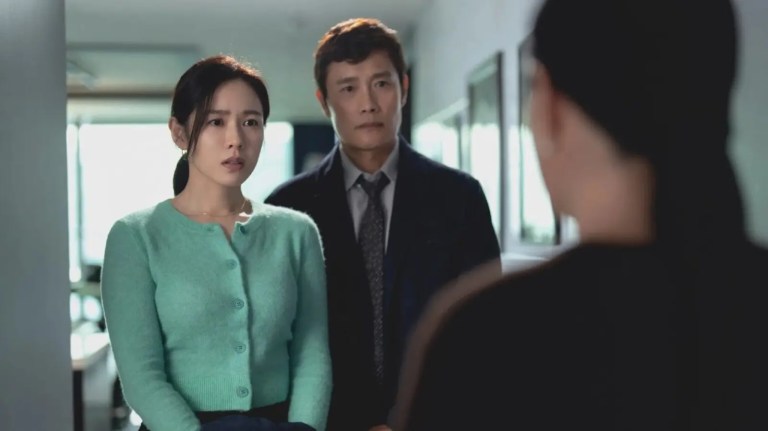
(From left) Son Ye-Jin as Miri and Lee Byung-hun as Man-Su in No Other Choice.

Always veering into doing too much, Park hides as much in its maximalist frames as he shows. Many have criticised the filmmaker for over-directing his screenplays, never allowing the writing to gleam through the forest of his craft, which I believe to be a false and overly simplistic reading of his work. In his very best films, whether original scripts or adaptations like in No Other Choice, he highlights the power and potency of the writing by its sheer ability to stand alongside some of the most visionary filmmaking this century through iconic characters and set pieces. It is only in his films like Stoker, with lesser scripts, that become mostly known for a scene transition (show hair transition scene from YouTube). 

What allows Park to ride so close to the edge of camp absurdism without toppling over is his ability to play to a crowd, both in enjoyment and the collective experience of being surrounded by strangers, all uncertain of what will happen next, which makes live sports an enduring event. With all respect to the perfect chase scene at the conclusion of One Battle After Another (2025), the legend of the final act, Park Chan Wook’s No Other Choice, has the finale of the year. A glorious send-up of modern late-stage capitalism as a ‘be careful what you wish for’ fairy tale that blends melodrama into a living nightmare into the best satire in years. It is a farcical screed of capitalism that gloriously blooms into something unexpectedly transcendent in its conclusion. 

The poetic irony in its final moments play like the deterministic singularity point that all modern art about the crushing weight of capitalism arrives at, there is literally no other choice. How Park doesn’t arrive at a place of crippling nihilism in its final moments but of cruel irony and humanity is nothing short of astounding. His revenge fables are without equal in modern storytelling, with No Other Choice arriving into this extended canon in surprising ways.

No Other Choice is in select theatres now.
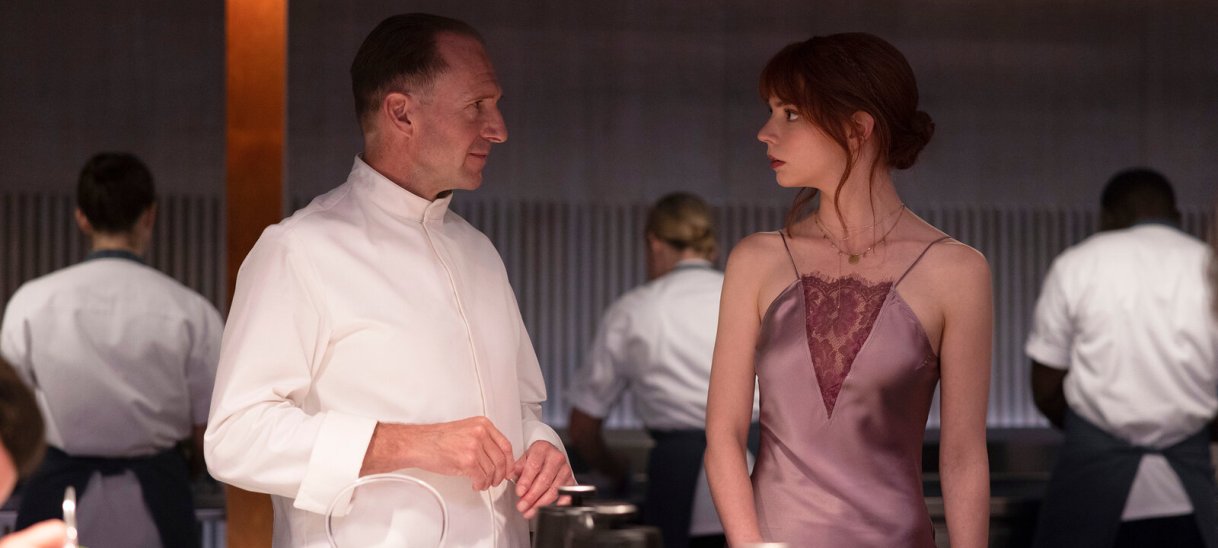
You Will Be Satisfied By The Menu

Rating: 3.5 out of 5.

A high-tension, comedic thriller on a bed of murky yet compelling satire, The Menu (2022) blends many styles and influences together with an entertaining wit and snark that is sure to delight audiences. With a strong combination of performances from Anya Taylor-Joy and Ralph Fiennes heightening this loosely structured comedy, The Menu manages to maintain an impressive level of tension and suspense that elevates some of its lacking cultural critiques.

We begin almost in media res as Tyler (Nicolas Hoult) and Margot (Taylor-Joy) wait to board a boat en route to the prestigious and uber-exclusive Michelin three-star restaurant Hawthorn headed by the revered Chef Slowik (Fiennes). By beginning moments before the arrival at the restaurant where the entire film will take place, we are given an active role in sleuthing out details about Tyler and Margot, as well as the other guests and the restaurant. This allows The Menu to be wonderfully engaging, giving the film an almost Agatha Christie-like momentum to the narrative.

Succession director Mark Mylod and writer Will Tracy collaborate with The Onion writer Seth Reiss (Tracy also worked at The Onion for a period) on this uniquely satisfying thriller comedy that blends styles of modern satire, to mostly enjoyable results. Unlike the Palme D’Or winning high-class satire of Triangle of Sadness (2022), the targets of satire in The Menu are not always clear. As the untethering of Chef Slowik’s mind allows an undercutting of his goals to widen the scope of the movie’s satire, Reiss and Tracy take aim more at the culture around the industry through a wider range of archetypes and ideas than cheaply mocking the individuals. This cloudiness may not add depth to its satirical lens, but it certainly adds intrigue through its obscuration. 

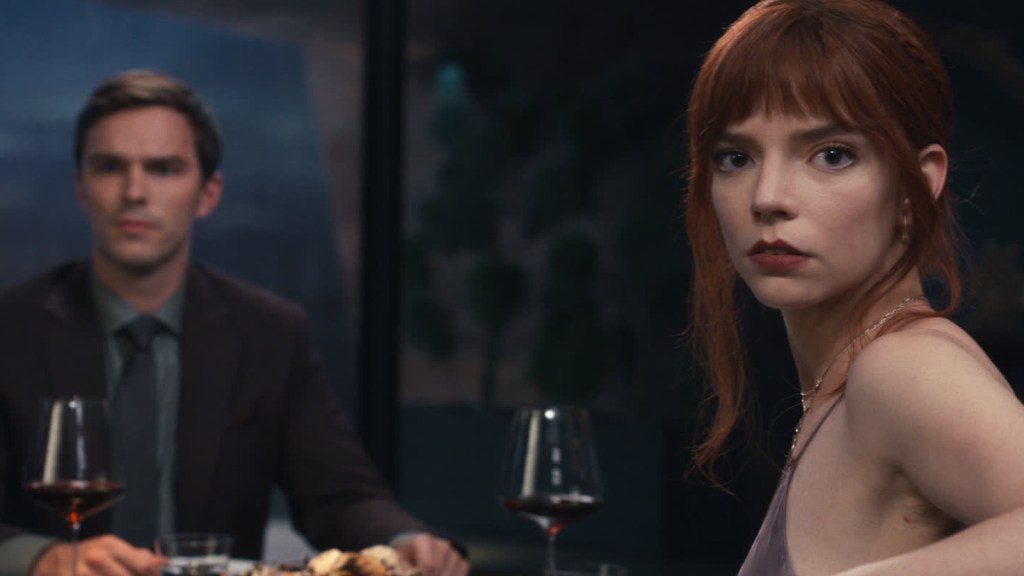
Nicholas Hoult and Anya Taylor-Joy in The Menu

Mylod’s style of heightened realism mixes compellingly with long-time Lynch collaborator Peter Deming’s work as a cinematographer to create a series of tense but compelling images that you will want to savour. Mocking the foodie content that permeates the internet while also executing it to an absurd degree, Deming and Mylod allow the audience to laugh alongside them, while also enjoying the voyeurism of experiencing fine dining from a theatre seat.

Working with three-star Michelin chef Dominique Creen as a consultant, there is an air of realism to this highly arch film that allows the comedic moments to flourish. The best of these moments are handled by the maître d’ Elsa, played by the perfectly cast Hong Chau, who makes an absolute meal out of this script.

Having a compass realignment structure of the courses, formalised in the metronomic Slowik clap, allows the film to bounce around different ideas and set pieces over the night. A series of comedic set pieces set out in an episodic format established by the meal courses, The Menu feels at times like a free-flowing sequence of comedic bits, attached to a lifeline of the structure established by the restaurant. This freedom allows the film to have its cake and eat it too; exploring different characters and comedic moments, while always having the ability to return to the tense thriller story with a powerful clap.

Certain writing decisions feel rebellious, like allowing us access to Chef Slowik’s motives early on, destabilising your expectations of where the night will take you. This creates an almost free-associative middle act that makes each individual moment enjoyable but lacks a certain level of cohesion (a comment literally made on one of the film’s many spinning-food-plate sequences) that leaves a unique taste in the mouth. This complication of knowing whether these decisions improve the film or work to its detriment will make The Menu a fascinating rewatch.

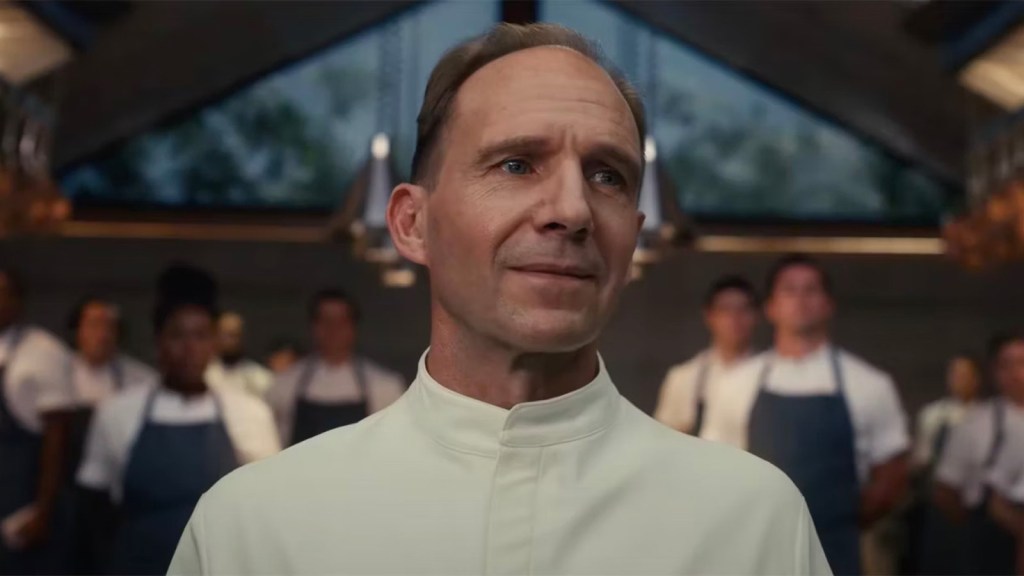
Ralph Fiennes in The Menu

A consistently compelling and interesting script, critiquing a form of art culture in a very similar style to 2019’s Velvet Buzzsaw, without the third-act issues that derailed that film. Where filmmaker Dan Gilroy asked the most from Jake Gyllenhaal in a truly bombastic performance, Mylod has Fiennes working with a sense of reserved enlightenment that allows the film to thrive in a truer thriller sense, while still achieving a wonderfully arch critique on both the creators and consumers of a certain high art field.

Joining a group of truly enjoyable all-in-one-night films, The Menu thrives more in its balance of genuine tension and comedy than its biting satire of high-end dining culture. It does, however, leave the audience much to chew on about the codependent relationship between consumer and creator in all forms of art mediums, with high-end dining as the most literal example. It’s impossible not to empathise with Slowik when he asks his regular customers to tell him what their last meal was, his existential dread permeating out of the screen, to find his obsessive devotion to his craft has not been responded to in kind.

Whilst not overly successful as a satire (we may be in a cinematic era that is impossible to craft a successful satire), The Menu is highly enjoyable as a comedic thriller in the world of fine dining. Like any great restaurant or food spot, it’s important to appreciate a location on its own terms, and the film’s like The Menu are no different. Anchored by terrific genre performances by Fiennes and Taylor-Joy, you will be charmed by the biting and absurdist humour while you also find yourself on the edge of your seat.

The Menu is in theatres now.

MIFF 22: Cheap Laughs Abound as Triangle of Sadness Lays Waste to the Wealthy

Rating: 3 out of 5.

In Ruben Östlund’s latest overblown, satirical romp, Triangle of Sadness (2022), there is a wealthy German stroke survivor whose only words of communication are “in der wolken” (translated: in the clouds). It’s a phrase she yells out countlessly across the film to the point where it wouldn’t be surprising if it pops its head in like an M. Night Shyamalan twist at the film’s close. It never does though, but it perfectly captures the underlying message behind Östlund’s rich ripping, caste crushing film — the wealthy just love to live in the clouds, out of touch with reality, no matter how dire a situation can get.

While most of the rich folk in this film are overblown caricatures that breach the threshold of excessiveness, for Östlund, excessiveness is the name of the game. Structuring his film into three chapters (three edges that make up a “Triangle of Sadness”, if you will), Östlund takes aim at the false pretences that the wealthy hide behind — fancy yachts, material goods like Rolex watches, and cosmetic procedures among other things — and bares them for viewers in all their grotesqueness. It’s nothing that hasn’t been depicted throughout cinema history in the past (2013’s The Great Gatsby and The Wolf of Wall Street come to mind from recent films), but Östlund isn’t privy to subtlety, rather, he’s going all in until you’re either exhausted, squeamish, or both.  

Where there is beauty, there is deceit — at least that’s part of the message that underpins Triangle of Sadness. Set on a luxurious yacht for the most part, the film is comprised of a solid ensemble that plays seamlessly off of Östlund’s material and each other. It’s Yaya (Charlbi Dean Kriek) and Carl (Harris Dickinson), two models and partners-with-benefits, that serve as the entry point into the mayhem that ensues. Both characters skimp by on their looks, and it’s part of the reason they find themselves in the company of millionaires and billionaires on the aforementioned yacht as Yaya is gifted a free trip courtesy of her influencer status.

On the ship we find a bunch of rich folk and everyone in-between including the ship’s crew. There’s a British couple who boast about their contribution to the munitions industry including their role in creating land mines and hand grenades (which Östlund returns to in explosive fashion); a down-on-his-luck code-seller whose partner didn’t join him on the cruise; the vessel’s drunk captain (Woody Harrelson); a Russian billionaire who made his money selling manure; and the chief stew of the ship, among others.

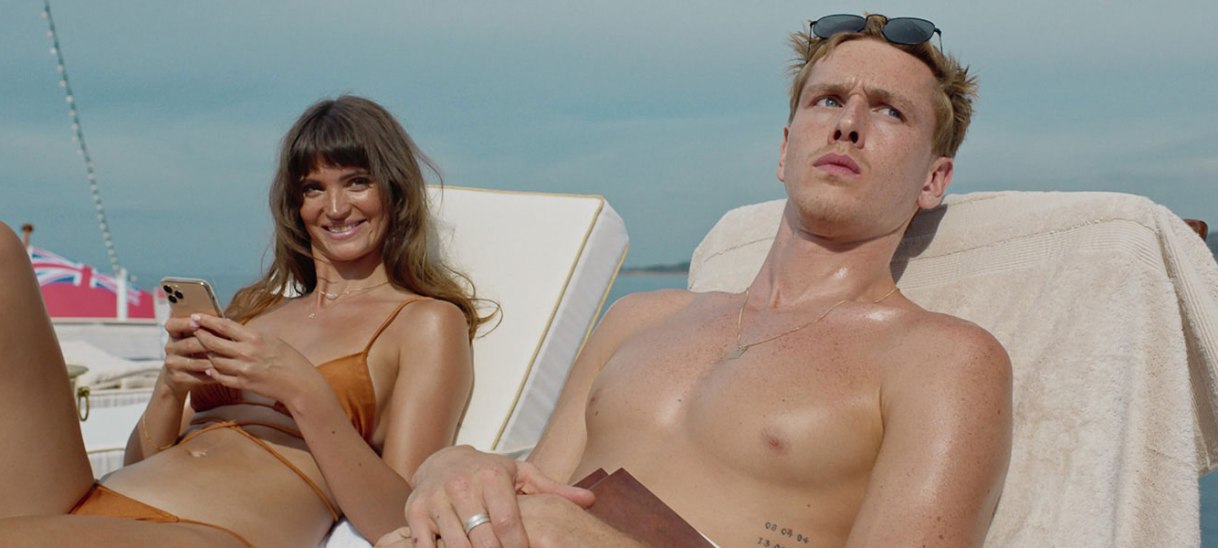
Charlbi Dean Kriek in Triangle of Sadness

Each character has a role to play in Östlund’s charade as events spiral from controlled to chaotic in an instant. He rocks the boat to the point where characters are literally spewing their guts out (of both ends) after a slimy buffet and storm, he throws in a pirate attack at one point, and in the third act he leaves some characters stranded on an island where he flips the hierarchical triangle on its head.

There’s a lot happening in Triangle of Sadness to the point where you can feel the lengthy runtime weighing proceedings down. This is undoubtedly a conscious choice on Östlund’s part as he leans into the satire he is going for to create an equally exhausting experience for his characters (especially in that third act).

At times it feels like his screenplay is made up of a bunch of short films or mini sketches that have just been welded together. There’s a scene involving the yacht’s captain and the rich Russian Dimitry (Zlatko Buric) as they indulge in a Marxist and capitalist back-and-forth while playing a drinking game that they continue in the captains quarters over the yacht’s PA system. There’s also a sexploitation sequence on the island portion of the film where the yacht’s Toilet Manager pays Carl for his services with pretzel sticks and shelter. All of these sequences are comical, but there’s never greater substance or deeper subliminal messaging beyond the superficiality of being rich and the vanity of these characters.

Triangle of Sadness is at its best during its first half, where it plays around with ideas of inadequacy and superficiality at a more measured level. The longer the film chugs on though, the more it tailspins into a cartoonish satire that trades subtlety for unhinged chaos, where you’re fed what you know and nothing more.

Triangle of Sadness hits Australian cinemas in late December.