Predator: Badlands Breaths New Life Into the Franchise

Rating: 3.5 out of 5.

With a powerful battle sequence between brothers on the Predator home world of Yautja Prime, Predator Badlands (2025) starts with an operatic bang. The two brothers, Dek (Dimitrius Schuster-Koloamatangi), and the older Kwei (Mike Homik), are training relentlessly. Dek, much smaller than the standard warriors we see in these films, is desperate to prove himself to the clan, and his brother is desperate to help him survive their ruthless culture. After a dramatic confrontation between the brothers and their father, Dek escapes with a quest to hunt the Kalisk, a rumoured unkillable monster on the unforgiving planet of Genna.

Like a live-action version of Scavengers Reign (one of the best shows of the decade), Badlands is all about the environment and the evolutionary marvel of a stranger crash landing on a new planet. With its unique plant and animal kinds that Dek must learn to understand to survive, director and now franchise steward Dan Trachtenberg has developed the first Predator film that actually puts the shoe on the other foot of the Yautja. What allows the film to thrive and stand alongside the John McTiernan original is its exploration of the dense planet of Genna, which brings the story’s intimacy into focus.

Quickly into Dek’s journey through Genna, he stumbles onto and is rescued by Thia, a severed Weyland-Yutani synth played by the effortlessly charming Elle Fanning. Through the overly chatty Thia and the attempting brooding of Dek, the familiar trappings of the mismatched adventure duo, laid on top of the familiar story of the runt of the litter in search of validation from the clan, ground the storytelling. This allows the simple charms and filmmaking craft to flourish inside a franchise that never settled on anything outside of its central figures’ iconic imagery.

Elle Fanning, surrounded by cute and fascinating creatures, has the charm and humour to sustain an entire film herself. A longtime actor who has recently become one of the most in-demand actors in the industry, Fanning pulls double shifts here as Thia and Tessa, two synths exploring the planet and also seeking the Kalisk. Her boundless energy, as Thia, is played in stark contrast to her “sister,” Tessa, a cold and driven synth that plays the role of a killing machine, typically reserved for the film’s resident predator. 

Elle Fanning as Thia in Predator: Badlands.

But this is not just a Fanning showcase. For too long, the Predator franchise has fallen flat in its characterisation of its iconic hunter. Until Dek and Kwei, we had not had a real conversation between Yautja, an outrageous failure of a franchise that never seemed invested in the science fiction genre that has allowed the Alien franchise to expand and evolve. By opening up the role of the predator as Dek finds his place amongst an unfamiliar world, Badlands is allowed a freedom to morph and change at will. Dimitrius Schuster-Koloamatangi does not have much facial real estate to exude personality to an audience, but the deep focus on him allows his fear and uncertainty to ground his journey in a familiarity rarely seen in the franchise.

Never before has the cultural bloodsport that is the heart of the Predator franchise been more sharply critiqued and illuminated as it is here, becoming quickly apparent why Trachtenberg felt there was so much left to say to rapidly pen a trilogy of feature films. A species of hyper-intelligent, hyper-athletic and advanced warriors so uninspired by their own cultural wealth that only the pursuit of a galaxy-spanning hunt can give them purpose. With a simple turn to have a Predator film centre a familiar narrative of the runt of the litter goes out to prove themselves to the pack, we finally see ourselves in the eyes of these once mythical, feeling creatures.

What allows the film to thrive is its cinematic integrity, focusing on a Yautja as a protagonist, staring intently at its face and eyes. Through those eyes, Badlands probes deeper into the worlds and cultures so rarely seen in a franchise a mile long and an inch deep. For too long, filmmakers have focused on the Yautja as an invisible hunter stalking prey, never probing into their real thoughts or struggles, or even giving them a language to communicate.

By striving for incremental IP world-building and narrative exploration over cinematic iconography, Badlands, like Prey (2022) before it, has quiet goals that it easily achieves. With a fully game duo in Fanning and newcomer Schuster-Koloamatangi, Trachtenberg, in a suite of films, takes his place as steward of the once flailing franchise. That he has achieved this not through IP management or navel gazing but by finding a unique balance between narrative exploration and genre entertainment is no small feat, something that should make fans, young and old, stand up and applaud.

Predator Badlands is in theatres now.
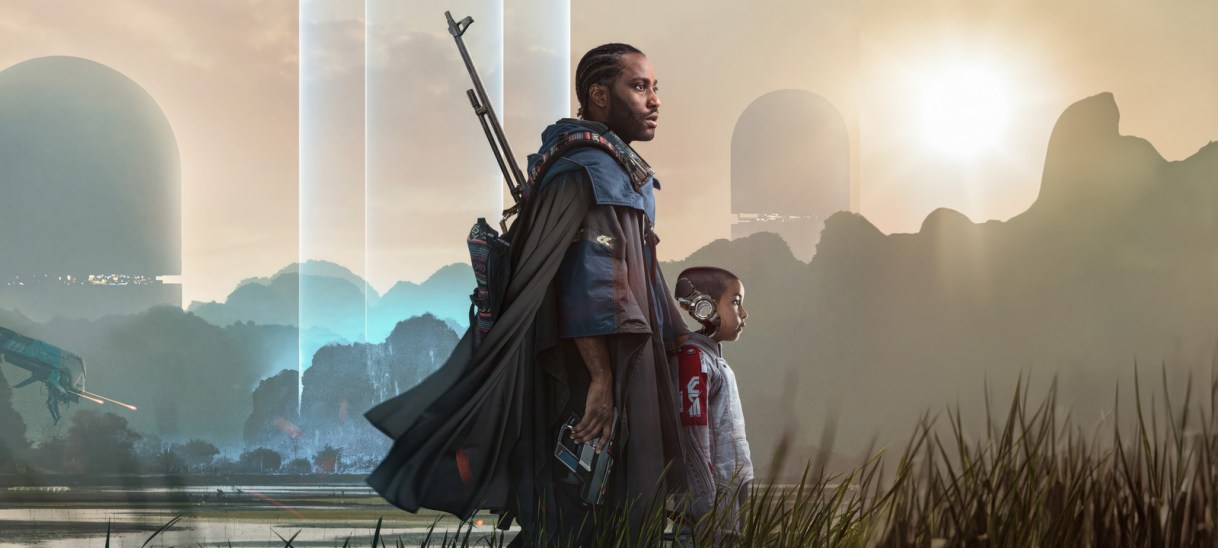
The Creator is Missing Some Parts

Rating: 3 out of 5.

Due to the frenetic nature of modern streaming churn based on shareholder growth over humane work practices or audience desire, the Star Wars industrial complex has pivoted to television in recent years. These shows have the blown-out budgets for blockbuster sci-fi epics, but are piped into our TVs and laptops. Some of these shows are great (Tony Gilroy’s Andor), and some aren’t (Obi-Wan Kenobi), but as a whole, this pivot has created a dearth of real blockbuster sci-fi with a sense of originality and modernity.

Enter The Creator (2023), the latest from visual stylist Gareth Edwards of Rogue One (2016) and Godzilla (2014) fame. In an alt-history world where robotic development arrived much earlier and Asia is seemingly conquered by Japan (the film is not equipped to deal with the meaning of his choice) and renamed New Asia, the US, seemingly under martial law, has declared war on AI who have allegedly detonated a nuclear weapon on LA (another choice we are not left given time to process). Joshua (John David Washington), an ex-special forces soldier, still mourning the death of his pregnant wife Maya (Gemma Chan in the most thankless role of the year), is brought onto a mission in New Asia to extract what they believe to be a new AI weapon.

Quickly we discover the weapon is actually an adorable child whom Joshua names Alphie (the standout newcomer Madeleine Yuna Voyles), turning The Creator into a showreel of Star Wars (1977) tropes that begin with a lone wolf and cub story, and concluding with the inevitable explode-death-ship-equals-victory mission. From the outset, the film is at war with itself, with its cheesy 90s sci-fi plot machinations and tropes on AI, robots, and human connection in a sci-fi world, styled as a contemplative Denis Villeneuve sci-fi. Edwards compels you into this visually entrancing film with real locations, considered visual effects, and evocative lighting that is truly stunning.

John David Washington and Madeleine Yuna Voyles in The Creator

The extraordinary production and visual design keep you invested in a film that’s narrative constantly draws groans from the audience. With a fifth of the budget of Star Wars Episode 9: Rise of Skywalker (2019) ($80m vs $416m), it is incredible what Edwards and his all star team have created visually. To contend with the wash of franchise blockbusters, Edwards has returned to the big screen with real weight behind him, including Hans Zimmer, cinematographer Greig Fraser, and editors Hank Corwin and Joe Walker, to elevate this familiar story to greater heights than this script deserves.

With Zimmer behind the wheel of a modern sci-fi, one would expect to be awestruck at the master composer’s work, but in The Creator, the great German is on autopilot. With some truly bizarre needle drops including Radiohead’s Everything in its Right Place, the audience is constantly pulled between the furiously disjointed world that is created in the theatre. Edwards has an enormous mountain to climb with this hacky script, with each decision taking away instead of building upon the last.

The film is loaded with arresting images and beautifully unique production designs, like the Nomad ship and South East Asia setting, but it’s all in service to a script that is a collection of sloppy plot machinations and simple tropes rather than genuine insight or human emotion. There is a pregnant wife to be sacrificed as character motivation. There is a surrogate child given to a character that lost a child to learn fatherhood. There are moustache-twirling, blonde military villains that were seemingly given a tape of Stephen Lang in Avatar (2009) to emulate. None of these moments are knowingly familiar or aware that fall into place by a steady hand, instead arriving to us as a manic bingo card of staid sci-fi plots that consistently underwhelm and frustrate.

Madeleine Yuna Voyles in The Creator

Events, even the visually stunning ones, occur as cheap building blocks designed to arrive in its most obvious destination. There is no room for exploration and character moments in this beautifully realised sci-fi world, like a child given every toy in a store only to spend an afternoon throwing a rock at a wall. These critiques on story and film structure pale in comparison to the wild othering and orientalism that occurs throughout this story that can seemingly be put down to a team of white writers not considering their choices and subject matter, a trend that becomes clear the further down the rabbit hole of the film you go. It is lovely to see the real world locations of Cambodia and Vietnam used in a large-scale studio sci-fi, but at what cost?

Concluding with a mandatory ‘defeat the enemy by blowing up their Death Star’ plot removes any hope for a satisfying and unique story that earns its dazzling imagery and sound design. The Creator flashes of brilliance are crashing waves, thrashing you against the sea, but once those waves subside, you realise you can easily stand in the shallow depths of the water.

The Creator is in theatres now.