Nearly a quarter of a century has passed since the last Peanuts comic strip was printed in newspapers; in that time, neither its popularity nor its relevance have faded — merchandise and media featuring its many characters are a constant, while the timelessness of the material ensures cross-generational appeal. And there is no better assurance of the latter fact than this feature-length adaptation from Blue Sky Studios.
Charlie Brown (voice of future Stranger Things star Noah Schnapp) is a boy with a perennial run of Bad Luck, unable to so much as fly a kite without it gravitating toward a tree, and everybody in the neighbourhood knows it. Well-aware that his reputation precedes him, he is spurred to reverse his fortunes by the arrival of a new kid in town, hopeful of leaving a positive impression on them and not an unfortunate one. That willpower only grows when Charlie Brown learns who the kid is: a cute girl with red hair who just so happens to be the same age as he.
Meanwhile, Charlie Brown’s dog Snoopy (voice of Bill Melendez) — a bipedal, literate beagle who sleeps atop a red kennel — is scripting works of fiction on a second-hand typewriter. Utilising his owner’s misfortunes as inspiration, and with the assistance of his good friend Woodstock the bird (also voiced by Melendez) he conceives tales of a fighter pilot in France, his aerial exchanges with the Red Baron, and his attempts to win the affections of a poodle named Fifi (Kristin Chenoweth).

The origins of Peanuts can be traced back to the late 1940s, when American cartoonist Charles M. “Sparky” Schulz published a weekly strip called Li’l Folks in his local newspaper. Within three years, the strip had become a daily, earned nationwide syndication and was renamed to its better-known title, which would be drawn and continuously printed for the next five decades. By the end of its print run in February 2000, Peanuts had established itself as a cultural institution, with its widely-recognised characters — chiefly Snoopy — proving as popular globally as the likes of Mickey Mouse and Bugs Bunny.
Key to the popularity and longevity of Peanuts was its resonant material. Beneath its juvenile sheen were philosophical musings that covered all aspects of life, be they existential or minute, and young minds whose constant streak of heartbreaks proved equal parts tragic and hilarious. Additionally, Schulz would often write storylines or introduce protagonists to align his strip with the times, such as Charlie Brown’s sage African-American friend Franklin, or the lovesick, sports-mad tomboy Peppermint Patty.
Both qualities are somewhat lacking from The Peanuts Movie (2015) but, pleasingly, its tone remains consistent with the spirit and ethos of the comics on which it’s based. A perfect balance is found between gentleness and causticity, the positive and the sombre; there’s plenty of tragedy that befalls our protagonists, but always an underlying sense of hope and optimism. Some pundits argue that its approach is a tad too saccharine and feel-good when compared to the source material, though such a fault could hardly be labelled as egregious — and it certainly won’t bother younger viewers who aren’t as familiar with the film’s origins.

The multitude of Peanuts television series and specials from years gone by also play their part in shaping the picture. A Charlie Brown Christmas (1965) is the most overt point of reference, as evidenced by the partial Christmas setting, the music of Vince Guaraldi, and the children’s wintry outfits that mimic those seen in the programme. Elsewhere, Melendez’s voicework of Snoopy and Woodstock is entirely archival, recorded for other adaptations prior to the famed animator’s death in 2008, and the voices of the child actors perfectly match those of their filmic counterparts, emulating a key strength of the TV shows.
Another commendable aspect is the lowkey nature of the screenplay, with Snoopy and Charlie Brown: The Peanuts Movie (to give its Australian title) eschewing the blockbuster trends of grandiose adventures and riotous humour to, again, mirror the ambiance of the original strips. That’s not to say its story is all minutiae and mundanity, with Snoopy’s adventures as the Flying Ace helping to offset the relative sedateness of the principal storyline — that being Charlie Brown’s quest to improve his reputation — before easing back into the main proceedings just as the aviation sequences become too much, once again finding a perfect balance.
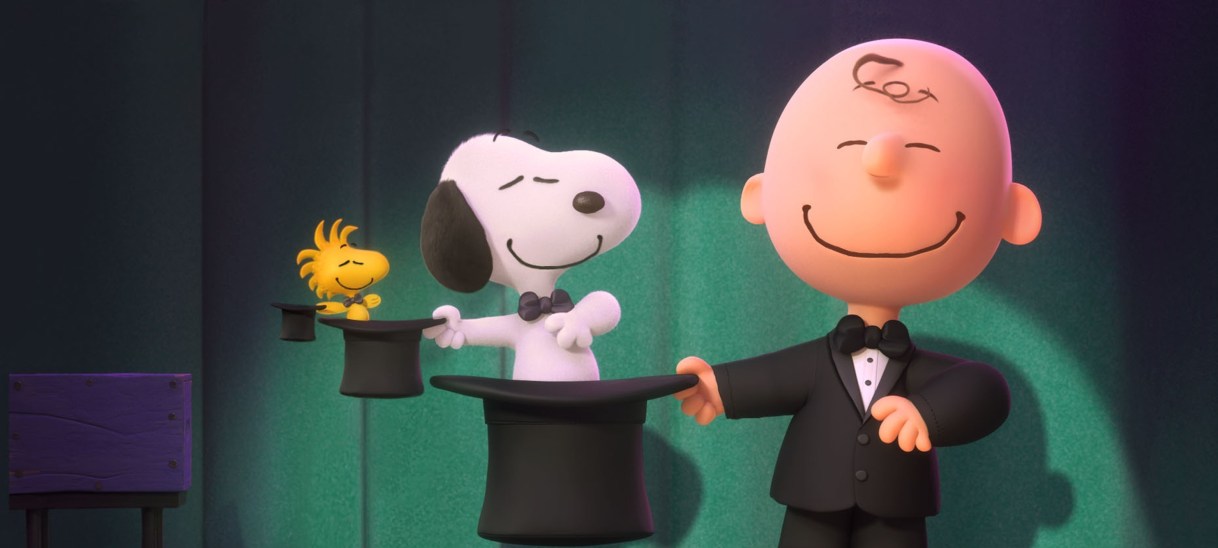
Charming further is the animation, which blends contemporary techniques with the traditional Peanuts aesthetics. Characters are rendered with computers into three-dimensional imagery, yet appear much the same as they do in the strips, owing to the clever utilisation of cel-shading; their movements are animated at half the usual frame-rate, evoking the hand-drawn specials and shows of yesteryear; and, as an added treat, Charlie Brown’s dream sequences are two-dimensional, black-and-white illustrations that practically mirror what Schulz drew. Yet again, a perfect balance has been found.

Despite all these many and impressive qualities — not to mention the brand prestige and nostalgia — The Peanuts Movie made only a modest impact on the box-office, in part due to the fierce competition it faced in theatres. Its opening weekend was shared with the James Bond flick Spectre (2015) in North America, and upon reaching Australia the following January, Snoopy and Charlie Brown had to contend with the blockbuster juggernaut that was Star Wars: The Force Awakens (2015). Resultingly, any contemporary impact the picture could have achieved was annulled.
But nobody can argue it has damaged the Peanuts legacy which, if anything, has strengthened since the film’s release eight years ago. Strips are still being printed in book form; merchandise continues to adorn the shelves of retailers; Apple TV+ has an exclusive deal to stream not just the classic Peanuts shows and specials, but any motion-picture material produced forthwith. To the latter point, Apple revealed just two months ago that the company would be producing a feature-length movie of its own, boasting the talents of director Steve Martino, Schulz’s son Craig and his grandson Bryan — the same team behind the 2015 picture.
And why shouldn’t they return for a follow-up when their first effort is as likeable and delightful as the comics on which it’s based? The Peanuts Movie draws upon the strengths of its originator and fuses them with its own quirks, presenting a somewhat fresh perspective that ideally, and remarkably, moulds with Charles M. Schulz’s vision. The result is a film that all viewers can appreciate, whether they be young or old, fans or otherwise.
The Peanuts Movie is available to stream on Disney+.
 Rating Frames