
“Who the fuck is he?!” There are few better ways of introducing the bravado world of the European music scene in the 18th Century than a violin battle between Mozart and our protagonist. Bursting onto the scene as a young, brash upstart, Joseph Bologne (played wonderfully by the emerging star Kelvin Harrison Jr.) won’t take no for an answer, accruing skills and accolades like his life depends on it, which they perhaps do in this world of extreme prejudice.
Chevalier (2022) is a briskly paced period musical drama in the mould of a stripped-down Amadeus (1984), focusing on the untold story of Bologne, a famed composer, fencer, and violinist, named Chevalier de Saint-Georges right on the precipice of the French Revolution. Harrison Jr whips through courtrooms and ballrooms with an active charm he wields as tightly as his rapier, staving off potential suitors and snobbish aristocrats in equal measure.
Directed by veteran TV journeyman Stephen Williams, Chevalier is as modest as a period drama can feel. At a brisk 108 minutes (50 minutes shorter than Amadeus), the film structures itself on the familiar grounds of music biographical drama, with Bologne’s newest goal to conquer in becoming the head of the Paris Opera, set out as a competition by his friend Maria Antoinette (Lucy Boynton) against the courts preferred pick, German composer Christoph Gluck (Henry Lloyd-Hughes).
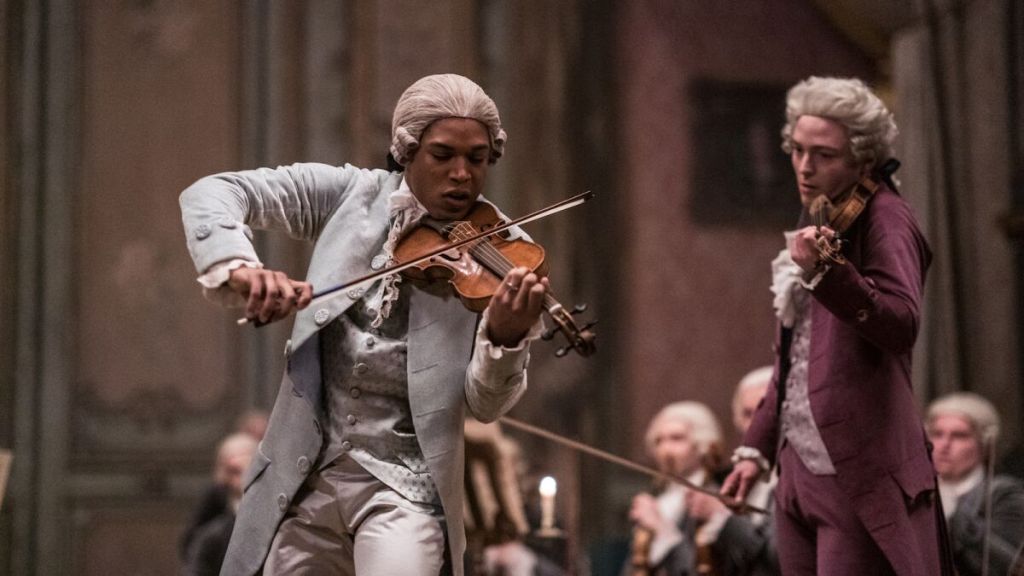
Bologne’s confidence and deeply ingrained desire for victory propels the story into a familiar but compelling opera-based sports film, with the customary training montages, interwoven romance subplot with his lead singer and muse Marie-Josephine (the great Samara Weaving), and buildup to the final game. The middle act of the film centres on the romance between Joseph and Marie-Josephine, with a whirl of montage spinning us through their relationship as it intertwines with the writing of their opera. There are few surprises through these moments, but the chemistry between Harrison Jr. and Weaving is given room to flourish and charm in the limited time given.
Penned by the great Atlanta writer Stefani Robinson, Chevalier feels unique next to the staid and rigid period biopics that have become all too predictable and unengaging. By highlighting instead of shying away from Bologne’s personal history as a biracial Creole man born of an enslaved mother Nanon (Ronkẹ Adékoluẹjo) and her enslaver George Bologne (Jim High), Robinson has crafted a savvier story that deserved a larger budget to tell his full story. Joseph’s deep desire to defeat any who challenge him stems from his father’s demand for his son to be great at all things, believing that is the only way he will be allowed entry into this white world. This idea permeates Chevalier, as Joseph’s identity stems from this complex moment that is at once a slave owner telling a young boy to dominate those around him to get what he wants out of a world that is against him, and as a father wanting more for his son.
Joseph’s identity is the engine that maintains the course of this unevenly paced drama that easily could’ve stumbled into a cheap cradle to grave story. While uniquely modest for a period drama, Robinson adeptly avoids the many potential cliche landmines that litter historical features of this time.

Where the film thrives is inside the relationship between Joseph and his mother Nanon, who comes to Paris a free woman after the death of George. Being taken from his mother and shipped off to a white boarding school, Joseph was forced to adapt to survive and thrive within the white world of European aristocracy and the musical landscape, never given the opportunity to learn of his culture and grow a relationship with his mother and that part of his life. Chevalier is at its best when we see this relationship, which is at first a tension point in Joseph’s life which he is eager to avoid, blossoms into a beautiful story of defiance and familial and communal bonds.
As Joseph learns to embrace his whole self , he wields the very defiant confidence and power he used to become accepted into the French aristocracy as Chevalier against them. With the undercurrent of unrest simmering under the surface throughout the film, we are led carefully through Joseph’s discovery of his place in these two worlds that are on the precipice of violence. As a man forced to survive through competition and determination inside the aristocracy that will not accept his place amongst them due to his race, Joseph Bologne is deserving of a place at the table of epic period dramas. In a more fleshed out and well funded telling of this tale, we would follow through into the French Revolution and Bologne’s impressive role in it. But for now, we will have to embrace Robinson and Williams for giving us this compelling and engaging, albeit brief encounter, with his story.
Chevalier is in theatres now.
 Rating Frames