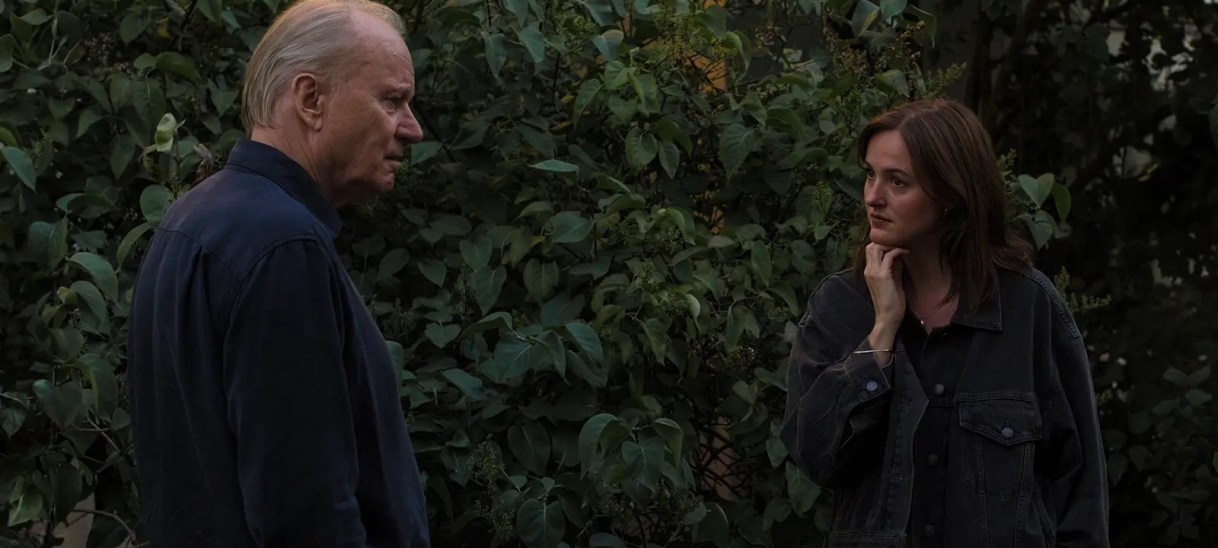
Sentimental Value is The Moving Family Drama to See

Rating: 4.5 out of 5.

Arriving on Australian shores on Christmas Day, Joachim Trier’s follow-up to the Millennial instant classic The Worst Person in the World (2021) follows a family collision of artists that may be the perfect film for the holiday. Sentimental Value (2025) is a film about artists unable to articulate their feelings but are able to embody them and translate it to a captive audience. Trier and frequent collaborator Eskil Vogt have moved from dense single-character explorations into a wider canvas of a family, allowing their humanist writing style to weave between the said and unsaid.

Centred is Nora Borg, played by another frequent collaborator in Renate Reinsve, a respected theatre actor suffering from immense stage fright; Agnes (a remarkable Inga Ibsdotter Lilleaas), her younger sister who has escaped the arts to make a more grounded life for herself; Gustav (a tremendous Stellan Starsgård), a well respected arthouse director and their distant father; and Rachel (Elle Fanning), an American star who aches to work on more meaningful work.

The film focuses on the return of Gustav, who has written a script that explores the past and present of the family’s history, set in the old family home, most of where Sentimental Value is set. He believes this script will launch him out of the retrospective tour space and back into the forefront of modern cinema; he just needs his estranged daughter, Nora, to agree to collaborate with him and star in the film. When she refuses to work with her father on the film, Gustav, after a chance encounter at a film festival, asks the young star Rachel to perform the role instead.

The act of writing a lead role for a loved one is something the film does not take lightly, whilst never allowing the work to unfold into a navel-gazing melodrama. A shaggy family drama about the film business and artistry would quickly implode, but Trier and Vogt’s script has a dedication to the central three family members that always feels generous. 
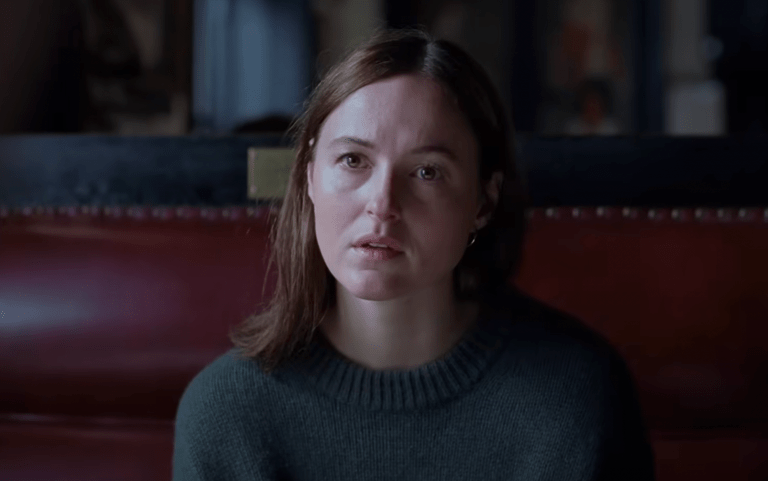
Renate Reinsve in Sentimental Value (2025.)

While a gut punch on first viewing, upon multiple viewings, it becomes clear that this is a generational performance by Skarsgård. This is made all the more extraordinary due to his health and his inability to memorise lines post-stroke. It is too rare where a character and performer to become as intrinsically linked as Skarsgård and Gustav do here, as an aging artist looking to the past, present, and future of their family line to understand themselves and those around them.

Bergman is always on the mind while interpersonal scenes float from moment to moment. The film dances between influences in Persona (1966) and Vertigo (1958) with Fanning’s character Rachel, arriving at an equal power through a balance of influences. While Hitchcock’s complicated masterpiece wields the weight of comedically heightened mirroring and Bergman’s film of duality that revel in never fully eliding its meaning to the characters, Trier’s mirroring achieves its power through its late decision to voice itself clearly and openly. 

A key scene of mirroring occurs in a pair of scenes that opens up the film into a world of collective humanity that is often the goal of Trier’s films. On one side of the glass is a monologue rehearsal scene with Rachel (after dying her hair to more closely resemble Nora) and Gustav, who is struggling to reach the impossible place he is searching for. On the other, a gorgeous scene where Nora finally reads the script after being given it by her sister, after she also finally reads it. After finally reading the script and releasing the intimacy that Gustav is pouring onto the page — something he would never articulate to them personally — the sisters are profoundly moved, and a point of familial understanding overwhelms them. 
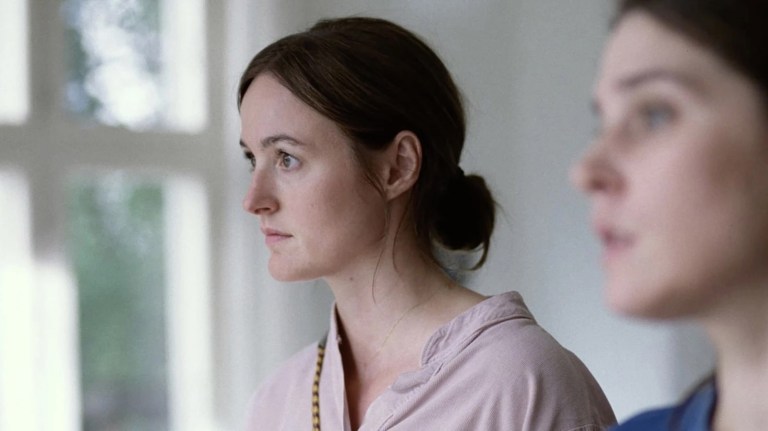
(from left) Renate Reinsve and Inga Ibsdotter Lilleaas in Sentimental Value (2025.)

Whether the film too neatly arrives at its climaxes is up to personal taste, but much needs to be credited to Trier and Vogt for the level of clarity and emotional weight they give to the struggle artists have with connecting to those they love without using their art. And the exploration Gustav has in writing extends as an olive branch to Nora, to tell her he sees her struggles, but gives her the medium of her art to explore them together.

It is in these moments of generous openness and charged, yet elided, dialogue that Sentimental Value becomes a beautifully emotive family drama. Trier and all his creative collaborators understand that to create is to bridge an ocean of the unsaid, even if that means building a replica of your generational family home on a soundstage, only to have it hidden on the 18th page of the Netflix arthouse section. Trier and Vogt understand deeply how, even through that artifice, true openness and connection can be translated into a final, powerful image of understanding but not resolution.

Sentimental Value is in select theatres now.

Dune: Part Two: A Sequel Worthy of Joining the Mount Rushmore of Sci-Fi Blockbusters

Rating: 4.5 out of 5.

Dune: Part Two preview screening provided by Universal Pictures

Few working directors have the capacity to deliver such audacious tentpole features like George Lucas and Sir Peter Jackson, and even fewer are able to do so authentically while ensuring that the end result is nothing short of spectacular. But that’s exactly what Denis Villeneuve has done with Dune: Part Two, his sequel to 2021’s Oscar winning Dune: Part One.

To call Dune: Part Two anything other than a generation defining Sci-Fi would be to undersell just how monumental an achievement the director has on his hands. Where Part One focused more on methodical world-building and planting the narrative seeds of Frank Herbert’s iconic novel (some might say in a much more trimmed down, thin fashion than expected), Part Two is all about scale and upping the ante.

And it picks up almost immediately after the first film, where Paul Atreides (Timothee Chalamet) has found his way to the Fremen and is working towards building their trust, learning to assimilate in their ways, and realising his potential as a Messiah. There is seemingly more pandering this time around, with the first film having the skeleton of what is sure to become a trilogy, established, but lacking that extra flesh for why we should care about these characters, the Kwisatz Haderach or any of the novel’s deeper lore.

The care for those aspects all starts with Paul though, with his plight becoming increasingly refined by screenwriters Villeneuve and Jon Spaihts, who inject more oomph into the script. Paul is much more nuanced here, having had to grow up faster than he would have liked, especially now that the Harkonnens have reoccupied Arrakis (or Dune) and are actively pursuing spice. In turn, time is of the essence for Paul and the Fremen, especially as the Harkonnens edge closer to their hidden locations.

(L-R JOSH BROLIN as Gurney Halleck and JAVIER BARDEM as Stilgar in Warner Bros. Pictures and Legendary Pictures’ action adventure “DUNE: PART TWO,” a Warner Bros. Pictures release. (PRESS KIT)

As a result the film places greater attention on the interplay between Paul and the Fremen. Fremen leader Stilgar (Javier Bardem) has become the guiding voice of reason who echoes the idea that the chosen one has arrived. He puts Paul through his paces via a series of trials that test out whether he truly lives up to all that was foretold. Whether that’s venturing out into the desert to overcome its harshness, battling the Harkonnens as they attempt to harvest spice, or riding a Shai-Hulud without guidance —there’s not shortage of incredible individual moments that both propel the narrative forward but also leave one in awe every time.

It’s in these moments that Part Two really shines and speaks to Villeneuve’s eye for detail and scale. It helps that the returning Greig Fraser (who won an Oscar for his cinematography for the first film) once again captures Dune’s deceptively beautiful vistas on a macro level, which allows that scale to shine through. Everything on Dune looks blown up in size which works to its advantage in creating this look of endlessness and enormity, a creative decision that speaks to the gravitas of the journey awaiting Paul. It’s all the more crystallised in the vibrancy of the desert colours, which further evoke that deceptive beauty of a world that will show you no mercy and swallow you whole.

For Paul, the only beauty that isn’t deceptive is that of young Fremen warrior, Chani (Zendaya). She helps him through his series of trials while continuing to hold her own as a character of interest that isn’t just sidelined to play second fiddle as a muse. Often she claps back against the popular opinion of Stilgar, and refuses to fall privy to what she sees as a cause that doesn’t exactly serve the interests of her people.

In fact, most of the female characters in Part Two play crucial roles in the film’s events, with Paul’s mother Jessica (Rebecca Ferguson) embracing her destiny as the Fremen’s Reverend Mother. Princess Irulan (Florence Pugh) has a much smaller part in proceedings as the Emperor’s (Christopher Walken) daughter, serving more as a springboard for the plot and entry point to its politics rather than anything else, which isn’t a problem per se.

A scene from Warner Bros. Pictures and Legendary Pictures’ action adventure “DUNE: PART TWO,” a Warner Bros. Pictures release.

On the flip side are the Harkonnens, with the Baron (Stellan Skarsgård) returning in his hauntingly enlarged state alongside his incompetent nephew Rabban (Dave Bautista) who is continually being outsmarted by the Fremen as he tries to gather spice on Arrakis. But it’s Austin Butler’s portrayal as the Baron’s nephew, Feyd-Rautha, that is a particular standout; he comes across across as both raw and subtle, at once menacingly distant yet eerily close.

When the Fremen do lock horns with the Harkonnens, the result is always jaw-dropping set pieces with well choreographed fights that are supported rather than supplanted by those unique visual effects. The battles are also much easier on the eye compared to a majority of recent blockbusters, in that the action is discernible rather than messy. To top it off, Hans Zimmer’s score is also complimentary rather than excessive, with his use of drums and sharp crescendos aptly suiting the various cultures and moments (I had literal goosebumps at moments as the soundscape reverberated through my seat and being).

If there was to be a shortcoming it would be that the closing sequence rounds off rather abruptly. At various points throughout the film I couldn’t help but wonder how Villeneuve would bring everything together as the finish line was becoming clearer and closer to the end. However, he had always said that this was a continuation rather than a direct sequel, and that aspect is felt, even though audiences might be left wondering by the end —with some threads left hanging.

That said, there are few directors who can create a spectacle at such a scale while leaving their own mark and remaining faithful to the source material. Dune: Part Two takes the best parts of the second half of Herbert’s novel —allegory and all— and serves them up in a digestible, refined and spectacular result that is reminiscent of some of the best sequels (or continuations) in cinema history.

Dune: Part Two opens nationally from the 29th of February.