Swinton and Moore Excel in The Room Next Door

Rating: 3.5 out of 5.

The Room Next Door preview screening provided by Sony Pictures.

The blurred lines between long-term friends, and lovers, and the rapid progression of time once a career begins to slow have become legendary Spanish auteur, Pedro Almodóvar’s, chief fascination in recent years, percolating and expanding in unique ways that complicate his melodramatic stories. With an extensive filmography of Spanish melodramas and knotty adult dramas spanning almost 50 years, Almodóvar is exploring a new world of cinema with his new Golden Lion-winning feature The Room Next Door (2024); his first English-language feature film and only his third work of adaptation.

After learning of a recent cancer diagnosis from an old friend, novelist Ingrid (Julliane Moore) rekindles the relationship from her youthful days at a magazine with war correspondent Martha (Tilda Swinton). In light of this diagnosis, the rekindled friendship forms a compelling inseparability, tying the melodrama to some probing ideas on the connection between relationships of all kinds and the presence of death. This friendship is immediately pressurised as Martha decides she doesn’t want to continue treatment, instead acquiring illegal medication to end her life on her own terms, in a secluded house in Upstate New York, with Ingrid accompanying her in the room next door. While not always effective as a knotty dramedy, The Room Next Door is a worthy modern entry in this new phase of Almodóvar, a singular voice in cinema.

Merging a cinematic melodrama inside of an Edward Hopper-influenced (including a centrally placed painting for maximum impact) backdrop shouldn’t sing this harmoniously, but Almodóvar makes it look like breathing. In his first non-Spanish-language feature (after his uneven but charming short Strange Way of Life from last year), Almodóvar’s passion for American literature is evident. However, the chasm between his Spanish lyricism and his English translations flitters haphazardly throughout the film. Like panning for gold in a murky riverbed, The Room Next Door contains beautifully poetic moments of humanity in the face of the end, while many other lines and whole scenes fall flat. 
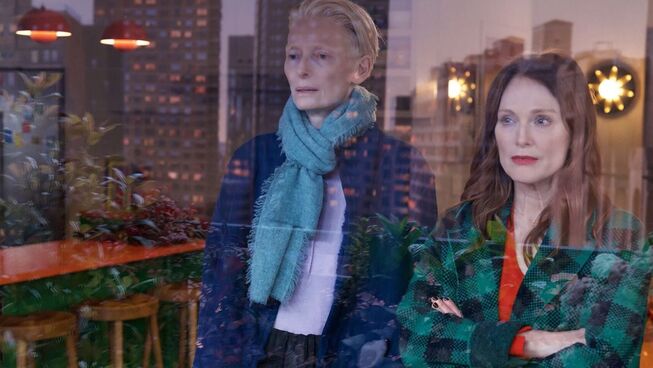
Tilda Swinton and Julianne Moore in The Room Next Door.

Luckily, the film is kept afloat by two of the best working actors and the best candidates to shepherd the Spanish auteur’s unique form of melodrama into the English language. Moore and Swinton are extraordinary together, quickly adapting to the certain quirks and manners that make Almodóvar’s style stand out in modern cinema. While the film relaxes into its story slower than his previous films, no doubt a complication from this being his first feature in English, its unique blend of offbeat humour and all-encompassing melodrama creates a luscious bedrock to lay in the sun with.

Even with the film adapted from the 2020 novel What Are You Going Through by Sigrid Nunez, The Room Next Door is a spiritual sequel to Almodóvar’s brilliant and tangly Pain and Glory (2019). While not as successful as the Antonio Banderas-led dramedy that operates achingly close to the auteur’s own life, The Room Next Door still excels in exploring contemporary ideas of loss and death in an increasingly uncertain world. In the second half of the film, fluttering between climate change doomsday scenarios brought on by John Turturro’s character Damian — an environmental academic and a previous lover of both Martha and Ingrid — and the criminal coverup necessary to keep Ingrid legally protected from Martha’s assisted suicide plan, is a rush of blood to the head, expanding this seemingly intimate story about two friends into a wider conversation about modern living. While unsuccessful in bridging this gap between late-stage friendship scenarios and the crushing weight of contemporary concerns, Almodóvar’s style still makes for an engaging and breezy ride through Upstate New York. 

A final poetic choice involving Swinton’s daughter Michelle will be divisive, simultaneously poking holes at the film’s clear eyed look at death while also exploring notions of interpersonal legacy in moments of tragedy. Much like Pain and Glory, Almodóvar has given audiences a full meal to chew on for years to come.

The Room Next Door is in select theatres Boxing Day.
Guillermo del Toro’s Pinocchio is the Year’s Best Animation, and it isn’t Even Close

Rating: 4 out of 5.

Breathing life into an intellectual property (IP) that has had countless iterations is no easy feat, yet Guillermo del Toro has done exactly that with his unique and heartfelt take on Disney’s iconic wooden boy, Pinocchio. In fact, Guillermo del Toro’s Pinocchio (2022) —or just Pinocchio— might be the best entry in this fabled story, and it’s easily one of del Toro’s best.

Like the careful craftwork of Geppetto, the woodcarver that creates Pinocchio, del Toro masterfully creates a heartfelt story of grief and loss through the lens of a fascist-set Italy. Unlike the year’s other Pinocchio film which felt like a sanded-down, stringless remake of the celebrated original, this one is coated in all the gloss that epitomises del Toro’s career: otherworldly creatures, a looming air of gloominess, a darker palette, religious commentary and evocative imagery. It’s in the un-del Toro-ness of the visual component —stop motion animation— that all of those ingredients shine, and where the film separates itself from the director’s past films.

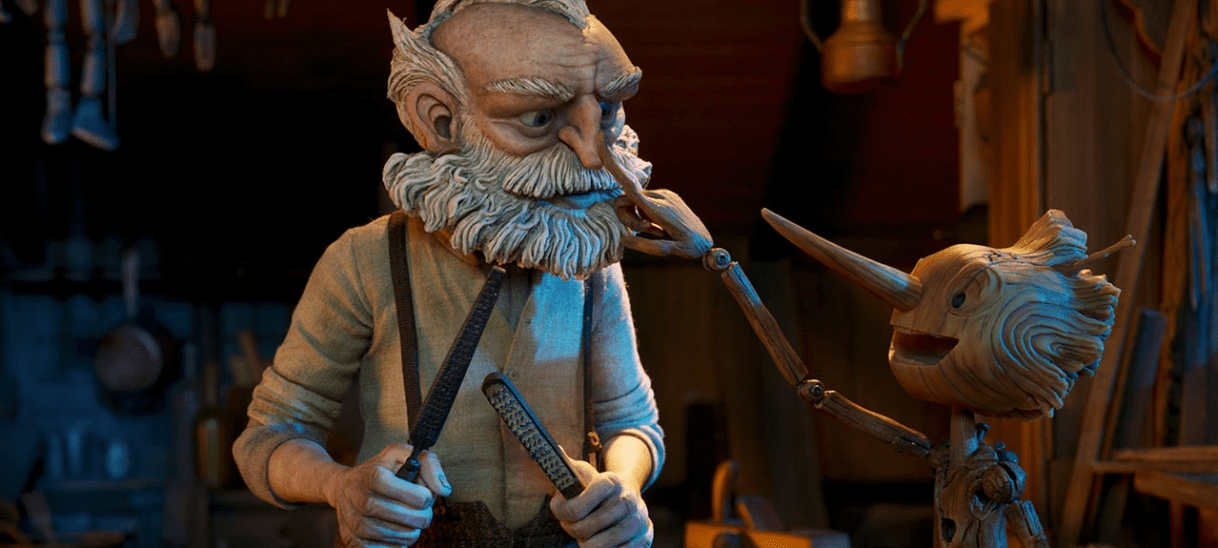
Pinocchio has some of the best stop motion work, period; unsurprising given that del Toro co-directed the film with Fantastic Mr. Fox (2009) Animation Director, Mark Gustafson. The world has an air of freshness and almost appears like a series of dioramas that have been stuck together. The details of the world are sharp and striking, right from the spaces the characters inhibit like a church and foresty area earlier on, to the underworld and Monstro scenes in later stages. It’s an enticing vista that sucks you in the more the film unfolds, and it’s clear that animators were given ample time to carefully workshop the look and feel that del Toro was going for. When coupled with Alexandre Desplat’s spine-tingling score that is in the vein of his score for The Shape of Water (2017), there is an added layer of enchantment that emerges.

In terms of the story itself, it hits all of the key beats from Carlo Colldi’s original book —the circus scenes, the water monster Monstro in the later stages, etc.— but del Toro works around these moments to add his own flourishes and feel. Whether that be the aforementioned fascist leanings, where he explores the loss of innocence from children in the face of conscription and nationalism, right through to those underworld moments where he asks questions pertaining to mortality and the significance of life and death.

They’re heavy themes and leanings for a story that has always been depicted as light and fluffy, and has mainly covered ideas relating to growing up and fitting in. It helps that del Toro immediately jumps into a moment of anguish, as Geppetto (voiced with a gut wrenching croakiness by David Bradley) mourns the loss of his son, Carlo (voiced by Gregory Mann who also voices the titular character), after a bomb is dropped on the town church by unsuspecting war planes above. This whole opening sequence that explores the prelude to Geppetto’s grief and prolonged mourning, establishes the sort of grimness that will persist.

Pinocchio (Gregory Mann) and Count Volpe (Christoph Waltz) in Guillermo del Toro’s Pinocchio (2022)

It also introduces the running commentary on religion that has underpinned most of del Toro’s oeuvre from and since The Devil’s Backbone (2001). For instance, the destruction of the church and its subsequent rebuilding goes on to symbolise Geppetto’s own rebuilding of his son. This is especially true as Pinocchio (after he has been magically brought into being) assumes the role of Carlo by helping Geppetto build out a wooden Jesus in the church (the last task the father and son shared). He goes on to raise one of the film’s most significant lines relating to why everyone likes the wooden Jesus but not him. This undercuts the road to self-discovery that Pinocchio ultimately takes as he faces death and rebirth numerous times, before enacting a moment of selflessness in the film’s final act that would bring him as close to ‘being a real boy’ as he can come.

In order to get to that point though, he has to face various hurdles including a money-hungry circus ringmaster, Count Volpe (Christoph Waltz); a fascist government official from the town, who is set on sending the puppet with immortality to war (del Toro’s frequent go-to, Ron Perlman); the prospect of living forever and seeing those around him die; and his own desire to experience the fullness of the world.

Along the journey he is also accompanied by the talking cricket Sebastian (formerly, Jiminy) voiced by a comforting Ewan McGregor who injects the film with some of the comedic relief (e.g. being squashed countless times, being interrupted just as he’s about to break-away into song). Tilda Swinton also has a subtle role as an angelic spirit of life that brings Pinocchio into the world, and she also plays the sphinx-looking, death alter-ego that meets him every time he dies. Each of these characters have a distinct look that is both familiar and different in the ethereal way that del Toro’s creatures tend to be.

While finding one’s purpose and identity comes with its challenges, Guillermo del Toro’s Pinocchio helps the wooden puppet get there, and at the same time creates an experience with a unique identity of its own.  

Guillermo del Toro’s Pinocchio is in select cinemas and will be streaming on Netflix from December 9.