
Screener provided by Rialto Pictures.
“I’ve lived here maybe 23 years. But I feel afraid to call it home. There’s always the feeling that I’ll have to leave.” These opening words, by a nameless individual, ring out throughout Payal Kapadia’s extraordinary film All We Imagine as Light (2024), shot against the backdrop of Mumbai, focusing on the women who inhabit it.
The most soulful film in years is also perhaps the best feature of the year, documentarian turned fiction filmmaker Kapadia exploding onto the scene with an honest and poetic portrait of humanity in modern India. A powerful blend of personal womanhood inside the political sprawled across modern Mumbai, Kapadia’s gorgeous and lyrical film centres on three multigenerational nurses navigating a world unwilling to accommodate their lives.
Centring on a pair of nurses, seasoned veteran Prabha (Kani Kusruti), and the youthful and expressive Anu (Divya Prabha), navigate an economically and politically uncertain time in Mumbai, along with older nurse Parvarty (Chhaya Kadam), who is facing eviction after the death of her husband. Prabha is dealing with the extended absence of her husband. This arranged marriage almost immediately left Mumbai to work in Germany, sending gestures to her home like a European rice cooker that only highlights the void he has left. On the other hand, Anu is attempting to balance her life while forming an interfaith romance with Muslim boy Shiaz (Hridhu Haroon), an increasingly contentious issue in current-day India.

We first see Anu and Prabha on public transport on their way to work, inside the lyrical six-minute opening sequence that guides you immediately into the world Kapadia is sharing with us. Anu is asleep on her side on a train seat, demonstrating her naive sense of safety in her position while also telling the audience her level of preparedness to arrive at work. In the immediate next shot, we see Prabha, gracefully shown in a medium closeup holding onto the pole of the same train for stability (seen above). By only showing Prabha from the shoulders up here, Cinematographer and frequent collaborator Ranabir Das portrays the battle-hardened nurse in grace with the world around her, yet never settled into one place.
There is a fear this remarkable film will be lost in the awards race shuffle due to India’s increasingly conservative film body and government not submitting it for the Academy Awards, even with the film winning the Grand Prix at Cannes. This is a sad but unsurprising occurrence after Kapadia emerged onto the film scene with her 2021 documentary A Night of Knowing Nothing, also critical of India’s patriarchal system.
The sweet centre of the film lies in the blossoming romance between Anu and Shiaz, a relationship that blends religion and the modern political moment in the city. In a series of push-pull romantic moments which includes a heartbreaking yet comedic booty call where Anu must purchase a hijab to visit him in the Muslim district where he lives. Kapadia avoids easy exits with this romance, concluding powerfully with an honest and poetic moment of acceptance and beauty, tied into an honest moment of private security.
In contrast to this romance, Prabha and her complicated relationship with her absent husband fills the remaining emotional bandwidth. Born of an arranged marriage that ties her to the city she does not call her own. In the opening prologue, a resident tells us, “That’s life. You better get used to the impermanence”. In a film centred on the relationship between people and the places they inhabit, this line pangs with an honest awareness.
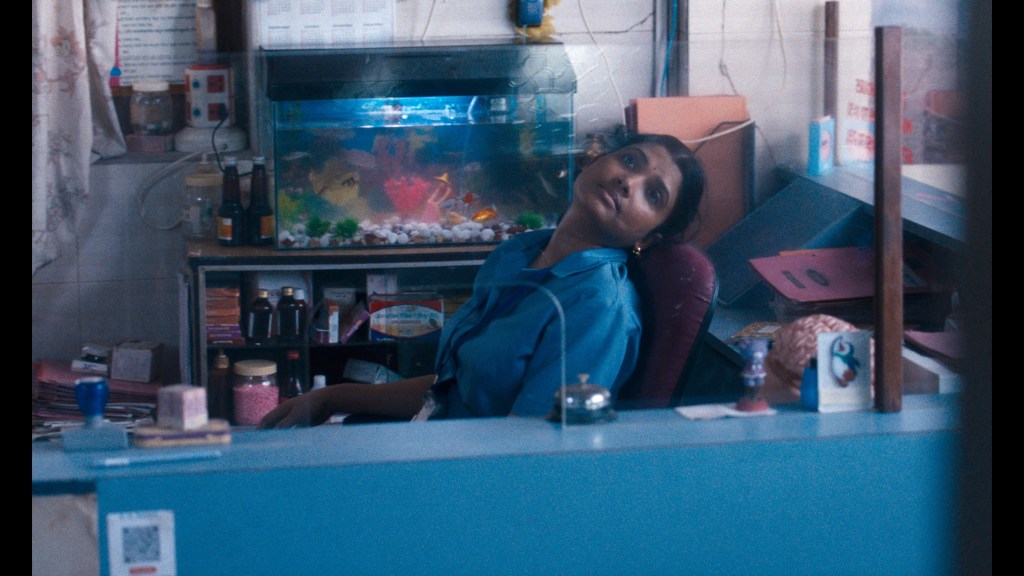
A film that comes to mind while watching Kapadia’s film is Steve McQueen’s Lover’s Rock (2020) from his Small Axe series, and not just because composers Dhritiman Das and Topshe’s playful piano score could’ve fallen out of one of his films. The short and sweet feature is in contention for the film of the decade, a complicated work of desire and connection inside a wealth of sumptuous visual storytelling and guile that simply overwhelms you. Both films use colour and vivid travelogue-styled cinematography to embrace the human connection of place. What separates the two films is Kapadia’s deceptively critical eye when depicting modern Mumbai, especially the three women’s place within it.
The slow, simmering drama underneath the film’s central pair is the wrongful eviction of a third nurse at the hospital, the older woman Parvaty. Her husband has died, removing her right to live in her own home. The potency of the feminist politics that simmer underneath All We Imagine as Light is in the grounded reality of the characters’ situation, one they are helpless to improve, finding solace in their own uneasy but accepting companionship.
The film operates within two acts, the first within the city that flows downstream into its latter half as the trio of women go to the beachside village that Parvaty grew up in. Kapadia, through her documentary lens, views characters as people who have been steeped in a certain place like tea, becoming more like a place the longer you inhabit it. While Mumbai is described as a place of impermanence and instability for the characters we meet, it is only in venturing out of the rapid city do they begin to view their life and their wants more clearly. In its final moments, would Anu and Shiaz ever have the courage to meet Prabha without this opportunity outside the city? And would Prabha’s spiritual exchange with her husband which opened her eyes to what she is holding onto and what she needs to give up to change have occurred in the melancholy that followed her throughout Mumbai?
Kapadia, with a refined hand through documentary work, flourishes in small moments. Whether it’s the embrace of a rice cooker given by a distant-slash-estranged husband working in Germany, or the small gesture of helping an older colleague move her things back to her old home after being wrongfully evicted, All We Imagine as Light embraces the aching emotionality of the quotidian, knowing these fleeting moments create a mosaic that reflects the light of human experience.
All We Imagine as Light is in select theatres now.
 Rating Frames