
The breakout film of Cannes, with a loud purchase by Netflix and an eye towards the Academy Awards, Spanish queer epic La Bola Negra (2026) has a deeply felt connection to the stories of the untold and how that untelling can create the uneasy ground for future generations to live on.
Inspired by the unfinished work of the same name by Federico García Lorca, as well as the play La piedra oscura by co-screenwriter Alberto Conejero, filmmaking duo Javier Calvo and Javier Ambrossi, commonly known as Los Javis, have announced themselves to the wider world with a bold and evocative epic spread across decades in Spain.
In 1932, Carlos (Milo Quifes), at the behest of his father, seeks to gain membership in the city’s exclusive casino but is denied (blackballed) on account of local rumours of him being homosexual. In 1937, listless musician Sebastián (Spanish singer-songwriter Guitarricadelafuente in one of the best performances of the year) is conscripted into the Spanish Civil War by the pro-Franco army, where he meets and falls for a leftist POW. In 2017, Alberto (Carlos Gonzalez), a playwright turned historian, receives an unexpected inheritance from a distant grandfather, causing friction in his already fraught relationship with his mother.
From the opening images, we see that Los Javis are interested in the great human scale of classic Hollywood, but with the modern digital lens rather than pure nostalgic lens that would’ve been terminal to a film of this kind.
The film is a tragedy of what happens when we deny ourselves; this queer identity triptych is didactic and bold, wearing its desire for acclaim proudly across its shoulders. With an eye towards One Perfect Shot maximalism, the Carlos sequences in particular. La Bola Negra is constantly pressing meaning out of every camera placement and blocking choice. When it is revealed the nature of why these moments are so heightened, the film more naturally locks into place.
Sebastián, in the centre of the film’s timeline, is the beating heart of the film. A mess of emotions and desires, forced into the most rigid of boxes, he discovers a glimpse of a brighter and more expansive Spain upon meeting Rafael Rodríguez Rapún (Miguel Bernardeau). A real life footballer, soldier, and personal companion of Lorca, Rapún blends the timelines together in unexpected ways, pulling beauty, tragedy and melodramatic poetry out of difficult scenes that require a delicate touch.
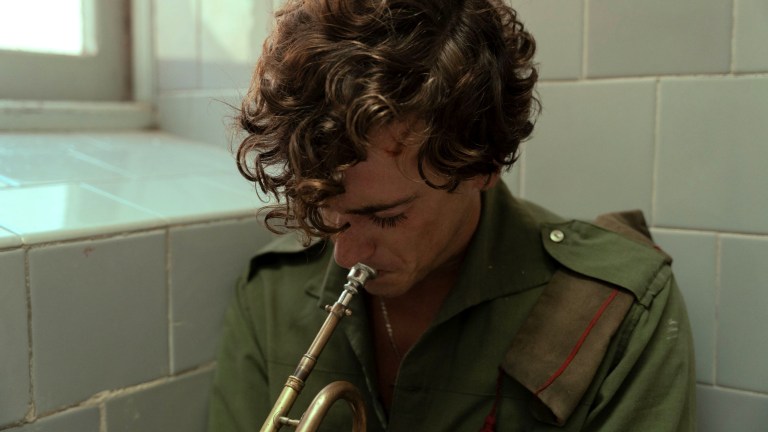
Sebastián, whose inability to navigate the moment has him retreating to a bathroom windowsill, frantically playing his trumpet to calm himself. The film has supreme confidence in landing these moments of overwhelming emotion, using Guitarricadelafuente’s embodied tumult and heartbreak as a pillar that generations will be built upon.

in La Bola Negra
There is a palpable modernity to Alberto that allows the torch-passing cuts from story to story to land with potency. A digital alarm. A Grindr notification. Martin Solveig and Dragonette’s Hello, the directing pair know how to use modern moments to create friction with the past. His search for meaning in the past is more grounded and elliptical than the narratives taking place in the 30s, turning a film that begins with a shout into a more measured narrative speaking volume. This does create an inconsistent tone that, while clearly intentional, lacks the avalanche-like structure Los Javis are striving for.
Weaving these stories of queer men unmoored and uncertain on how to navigate a combative, fascistic Spain across decades with dedication, La Bold Negra flitters between a tactile poetry and uninspired melodrama until finally arriving at a surprisingly emotional and potent final act.
With a second half in need of a jolt, the film offers us an explosive performance by Penélope Cruz. Arriving at the perfect time in the epic, giving Sebastián a true north star with the promise of a future in Madrid.
Where the film discovers transcendence is in its moments of musicality, either through the original song “La Nieve” (“The Snow”) by Guitarricadelafuente, or through composer Raül Refree, who is given key scenes to shine through a combination of modern synths and older instrumentation. The film has an air of deep collaboration and heart from many great Spanish artists, with an eye to telling the stories of Lorca’s unfinished work to a new audience eager to hear it.
“This country has too many love stories buried in the fields”. Operatic in theme and style, La Bola Negra knows how to land its climax with La Nieve, pushing past melodrama to arrive at a moment of poetic, emotional clarity that defines the ambitious goal Los Javis are searching for in their epic. With a groundbreaking performance from multi-hyphenate Guitarricadelafuente, La Bola Negra has a pillar to build an ambitious queer epic we too rarely see in modern cinema. While occasionally dipping into rote melodrama that can feel manicured, Los Javis still achieves moments of emotional reckoning most films only hope to glean, with characters that live long in the minds of its audience.
La Bola Negra is in select theatres from October 15th.

