The best restaurants, no matter where in the world, tell their story through food. A beautiful combination of complimentary flavours and textures, coalescing into one satisfying meal. A Taste of Hunger attempts to weave the story of the relationship of Danish restaurant owners Maggie (Katrine Greis-Rosenthal) and Carsten (Nikolaj Coster-Waldau), through their relationship with food. Resting on a bed of passion and desire, A Taste of Hunger flutters between flashbacks of their relationship fermenting and a present-moment quest to obtain a Michelin star for their restaurant.
The enchanting chemistry between Coster-Waldau and Greis-Rosenthal that begins right from the opening frames allows us to immediately invest in this pairing. Greis-Rosenthal especially is electric in every scene, it is impossible not to get caught up in her charm and passion the same way Carsten does. Unfolding slowly is Carsten’s need for control butting up against Maggie’s free-flowing and spontaneous nature, something that created the spark in their relationship.
The stakes of the present tense narrative are low, even taking into consideration the character’s driven pursuit of a Michelin star. Director Cristoffer Boe attempts to heighten the stakes by adding a clock to the scenes, but it is hard to invest in this aspect of the story. Perhaps it is due to the film’s lack of time spent in the restaurant, but the audience’s engagement is squarely focused on the family dynamic, not on the success of their already successful restaurant.
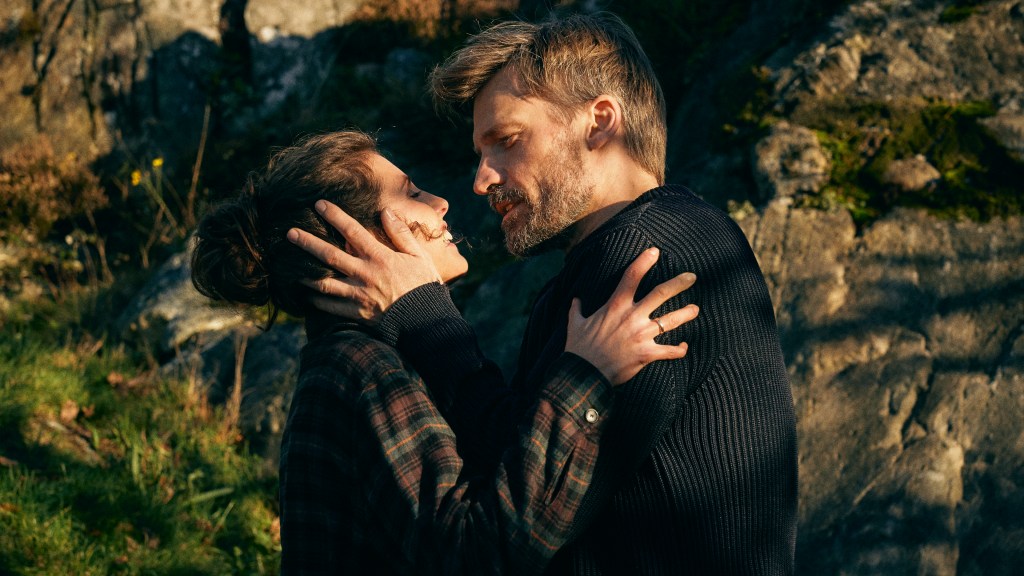
Katrine Greis-Rosenthal and Nikolaj Coster-Waldau in A Taste of Hunger
Outside forces are usually the antagonist in these restaurant dramas, so it was refreshing to spend time in this family, understanding where the original passion came from, while also understanding how that same passion works against them. The passion between Carsten and Maggie sustains the entire course, allowing small moments to flourish, especially scenes with their children August and Chloe, characters that are usually sidelined in these stories but felt integral to the film as a whole.
There is a wonderful patience to the edit, rare for the usual frenetic restaurant drama. This decision prevents the film from being a collection of foodie insert shots, instead allowing the audience’s gaze to fall upon those making and eating the food. The most sensual moments of cooking are scenes when the pair are cooking together, a stark contrast to their restaurant when Maggie is not around. A Taste of Hunger is a drama about a family making food and how it consumes them, with the food itself operating as the object of passion for the characters more than the passion for the filmmakers.
A Taste of Hunger shines in its structural pairing of its flashbacks, contextualising the present tense scenes wonderfully. By attributing cooking components of sweet, fat, salt, sour, and heat, to sequences, director Christoffer Boe guides us through the story while still allowing the audience room to perceive the characters more honestly.
Unfortunately, A Taste of Hunger lacks a depth of flavour in its storytelling that becomes apparent the longer this simple story stretches out. Co-writers Boe and the acclaimed Tobias Lindholm (2012’s The Hunt, 2020’s Another Round) use a few thematic prop crutches in its narrative (the knife, the hot dog, the letter), that work well in isolating sequences, but as a collective story, there is a strained repetition that undermines what originally felt satisfying. A good story and script is dense enough in its thematic ideas to not need them littered in every scene, so when they arrive later down the road, they leave a more satisfying taste on the palette.
All the flavours are here for a dense and rich film, but the ideas never get pushed into truly compelling places. Save for some Giallo lighting choices, the film is very plain, which is not to say it was unsatisfying, but it could’ve been an expansive drama and one of the year’s best.
Hollywood is littered with examples of filmmakers getting into relationships with an actor on set, causing friction with the rest of the production, as well as stoking a spectacle of drama and conflict that almost always overshadows the work. Most famous of this occurring was Ingrid Bergman’s affair with Roberto Russellini, which was unveiled just before the release of their film Stromboli (1950).
Don’t Worry Darling is the rare film where the situation involved a female director, with all the nuances that come with that difference. There will no doubt be tomes written about this production, but, for now, let’s simply discuss the text itself.
After the rapturous acclaim of 2019’s Booksmart, there was a bidding war for the follow-up feature of Olivia Wilde and screenwriter Katie Silberman, who have returned with one of the most confusing and underbaked films in years. Where their debut was an enjoyable yet frictionless teen comedy, Don’t Worry Darling is a big swing, period thriller that is after sweeping ideas on the modern world. Ideas that become exceedingly unclear the further away you get from the theatre.
Taking place in the 1950s, in a company town for the mysterious corporation Victory that is driven to create a new world, helmed by visionary Frank (Chris Pine), Don’t Worry Darling centres on young newlyweds Alice (Florence Pugh) and Jack (Harry Styles). The couple is very much in love and can barely keep their hands off each other.
As Jack goes off to work (at the same time as the rest of the men on the street in one of many gorgeous sequences from cinematographer Matthew Libatique), Alice is left to clean and busy herself at home, which she seems content with. This seemingly ‘perfect’ life for Alice begins to come crashing down as she seeks to discover the town’s true nature and the work being done by Victory.
Don’t Worry Darling is intended as a social thriller but is lacking any clear vision or identity in its story, which causes issues with the well-intentioned and well-executed design of the film. It forces its themes and motifs to become immediately literal. The idea of Alice’s world crashing down around her is shown with an unexplained tremor while she and Jack are in the kitchen in the very first scene. Not every film needs to be subtle and coy with its storytelling, but it’s a crucial element to the thrillers Don’t Worry Darling is cribbing from, so when you remove that element from the story, you better be doing it to heighten another aspect to make it an enjoyable experience.
Florence Pugh and Harry Styles in Don’t Worry Darling
The film is also doing itself a disservice by avoiding the story’s more thriller and horror aspects, which were crucial pillars in similar films like The Stepford Wives (1975) and Rosemary’s Baby (1967). The film has lazily been compared to Jordan Peele’s Get Out (2017) due to its socially conscious thriller nature, however, what allows Get Out to thrive as a piece of social commentary is how it fits within the structures of the genre, something Don’t Worry Darling is sorely lacking.
Florence Pugh is doing the most with what the film offers, using her established skills at conveying palpable tension over the course of a film’s duration. Unfortunately, in contrast to Katharine Ross in Stepford Wives and Mia Farrow in Rosemary’s Baby, Pugh’s Alice is somehow always behind on what the audience knows, even when we are both unsure what’s going on. Perspective is usually the most important tool that is weaponised by filmmakers in these thrillers but is so muddled in this seemingly first-person narrative with Alice that the film becomes increasingly tiresome.
Pugh isn’t helped in the film by her partner in marriage, Jack, played by pop superstar Harry Styles. The pop star is a classic example of an arena-sized bundle of charisma and coiffed hair that is unable to translate into the film, offering nothing compelling in the crucial two-hander scenes he shares with Pugh. There is also a serious lack of chemistry between the pair which proves fatal in many of these romantic scenes.
Some of the controversy surrounding the film has been about Shia LaBeouf’s role as Jack shifting over to Styles late in pre-production, which would’ve been equally as baffling a casting choice. That being said, with no hints towards spoilers, the final reveal makes the casting of Styles so utterly bizarre and only emphasises the baffling decision.
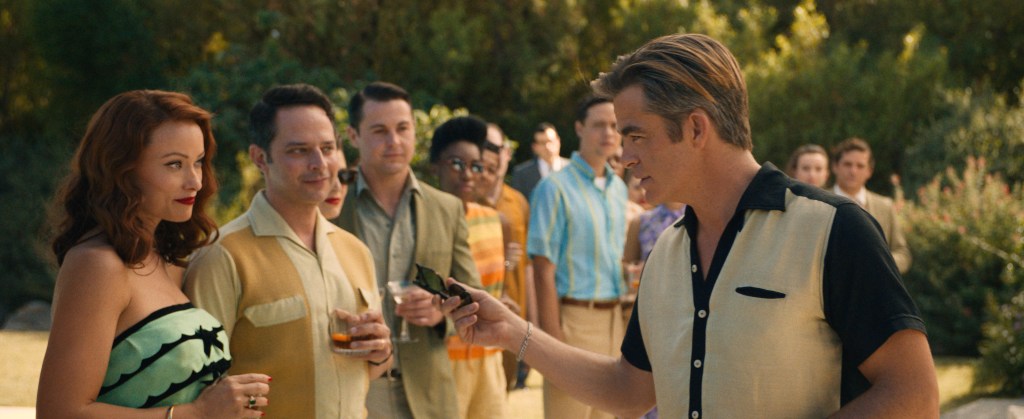
Olivia Wilde, Nick Kroll, and Chris Pine in Don’t Worry Darling
To Wilde’s credit, she has created a lush aesthetic with a suite of impressive visual flourishes with the help of Libatique and production designer Katie Byron, but it’s unfortunately always in service of a truly lacking script. There is much to like in the design of the film and will surely allow Wilde to take another bigger budget swing like this, hopefully with a tighter and more compelling story.
However, Don’t Worry Darling is so smugly showing off its production design and recreation of 1950s America, instead of placing the story within its lavish designs. This is no better exemplified than in the opening minutes of the film where we are shown Alice’s hallucinations. No time is spent establishing the baseline world we find ourselves in before the film is trying to upend it. This would be an interesting decision if the film chose to do anything with the extra time afforded by speeding through the standard opening to most thrillers, but it doesn’t.
The film is caught up in its own withholding plot structures that never let the ideas ferment in any way. Everything feels surface level because to address the nature of the film would be giving the game away. It’s hard not to see the film in a similar way to M Night Shyamalan’s unsuccessful films like The Happening (2008) or 2015’s The Visit (although that movie has been reclaimed since release), but even that honestly feels like a compliment.
By withholding its reveal until the end, the film doesn’t allow itself to examine the implications of the world it has spent two hours crafting, preferring instead to leave the audience shocked. We are instead left confused by these decisions. In a film so heavy-handed in its choice of motifs (there is enough humming and circular imagery in this film to die from sigh-induced exhaustion), is it confounding how little air is given to its final revelations.
Don’t Worry Darling’s central issue is ultimately the striving to be a discourse movie for 2022, but without any modern ideas worth exploring. There isn’t anything new here that wasn’t explored in feminist texts 60 years ago (the film does not deserve the waves of feminist retaliatory think pieces it will stoke). This wasn’t an issue with the filmmaker’s previous film Booksmart, a low-stakes, fun teen comedy that was without friction, opting to always play it safe socially and politically.
In Don’t Worry Darling, however, Wilde and Silberman are attempting to grasp at something outside their reach. One of the most exciting things Hollywood can do is give a large budget to give creatives the opportunity to take risks. Whether those risks land or not is up to audiences to decide. Don’t Worry Darling is a strange mix of massive risks and unfortunate turns to safety that will ultimately leave you somewhere in the flat, uninteresting middle.
A film seemingly designed to be released in between Knives Out films, See How They Run (2022) is a star-studded period comedy that feels perfect for a Sunday matinee, but perhaps not for an opening night. The film includes wonderful comedic turns from some of our best performers with Saoirse Ronan, Sam Rockwell, Adrien Brody, and David Oyelowo.
The 1950s, London West-End set farce, centred around the longest-running ever show, the murder mystery The Mousetrap, which has its run abruptly ended when the director (Brody) of a planned filmed version of the play is murdered. If you think that’s a rather meta plot for a film, that’s just scratching the surface of the meta-textual humour that is the engine of Mark Chappell’s script.
It’s the similar meta, postmodern humour that can be seen more and more often in film and television, usually with tiring results. For every example of 2016’s Fleabag (the best modern use of meta humour), there are your She-Hulk’s (2022) and Deadpool’s (2016). These latter shows and films use their meta humour to address the script’s flaws whilst never truly experimenting with its form. This is a trend that may be the prevailing screenwriting quirk of the past 15 years and that is quite an upsetting thought. See How They Run at least bakes its meta humour into its conceit, as a whodunit inside of a play version of a whodunit, with the ambitions of being adapted into a film.
See How They Run laces in the real aspects of the era (Richard Attenborough is the lead in the play, performed by Harris Dickinson), with the fictional characters of Constable Stalker (Ronan) and Inspector Stoppard (Rockwell, named after the esteemed playwright).
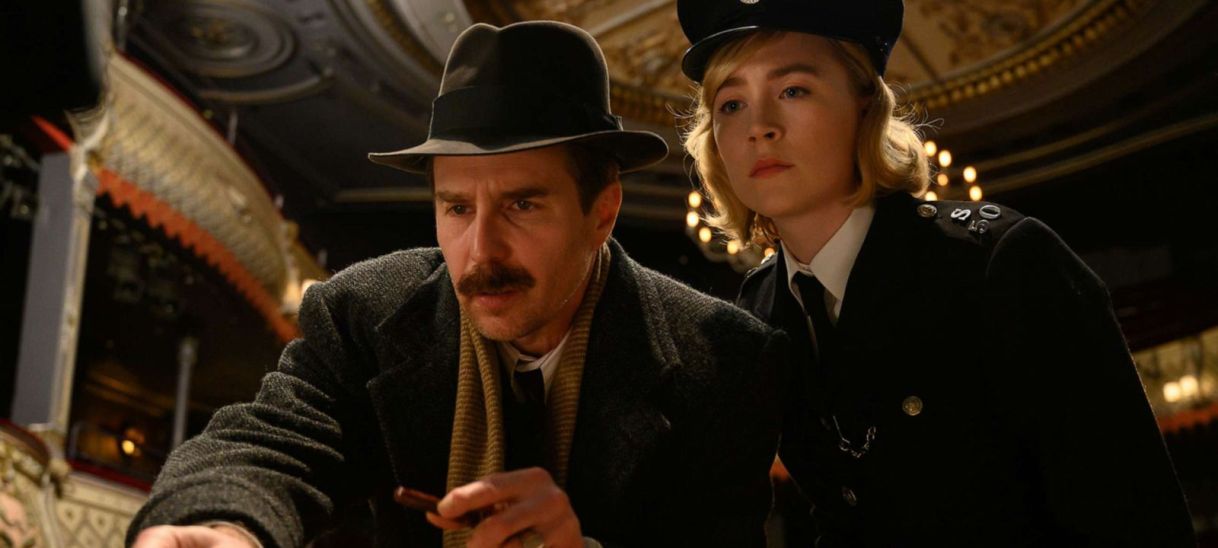
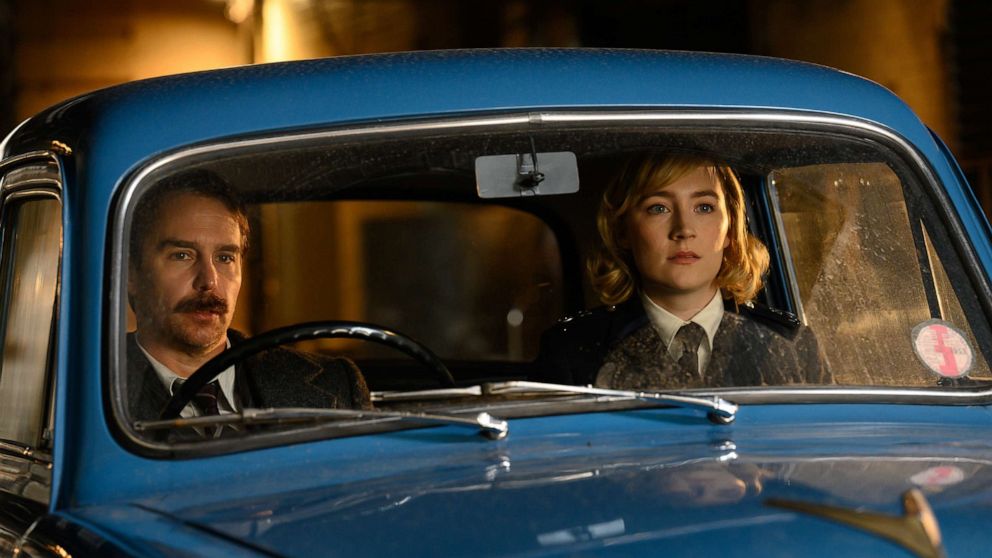
Sam Rockwell (left) and Saoirse Ronan (right) in See How They Run. Searchlight Pictures
The ensemble is clearly delighted to be involved in this farcical production, something that is palpable in every scene, especially by Ronan who is having a blast with the script. Brody appears to have walked directly off the set of The French Dispatch (2021) and into this film, with the same energy and acerbic tone that makes his inevitable demise all the more understandable.
The screenplay is full of wonderfully funny moments, especially when it choses a more jovial whimsy tone over caustic, a style that doesn’t not fit into the rest of the film. There is an inconsistency to the tone and filmmaking style, like the film is being pulled apart at the seams. For as many funny sequences the filmmakers throw at you, there is an equal amount of dead air which creates an unevenness to the film. This dead air is also extended to the frame, with a curious choice made to extend the headroom on most shots. With a film scattered with Wes Anderson frame homages, these choices are jarring and dislocate the characters from their environments more than they are welcomed into them.
The film is straining itself in its clever pursuits, which is no better illustrated than having all the characters coalesce in Agatha Christie’s house for the inevitable final act reveal. Many jokes land, but then consistently go a step further to wink at its audience. Too often the film sprints over the line of meta-commentary most films toe over. There is a screenwriting expression “hanging a lantern” which refers to illuminating a flaw in a story for the audience in an attempt to disguise it. In the case of See How They Run, stadium floodlights are used in every room.
The highest grossing film of all time when not adjusting for inflation (1939’s Gone with the Wind will always have that title), not based on established IP, and created by Steven Spielberg’s successor as king of the blockbuster James Cameron, should have an indelible mark on 21st Century culture, right?
2009’s Avatar is perhaps the most curious artefact in the history of cinema. At once a totemic text seen by an entire generation, reviving 3D as the preferred medium for primetime blockbuster entertainment (as well as leading electronics companies to release 3D TV’s), until audiences grew weary years later. And yet, why does the film seem to lack any form of lasting cultural imprint?
This is a film Roger Ebert opened his four-star review by stating, “Watching “Avatar,” I felt sort of the same as when I saw “Star Wars” in 1977.” So, why does a film celebrated by critics and seen by an enormous audience at the time feel so disconnected from cinema history and modern culture?
Now, in 2022, 20th Century Fox (now owned by Disney) has remastered Avatar, putting it back in theatres before the release of Avatar 2: The Way of Water (2022). I was not writing about films when the film was in theatres in 2009, but I was among the masses that saw the film in IMAX, an experience that left a mark on my psyche, even if the film itself did not. By remastering and rereleasing the film into theatres upon the release of its long gestated sequel, they are giving a new generation the opportunity to live through that again, but does it hold up?
Zoe Saldaña as Neytiri in Avatar
Surprisingly, it really does. The film is an 80s action film dressed in the clothes of a 21st sci-fi epic. The performances are hammy (Stephen Lang is an all-time 80s villain in this), creating a buoyancy between scenes. This buoyancy allows Cameron to do what he does better than almost any filmmaker; pace an engaging film, no matter the runtime. Genuinely one of the breeziest 160+ minute films you’re likely to see, something that has been severely lacking in modern Hollywood filmmaking.
Visually, the film is without comparison. It is ridiculous to consider the budget for the film is akin to this year’s The Gray Man, the cinematic equivalent of a beige wall. The visuals have been upscaled and remastered for this new version returning to cinemas and is remarkable to see a film of this quality on screen, especially within a quiet month of theatrical releases. Cameron has always been able to get the most out of a budget, finding new ways to scale up even an enormous sci-fi epic.
Avatar was once the story of the 2000s, and as we get further away from its release the clearer it is that the film excels in stark contrast to modern blockbuster filmmaking. You could do a lot worse this weekend than seeing the somehow ill-remembered, but still high-quality mega-blockbuster from one of Hollywood’s living legends.
Avatar Remastered is having a limited release in theatres from September 22nd.
With another great year completed at Melbourne’s International Film Festival, our writers have come out the other end bleary-eyed and brimming with excitement. MIFF 20222 was an impressively consistent festival with new releases from a combination of old masters and emerging talents, both internationally and locally.
Here, our writer Darcy has dropped his notebook full of notes and thoughts on the many films he was able to catchat the festival, all of which should hopefully be brought to larger audiences throughout the rest of the year.
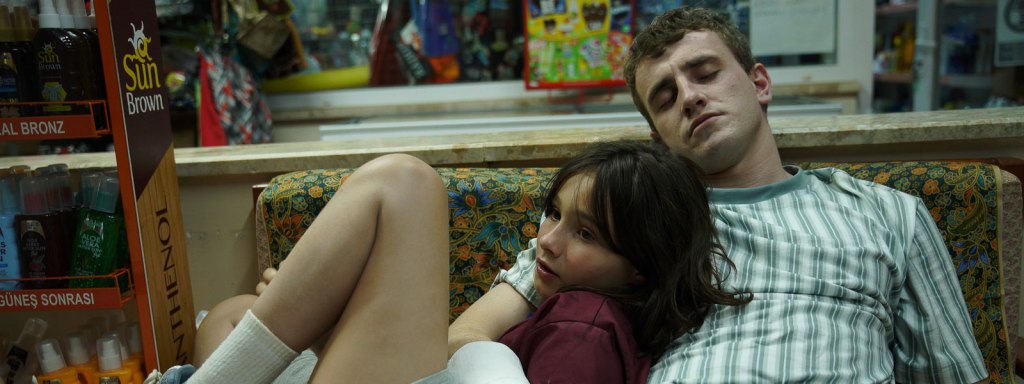
Aftersun (Charlotte Wells) 2022:
A gorgeous film about age, parenthood, and mental health that has such a warm and caring heart, it allows its heavy moments and ideas to linger with the audience.
Aftersun is a debut so assured, so confidently written and directed by Charlotte Wells you will be scrambling to discover her short film work. The film is an achingly intimate portrait of a young father on holiday with his 11-year-old daughter, played touchingly by Paul Mescal and Frankie Corio.
It will be hard to find a more affecting film this year, one so beautifully written you can’t help but see yourself in both characters. I both dread and can’t wait to return to the glow of Aftersun.
⭐⭐⭐⭐
Rating: 4 out of 5.
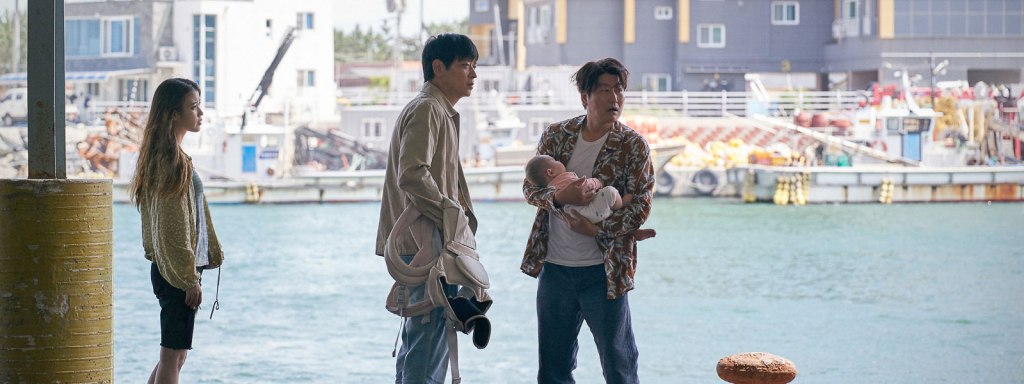
Broker (Hirokazu Koreeda) 2022:
In contention for best film of the festival, Broker is a deeply complicated but always empathetic drama from a true modern master. Hirokazu Koreeda’s films have a certain sticky quality, maturing in your mind long after the credits roll. His films will always affect you emotionally, but their true power is the depths he is able to mine from a collection of characters.
Broker, leaning into the more Korean style of cinema, is more forceful and plot-driven in its storytelling than Koreeda’s other films, but is more successful than his previous non-Japanese film, The Truth (2019).
The film is quite astonishing and deeply felt, with perhaps the only false note being its loud, heavy-handed moments. These moments are further leaned on by quite an obtrusive and manipulative score by Jung Jae-il, especially by Koreeda standards, who usually allows emotions to develop more naturally in his films.
Thank you for being born.
⭐⭐⭐⭐⭐
Rating: 4.5 out of 5.
Decision to Leave (Park Chan-Wook) 2022:
A deeply sensual romance under the guise of a quirky police mystery. Park Chan-Wook has always had a keen understanding of his audiences, usually to an extreme effect like in Oldboy (2003) and The Handmaiden (2016).
The film requires a rewatch as the pieces all work individually but I’m unsure as to their cohesion as the film rounds out into a melodrama. The two lead performances are complicated and layered with conflict, making the film engaging but hard to latch onto as a whole.
⭐⭐⭐⭐
Rating: 4 out of 5.
Dual (Riley Stearns) 2022:
Dual (2022) is a vacuum-sealed dry comedy that owes a lot to Yorgos Lanthimos. Riley Stearns’ idiosyncratic comedic style burst onto the scene with the deeply funny film The Art of Self-Defense (2019), thanks in large part to the terrific performances by Jesse Eisenberg, Imogen Poots, and Alessandro Nivola. Like Lanthimos, it is clear actors get a certain excitement from working with his dialogue, but not all are suitable for it. It’s unclear if Dual’s lead Karen Gillan or its uber-dry dialogue lets down this film in contrast to his previous work, but it is certain to be missing a key element.
That being said, Dual is still deeply funny in places, in particular the doctor’s visits which feel the most inappropriately appropriate locale for Stearns’ dialogue. What is largely absent in the dialogue and writing as a whole, however, is any semblance of humanity and life. With this style of upfront, dry comedy writing, you lose the ability to play between the lines, as everything is pitched straight down the middle to the viewer.
Stearns has achieved success through his idiosyncratic writing style, a mountaintop many writers never reach. Now it’s time for him to seek to expand on it, engaging with his audiences more emotionally, something which would make for a pretty special film.
⭐⭐⭐
Rating: 3 out of 5.
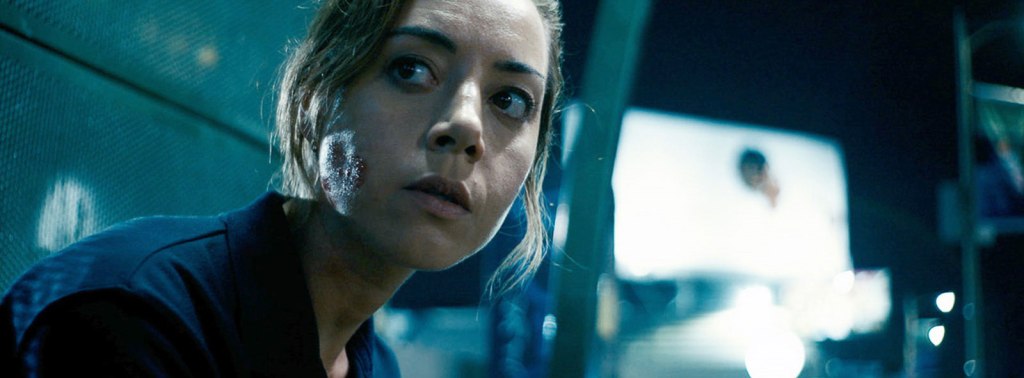
Emily the Criminal (John Patton Ford) 2022:
A solid crime drama with a pointed look at the economic lives of millennials, anchored by a truly great dramatic performance by Aubrey Plaza. Emily the Criminal (2022) works wonderfully as a cascading waterfall of small, utterly reasonable decisions until they come crashing down in its final act.
The film is a great debut by John Patton Ford that is certain to spark hopefully a long and interesting career. Ford’s script is the film’s highlight, especially in its ability to connect the criminal world of the film with the economic reality too many millennials find themselves trapped within.
Even though some of the decisions made in its final act undercut a lot of the messaging and themes, it is still wildly entertaining and painfully relatable, making it a deeply worthwhile watch.
⭐⭐⭐⭐
Rating: 3.5 out of 5.
Fire of Love (Sara Dosa) 2022:
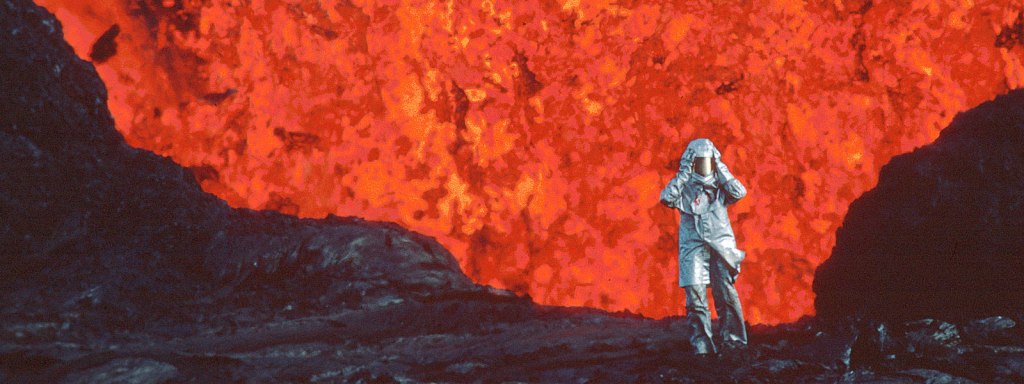
A charming, playful documentary about French volcanologist couple Katia and Maurice Krafft. Their work is highly specific but their passion is relatable and life-affirming. The film is a wonderful companion piece to the Jacques Cousteau documentary, Becoming Cousteau (2021), a clear inspiration to the Krafft’s, even down to the iconic red beanie.
The voiceover by filmmaker Miranda July is sweet and feels deeply entwined with the style of Sara Dosa’s documentary, allowing the film to work both emotionally and narratively.
A truly affecting moment was the shift from watching the couple evolve their focus from a totally self-absorbed drive for witnessing and studying volcanoes, to using their knowledge and relentless drive to protect the people living near dangerous volcanoes.
⭐⭐⭐⭐
Rating: 3.5 out of 5.
Marcel the Shell with Shoes On (Dean Fleischer-Camp) 2021:
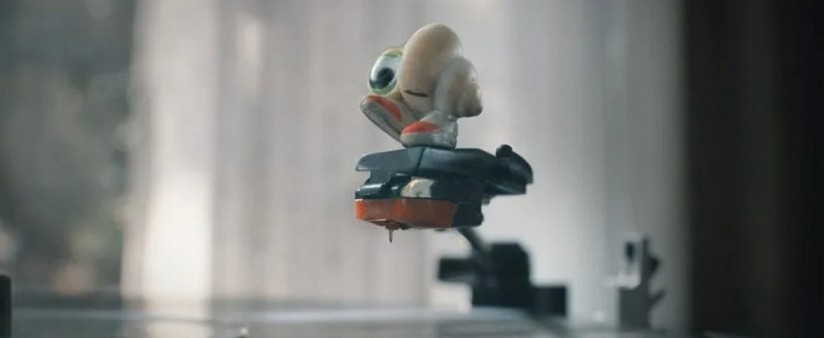
A joyful, all-ages film that was a perfect note of contrast to the festival’s more dramatic highlights, Marcel the Shell with Shoes On (2021) will win over even the more serious audiences. Based on a viral video series that is cleverly woven into the feature film’s narrative, Marcel follows an anthropomorphic shell named Marcel and an amateur documentarian (Fleischer-Camp), who has discovered the shell while staying at an Airbnb.
The film somehow never tips over into pure saccharin which is impressive given its story, which is a credit to the writing and the performances of Jenny Slate and Fleischer-Camp. It’s impossible to not get swept up in Marcel’s journey to find his family, but you may be surprised by how affected you will be by its simple story.
⭐⭐⭐⭐
Rating: 4 out of 5.
Meet Me in the Bathroom (Will Lovelace, Dylan Southern) 2022:
Based on Lizzie Goodman’s totemic book of the same name, Meet Me in the Bathroom tracks the rise of the 2000s New York rock movement after many years in the wilderness, told through the words and lives of The Strokes, Yeah Yeah Yeahs, LCD Soundsystem, and many other important figures.
A deeply complicated time period to capture as a documentary, with the looming figure of 9/11 across so much of the music that came from the scene. It’s impossible for this sobering moment to not emanate outward into the rest of the film, even when we are witnessing rock stars being born.
It’s of course going to feel sparse in comparison to the 800-page oral history time that is Lizzie Goodman’s book, but it could’ve felt more focused. The approach is scattershot and without a propulsive narrative, something that is commonly absent in most documentaries but is what separates the true greats.
Lovelace and Southern’s great achievement is in the LCD Soundsystem’s Last Waltz-esque, one-last show documentary Shut Up and Play the Hits (2012), a monument to the power of access in nonfiction filmmaking. The film also indulges in copious amounts of self-mythologising (something they allow James Murphy to do again here) but is vindicated at the conclusion of the film as we become a Murphy disciple inside a sold-out Madison Square Garden crowd.
⭐⭐⭐
Rating: 2.5 out of 5.
Moonage Daydream (Brett Morgen) 2022:
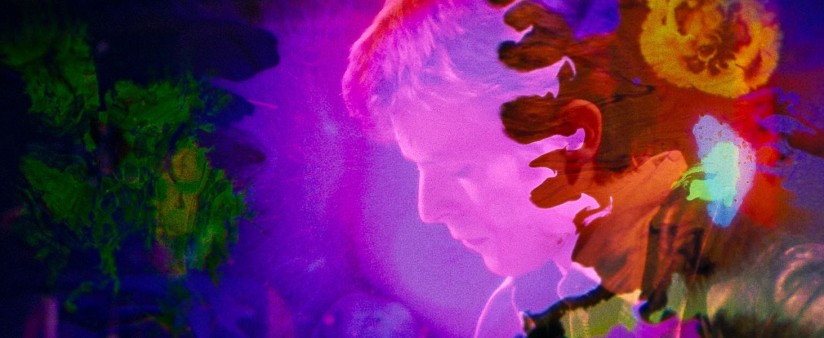
Filmmaker Brett Morgen, known for his wonderful 2015 documentary, Cobain: A Montage of Heck, declared this an experience about Bowie, not a biography of David Jones, and he truly delivered on this promise. Moonage Daydream (2022) is a deeply arresting piece of nonfiction cinema that operates as a mood piece that will be put up next to the very best in the genre.
The film weaponises its breathless propulsion in sly and interesting ways that will sneak up on you emotionally, much like Bowie’s very best work.
It takes time to show its form to you, but once it does its effect is moving and profound. Morgen found something deeply relatable in his pursuit of capturing the figure of Bowie on film, unveiling a beautiful portrait of isolation for an artist that created community, showing us an image of the chameleonic legend that you won’t soon forget.
Recipient of the MIFF Bright Horizons award, Neptune Frost (2021) is a gorgeously experimental afro-futurist musical that is never short on ideas.
The heart of the story is of revolution, with a character going through their own personal revolution sparking a larger revolution in others through their connection to both land and technology. Too often technology-focused sci-fi is based on fear, not on what is possible through it. There is beauty in Uzeyman and William’s use of technology that makes the film instantly unique and fascinating.
Feels close to the films of Apichatpong Weerasethakul, focusing on a spiritual journey over a traditional narrative. This style is in stark contrast to the musical moments of the film, which play out as wondrous set pieces that create contemplative valleys afterwards. This wildly inventive approach to the film works more often than it doesn’t, toeing a nearly impossible line with confidence and style.
You will not find another film like Neptune Frost, with the thematic density of the best science fiction stories, surrounded by wildly inventive musical set pieces that will be burned into your mind.
⭐⭐⭐⭐
Rating: 4 out of 5.
Triangle of Sadness (Ruben Ostlund) 2022:
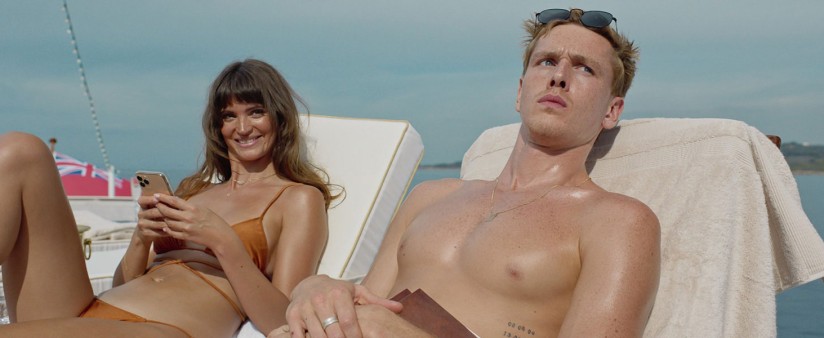
Triangle of Sadness (2022) is so arch you fear it will snap in half. Outrageous and offbeat with some truly theatre-rupturing moments, with the climactic dinner scene feeling closer to a disaster movie than the dinner sequence in The Square (2017). Unfortunately, the film is terribly bloated. This wouldn’t be as big an issue if Ostlund had put any humanity into his film. This cheapens any impact of the outrageous moments, as well as the satirical ones.
The middle chapter is the highlight of the film, which will answer the question, “What if a Jackass skit was shot well enough to win a Palme d’Or?”
What usually holds Ostlund’s wild scripts together is the tremendous performances of its main cast (Claes Bang in The Square, Lisa Loven Kongsli and Johannes Kuhnke in Force Majeure), which feels absent in Triangle of Sadness. His scripts are difficult to instil emotion and humanity into, but Bang, Kongsli and Kuhnke have in the past been able to achieve it, leading to those films’ great success.
Ostlund was definitely striving for a social satire in the vein of the legendary Luis Buñuel (1972’s The Discreet Charm of the Bourgeoisie) but instead felt closer to Adam McKay. The ideas of this satire are quite murky and messy, but rarely in an endearing or interesting way.
⭐⭐⭐
Rating: 3 out of 5.
Saloum (Jean Luc Herbulot) 2021:
The surprise hit of the festival so far, Saloum (2021) is a film destined for cult status. A kinetic western-horror genre mashup that leaves you wanting so much more, something I pray Shudder also realises.
The story follows three mercenaries, transporting a Mexican cartel member across Africa whose plane runs out of gas over Senegal and must stay at a local village. The film is full of unique characters and is told with such style and a deft hand you won’t even notice the more fantastical moments until Herbulot wants you to focus on them.
⭐⭐⭐⭐
Rating: 3.5 out of 5.
Return to Seoul (Davy Chou) 2022:
A unique mix of Korean and French cinema styles allow Return to Seoul (2022) to always feel fresh and new.
The story focuses on French-Korean 20-something Freddie (Park Ji-Min), a complicated and compelling character that elicits empathy and frustration in equal measure. She has returned to Seoul to find her birth parents, having been adopted by a french couple as a baby. Freddie has seemingly taken this trip on a whim, and as the film continues her self-destructive tendencies that seem at first like a quirk in her character, quickly form a heartbreakingly predictable pattern.
The film loses its momentum and the audience as it transitions into short, time-jumping vignettes in its final third. Not that each individual scene isn’t compelling and breathes new life into Freddie’s story, but the decision comes so late in the film’s runtime that it catches the viewer off guard, and not for greater results. The important connective tissue in this final act is unfortunately thin and leaves you mixed on a film that was rather special up until this point.
⭐⭐⭐
Rating: 3 out of 5.
Three Thousand Years of Longing (George Miller) 2022:
A real ‘one for me’ film for George Miller, Three Thousand Years of Longing (2022) is sure to divide audiences in ways only he can. Sandwiched between working on large-budget Mad Max franchise films, the famed Australian director has crafted a visually stunning, narratively dawdling feature that will charm and beguile audiences.
Adapted from A.S. Byatt’s collection of short stories, an important context to give the film as Miller and co-writer Augusta Gore have decided to give the film a similar structure. Leaping between casual conversations shared by narratologist Alithea (the ever off-kilter but charming Tilda Swinton) and Idris Elba’s djinn, shared in an Istanbul hotel room, and the djinn’s story of how he came to be beholden to her.
The film works in its visually dense production design which is Miller’s cinematic superpower, but never really excels in its more meandering storytelling approach. It does, however, feel like exactly the sort of film that will excel several years down the road as we live longer in these stories, constantly revisiting the couple in Istanbul for just one more story.
⭐⭐⭐⭐
Rating: 3.5 out of 5.
Sweet As (Jub Clerc) 2022:
A charming, coming-of-age teen drama that feels beautifully lived in and tinged with autobiographical detail. Sweet As (2022) feels both deeply Australian but also universal, something that could allow it to really break through overseas which is incredibly exciting.
The film is gorgeously shot by the terrific Australian cinematographer Katie Milwright, allowing the natural contrast between the mining town to billow out through the Kimberley region that could easily moonlight as a travel ad for the Northern Territory.
There are rough edges around Sweet As, as most debuts do, but the emotional maturity of Clerc is what shines through in every scene. She has a keen sense and care for her characters that make it impossible not to fall in love with them.
⭐⭐⭐
Rating: 3 out of 5.
Something in the Dirt (Aaron Moorhead, Justin Benson) 2022:
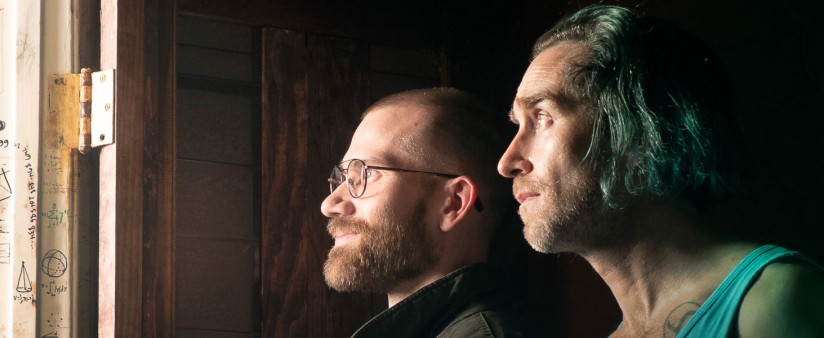
There’s nothing like a low-budget, high-concept sci-fi on a late night at a film festival, especially by a couple of cult film legends in Moorhead & Benson.
Something in the Dirt (2022) operates as a mock documentary, something that may feel like a tired narrative framing for a low-budget indie, but the directing pair makes the film seem boundless.
There is a certain awe that comes when a film feels like it could’ve come straight out of film school, but with all of the confidence of a veteran.
Road trip comedies have always been an effective vehicle for cinema, especially for low-budget indie filmmaking. Forcing a collection of people, whether it be friends, family, or strangers, into a contained space for long stretches of time allows comedy and drama to play out in unique ways, assuming the dialogue is airtight.
A gorgeously written, confident, and assured debut by the son of famed Iranian auteur Jafar Panahi, Hit the Road (2021), wipes away any thought of nepotism in its opening frames. The film feels deeply personal to the story of the Panahi family but is never weighed down by their history. This is due to the film being a comedy-focused film used to buoy not just the scenes, but also the characters who are using humour to hold the serious nature of their trip at bay.
What stands out immediately with the film is the beautifully realistic direction of a family, all with specific, nuanced dynamics that play out in an always engrossing comic drama. Panahi mines the relationships between all four characters to their emotional core with impressive brevity. So many debuts suffer from over-explaining plots or character motives that bog down strong scripts, something Panahi has seemingly mastered already.
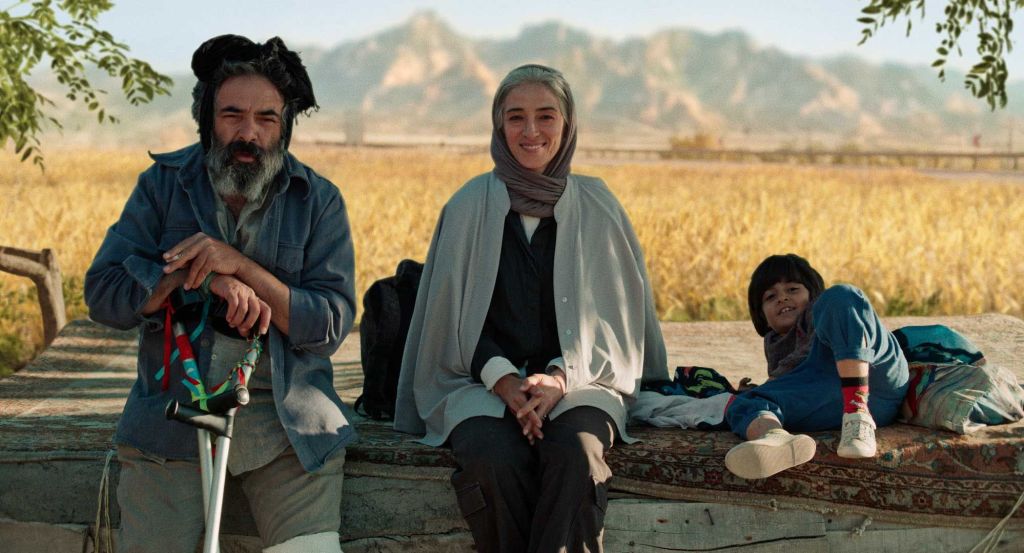
Hit the Road operates with such economical storytelling through its extraordinary collection of performances, with a true firecracker from Rayan Sarlak as the 9-year-old brother. The way the family interact with him is a constant source of humour, with a late scene suggesting that the father gets up earlier and earlier each morning to get some time away from his manic energy.
Mohammad Hassan Madjooni, Pantea Panahiha, and Rayan Sarlak in Hit the Road. Screening provided by Rialto Distribution.
Compositionally, the film is gorgeous and begs to be seen on the big screen. Panahi and cinematographer Amin Jafari capture both the sprawling vistas and confined car sequences with a considered lens. They allow the emotion and tension to play out in contrast in these two locations; the vistas allow the weather and distance to exude emotion, while the confined interiors of the car force us into the family trip and all of its complications.
There is an engrossing amount of ambiguity as to the situation of the family, something that is only amplified by their hesitancy to talk about it at all that is true to their dynamic. The comedy is at the forefront of the film, with Sarlak’s performance as its engine. Even in scenes where he isn’t the focus, his presence is never absent.
Panahi plays not just with what’s seen and not seen in terms of mise en scene, but also with the edges of the family’s story. There is a confidence in the piecemealing out of the family’s backstory, knowing that the strong dialogue and performances will keep the audience engaged instead of focusing purely on the mystery of their trip.
But that mystery is what heightens so many scenes. It works as the riveting narrative pull, running through the entire film, asking us why. Why is this family on a road trip? Why is the mother so concerned as to bury her 9-year-old son’s phone on the side of the road? Why is the driver so crippled with apparent anxiety as to barely speak in the first act? Panahi stretches these questions out, allowing us to peer into the window of this family’s lives and our imagination to run wild with ideas, all within the confines of their small car.
Hit the Road is one of the year’s best films, and a powerful debut to remember. It works as a political thriller, road trip comedy, and family drama all at once, with a keen eye for cinematic storytelling. With a standout cast that is sure to make a star out of Sarlak, this is a trip you don’t want to miss.
After making a festival run in 2021, including being selected as the Chadian entry for last year’s Academy Awards, Mahamat-Saleh Haroun’s engrossing and often stunning family drama Lingui, the Sacred Bonds (2021) arrives at MIFF with acclaim. The film is slight, coming in at just 87 minutes, but is always deeply engaging.
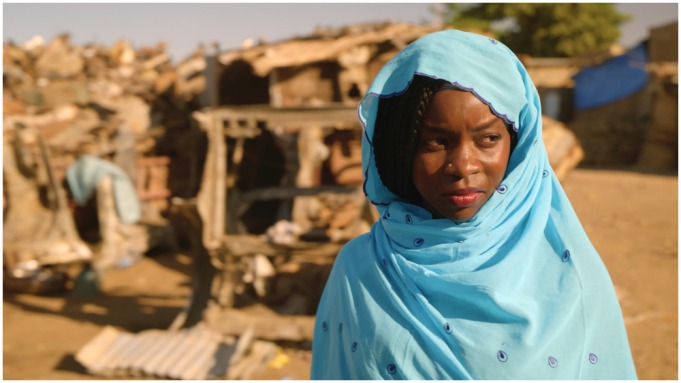
We begin with a dedicated Amina (Achouackh Abakar Souleymane), a single mother crafting intricate stoves out of the wiring in car tyres to support herself and her 15-year-old daughter Maria (Rihane Khalil Alio) in the Chadian city of N’Djamena. The sequence is shot beautifully, as most scenes are by cinematographer Mathieu Giombini, focusing on Amina’s breathing and her drive to support her family.
What Amina does not yet know is she will have to do much more to support Maria, who she is soon to learn is pregnant, and wants an abortion. We learn of this with Amina through a meeting with Maria’s school principal, who informs her she has been expelled because of her pregnancy, stating that it’s “bad for our image.” This explanation is heartbreaking to hear, especially from a woman similar in age to Amina.
What follows is a gripping confrontation between mother and daughter in one of the most extraordinary framed and blocked sequences of the film that is truly stunning. There is a certain grace Haroun is deliberately pairing with the harshness of this confrontation and circumstance that is where the film truly clicks into place and becomes quite special.
Achouackh Abakar Souleymane in Lingui, the Sacred Bonds. Screening provided by Rialto Distribution.
I hesitate to call this an abortion drama, as the film is much more focused on the mother-daughter and the bonds they hold as the navigate their city, religion, and their perception. While similar subject matter has been shown with a clinical harshness to harness the stark reality in films like Never, Rarely, Sometimes, Always (2020) and 4 Months, 3 Weeks and 2 Days (2007), Haroun instead centres this story on the community of women that have to support one another in this city.
The beauty in the film comes from seeing these two women grow in front of our eyes, a remarkable achievement in character work in such a slender film. The pair of performances from Souleymane and Alio are quite special. They are able to embody the quiet, seething rage necessary, as well as the desperation the story requires. Many of these stories can be guilty of wallowing in despair and misery of the characters’ situation, something Haroun is able to navigate around remarkably. Lingui is always focused on its namesake, the bonds between the women of the film, rather than the situation they are in.
There is a remarkable level of restraint that only heightens the dramatic tension scene to scene. Haroun avoids any clean outs in the story, so even with its slender frame, Lingui never feels predictable or dishonest. It is slow to unfold, but once it does you will be struck by its elegance and beauty. The performances and frame widen and lighten that makes the restrained opening worthwhile. If the beginning of the film is a tight series of hyperventilating inhales, the final act feels more like a relieving exhale.
There is a maternal warmth that emanates throughout the film’s female characters, illuminating the necessary bonds these women have with each other in the city that is truly powerful. Depictions of this are so fleeting in film, especially by a male filmmaker, that makes the film so captivating and fresh. Lingui, the Sacred Bonds move slowly on its course, but once the end of the tunnel is in sight, you will be astounded by how much it affects you.
Lingui, the Sacred Bonds willbe in select theatres till August 21st and on MIFF Play from August 12th to 28th.
Taking place at the conclusion of Jazz titan Thelonious Monk’s European tour in 1969 on the French TV show Jazz Portrait, Rewind and Play (2022) gives us a window into how he was treated by even those that believed they were celebrating his genius. French-Senegalese filmmaker Alain Gomis uncovered this footage while working on a fictional, mosaic film based on the legendary musician. This is the filmmaker’s first documentary feature and is a remarkably selfless act to show this footage of unflinching honesty to a broader audience.
Similar in style to Peter Jackson’s miracle of a Beatles documentary Get Back (2021), Rewind and Play gives us a window into one of Jazz’s biggest figures playing his instrument to what is ostensibly no audience. That alone is worth the price of admission.
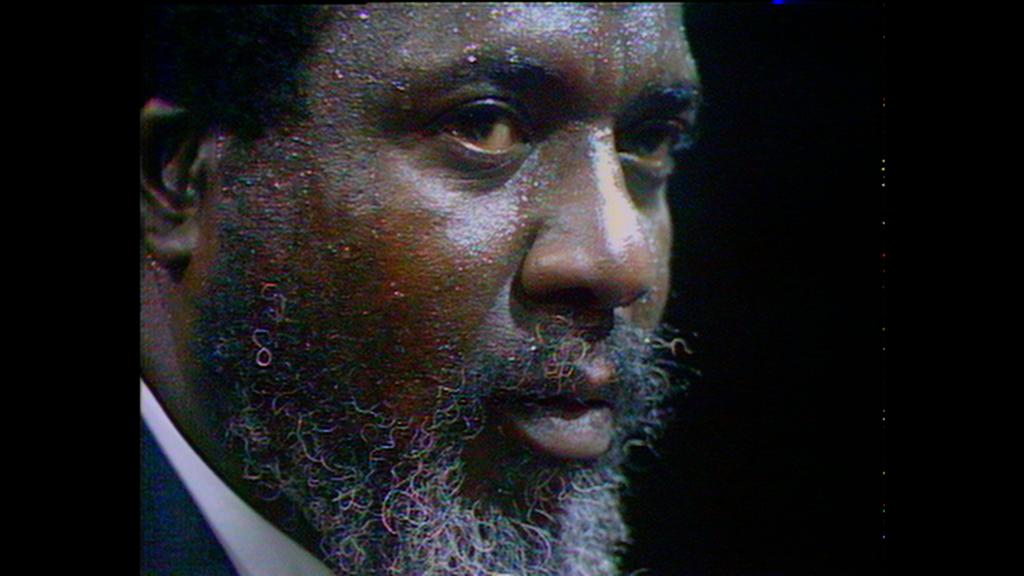
Right at the beginning of the film, you are struck by Monk, hunched and dripping with sweat. His exhausted breathing slowly overwhelms the rest of the audio, drowning out the host. In a film with a strong restraint in editorialisation of footage, Gomis from the first minute of screen time shows that he wants us to feel the harsh lights and environment the legendary pianist finds himself in. Gomis, throughout the documentary, uses Monk’s words and, more importantly, his piano, to drown out the words of those around him.
As soon as the host Henri Renaud begins to interview Monk, the callous and horrible treatment we are soon to endure rears its ugly head. When asked about his first time in France, Monk immediately mentions how he was ossified, something the host doesn’t want to be included in the show, as “it’s not nice”. The statement is also used by Gomis in the film’s opening credits.
Thelonious Monk in Rewind & Play. Screening provided by Andolfi Productions
Monk, like many musicians, communicates through his instrument. The language barrier is larger than the English and French divide here. He is clearly uncomfortable discussing his life, especially in front of a piano that he would rather be playing. Renaud is constantly interjecting his own experiences with Monk throughout the show, while also lazily translating what the pianist is saying back into French, usually in service of himself. The lack of respect and even acknowledgement of Monk’s playing is beyond frustrating, something we see draped across his face constantly.
The sadness from the documentary comes from Monk’s constant civility, coupled with an inability, or lack of desire, to combat with the host and crew on this french late night show. This is not James Baldwin on the couch of a French talk show trading barbs, Monk can only talk his frustrations out on the Steinway in front of him.
The repetition and rigidness of the talk show format is such an antithesis to the early jazz style, which centred on free-flowing, emotive pieces that had no desire to be replicated. The power of the Blue Note jazz movement came from the spontaneous outbursts in creative musicality that can be shared with an audience.
To have one of Jazz’s preeminent figures reduced to essentially a hotel lobby pianist is truly heartbreaking. And it’s not like these tv producers have an issue with the musician. They clearly adore Monk’s music and place in modern Jazz, but they cannot help themselves with their stereotypical ideas about him.
Gomis ironically closes the film with a cross-cutting sequence of Monk playing as the host describes a story of seeing the musician in a Harlem club, playing during a knife fight. The host asked Monk after the club shut down “Thelonious, how come you had the nerve to go on playing?” To which Monk replied, “it was no big deal, there was no need to stop”. This quote perfectly encapsulates the legendary musician’s relationship with music and the chaos of the world around him, highlighting the host’s lack of understanding about the man he was dealing with, then and now.
Rewind & Play willbe in select theatres from August 17th to 21st and on MIFF Play from August 12th.
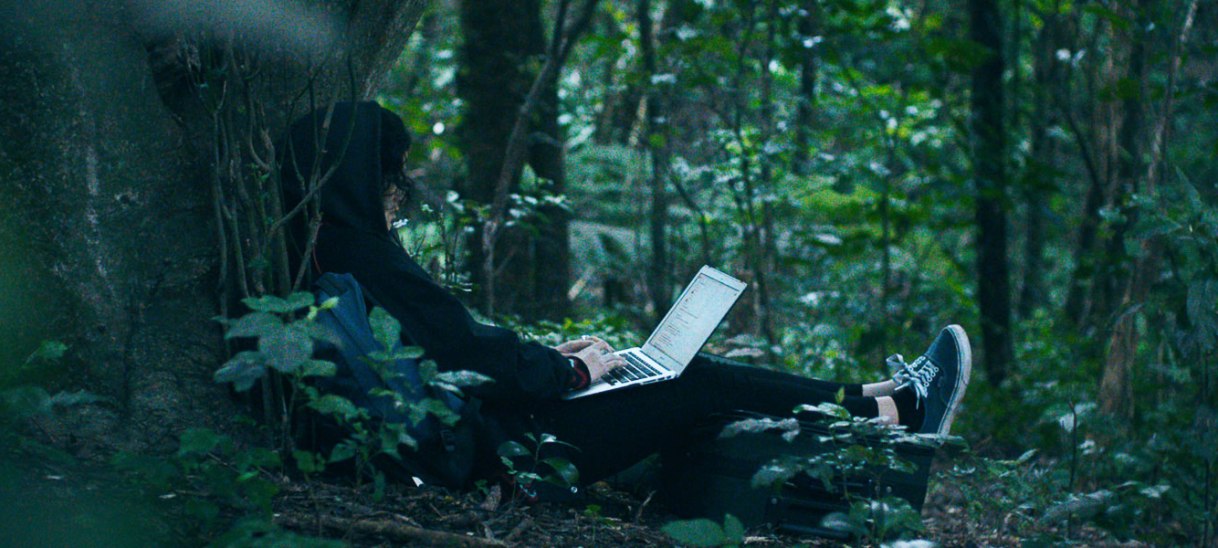
What would you do if a simple lie could get you out of an uncomfortable situation with the people you love? That is the central dilemma in this terrific debut feature out of New Zealand, a deeply relatable tale of anxiety that never shies away from the hard truths its protagonist desperately trying to avoid. Confidently directed by MIFF Accelerator alum Michelle Savill, Millie Lies Low (2021) embraces its titular character’s resourcefulness and willingness to keep the narrative alive with a relentless, anxiety-inducing farce that will break your heart.
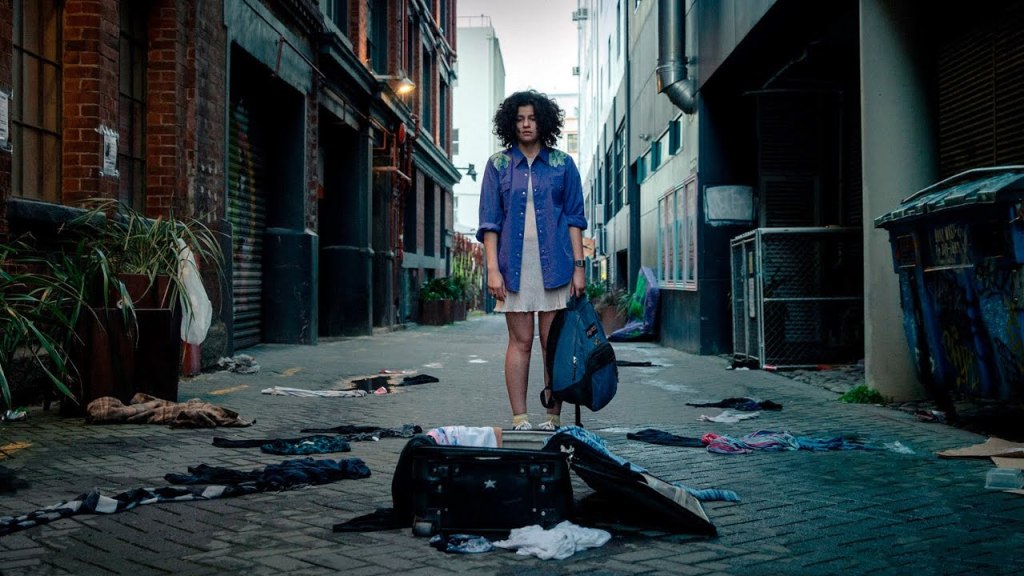
The film tracks architecture student Millie’s web of lies and schemes as a result of her leaving the New York-bound plane on the tarmac due to a panic attack. Instead of returning home to organise a new flight, the anxious Millie (Ana Scotney) decides to create a facade through Zoom and Instagram to her friends and family that she has indeed arrived in the Big Apple.
The film is acted wonderfully and with real compassion by the whole ensemble, with Scotney a real breakout as Millie. A truly compelling lead that buoys the entire story. Scotney fills every inch of the frame with her manic, cunning, and deeply human presentation of an anxiety-filled, self-destructive young person who is impossible not to relate to on some level. There is a level of care and empathy the film takes in showing Millie digging herself further into this hole.
Co-written by Savill and Eli Kent, the film has real compassion for all its characters that allows the film to never devolve into gawking at the cringeworthy situations. All of the supporting characters are just that, true supporters who only want the best for Millie.
Much in the mould of modern anxiety-cinema staples like Good Time (2017) and Eighth Grade (2018), Millie Lies Low propels its narrative with reckless abandon. Before you can even scream out to tell Millie to release herself from this prison she has made for herself, she is already being flung into the next desperate attempt to keep the facade going.
The narrative of Millie’s life is told with heartbreaking honesty, never giving us more than we need to work with scene to scene. Millie is a survivor who is capable of making quick decisions to continue on her path, even if they are detrimental to her in the long run.
There is a terrific sequence where Millie is walking through her friend’s party, the night she is meant to have landed in New York, with a poncho and motorbike helmet on. She is able to overhear her friends talking about her, filling her with more anxiety and pain. Millie is able to move through the party like a phantom, a ghost peering into the lives of her friends without their knowledge. This sequence gives us a window into the other characters of the film while still allowing Scotney to maintain a literal presence on screen for the entire film’s runtime.
Savill and cinematographer Andrew Stroud shoot Wellington in a truly cinematic way, with a clear inspiration stemming from the best of indie New York cinema. The New Zealand capital is captured by people who clearly adore the city, even within a narrative as heartbreaking as this one.
Ana Scotney as Millie in Millie Lies Low. Screening provided by Rialto Distribution.
Unfortunately, the final act felt quite unbalanced in comparison to the energy of the first hour as the many spinning plates Savill and Kent have been managing begin to slow, with the narrative beginning to lean on tropes and flimsy choices that are glaring in contrast to the impressive tightness of its relentless opening.
These sorts of anxiety-inducing, propulsive solo pieces work best with a deeply subjective camera, where any moment without its lead can suck the energy out of the space. Thankfully, Millie Lies Low understands this and maintains Scotney’s white-knuckled grip on her audience for the entire runtime. We are never able to release ourselves from her story, just as she is never able to remove us from witnessing it.
Millie Lies Low will be in select theatres from November 17th.
Before Taika Waititi and Chris Hemsworth collaborated on the wonderful Thor: Ragnarok (2017), no one would have foreseen the Marvel character entering its 11th year of films, with the possibility of many more, but here we are. The God of Thunder returns to the Marvel franchise with possibly the best comedy of the year in Thor: Love and Thunder (2022), the 4th instalment in a character that Waititi and Chris Hemsworth are able to bring the best out of consistently.
This time around, Natalie Portman’s Jane Foster returns to breathe new life into the franchise in a wonderfully charming performance. Her return feels like a notable response to the criticisms of the previous film, Thor: Ragnarok, which lacked a true emotional throughline. Adding to the emotional weight of the film is the inclusion of Christian Bale as Gorr the God Butcher, who is able to toe the line of outrageous superhero villain with real pathos that made Josh Brolin’s Thanos such a hit with audiences.
There are a suite of comedic bits throughout the film that place you firmly within the returning vibe of Waititi’s previous Marvel film, feeling closer in parts to his earliest work with Flight of the Conchords and What We Do in the Shadows (2014) —the distant girlfriend-as-weapon bit feels taken straight from the show— a distinctly comedic tone that feels oftentimes removed from the Marvel house style. The film revolves more around its comedy set-pieces than its action ones, a refreshing shift for the franchise that has often had lacking action moments. Love and Thunder is a comedy-focused superhero film, with Waititi clearly given carte blanche to make the silliest and most enjoyable film possible.
The more recent Marvel films, especially Sam Raimi’s Doctor Strange in the Multiverse of Madness (2022), have such a burden of being more than just a film about their hero that it drags down the emotional and narrative weight of the individual films. A key reason Love and Thunder works is due to its breezy and fresh narrative that flows in the absence of these burdens, allowing it to thrive in a similar way the first phase of Marvel properties do. Unfortunately, this appears to be a rarity in this newest phase of Marvel.
What really allows Love and Thunder to excel is the level of filmmaking craft top to bottom throughout. Chief Mandolorian cinematographer Barry Idoine joins the franchise, which is a major step up for him after working many years as a camera operator for the upper echelon of filmmakers in the industry including Paul Thomas Anderson and Steven Soderbergh. Love and Thunder is constantly seeking to expand the visual dynamism of the Marvel style that has become well-trodden and allows it to feel weightless in comparison to other recent Marvel entries.
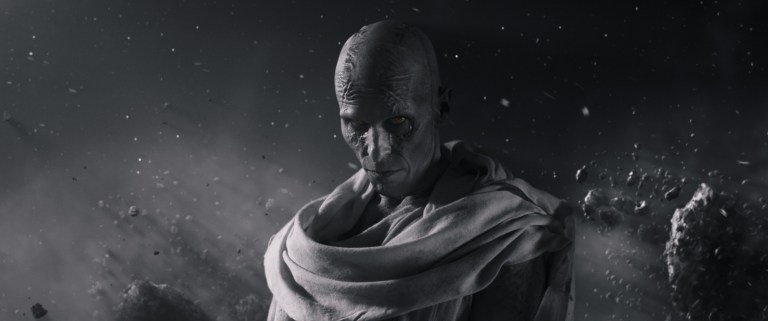
Idoine and Waititi use the tone of the Thor scenes and the audience’s expectations for the film as a compelling counterpoint to the scenes with Bale’s Gorr, shot in borderline german expressionist shadows, mostly without a score or soundtrack, with one striking sequence taking place in a world with no colour. Being able to display a superhero story through tone and colour is an impressive feat the film is able to achieve and is the sort of craft audiences should seek out, even in franchise blockbuster entertainment.
Sadly for audiences, the film is also potentially Taika’s final involvement with Marvel, moving onto a yet unnamed Star Wars film, as well as being in production on a live-action adaptation to the iconic 80’s anime film Akira (1988). Waititi is so comfortably able to imprint his writing and filmmaking style onto these super-budgeted films that are so beyond other filmmakers in the medium of the franchise blockbuster. It was great to see him branch out into a film like Jojo Rabbit (2019), but what makes him a truly singular talent is his ability to scale up without ever diminishing the product or undercutting the story in any way.
Surprisingly, after winning his Oscar for Jojo Rabbit, Waititi has operated mainly in the television space, writing, acting, and producing in fantastic series’ What We Do in the Shadows, Reservation Dogs (one of the best new shows of last year), and Our Flag Means Death. He is one of the brightest lights in the industry with one of the most fascinating careers to follow, becoming one of the most must-see filmmakers working.
Love and Thunder is a real throwback to older Marvel sequels like Iron Man 3 (2013), (a film I will defend as possibly the franchise’s best), where a writer-director auteur is allowed to throw their weight around inside a mega-franchise structure without breaking any load-bearing walls. The film thrives in its eccentricities and the ensemble’s commitment to Waititi’s tone, making it a great watch that feels more of an established, stand-alone piece, rather than a stepping stone to something larger.
Thor: Love and Thunder is is currently screening in cinemas nationwide.
















 Rating Frames