MIFF 22: Citizen Ashe Has Smarts, Lacks Power

Rating: 3.5 out of 5.

Historically, tennis has been a gentleman’s game, and there’s arguably no player who better personifies this philosophy than Arthur Ashe. Embodying this same spirit is a feature-length documentary about the late athlete and activist which, while fascinating and well-told, doesn’t quite do its subject justice.

Born in the former capital of the Confederacy and raised in the shadow of segregation, Ashe overcame socio-economic disadvantage to achieve a bold ambition he set himself in his youth: doing for tennis what Jackie Robinson did for baseball. On the court, he devoured opponents with an icy elegance and disarming modesty; off it, he was a polite yet passionate advocate for civil rights the world over. His relentlessness continued well into retirement, using his name and voice in the fight against HIV/AIDS – a disease which he himself contracted, with fatal consequences.

It’s quite fitting that Citizen Ashe (2021) should be screening as part of this year’s Melbourne International Film Festival. Our city is, of course, home to the Australian Open, the Asia-Pacific’s premier tennis tournament; but it’s also the place where Ashe obtained his last ever Grand Slam title, winning the Men’s Doubles competition with Aussie player Tony Roche in January 1977. Additionally, its showing continues the Festival’s affinity with politically-minded sports documentaries, with previous examples including The Witches of the Orient (2021) and The Australian Dream (2019). That’s right – this is no mere tennis story.

Ashe’s sporting achievements have since been overshadowed by the likes of the Williams sisters and Roger Federer, so it’s not surprising that directors Rex Miller and Sam Pollard have opted for a greater focus on the politics and social issues that shaped the athlete’s mindset. Insights are provided by the likes of Johnnie Ashe, who discusses his older brother’s upbringing in Montgomery, Alabama and his military service; and Harry Edwards, a former Black Panther who reflects on the tennis star’s passive approach to racism.

What’s most intriguing, and impressive, about Citizen Ashe is how Miller and Pollard tell their story. Fresh interviews with Edwards, Johnnie Ashe and others are woven together with archival video, and audio, of its subject appearing on current affairs programs and chat shows, all of which is expertly edited – to the point where the film negates the need for a dedicated narrator. At times, it’s almost as though Arthur Ashe is speaking directly to the viewer, his soundbites seemingly uttered with this very documentary in mind. And the ingenuity of the screenplay doesn’t end there.
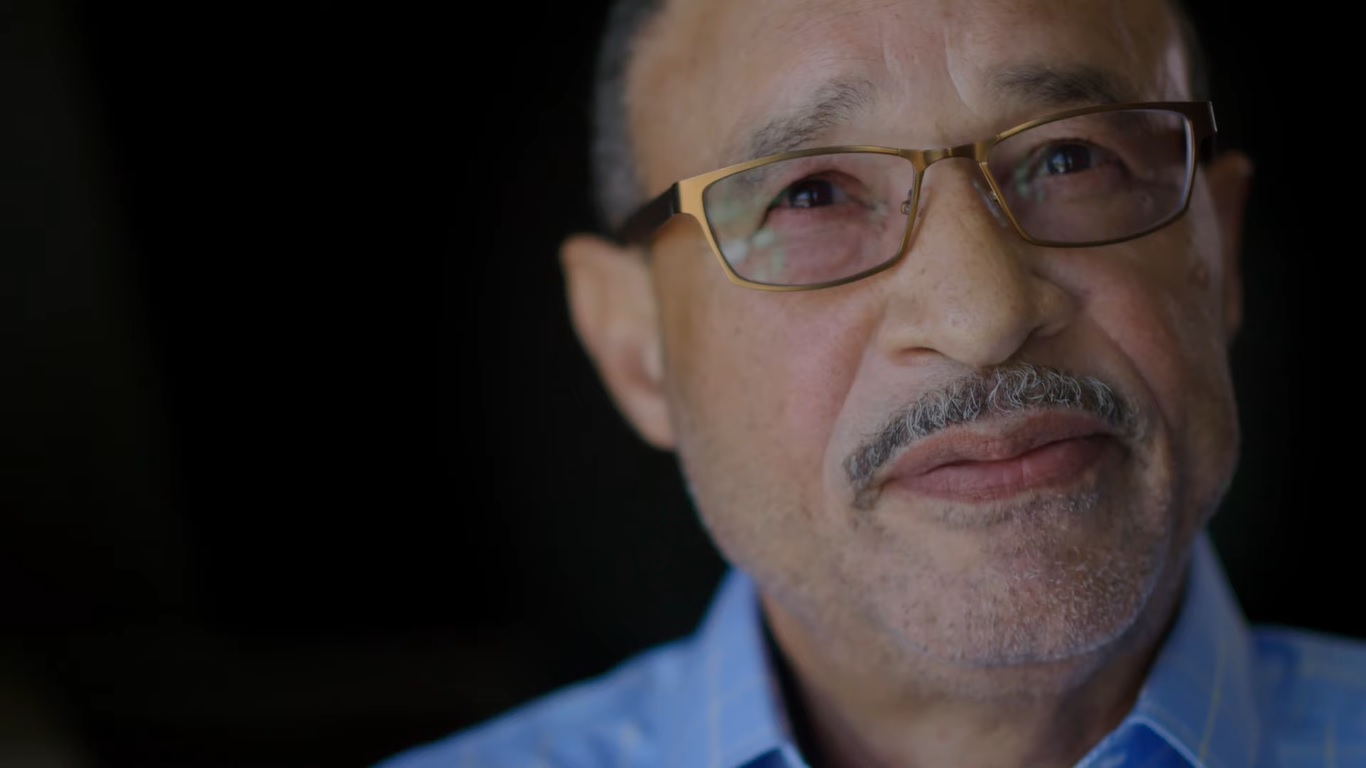
Arthur Ashe’s younger brother, Johnnie is one of the talking heads in Citizen Ashe

Every good tale needs an adversary, and Ashe has one in Jimmy Connors. Having emerged on the tennis scene just as Ashe was reaching his peak, Connors appears to be everything that his counterpart isn’t, a man who’s strong, brash and loud – he’s widely recognised as one of the first “grunters” in the sport. Connors’ game-changing techniques contrast with the more traditional, tactical approach of his rival, making him the James Hunt to Ashe’s Niki Lauda, or the John McEnroe to the other’s Bjorn Borg. So intriguing is this rivalry that it could be a fascinating movie or mini-series on its own.

The same could be said for the rest of the documentary, for that matter. Every aspect of Ashe’s extraordinary life – whether it be his childhood, his studies in California, his military service, his visit to Apartheid-era South Africa, his coaching of the American Davis Cup team, his relationship with John McEnroe, his marriage to Jeanne Moutoussamy, or his AIDS diagnosis – is worthy of the feature-length treatment. But instead, Citizen Ashe condenses it all into a 95-minute runtime. While this is a commendable feat, the film needs at least another half-hour to thoroughly study its namesake, and reflect upon his legacy.

As a result of its abbreviated duration, the tone of Citizen Ashe is somewhat remote. His many achievements and milestones are made to feel more like footnotes, never reaching the cathartic highs of other documentaries about the African-American experience, such as Summer of Soul (2021). And in being so emotionally distant, the picture never becomes the profound, moving tale that it ought to be, nor does the viewer feel compelled to emulate its central figure and become a better person – as was the case in The Australian Dream.

Much like the man himself, Citizen Ashe refrains from melodrama, telling its narrative with poise and intelligence. The documentary falters as a tribute to the professional athlete, for it is overly clinical in its delivery, though it does serve some purpose as a neat introduction to those who are unfamiliar with all that Arthur Ashe accomplished in his remarkable, all-too-short life.

Citizen Ashe is streaming on MIFF Play until Sunday, August 28.
Hit the Road is a Road Trip Worth Savouring 

Rating: 4 out of 5.

Road trip comedies have always been an effective vehicle for cinema, especially for low-budget indie filmmaking. Forcing a collection of people, whether it be friends, family, or strangers, into a contained space for long stretches of time allows comedy and drama to play out in unique ways, assuming the dialogue is airtight. 

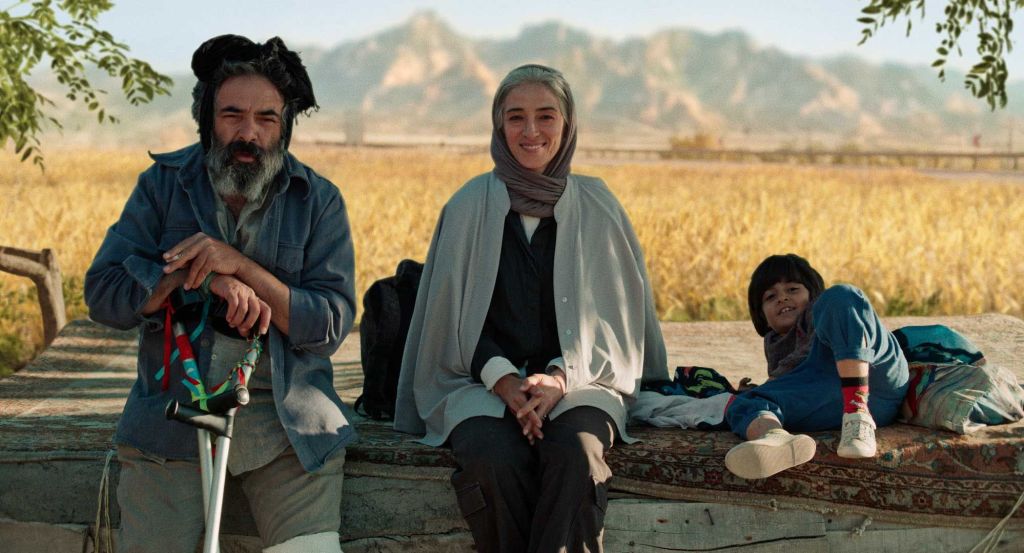
A gorgeously written, confident, and assured debut by the son of famed Iranian auteur Jafar Panahi, Hit the Road (2021), wipes away any thought of nepotism in its opening frames. The film feels deeply personal to the story of the Panahi family but is never weighed down by their history. This is due to the film being a comedy-focused film used to buoy not just the scenes, but also the characters who are using humour to hold the serious nature of their trip at bay.

What stands out immediately with the film is the beautifully realistic direction of a family, all with specific, nuanced dynamics that play out in an always engrossing comic drama. Panahi mines the relationships between all four characters to their emotional core with impressive brevity. So many debuts suffer from over-explaining plots or character motives that bog down strong scripts, something Panahi has seemingly mastered already.

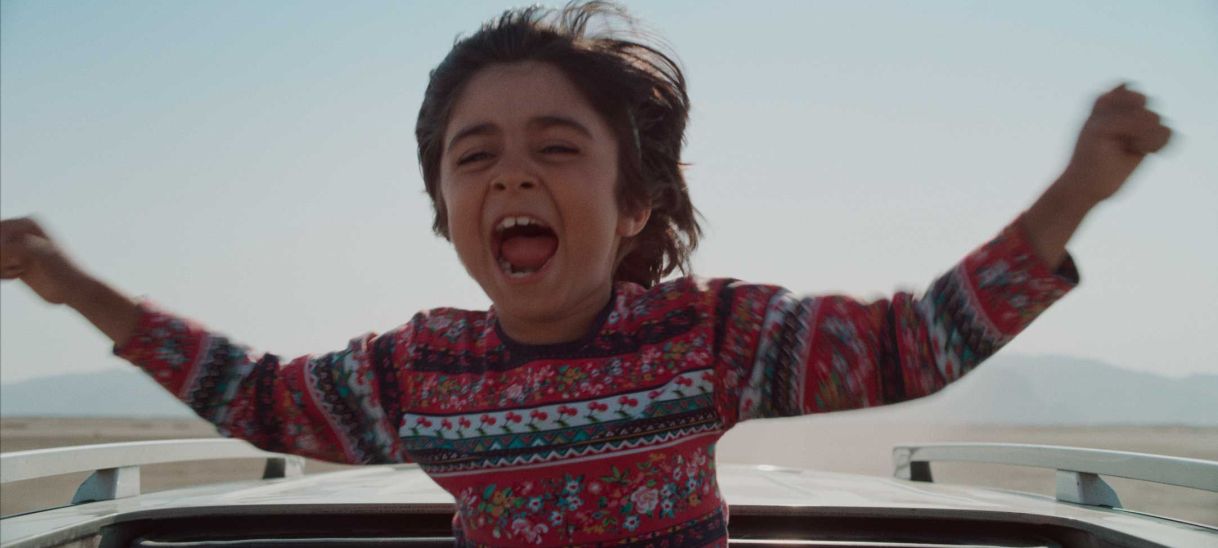
Hit the Road operates with such economical storytelling through its extraordinary collection of performances, with a true firecracker from Rayan Sarlak as the 9-year-old brother. The way the family interact with him is a constant source of humour, with a late scene suggesting that the father gets up earlier and earlier each morning to get some time away from his manic energy. 

Mohammad Hassan Madjooni, Pantea Panahiha, and Rayan Sarlak in Hit the Road. Screening provided by Rialto Distribution.

Compositionally, the film is gorgeous and begs to be seen on the big screen. Panahi and cinematographer Amin Jafari capture both the sprawling vistas and confined car sequences with a considered lens. They allow the emotion and tension to play out in contrast in these two locations; the vistas allow the weather and distance to exude emotion, while the confined interiors of the car force us into the family trip and all of its complications.

There is an engrossing amount of ambiguity as to the situation of the family, something that is only amplified by their hesitancy to talk about it at all that is true to their dynamic. The comedy is at the forefront of the film, with Sarlak’s performance as its engine. Even in scenes where he isn’t the focus, his presence is never absent.

Panahi plays not just with what’s seen and not seen in terms of mise en scene, but also with the edges of the family’s story. There is a confidence in the piecemealing out of the family’s backstory, knowing that the strong dialogue and performances will keep the audience engaged instead of focusing purely on the mystery of their trip.

But that mystery is what heightens so many scenes. It works as the riveting narrative pull, running through the entire film, asking us why. Why is this family on a road trip? Why is the mother so concerned as to bury her 9-year-old son’s phone on the side of the road? Why is the driver so crippled with apparent anxiety as to barely speak in the first act? Panahi stretches these questions out, allowing us to peer into the window of this family’s lives and our imagination to run wild with ideas, all within the confines of their small car.

Hit the Road is one of the year’s best films, and a powerful debut to remember. It works as a political thriller, road trip comedy, and family drama all at once, with a keen eye for cinematic storytelling. With a standout cast that is sure to make a star out of Sarlak, this is a trip you don’t want to miss.

Hit the Road is in select cinemas now.

MIFF 22: Cheap Laughs Abound as Triangle of Sadness Lays Waste to the Wealthy

Rating: 3 out of 5.

In Ruben Östlund’s latest overblown, satirical romp, Triangle of Sadness (2022), there is a wealthy German stroke survivor whose only words of communication are “in der wolken” (translated: in the clouds). It’s a phrase she yells out countlessly across the film to the point where it wouldn’t be surprising if it pops its head in like an M. Night Shyamalan twist at the film’s close. It never does though, but it perfectly captures the underlying message behind Östlund’s rich ripping, caste crushing film — the wealthy just love to live in the clouds, out of touch with reality, no matter how dire a situation can get.

While most of the rich folk in this film are overblown caricatures that breach the threshold of excessiveness, for Östlund, excessiveness is the name of the game. Structuring his film into three chapters (three edges that make up a “Triangle of Sadness”, if you will), Östlund takes aim at the false pretences that the wealthy hide behind — fancy yachts, material goods like Rolex watches, and cosmetic procedures among other things — and bares them for viewers in all their grotesqueness. It’s nothing that hasn’t been depicted throughout cinema history in the past (2013’s The Great Gatsby and The Wolf of Wall Street come to mind from recent films), but Östlund isn’t privy to subtlety, rather, he’s going all in until you’re either exhausted, squeamish, or both.  

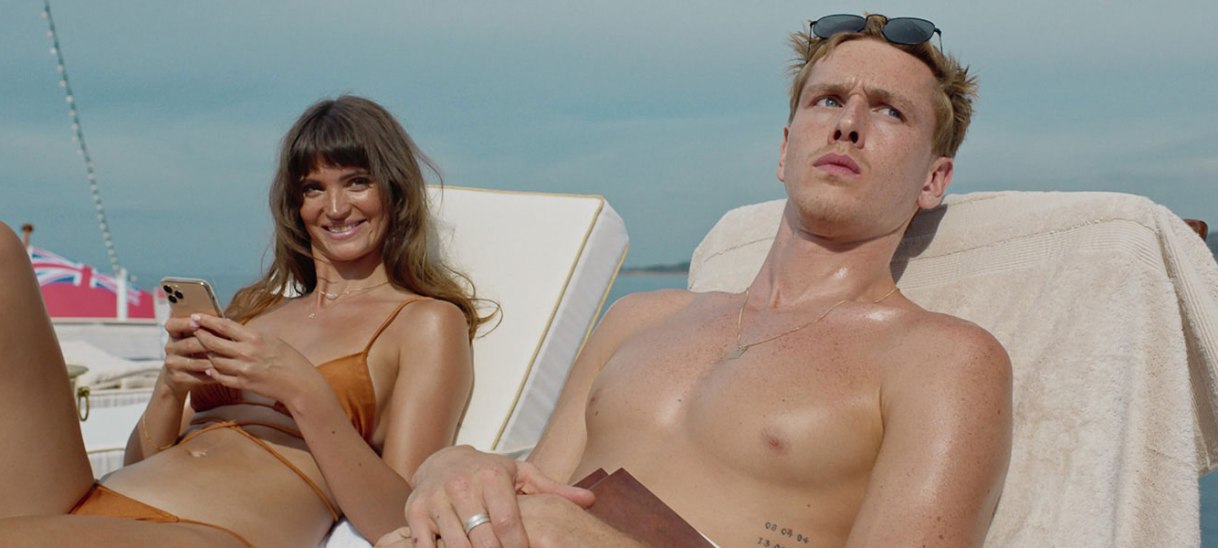
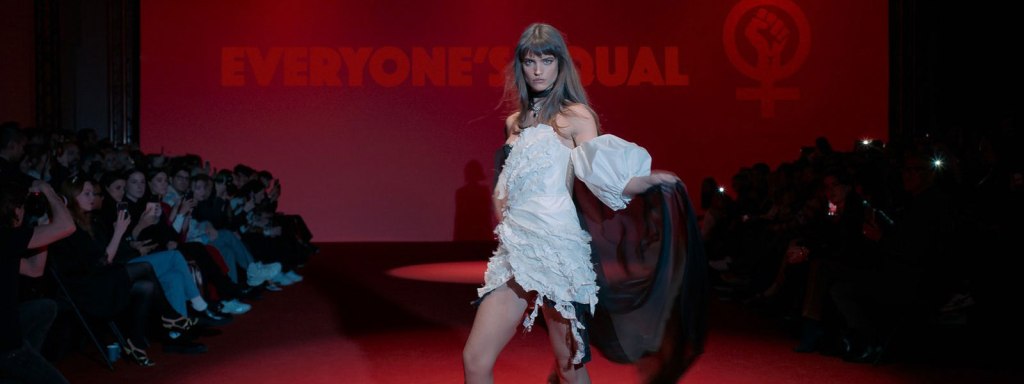
Where there is beauty, there is deceit — at least that’s part of the message that underpins Triangle of Sadness. Set on a luxurious yacht for the most part, the film is comprised of a solid ensemble that plays seamlessly off of Östlund’s material and each other. It’s Yaya (Charlbi Dean Kriek) and Carl (Harris Dickinson), two models and partners-with-benefits, that serve as the entry point into the mayhem that ensues. Both characters skimp by on their looks, and it’s part of the reason they find themselves in the company of millionaires and billionaires on the aforementioned yacht as Yaya is gifted a free trip courtesy of her influencer status.

On the ship we find a bunch of rich folk and everyone in-between including the ship’s crew. There’s a British couple who boast about their contribution to the munitions industry including their role in creating land mines and hand grenades (which Östlund returns to in explosive fashion); a down-on-his-luck code-seller whose partner didn’t join him on the cruise; the vessel’s drunk captain (Woody Harrelson); a Russian billionaire who made his money selling manure; and the chief stew of the ship, among others.

Charlbi Dean Kriek in Triangle of Sadness

Each character has a role to play in Östlund’s charade as events spiral from controlled to chaotic in an instant. He rocks the boat to the point where characters are literally spewing their guts out (of both ends) after a slimy buffet and storm, he throws in a pirate attack at one point, and in the third act he leaves some characters stranded on an island where he flips the hierarchical triangle on its head.

There’s a lot happening in Triangle of Sadness to the point where you can feel the lengthy runtime weighing proceedings down. This is undoubtedly a conscious choice on Östlund’s part as he leans into the satire he is going for to create an equally exhausting experience for his characters (especially in that third act).

At times it feels like his screenplay is made up of a bunch of short films or mini sketches that have just been welded together. There’s a scene involving the yacht’s captain and the rich Russian Dimitry (Zlatko Buric) as they indulge in a Marxist and capitalist back-and-forth while playing a drinking game that they continue in the captains quarters over the yacht’s PA system. There’s also a sexploitation sequence on the island portion of the film where the yacht’s Toilet Manager pays Carl for his services with pretzel sticks and shelter. All of these sequences are comical, but there’s never greater substance or deeper subliminal messaging beyond the superficiality of being rich and the vanity of these characters.

Triangle of Sadness is at its best during its first half, where it plays around with ideas of inadequacy and superficiality at a more measured level. The longer the film chugs on though, the more it tailspins into a cartoonish satire that trades subtlety for unhinged chaos, where you’re fed what you know and nothing more.

Triangle of Sadness hits Australian cinemas in late December.

MIFF 22: Lingui, the Sacred Bonds is a Beautiful Portrait of Resilience

Rating: 4 out of 5.

After making a festival run in 2021, including being selected as the Chadian entry for last year’s Academy Awards, Mahamat-Saleh Haroun’s engrossing and often stunning family drama Lingui, the Sacred Bonds (2021) arrives at MIFF with acclaim. The film is slight, coming in at just 87 minutes, but is always deeply engaging.

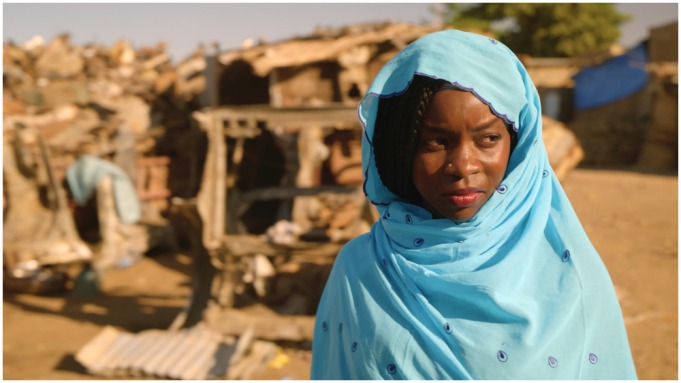
We begin with a dedicated Amina (Achouackh Abakar Souleymane), a single mother crafting intricate stoves out of the wiring in car tyres to support herself and her 15-year-old daughter Maria (Rihane Khalil Alio) in the Chadian city of N’Djamena. The sequence is shot beautifully, as most scenes are by cinematographer Mathieu Giombini, focusing on Amina’s breathing and her drive to support her family. 

What Amina does not yet know is she will have to do much more to support Maria, who she is soon to learn is pregnant, and wants an abortion. We learn of this with Amina through a meeting with Maria’s school principal, who informs her she has been expelled because of her pregnancy, stating that it’s “bad for our image.” This explanation is heartbreaking to hear, especially from a woman similar in age to Amina.

What follows is a gripping confrontation between mother and daughter in one of the most extraordinary framed and blocked sequences of the film that is truly stunning. There is a certain grace Haroun is deliberately pairing with the harshness of this confrontation and circumstance that is where the film truly clicks into place and becomes quite special.

Achouackh Abakar Souleymane in Lingui, the Sacred Bonds. Screening provided by Rialto Distribution.

I hesitate to call this an abortion drama, as the film is much more focused on the mother-daughter and the bonds they hold as the navigate their city, religion, and their perception. While similar subject matter has been shown with a clinical harshness to harness the stark reality in films like Never, Rarely, Sometimes, Always (2020) and 4 Months, 3 Weeks and 2 Days (2007), Haroun instead centres this story on the community of women that have to support one another in this city. 

The beauty in the film comes from seeing these two women grow in front of our eyes, a remarkable achievement in character work in such a slender film. The pair of performances from Souleymane and Alio are quite special. They are able to embody the quiet, seething rage necessary, as well as the desperation the story requires. Many of these stories can be guilty of wallowing in despair and misery of the characters’ situation, something Haroun is able to navigate around remarkably. Lingui is always focused on its namesake, the bonds between the women of the film, rather than the situation they are in.

There is a remarkable level of restraint that only heightens the dramatic tension scene to scene. Haroun avoids any clean outs in the story, so even with its slender frame, Lingui never feels predictable or dishonest. It is slow to unfold, but once it does you will be struck by its elegance and beauty. The performances and frame widen and lighten that makes the restrained opening worthwhile. If the beginning of the film is a tight series of hyperventilating inhales, the final act feels more like a relieving exhale.

There is a maternal warmth that emanates throughout the film’s female characters, illuminating the necessary bonds these women have with each other in the city that is truly powerful. Depictions of this are so fleeting in film, especially by a male filmmaker, that makes the film so captivating and fresh. Lingui, the Sacred Bonds move slowly on its course, but once the end of the tunnel is in sight, you will be astounded by how much it affects you.

Lingui, the Sacred Bonds will be in select theatres till August 21st and on MIFF Play from August 12th to 28th.

MIFF 22: Rewind & Play is a Must-See for Jazz Fans

Rating: 3.5 out of 5.

Taking place at the conclusion of Jazz titan Thelonious Monk’s European tour in 1969 on the French TV show Jazz Portrait, Rewind and Play (2022) gives us a window into how he was treated by even those that believed they were celebrating his genius. French-Senegalese filmmaker Alain Gomis uncovered this footage while working on a fictional, mosaic film based on the legendary musician. This is the filmmaker’s first documentary feature and is a remarkably selfless act to show this footage of unflinching honesty to a broader audience. 

Similar in style to Peter Jackson’s miracle of a Beatles documentary Get Back (2021), Rewind and Play gives us a window into one of Jazz’s biggest figures playing his instrument to what is ostensibly no audience. That alone is worth the price of admission. 

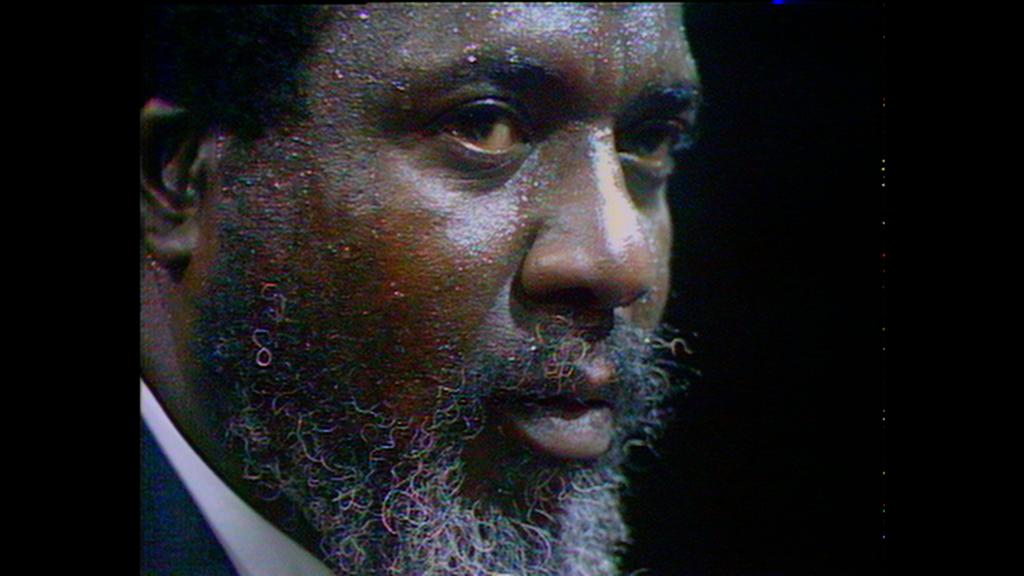
Right at the beginning of the film, you are struck by Monk, hunched and dripping with sweat. His exhausted breathing slowly overwhelms the rest of the audio, drowning out the host. In a film with a strong restraint in editorialisation of footage, Gomis from the first minute of screen time shows that he wants us to feel the harsh lights and environment the legendary pianist finds himself in. Gomis, throughout the documentary, uses Monk’s words and, more importantly, his piano, to drown out the words of those around him.

As soon as the host Henri Renaud begins to interview Monk, the callous and horrible treatment we are soon to endure rears its ugly head. When asked about his first time in France, Monk immediately mentions how he was ossified, something the host doesn’t want to be included in the show, as “it’s not nice”. The statement is also used by Gomis in the film’s opening credits.

Thelonious Monk in Rewind & Play. Screening provided by Andolfi Productions

Monk, like many musicians, communicates through his instrument. The language barrier is larger than the English and French divide here. He is clearly uncomfortable discussing his life, especially in front of a piano that he would rather be playing. Renaud is constantly interjecting his own experiences with Monk throughout the show, while also lazily translating what the pianist is saying back into French, usually in service of himself. The lack of respect and even acknowledgement of Monk’s playing is beyond frustrating, something we see draped across his face constantly.

The sadness from the documentary comes from Monk’s constant civility, coupled with an inability, or lack of desire, to combat with the host and crew on this french late night show. This is not James Baldwin on the couch of a French talk show trading barbs, Monk can only talk his frustrations out on the Steinway in front of him.

The repetition and rigidness of the talk show format is such an antithesis to the early jazz style, which centred on free-flowing, emotive pieces that had no desire to be replicated. The power of the Blue Note jazz movement came from the spontaneous outbursts in creative musicality that can be shared with an audience.

To have one of Jazz’s preeminent figures reduced to essentially a hotel lobby pianist is truly heartbreaking. And it’s not like these tv producers have an issue with the musician. They clearly adore Monk’s music and place in modern Jazz, but they cannot help themselves with their stereotypical ideas about him.

Gomis ironically closes the film with a cross-cutting sequence of Monk playing as the host describes a story of seeing the musician in a Harlem club, playing during a knife fight. The host asked Monk after the club shut down “Thelonious, how come you had the nerve to go on playing?” To which Monk replied, “it was no big deal, there was no need to stop”. This quote perfectly encapsulates the legendary musician’s relationship with music and the chaos of the world around him, highlighting the host’s lack of understanding about the man he was dealing with, then and now.

Rewind & Play will be in select theatres from August 17th to 21st and on MIFF Play from August 12th.

MIFF 22: Millie Lies Low is a Propulsive Debut to Remember

Rating: 3 out of 5.

What would you do if a simple lie could get you out of an uncomfortable situation with the people you love? That is the central dilemma in this terrific debut feature out of New Zealand, a deeply relatable tale of anxiety that never shies away from the hard truths its protagonist desperately trying to avoid. Confidently directed by MIFF Accelerator alum Michelle Savill, Millie Lies Low (2021) embraces its titular character’s resourcefulness and willingness to keep the narrative alive with a relentless, anxiety-inducing farce that will break your heart.

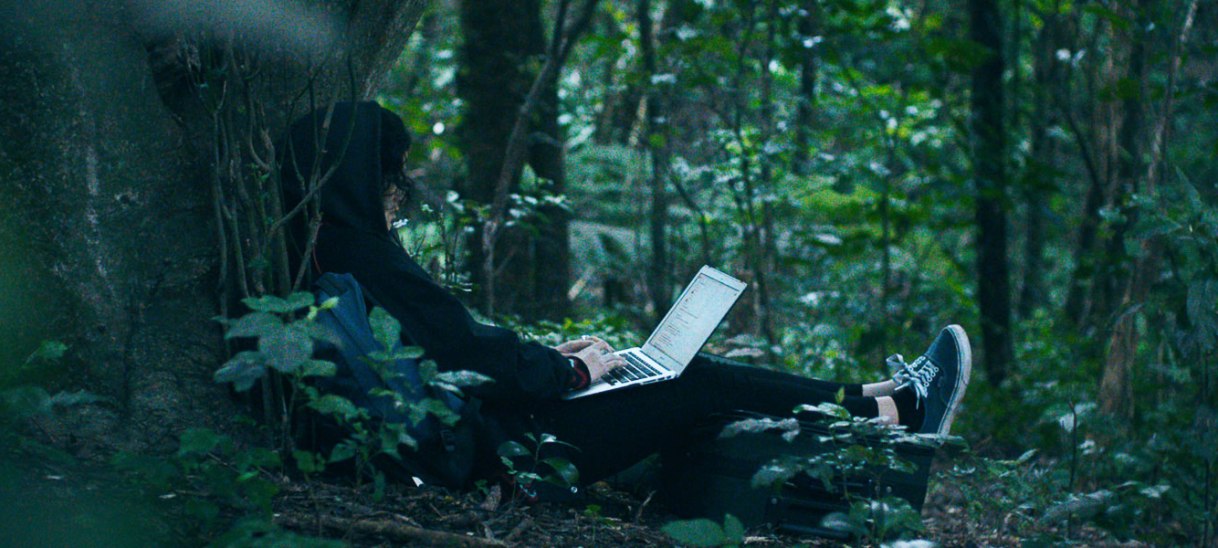
The film tracks architecture student Millie’s web of lies and schemes as a result of her leaving the New York-bound plane on the tarmac due to a panic attack. Instead of returning home to organise a new flight, the anxious Millie (Ana Scotney) decides to create a facade through Zoom and Instagram to her friends and family that she has indeed arrived in the Big Apple.

The film is acted wonderfully and with real compassion by the whole ensemble, with Scotney a real breakout as Millie. A truly compelling lead that buoys the entire story. Scotney fills every inch of the frame with her manic, cunning, and deeply human presentation of an anxiety-filled, self-destructive young person who is impossible not to relate to on some level. There is a level of care and empathy the film takes in showing Millie digging herself further into this hole.

Co-written by Savill and Eli Kent, the film has real compassion for all its characters that allows the film to never devolve into gawking at the cringeworthy situations. All of the supporting characters are just that, true supporters who only want the best for Millie.

Much in the mould of modern anxiety-cinema staples like Good Time (2017) and Eighth Grade (2018), Millie Lies Low propels its narrative with reckless abandon. Before you can even scream out to tell Millie to release herself from this prison she has made for herself, she is already being flung into the next desperate attempt to keep the facade going. 

The narrative of Millie’s life is told with heartbreaking honesty, never giving us more than we need to work with scene to scene. Millie is a survivor who is capable of making quick decisions to continue on her path, even if they are detrimental to her in the long run. 

There is a terrific sequence where Millie is walking through her friend’s party, the night she is meant to have landed in New York, with a poncho and motorbike helmet on. She is able to overhear her friends talking about her, filling her with more anxiety and pain. Millie is able to move through the party like a phantom, a ghost peering into the lives of her friends without their knowledge. This sequence gives us a window into the other characters of the film while still allowing Scotney to maintain a literal presence on screen for the entire film’s runtime. 

Savill and cinematographer Andrew Stroud shoot Wellington in a truly cinematic way, with a clear inspiration stemming from the best of indie New York cinema. The New Zealand capital is captured by people who clearly adore the city, even within a narrative as heartbreaking as this one.

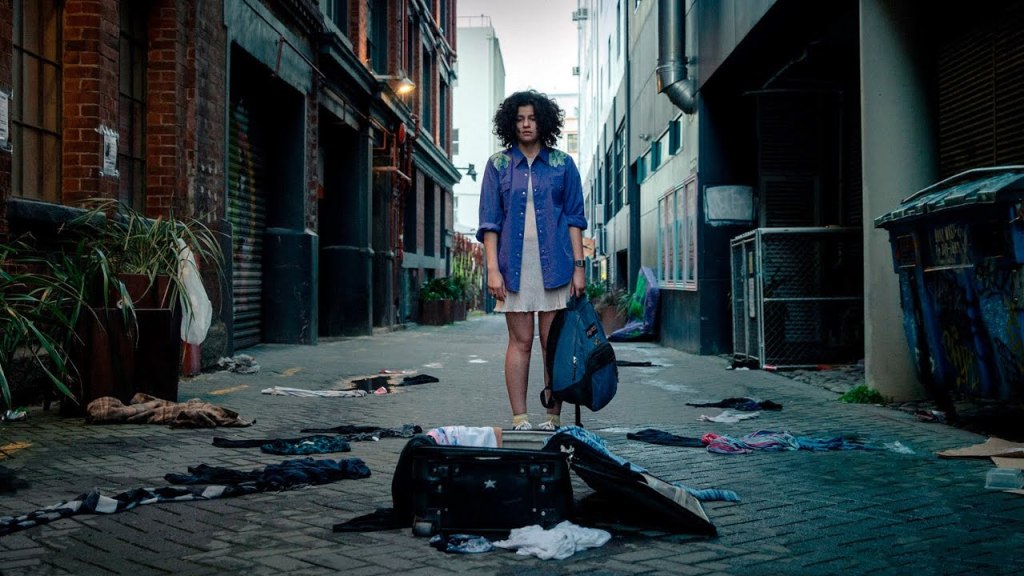
Ana Scotney as Millie in Millie Lies Low. Screening provided by Rialto Distribution.

Unfortunately, the final act felt quite unbalanced in comparison to the energy of the first hour as the many spinning plates Savill and Kent have been managing begin to slow, with the narrative beginning to lean on tropes and flimsy choices that are glaring in contrast to the impressive tightness of its relentless opening.

These sorts of anxiety-inducing, propulsive solo pieces work best with a deeply subjective camera, where any moment without its lead can suck the energy out of the space. Thankfully, Millie Lies Low understands this and maintains Scotney’s white-knuckled grip on her audience for the entire runtime. We are never able to release ourselves from her story, just as she is never able to remove us from witnessing it.

Millie Lies Low will be in select theatres from November 17th.

Thor: Love and Thunder Brings Both in Equal Measure

Rating: 3.5 out of 5.

Before Taika Waititi and Chris Hemsworth collaborated on the wonderful Thor: Ragnarok (2017), no one would have foreseen the Marvel character entering its 11th year of films, with the possibility of many more, but here we are. The God of Thunder returns to the Marvel franchise with possibly the best comedy of the year in Thor: Love and Thunder (2022), the 4th instalment in a character that Waititi and Chris Hemsworth are able to bring the best out of consistently.

This time around, Natalie Portman’s Jane Foster returns to breathe new life into the franchise in a wonderfully charming performance. Her return feels like a notable response to the criticisms of the previous film, Thor: Ragnarok, which lacked a true emotional throughline. Adding to the emotional weight of the film is the inclusion of Christian Bale as Gorr the God Butcher, who is able to toe the line of outrageous superhero villain with real pathos that made Josh Brolin’s Thanos such a hit with audiences.

There are a suite of comedic bits throughout the film that place you firmly within the returning vibe of Waititi’s previous Marvel film, feeling closer in parts to his earliest work with Flight of the Conchords and What We Do in the Shadows (2014) —the distant girlfriend-as-weapon bit feels taken straight from the show— a distinctly comedic tone that feels oftentimes removed from the Marvel house style. The film revolves more around its comedy set-pieces than its action ones, a refreshing shift for the franchise that has often had lacking action moments. Love and Thunder is a comedy-focused superhero film, with Waititi clearly given carte blanche to make the silliest and most enjoyable film possible. 

The more recent Marvel films, especially Sam Raimi’s Doctor Strange in the Multiverse of Madness (2022), have such a burden of being more than just a film about their hero that it drags down the emotional and narrative weight of the individual films. A key reason Love and Thunder works is due to its breezy and fresh narrative that flows in the absence of these burdens, allowing it to thrive in a similar way the first phase of Marvel properties do. Unfortunately, this appears to be a rarity in this newest phase of Marvel.

Chris Hemsworth as Thor in Marvel Studios’ THOR: LOVE AND THUNDER. Photo by Jasin Boland. ©Marvel Studios 2022. All Rights Reserved.

What really allows Love and Thunder to excel is the level of filmmaking craft top to bottom throughout. Chief Mandolorian cinematographer Barry Idoine joins the franchise, which is a major step up for him after working many years as a camera operator for the upper echelon of filmmakers in the industry including Paul Thomas Anderson and Steven Soderbergh. Love and Thunder is constantly seeking to expand the visual dynamism of the Marvel style that has become well-trodden and allows it to feel weightless in comparison to other recent Marvel entries. 

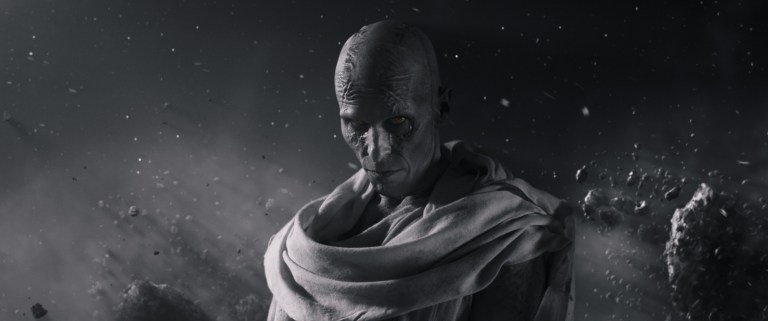
Idoine and Waititi use the tone of the Thor scenes and the audience’s expectations for the film as a compelling counterpoint to the scenes with Bale’s Gorr, shot in borderline german expressionist shadows, mostly without a score or soundtrack, with one striking sequence taking place in a world with no colour. Being able to display a superhero story through tone and colour is an impressive feat the film is able to achieve and is the sort of craft audiences should seek out, even in franchise blockbuster entertainment.

Christian Bale as Gorr in Marvel Studios’ THOR: LOVE AND THUNDER. Photo courtesy of Marvel Studios. ©Marvel Studios 2022. All Rights Reserved.

Sadly for audiences, the film is also potentially Taika’s final involvement with Marvel, moving onto a yet unnamed Star Wars film, as well as being in production on a live-action adaptation to the iconic 80’s anime film Akira (1988). Waititi is so comfortably able to imprint his writing and filmmaking style onto these super-budgeted films that are so beyond other filmmakers in the medium of the franchise blockbuster. It was great to see him branch out into a film like Jojo Rabbit (2019), but what makes him a truly singular talent is his ability to scale up without ever diminishing the product or undercutting the story in any way.

Surprisingly, after winning his Oscar for Jojo Rabbit, Waititi has operated mainly in the television space, writing, acting, and producing in fantastic series’ What We Do in the Shadows, Reservation Dogs (one of the best new shows of last year), and Our Flag Means Death. He is one of the brightest lights in the industry with one of the most fascinating careers to follow, becoming one of the most must-see filmmakers working.

Love and Thunder is a real throwback to older Marvel sequels like Iron Man 3 (2013), (a film I will defend as possibly the franchise’s best), where a writer-director auteur is allowed to throw their weight around inside a mega-franchise structure without breaking any load-bearing walls. The film thrives in its eccentricities and the ensemble’s commitment to Waititi’s tone, making it a great watch that feels more of an established, stand-alone piece, rather than a stepping stone to something larger.

Thor: Love and Thunder is is currently screening in cinemas nationwide.

Hustle is an Impressively Real NBA Drama

Rating: 3 out of 5.

The history of basketball and the NBA in cinema is long and interesting, going from Julius Erving (who also cameos in Hustle) in The Fish that Saved Pittsburgh (1979), Kareem Abdul-Jabbar in Flying High! (1980), and Michael Jordan in Space Jam (1996), to more legitimate performances from players like Ray Allen in Spike Lee’s iconic He Got Game (1998), and Kevin Garnett in Uncut Gems (2019). All these films use their NBA stars to bolster the credibility of the basketball film (sans Flying High!), but very rarely has a movie been made directly about the NBA. Enter basketball super fan and walking green light Adam Sandler.

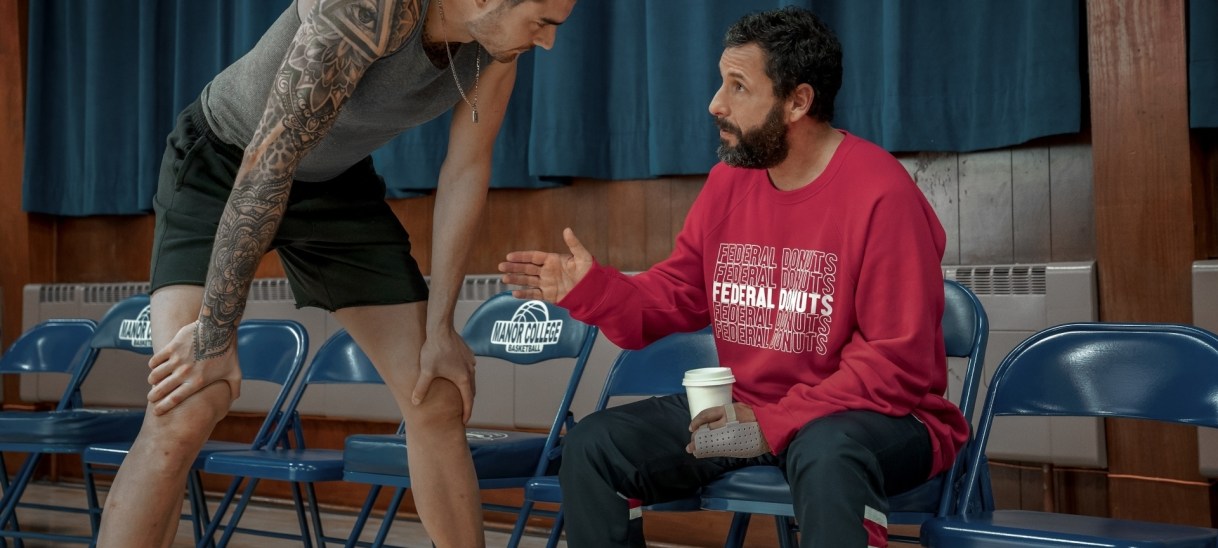
Sandler is a notorious basketball obsessive – famously setting up a net at most of his productions – with even NBA legends vouching for his skill on the court, so it’s no surprise to see him making a movie in this world. The film follows Sandler as ageing scout Stanley Sugerman for the Philadelphia 76ers, owned in this world by Robert Duvall’s Rex Merrick. After Rex’s death and ownership changes hands to his petulant son Vince (Ben Foster), Stan is forced to scout internationally to find a player, which he does in Bo Cruz, played by actual NBA player Juancho Hernangomez. 

The film is ultimately a paint-by-numbers inspirational underdog sports movie, closer to Rocky (1976) than The Fish that Saved Pittsburgh, but what makes the film worthwhile is the extraordinary verisimilitude of the NBA world, as well as some truly impressive basketball set pieces that tie the film together. Zagar deploys several extended training montages—a staple in any sports film—including Cruz running up steps in Philadelphia that Sandler had to point out during the sequence. The fact that even this moment is played earnestly is an example of the tone the creators are striving towards that separates it from a suite of recent films.

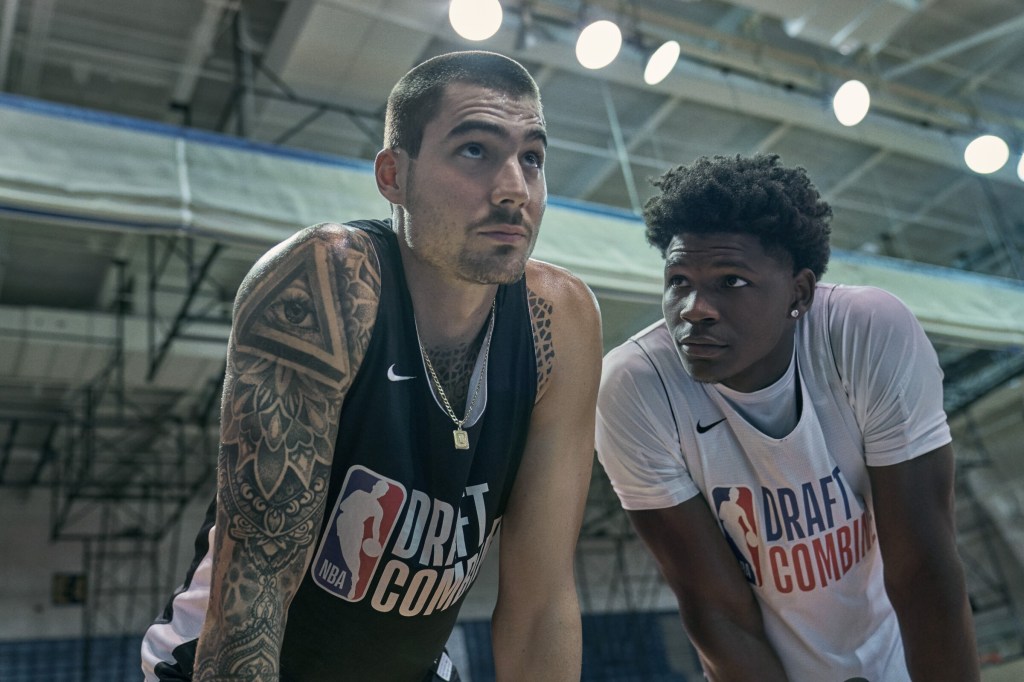
Juancho Hernangomez (left) and Anthony Edwards (right) in Hustle


Shot wonderfully on film, director Jeremiah Zagar mines intimate moments out of Hernangomez and his family that are as affecting as the high-octane basketball scenes, especially those between Kermit Wilts (played incredibly by NBA star Anthony Edwards) and Bo Cruz. Any fan of the NBA in recent years could tell you Edwards has exploded onto the scene as one of the best personalities in the sport, and Hustle uses his charm and confidence in a wonderful heel turn as Cruz’s rival leading into the draft.

Hustle is a modern sports film made with a high level of skill by Zagar, but it comes at an interesting moment in the genre. The modern sports film finds itself in a precarious position, with the dominance of sports documentary films and series crowding the market. On top of this, the only avenue for filmmakers to create a sports film or series in the 2020s seems to be the involvement of the athlete in question or as part of an athlete-led production company. Hustle is no different here with the involvement of LeBron James and Maverick Carter’s production company, Springhill Company involved, no doubt a key reason the film was able to achieve such a high level of NBA verisimilitude.

While not a terribly innovative or imaginative sports drama, Hustle continues Sandler’s recent run of more serious performances, growing into his later years as an actor that is choosing to work in more interesting and creative spaces. Die-hard NBA fans will lap this film up, while also having enough quality sports filmmaking moments to entertain the less sports averse.

Hustle is currently streaming on Netflix.

Top Gun: Maverick is the Perfect Sequel at the Perfect Time

Rating: 4.5 out of 5.

By all accounts, the 80s were quite the decade for the pop culture scene with rapturous music, unique fashion, and iconic films that spoke to the sentiment of the times. It was also an era coming to terms with the aftermath of the Vietnam war which saw a plethora of action-induced, patriotic films being churned out and inspiring the youth of the time.

The most profound of those films is easily Tony Scott’s now iconic Top Gun (1986), a film that both turned Tom Cruise into the poster-boy for American patriotism, and also captured the hearts of audiences young and old with its dazzling displays of all things 80s Americana. It’s telling then that 36 years later, Joseph Kosinski’s Top Gun: Maverick (2022) has managed to surpass the awe of its predecessor, and at the same time, deliver a sequel to rival all sequels.

It might be that the last few years have left an uncertainty in their wake in the same way that the Vietnam war did in the many years after its conclusion. The state of the world today is wrought with turmoil including ever-ravaging wars, a pandemic that continues to linger, the propulsion of gun violence in the USA, and growing speculation of an incoming recession (like the early 80s Reagan-recession). Maverick feels like a response to these last few years, or at the very least, a banner of hope that audiences have embraced with open arms.

Perhaps that’s because Kosinski’s film places audiences into a two hour, jet-fuelled cockpit of escapism that pauses all the worries in one’s mind and creates an unnatural sensibility for what is being showcased. It’s a polished and daring display of practicality that sends goosebumps across one’s body as soon as Kenny Loggins’ ‘Danger Zone’ roars in the opening sequence — and that’s before any of the “out-there” moments even come to pass.

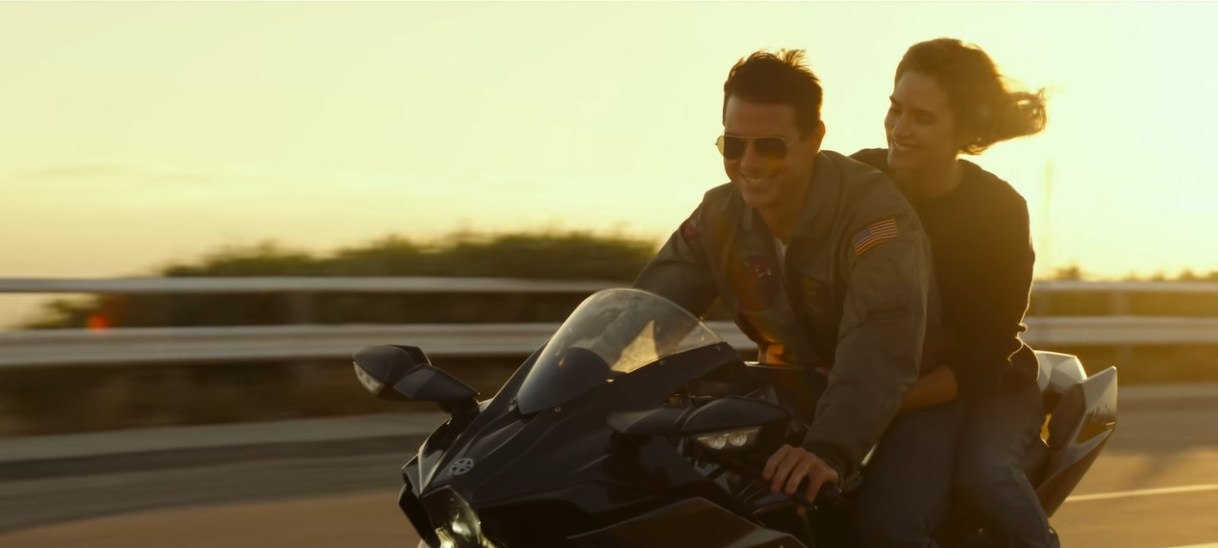
Tom Cruise in Top Gun: Maverick

Narratively speaking, Maverick follows Pete ‘Maverick’ Mitchell (Tom Cruise) in the years after his short-lived spell at the Top Gun academy for aviation. Now in his mature years, Maverick has traded dog fights for test flights, taking some of the latest aircrafts and pushing them to their limits in the sky. It’s a fitting reintroduction to the character and the direction of his arc for the remainder of the film, as he himself becomes pushed to his limits in the events that unfold.

Most of the film revolves around reconciliation, or coming to terms with the past, with the clearest example being in the death of Maverick’s wingman “Goose” that continues to plague our otherwise steadfast protagonist. It’s through Goose’s son, Bradley “Rooster” Bradshaw (Miles Teller), that we see this internal struggle and guilt of Maverick’s, surface. The film rides this wave of reconciliation for its majority, but it works because there is no throwaway dialogue here. The screenwriters, helmed by a trio comprising Ehren Kruger, Eric Warren Singer, and frequent Cruise-collaborator, Christopher McQuarrie, do a great job of balancing Maverick’s place in the world with the passing-of-the-torch to the young.

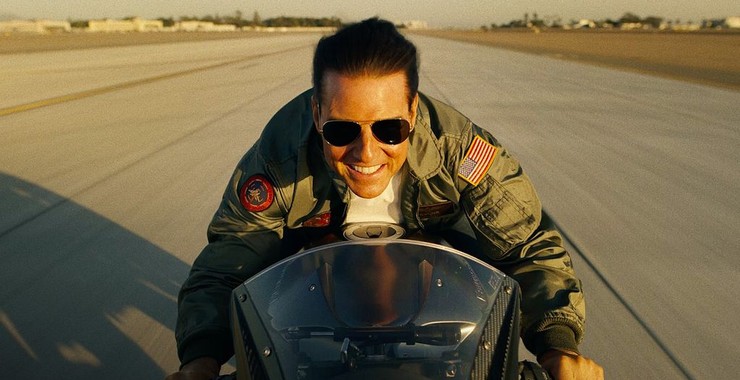
But even with all the side characters —including a short, heartfelt appearance by Val Kilmer’s Tom “Iceman” Kazansky— Maverick is still unequivocally Cruise’s. The actor has come a long way since his Risky Business (1983) days, even if there is a part of me that still craves to see more performances in the vein of Jerry Maguire (1996) or Magnolia’s (1999) Frank T.J. Mackie. Maverick feels like the first real film to see the actor come to terms with his place in cinema. For all the ‘old-timer’ and ‘relic’ lines that are thrown around, Cruise is still the biggest blockbuster name outside of the Marvel engine, and it’s no surprise that he’s being hailed as the last major Hollywood star.

Tom Cruise in Top Gun: Maverick

The actor shows no signs of slowing down here, in fact, if his last few films are any indication, he still has some fuel left to burn. It helps that he has a young supporting cast that almost mirrors the antics of the original cast (Glen Powell’s Hangman is a spitting image of Val Kilmer’s young and cocky Iceman). He also has a new objective: to prepare these young pilots for a dangerous mission in enemy terrain.

The details of the mission aren’t nearly as important as the actual flying and shooting, or in other words, the stuff that gets you your money’s worth. The bravado of the film is nestled in the spectacle of its third act, where the cast is crammed into their F/A-18’s and made to feel the full force of the turns and hoops that ensue. Kosinski, clearly in his element here, shoots these death defying air-scapades with a desire to achieve as much realism as he can, and realism is what he gets, with heart-in-your-throat level action that makes Marvel seem like a rusty kids playground in need of a major renovation.

What’s true for Maverick is that it does feel like a polished playground of possibility, one that is set on pushing the limits of what’s possible for the cinematic medium. This has been true for anything Cruise related for years now, but with Maverick there is a bittersweetness in realising that films like this only get made because there is someone willing to push the medium to its breaking point and not play it safe — in that way, Cruise and Maverick aren’t so different.

Top Gun: Maverick is is currently screening in cinemas nationwide

Turning Red is a Bold, Welcome Deviation

Rating: 4 out of 5.

Critics are fast running out of superlatives to describe the filmography of Pixar Animation Studios. Every release by the company, especially of late, has possessed a rousing soundtrack, heartfelt screenplay, top-notch voice-acting and of course, computer-generated illustrations beyond compare, almost to the point of conformity. That all changes with this production, and for the better.

Toronto resident Meilin Lee (Rosalie Chiang) is on the verge of adolescence, lusting after boys she ordinarily wouldn’t and engaging in activities that draw the disapproval of her otherwise doting mother, Ming (Sandra Oh). But puberty is not the only drastic change the youngster is having to contend with – now that she’s a teenager, Mei finds herself transforming into a giant red panda whenever her emotions are heightened, a source of embarrassment greater than any other in her life.

The driving force behind Turning Red (2022) is writer-director Domee Shi who, just like Mei, is a proud Torontonian with Chinese heritage. Shi’s career trajectory is more interesting than most, having joined Pixar as an intern before garnering widespread acclaim with her allegorical short film Bao (2018). After this success, Shi was promoted to Pixar’s “Brain Trust” and given the opportunity to craft her own feature-length production; in turn, the film-maker has concocted the most energetic, inimitable Pixar film yet.

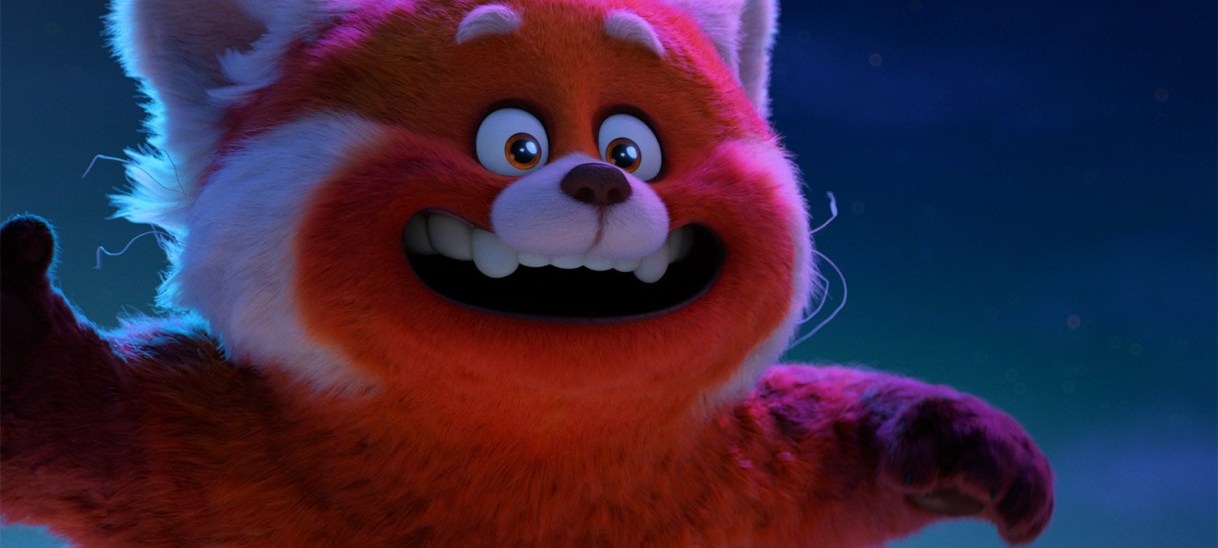
The most distinguishing element of Turning Red is the art-style. While there are shades of Pixar’s influence in the design of the characters and settings, the look of the film is distinct from any of the studio’s previous feature-length productions, a change that is most welcome. Soft colours dominate the architecture of Toronto, and clothing of those who inhabit its surroundings; humans of all sizes and body types interact with one-another, while their faces are adorned with large teeth and pupils that comically dilate or contract depending on their mood.

The animation, too, is a point of difference from other Pixar films. Where in the past, a character would move smoothly and gracefully (one could even say “realistically”), in Turning Red, the movement of the protagonists is quick and frenzied, welcomely leading to some well-timed physical gags that border on slapstick. Adding to this witty and frantic vibe is the editing, which occasionally employs some Edgar Wright-style quick cuts to further discern the picture from its contemporaries. Yet the differences go even deeper than that.

Ming Lee and daughter Meilin are often at odds in Turning Red.

Further distinctions are found in the screenwriting, which matches the vibrancy of Turning Red’s visuals. The plot is narrated in the first-person by a self-aware figure who frequently breaks the fourth wall and wears her geekiness with pride, forgoing the usual stereotype of an introverted, awkward teenager. Likewise, her friends are eccentric, outgoing and unashamedly nerdy, offering the perfect social and moral support – another rarity in coming-of-age tales. Additionally, it’s a tale that feels quite timeless, despite the film’s early-2000s setting.

Yet for all the freshness this script provides, it is stymied by the occasional flaw. One such example is the antagonistic Tyler (Tristan Allerick Chen), who is underwritten and poorly developed – efforts made by the film to complexify and soften his character are tame at best and confusing at worst. Another letdown is the third act, relinquishing the vim and momentum present elsewhere in Turning Red, slowing events to an underwhelming conclusion, and providing a left-field revelation about Tyler that bears no relevance to the conflict.

The one upside to these blemishes is that they aren’t a common sight in Pixar’s filmography, offering further proof that the team at Emeryville are no longer adhering to a formula or norm. Between this flick and Luca (2021), it looks as though Pixar is shying away from being a safe, comfortable brand and instead following the route of its fellow CGI powerhouses, DreamWorks and Sony in taking risks – they’re hiring new people, toying with different art-styles and telling more diverse stories.

Turning Red heralds a promising future for Pixar Animation Studios, providing the medium with a fresh and distinctive voice in Domee Shi. Viewers will find themselves drawn to the quirky characters, original story, lively animation and bright illustrations of a stylised Toronto, making for an entertaining and resonant experience regardless of one’s background.

Turning Red is now available on home-video and on-demand services, and streaming on Disney+.