Pig Sees Nicolas Cage Shine in One of the Year’s Best Films

Rating: 4.5 out of 5.

There seems to be a trend of films and film titles revolving around farm animals in the last 18 or so months. From Kelly Reichardt’s First Cow (2019/2020) to Valdmiar Johansson’s Lamb (2021) and Michael Sarnoski’s Pig (2021); each of these films places these animals at the forefront, but each one tells a vastly different story and to different avail.

Pig is a film that centres on themes of grief and loss, but it is also about acceptance and surviving. It sees a truffle hunter, Robin (played by the unsurprisingly great Nicolas Cage) have his pig companion stolen in the middle of the night while living off-grid in some cabin. This results in him setting out to find his pig with the help of Amir (Alex Wolff) who pays Robin for his truffle work.

For what it’s worth, the premise is deceptively simple as it plays on audience expectations that Robin will go out on a killing spree until his pig is found. This deception is particularly true given that the man playing Robin is Cage, who audiences almost expect will go on a killing frenzy comprised of outbursts and sadistic rage like in Mandy (2018), Color Out of Space (2019), or Vengeance: A Love Story (2017), to name a few.

While there are moments of rage bubbling beneath the surface (with the most extreme outburst seeing Cage kick the crap out of a yellow Camaro’s door), Sarnoski never goes down that predictable rabbit hole (which would be a great name for another animal film). Rather, Sarnoski uses Robin’s loss and grief as a catalyst for exploring how sometimes we can’t control what happens to us — sometimes our efforts are in vain even if we think there is a silver lining at the end of the tunnel.  

What is especially interesting to note is that Robin isn’t just some weirdo who drew the short straw and is now out to exact revenge, but he is a renowned former chef whose name is uttered like a long lost legend. He’s had his share of fortune, has mingled with the city folk, and has lived under the false pretences of success that capitalism masquerades as — ultimately seeing him swap city lights for green bushland. What this approach allows Sarnoski to do is to paint capitalism as a grotesque construct that can tear down even the most successful people if they aren’t willing to adapt to the changing world around them.

Nicolas Cage in Pig

There’s a particular scene in a high end restaurant where Robin — in his rugged, beat-up state — calmy rips into the chef of the restaurant (who happens to be a former intern of his) for allowing himself to forgo his dreams and settle for a world built around falsity and conformity. It is one of the many profoundly moving scenes in the film that gets to the heart of selling ones soul and settling — ultimately forgetting about what it is that we really care about. Robin asserts to that chef that “we don’t get a lot of things to really care about”; In essence, the pig and the lengths Robin goes to in order to find it, represents that pursuit for what we really care about, which is often quashed by settling.

In a sense, you’d be forgiven for thinking this film plays out somewhat semi-biographically for Cage where he sees his own past mistakes and strives to protect and salvage what he cares about, but may have ignored in the past. There’s the whole ‘fall from grace’ type approach where Robin is an esteemed chef (Cage is an esteemed actor) who disappeared from the spotlight only to re-emerge out of nowhere and still cook (act) like a pro. Heck, a character asserts to Robin that “I remember a time when your name meant something to people, Robin”.

It makes for a resounding 90 minutes that gives Cage a platform to showcase why he is among the top 10 actors of all time. Cage himself asserted in recent interviews that the acting came easy for him here because he didn’t need to act as much due to having dreams and thoughts about losing his cat — which he channelled into Robin. In this sense, Cage plays Robin with a degree of verisimilitude that many (including yours truly) will be able to relate to. Whether someone has lost an animal, a loved one, or just an inherent desire — it’s about finding what you care about and protecting it at all costs, no matter the outcome.

The comparisons between John Wick and Pig have been plentiful due to the nature of messing with one’s animal companion and then hunting down the perpetrators. However, Sarnoski’s take on the revenge storyline plays out in a resoundingly different light. Robin is the one that gets beat down (physically and mentally) throughout the whole film without so much as throwing a punch. It’s a unique take on what we might expect to have happened, but it adds a level of humanism and honesty that captures how things don’t always end up the way we want them to.

The film is a masterclass in exploring how we deal with grief and how we learn to live with it in a system that encourages people to forget about what they truly care for and move on. Nicolas Cage delivers one of his most subtle and sublime performances ever, and the result is one of the most touching, sombre and best films of the year.

Pig is streaming on Palace Home Cinema

A Big Heart Defines the Colourful Musical Vivo

Rating: 3 out of 5.

In 2021, seemingly everybody wants a piece of Lin-Manuel Miranda, and Sony Pictures Animation is no exception. The studio looks to be pinning its hopes on the Puerto Rican’s ceaseless popularity with its newest release – support it may not have needed, given the production’s strengths lie elsewhere.

Andréas (Juan de Marcos González) is a musician and street entertainer living in Havana, Cuba, who for years has entertained locals with his dancing kinkajou – a tree-dwelling, monkey-like mammal with golden fur – which he calls Vivo (the abovementioned Miranda). The pair are most happy living and performing together, but their relationship is tested when Andréas is invited to play alongside his long-lost love, songstress Marta (Gloria Estefan) in Miami, the city she now calls home.

After some internal deliberation, Vivo decides to join Andréas on his trip Stateside, only for a twist of fate to quash their plans and leave the latter’s affections for Marta unaffirmed. It’s at this point that the kinkajou decides on journeying alone to Miami, eventually alighting at the port town of Key West, Florida, three hours’ drive from his intended destination. Luckily, Key West is also the home of Andréas’ great-niece, Gabi (Ynairaly Simo) who pledges to help Vivo in his quest to locate Marta.

Vivo (2021) is the latest project to bear the stamp of the multitalented Lin-Manuel Miranda, who has been busier than ever this year – he’s already produced a widely-acclaimed film adaptation of his stage musical In the Heights, made an appearance in Questlove’s documentary Summer of Soul, written songs for the upcoming Disney feature Encanto, and next month will be making his directorial debut with Tick, Tick… Boom! On this occasion, Miranda’s song-writing abilities are utilised in addition to his vocal talents, undoubtedly pleasing fans of his work and riling those who find him less appealing.

In keeping with the film’s settings, there’s a clear Latin American and Afro-Caribbean influence to the tunes, which is unfortunately the only praise that can be afforded to the soundtrack. Miranda’s music is more grating than ever in Vivo, his hybridised rapping-singing making for an inelegant accompaniment to the visuals, and almost none of his numbers being memorable – the sole outlier is Gabi’s song “My Own Drum”, if only for how obnoxious and annoying it is. Indeed, so unremarkable are these compositions that they are enough to eradicate any tolerance for Lin-Manuel’s stylings.

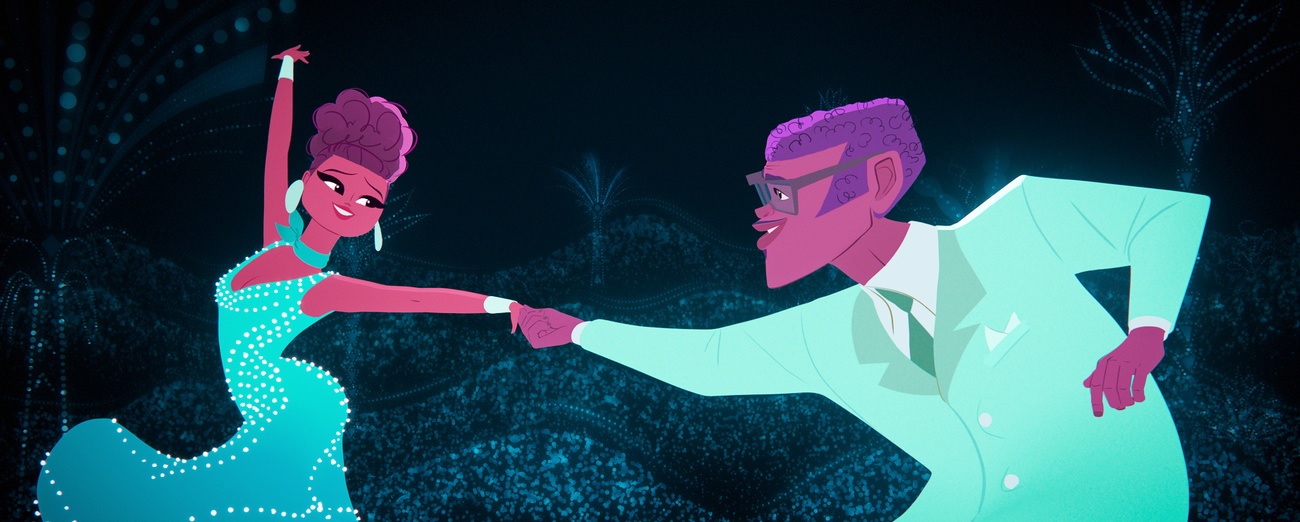
The young Marta and Andréas in a dreamlike 2D dance sequence in Vivo

Another weak element of Vivo is the screenplay, being of a lesser standard than what other studios are producing. It’s storytelling at its most basic on display here, including a familiar narrative arc and tropes diligently adhered to, resulting in a plot that is quite bland and unimaginative. That stated, the story is a heartfelt one, with its resonant struggles and touching moments between characters ensuring an emotional wallop for viewers of all ages; and for younger demographics, the film offers considered, thoughtful messaging about dealing with grief.

More pleasing still are the visuals, with Vivo’s distinctive illustrations and unique designs echoing the quality of its Sony Pictures Animation stablemates, Spider-Man: Into the Spider Verse (2018) and The Mitchells vs. The Machines (2021) – although neither are surpassed in this instance. Highly stylised versions of Havana and Miami have been rendered, featuring thick, blocky architecture shaded the brightest of colours, while the human characters are all round- or wide-shaped figures that differ from the artform’s norm. (There’s even some brief, yet nonetheless enjoyable 2D sequences, as evidenced above.)

Also worthy of compliment is the voice-cast, with every actor performing solidly. Ynairaly Simo leaves the greatest impression, being the perfect choice for the outgoing, rambunctious Gabi, even managing to outdo established celebrities like Zoe Saldana, who voices Gabi’s mother, Rosa. And on the subject of celebrities, there’s a fair number who lend their vocal talents to the movie, the most entertaining of which are Brian Tyree Henry as a lovesick spoonbill, and Michael Rooker as a sinister python, both of whom put all their effort into their performances despite being heard only briefly.

Save for a cliched plot and middling soundtrack, Vivo is a pleasurable distraction that benefits from great voice-work, vibrant imagery and, above all, scenes of tenderness that are bound to move even the most hardened of viewers. Consider the inclusion of Lin-Manuel Miranda as an added bonus – or minus, depending on preference.

Vivo is currently streaming globally on Netflix.

Becoming Cousteau Documents Jacques Cousteau’s Lifelong Pursuit of the Sea

Rating: 3.5 out of 5.

Screener provided by Rialto Distribution

It feels somewhat reductive to call Jacques Cousteau an explorer. He was a pioneer, an inventor, a filmmaker, an author, and, at the later stages of his life, a conservationist to say the bare minimum. Sporting his unmistakeable red beanie, Cousteau set out on a lifelong journey to understand the depth of the ocean, which he and his team on the Calypso saw as an endeavour on the scale of space travel. People unfamiliar with his story may recognise his iconography through the Wes Anderson film The Life Aquatic with Steve Zissou (2004), where Cousteau was the main inspiration for Bill Murray’s titular character, albeit with vastly different personalities.

Helmed by Oscar-nominated documentary filmmaker Liz Garbus and a mountain of Cousteau’s own archival footage, this documentary is an honest and, at times, quite moving film about how an individual’s singular passion can be inspiring while also blinding them to the relationships to the people and world they inhabit. The film is neither a pure work of lionisation or exposé like many recent documentaries end up being. Garbus is able to toe that incredibly difficult and constantly shifting line that has made her one of the best in the business in working with subjects of immense cultural weight like Marilyn Monroe and Nina Simone.

From the outset, the film strikes you with a certain somber energy, constructed primarily through its voiceover interview delivery as well as the Desplat-esque score from workhorse film composers Danny Bensi and Saunder Jurriaans, furthering the Wes Anderson connection. In a documentary that uses almost entirely archival footage (which is much more effective than a constant barrage of talking heads in hotels), audio is one of two crucial elements Garbus has to involve the audience (the other being the editing), and is where the films grounds itself wonderfully. This gives the film this off-beat energy that never holds your hand into feeling certain emotions while the extraordinary footage of the Calypso’s archival footage crashes over you in waves. This is best illustrated in an early sequence where we are shown actual footage of one of Cousteau’s closest friends, a fellow “musketeer of the sea” Maurice Fargues, which felt somehow both confronting and respectful to the depths they were willing to go to achieve their insatiable goal of exploration.

Jacques Cousteau in Becoming Cousteau

Becoming Cousteau is sequenced in an interesting and poignant way, tracking the transformation of Cousteau from a young passionate man driven to conquer the unknown depths of the ocean, to a seasoned traveller tasking himself with its protection. Garbus does an excellent job shaping Cousteau’s narrative in a cinematic way, from a visionary explorer ahead of his time that was all too often used for his passions by seperate interests (the revelation that the Calypso can be directly linked to the discovery of oil on the Qatari coast felt especially heartbreaking as the film went on), that had to eventually grapple with those earlier decisions.

In the era of the docuseries, it’s hard not to ponder the idea of Cousteau needing an extended runtime to dive deeper into each step of his journey. The films 90-minute runtime oftentimes felt to be moving at warp speed through many nuggets of narrative, from his Oscar and Palme d’Or winning documentary The Silent World (1956) that did The Abyss (1989) two years after James Cameron was born, to his struggles and achievements as a conservationist in his later years. While there is a certain charm to the quick burst documentary film, Becoming Cousteau definitely falters in its execution as a cradle-to-grave story, an issue with most single subject documentary and biopic features, but works well in creating an honest portrait of an inspirational figure that gave us the gift of his own journey on film.

Becoming Cousteau is coming to select national cinemas October 22nd.

Coupon Comedy Film Queenpins is all but Funny

Rating: 2 out of 5.

With Paramount + starting to kick into second gear with more content being released, it seemed fitting to check out the streaming providers latest original title, Queenpins (2021).

As its name suggests, in a rather unsubtle manner, the film is a take on the kingpin story that has been tried and dried since cinemas inception. To elaborate, there’s an idea that hits the protagonist, which ultimately leads to an illegal business involving money laundering, and then a culmination of a series of events that either see the protagonist get away with their dirty work or end up caught.

That ‘idea’ is what the film leans on for support and uses to try and differentiate itself from more serious films in the sub-genre. Connie Kaminski (played by the ever delightful Kristen Bell) finds a loophole in the supermarket coupon system where, after having complained to companies via email over the quality of their products, she is sent coupons to obtain those items for free. It isn’t until her YouTube-wannabe-star friend JoJo (played by Bell’s The Good Place co-star, Kirby Howell-Baptiste) suggests the potential to resell these coupons for half price, that Connie sees the potential to make some dough.

This is what directors Aron Gaudet and Gita Pullapilly use to try and incorporate the more comical side of the film whilst also retaining a level of seriousness of the real life events that inspired the film. For the most part, the concept of the film is actually quite comical in and of itself. Evidently, Bell’s presence brings a level of warmth to this character that works alongside the premise of the film to make her not fall into the standard anti-hero of kingpin criminal films.

Connie’s backstory also helps to bring a level of sympathy to her character as she struggles financially due to undergoing expensive IVF treatments with her husband Rick (an incredibly underutilized Joel McHale). Subsequently, while her actions of counterfeiting coupons never really becomes something that sends fear down her spine should she be caught (particularly due to the naivety shown during the laundering process), it does give a more playful version of events.  

Paul Walter Hauser and Vince Vaughn in Queenpins

Joining Bell and Howell-Baptiste in this very buddy-up style comedy is Paul Walter Hauser and the quintessential serious-funny-guy type in Vince Vaughn. Hauser plays Ken Miller, a supermarket Loss Prevention Officer, while Vaughn plays Simon Kilmurry, a U.S Postal Inspector. Ken and Simon are the other side of the coupon counterfeiting coin as the FBI effectively demotes the issue as unimportant, and it is up to the two of them to crack the coupon case.

When spending time with Ken and Simon, the film leans into that buddy-cop type telling where the humour lies. Most of this humour comes from the very fact that the duo aren’t FBI agents, they’re serious about a coupon crime, and they have small gags that are aimed at drawing a laugh (Ken defecates in the car while out scouting Connie and JoJo with Simon). Most of these gags will either bring about a laugh or two, or simply just fall flat seeing as they just spontaneously pop up seemingly for the sake of a cheap laugh (a sign that the humour just isn’t great).

It’s easy to see that pairing the female leads together and the male leads together gives the film a lot more to work with as the actors play off of each other quite nicely when we do spend time with them. The problem with this duality is that we end up with two perspectives that seem to play out as two separate films. In essence, both the Bell/Howell-Baptiste and Vaughn/Hauser dynamic would really have worked better had they been two separate versions of this story or had we spent more time with Bell and Howell-Baptiste.

At the end though, the film banks on those back and forths between the female and male pairings. The actual coupon issue doesn’t carry enough weight behind it and just simply never feels like it raises the stakes due to how measured and composed Bell and JoJo are, even when they’ve been caught (an issue on the part of characterisation that is lacking). When all is said and done, Queenpins is a light-hearted but hardly humorous two hours.

Queenpins is now streaming on Paramount +

Black Cinema Gains a New Voice Via the Summer of Soul

Rating: 4.5 out of 5.

African-American directors have long used their powerful voice to admonish racism and injustice – think John Singleton, Ava DuVarney, Jordan Peele and of course, Spike Lee with his signature Joints. Newly ranking among this cohort is Ahmir Thompson, utilising long-lost footage of a monumental event to concoct a narrative of equal distinction.

In 1969, amidst a Climate of Hate in the United States, the New York neighbourhood of Harlem played host to a series of outdoor concerts, featuring musicians both prominent and rising, locally famed and internationally recognised. The free events, promoted as the Harlem Cultural Festival, took place over successive weekends during the Summer, their family-friendly façade masking an ulterior intention – as interviewee Darryl Lewis bluntly puts it, “to keep Black folks from burning up the city in ’69.”

Despite being attended by as many as 300,000 people, and earning the public support of New York City’s white, Republican Mayor, John Lindsay, press coverage of the Festival was limited, and a proposed film documenting the performances was shelved after failing to garner an investor. Multiple reels of video and audio that had been recorded for a documentary instead lay dormant in storage, unseen by the public eye for over five decades – hence this picture’s, full title, Summer of Soul (…Or, When the Revolution Could Not Be Televised) (2021).

Director Thompson, a.k.a. Questlove, is best known for his work in the realm of music, and that melodic expertise is more than apparent in his selection of performances that are showcased within the feature. Highlights include a young Stevie Wonder’s masterful playing of the drums and keyboards; Mahalia Jackson and Mavis Staples’ powerful duet of “Precious Lord, Take My Hand”; Ray Barretto on bongos trading fours with his double bassist; Sonny Sharrock wildly shredding on the electric guitar; Nina Simone’s eloquent prose in “To Be Young, Gifted and Black”; and Sly and the Family Stone’s call-and-response with the Harlem crowd.

Just about every performance that’s seen in Summer of Soul is reminisced about through present-day interviews with Festival attendees, social commentators, the musicians themselves, and a handful of celebrities with the most tenuous of links to the Festival – comedian Chris Rock being such an example. Most of the input these subjects provide amounts to little more than soundbites, but their statements are nonetheless insightful, and the fondness with which they recollect events appears earnest and genuine.

Stevie Wonder performing at the Harlem Cultural Festival, as seen in Summer of Soul

Not content with directing a concert film, Thompson also shapes Summer of Soul as a historical document of the African-American experience. Each performance is seceded by a brief interlude that explains, through archival footage and clips from the abovementioned interviews, the happenings in Harlem, the United States and the world that led to the Cultural Festival, demonstrating its place in a broader cultural movement of “Neo-Super Blackness” (as interviewee Greg Tate aptly describes it) and how it assisted in propelling it.

Some viewers might be baffled at this suggestion, given the lack of prominence afforded to the concerts until now. Summer of Soul hypothesises that an overshadowing of the Festival by two other events is the cause of that, said events being the Moon Landing in July of the same year, and the Woodstock Music and Art Fair, which took place the very same weekend that Nina Simone and B.B. King performed in Mount Morris Park. (In a delicious case of irony, the film treats both of these cultural touchstones with indifference.)

One gripe, admittedly minor, to be had with Summer of Soul is the varying quality of the concert footage. Video and audio of the event has been digitally restored from the original tapes, most of which looks and sounds pretty crisp; yet there are occasions when markings and damage to the recordings are rather visible, detracting from the experience. What’s needed is some further enhancement, or cleaning of the original imagery in order to truly, fully do the Harlem Cultural Festival justice.

Ahmir Thompson’s directorial debut is more than the recreation of a significant moment in history – it’s a stirring celebration of Black culture with a central message that’s just as relevant today. Possessing a voice that’s as loud and proud as the singers featured within, Summer of Soul is a documentary that ought to be seen and heard by all.

Summer of Soul (…Or, When the Revolution Could Not Be Televised) is now streaming on Disney+.

The Guilty is a Stripped Back but Lacking Drama

Rating: 2.5 out of 5.

Shot in just 11 days through strict Covid restrictions, Jake Gyllenhaal and director Antoine Fuqua once again collaborate on a remake of Gustav Möller’s 2018 debut feature Den skyldige, with mixed results. The script, adapted by crime drama maestro Nic Pizzolatto, maintains the same structure and narrative beats from the original, but lacks the propulsive energy that made Möller’s so gripping and entertaining.

The film centres around the LAPD officer Joe Baylor (Jake Gyllenhaal) who is benched to 911 response duty during a wildfire while he awaits trial for an incident while on duty, something that is giving him extreme anxiety. His night takes a turn when he receives a call from a kidnapped woman (Riley Keough) that he takes upon himself to save. While predominately a solo performance, the film is helped out greatly by quality voice acting performances from an ensemble of actors too long to mention that help ground the film that is limited in its ways to communicate the story.

The Guilty is all about limitations and the feeling of being trapped on the other side not being able to do enough to help, and in that regard, Fuqua largely succeeds by focusing on a more vulnerable lead performance than the original. This allows the audience to engage with Joe’s situation on a more emotional level which is Gyllenhaal’s bread and butter, and must’ve appealed to him about the role.

Unfortunately, too much of the film feels like a rushed first draft of a film, and not in the endearing two takes and that’s lunch Eastwood way. There is a serious lack of experimentation and innovation in a project that desperately calls for it, being handcuffed to one character on the phone for 90 minutes, that makes the 11-day shoot painfully apparent. Maybe it is unfair to ask for more than an average movie from that absurdly short turnaround from quality creators, but the work we’ve seen from Fuqua, Pizzolatto, and Gyllenhaal in the past warrants it.

Jake Gyllenhaal consumes every inch of the frame in The Guilty

Coming from the perspective of someone who has seen and enjoyed the original film which screened at MIFF in 2018, it is a more interesting exercise to dive into what is added in this work of adaptation. Firstly, thematically and narratively speaking, the story is actually improved by centring around an LAPD officer, as it adds an entire history for the audience that changes the context to many scenes, especially in comparison to the original story set in Denmark.

By setting the film in LA, the audience views the actions of Joe in a profoundly different way compared to Asger’s (the lead Jakob Cedergren in Den skyldige), as we immediately question his first response in situations of extreme pressure, namely leaping to violence as the only answer. Having this seed of doubt coupled with Gyllenhaal’s rapidly deteriorating mental state is where the film truly separates itself from the original, and if given more time, may have been where a more polished version of this movie would’ve put more consideration into.

The other aspect that centred the film’s setting is the California wildfire that is present throughout the film, but is never a true character that it needed to be. The roaring fire is only present in brief mentions by officers on the phone, as well as on the large monitors that bear down upon Joe’s desk, but add no actual weight to the story or emotionality Pizzolatto was going for and is another instance of the film greatly needing more time and care to expand its ideas.

While The Guilty is a commendable film and an interesting touch point in the recent history of US adaptations of European films, it is difficult to recommend this over the original film Den skyldige, even if it is only available to rent in Australia (it is currently streaming on Hulu). This is a film that may end up being merely a footnote in the collaborative journey between Gyllenhaal and Möller, as they adapt the graphic novel thriller Snow Blind, which will be Möller’s first English-language feature.

The Guilty is streaming on Netflix now.

Annette is a Whirlwind of Ideas Mashed into one very Unique Feature

Rating: 3.5 out of 5.

Few films of recent memory have been as visually abstract and wavering in their focus as Leos Carax’s Annette (2021). It’s one of those films that leans into art-house conventions of filmmaking and asks its audience to latch onto them for dear life as the film zig-zags through a minefield of ideas, set pieces, and oddness to provide an experience unlike any other in 2021.  

So where does one start with a film that is more interested in keeping its audience guessing than providing them with a clear cut narrative? Well for starters, Annette unfolds in an operatic-like showcase that echoes early French Avant-Garde filmmaking (particularly that of Jacques Demy whose influence is definitely felt). For instance, dialogue is often sung throughout the film, scenes are choreographed to play out like live theatre, and there is a particular emphasis on the unnaturalness of how the actors move through space and time.

With a screenplay by the Mael brothers (Sparks Brothers) and Carax, Annette is never short on surprises and wackiness as it leans into a romantic-fantasy-musical akin to what I can best describe as Beauty and the Beast (1991) meets A Star Is Born (2018).

At its core though, the premise of the film is a relatively simple one revolving around romance and the struggles of stardom. Henry McHenry (Adam Driver) and Ann Defrasnoux (Marion Cotillard) are both performers — a comedian and soprano, respectively. As with most celebrities, their life and personal affairs cannot escape the public eye, and Henry becomes more agitated and narcissistic as the film progresses, while Ann gradually begins to pull back and become somewhat of a muse. This is particularly true for both characters as they welcome their baby daughter Annette, into the world.

Annette herself is presented in puppet form which raises interesting ideas pertaining to artifice, especially when it comes to how Henry and Ann see the world around them. Both characters seemingly awaken following Annette’s birth in that they realise the life they have been living up until now has all been a farce so as to maintain the illusion of contentedness. Annette’s presence sees that illusion be torn down as the film spirals into a hodgepodge of visual cues, symbols and motifs that are really difficult to grapple with (oh and did I mention Annette is gifted with an incredible musical voice?).

Marion Cotillard in Annette

The music of the film is also a big reason for why its zaniness works — perhaps because it was conjured up by the equally zany Sparks Brothers. With lyrics that penetrate and carry over between each set piece (especially “We Love Each Other So Much”) Carax is able to nurse the film into a level of tenderness that becomes crucial to living up to the films tragic finale. The repetition of music and lyrics has a level of sadness that brings to light the illusory truth effect where, the more something is repeated, the more likely it is an individual will believe it to be true.

But for Henry and Ann, there is a level of truth to their repetition no matter how much it seems to divide them. Carax makes this apparent by intertwining the aforementioned lyrics into very physical actions and events (i.e. Henry performing oral sex on Ann, Ann giving birth while those in the birth theatre sing). In this sense, Henry and Ann aren’t repeating for the sake of wanting to believe that they love each other, rather, as Henry lyrically asserts to Ann’s former partner The Conductor (Simon Helberg), “that song was our song”. In the same way, that love was their love — it was born out of truth and remained so, even as Henry continued to descend into a deeper low (which I won’t spoil).

The film isn’t without its shortcomings though. Carax is less interested in drawing an emotional response from audiences due to the lack of avenues from which to draw that response (at least for the first two acts), and is instead interested in using symbols and motifs (Annette in her puppet state, Ann’s distinct vocal pattern etc.) to build up the audiences understanding of events. For most of the second act, the film relies on these cues to give some sort of structure and direction to an otherwise unruly narrative. Sure, fans of Carax will band together to point out that Carax’s style is less about narrative coherency as it is about using the affordances of the medium in a Lynchian fashion, but it’s an absence, nonetheless.

Most of Annette relies on the audiences desire to be in equal parts submissive to the subversive form of the film, and to experience the film through its wandering structure. It’s a unique experience that can often feel exhausting which I have no doubt is intentional as Henry and Ann’s relationship is an exhausting one, but it’s worth taking the ride.

Annette is currently screening in select cinemas, and on Palace Home Cinema

Free Guy is a Serviceable, Yet Sweet Action-Comedy

Rating: 3 out of 5.

Sometimes, there’s just no saving a picture from mediocrity; but in the right hands, even a milquetoast production can win the hearts of a cynical audience, provided it has the necessary elements. Said elements could be a poignant story, or dazzling visuals, or simply a charming performance from a famous thespian… or even a combination of the three.

Free City is a place where crime is so widespread that it’s more or less accepted as a daily occurrence by those who live there, casually treating the most violent of felonies as a minor inconvenience. What the city’s many residents don’t realise is that their home is actually the setting for an open-world video-game, and they are the non-playable characters – or NPCs – who have been programmed to endure any and all hostile behaviour.

The only NPC with a shred of self-awareness is Guy (Ryan Reynolds), a bank teller who wonders if there’s more to his existence than stamping cheques and being threatened at gunpoint. Guy’s theory that proves true after a chance encounter with Molotov Girl, the avatar of human user named Millie (both played by Jodie Comer) who, much to her bemusement, explains how Guy can actively play the game, rather than just be part of it.

Much like Rich Moore’s Wreck-It Ralph (2012) or Steven Spielberg’s Ready Player One (2018), the appeal of Free Guy (2021) relies heavily on the viewer’s knowledge and appreciation of pop-culture, and gaming culture in particular – those who adhere to the latter category will undoubtedly distinguish Guy’s Free City game as an amalgamation of Grand Theft Auto Online and Fortnite. Non-gamers need not fear though, since these references to other properties are infrequent, and a greater emphasis is placed on the surprisingly compelling struggles of the characters.

One such character is Guy, whose desire to want more out of life is by no means unique, but is made endearing by his sweet, innocent and wholesome personality. It’s a performance that refreshingly deviates from Ryan Reynolds’ usual schtick, forgoing the snark and self-referential humour whilst retaining the exuberance which he now readily identifies with. Thus, Free Guy marks one of the rare instances where the presence of Reynolds doesn’t become grating.

The live-action antagonist of Free Guy, Antwan (Taika Waititi)

Of equal interest is the secondary plot involving Millie, which sees her scouring Free City to locate a stolen piece of software supposedly hidden within the game. This conflict has much higher stakes than Guy’s, thereby being the more engaging of the two; but again, its charm is due largely to the performer – in this instance Jodie Comer – adding a disarming sweetness to their character. (It’s something of a trend for Comer, who has flexed her acting muscles on TV’s Killing Eve and is now well on her way to conquering Hollywood.)

Comer and Reynolds aren’t the only charmers in Free Guy, with the film profiting from the inclusion of plenty more talented actors. Lil Rel Howley is the standout within the digital realm of Free City, offering his usual buoyant energy as Guy’s lazily-named friend, Buddy; in live-action settings, events are made pleasant by the likes of Utkarsh Ambudkar and Stranger Things’ Joe Keery, both playing coders who work under the eccentric game developer Antwan, as performed by the ever-delightful Taika Waititi.

Weirdly, the sprawling Free City is a sight that proves just as alluring. Most of the location’s exterior shots have been filmed in Boston, Massachusetts, with visual effects being utilised when required to mask similarities and maintain the illusion of a video-game, the result being an environment that looks ideally suited to a free-roaming adventure. And for petrolheads, there’s extra fun to be had in spotting all the cars and motorcycles littered throughout.

While the visuals and cast are exemplary, the other aspects of Free Guy are somewhat lackadaisical. This includes the action, which is well-choreographed yet lacks the tension and excitement of that in other blockbusters; the comedy, with plenty of quips and gags but only one or two producing a giggle; and the references, which are of such low effort that they generate no glee whatsoever. All three of these elements do nothing to elevate the picture, serving only to make proceedings decidedly plain.

Yet when all is considered, Free Guy remains deserving of appreciation, even by those with only the slimmest awareness of pop-culture. A group of gifted performers, impressive effects and an unexpectedly touching screenplay are what satisfy most, all ensuring the film is never tedious nor bland.

Free Guy is currently screening in cinemas where open, and streaming on Disney+.

The Mad Women’s Ball is a Deeply Compelling and Arresting French Period Drama

Rating: 4 out of 5.

Centred around the infamous Pitié-Salpêtrière Hospital during the reign of Jean-Martin Charcot in the late 19th century, The Mad Women’s Ball (or Le Bal des folles in its native french, 2021), written, directed, and starring the terrific Mélanie Laurent (who audiences will recognise as Shoshanna from Inglorious Basterds or as Two from 6 Underground), is a compelling and gripping period drama, adapted from the critically acclaimed 2019 novel from Victoria Mas of the same name.

The film focuses on Eugénie Cléry (played by a mesmerising Lou de Laâge), a wealthy and defiant woman who is desperate to experience the world around her through books and exploration, a world that to her feels as tight and restricting as a corset (more on that later). We quickly come to learn that Eugénie has the ability to communicate with spirits, in several gripping sequences that would not feel out of place in Hereditary (2018), which keep the audience on edge for the entire first act, unsure of where the story is headed.

The film turns as Eugénie’s family discovers her abilities and, out of fear, admits her to the famous hospital, in the care of neurologist Jean-Martin Charcot (Grégoire Bonnet) and head nurse Geneviève Gleizes (Mélanie Laurent). Based on previous expectation of films and novels set in psychiatric wards, we assume Geneviève will be the antagonising presence of the film, but is quickly apparent that the relationship and bond between Geneviève and Eugénie will be the driving force of the film moving forward.

It is in this two-hander that the film truly excels, with Laurent and Cléry playing off each other tremendously with a quiet electricity only the best can achieve. Laurent has experience capturing Cléry’s intoxicating screen presence in her 2014 coming-of-age film Breathe and that familiarity is immediately apparent with a creative relationship that will hopefully continue into the future.

What separates a protagonist like Eugénie from those in similar films is her undying faith in her abilities. Even while under extreme duress inflicted upon her in barbaric fashion by the doctors in Salpêtrière, Eugénie never once backs down from her belief, all but guaranteeing her imprisonment but endearing her to those around her. Her lack of doubt in what she sees is truly refreshing, not bogging the narrative down in the swamp of a protagonist questioning themselves, as their resolve is the survival mechanism they require to withstand the world around them.

 Lou de Laâge and Mélanie Laurent are extrordinary together in The Mad Women’s Ball

The Salpêtrière is shown to us and Eugénie immediately as a monstrous place, with the howls of women echoing throughout the walls as she is dragged from her carriage – her father François (Cédric Kahn) and brother Théo (Benjamin Voisin) barely able look at her out of shame – unable to face the nightmare they have condemned her to. This is a famed hospital, the largest in Paris and known for its discoveries in neuroscience, but this film sets out to show us that within these hallowed walls, there is great pain and trauma being inflicted on the women inside, imprisoned here and experimented on in truly barbaric ways.

These acts of barbarism would weigh down most films, but Laurent is able to dull the blade of the men’s savagery through the close and careful attention given to the women Eugénie meets in the dormitory, who develop a wonderful camaraderie over the course of the film. A quietly moving moment happens after Eugénie returns from a horrific stay in hydrotherapy where we see her truly open up to the other inmates around her, embracing those she originally turned away from.

Whilst The Mad Women’s Ball is very much an actor’s showcase, there are some truly wonderful flourishes from Laurent and cinematographer Nicolas Karakatsanis. There is a beautiful use of natural lighting which was displaying throughout, highlighted in images echoing still life paintings of tea cups and hairbrushes that places the film firmly in the set period of the 19th century. It is common for actor-turned-director’s to focus on their actor to a fault, but Laurent is shown to have a clear vision for the story that is consistent and thoughtful throughout the film.

In a film full of thematic motifs and imagery, the corset stands out, climaxing in a gripping intercut sequence between Eugénie and Geneviève, removing the symbolic restrictions placed upon the two women by a patriarchal world that looks to dominate them. The scene is a climax of earned melodrama, which a lot of films fall short of achieving, but when it is captured it can be quite transcendent. The motif of the corset is established not just through the literal clothing item, but in the constant hounding from Eugénie’s father François, telling her to fix her posture in almost every scene they share, attempting to drill his ideas of appearance and respectability through societal pressures into his daughter.

This is Laurent’s largest production to date and is setup for big things next year with an adaptation of the bestselling novel The Nightingale by Kristin Hannah on the horizon next year, starring Dakota and Elle Fanning, that is sure to further launch her into the next level of her terrific filmmaking career.

The Mad Women’s Ball is streaming on Amazon Prime Video.

Greyhound: Tom Hanks Writes and Stars in WW2 Thriller

Rating: 2 out of 5.

With WW2 and war films continuing to permeate film culture, it is no surprise that Tom Hanks would find himself at the helm of a war destroyer in open seas. Greyhound (2020) represents Apple TV’s first proper dip into distribution of a large scale film, and for the most part, it is a clear and simple adaptation of C.S. Forester’s 1955 novel, The Good Shepherd.

The film centres around Ernest Krause (Tom Hanks), a US Navy Commander who has the mission of escorting a large convoy across the Atlantic during WW2 while German U-boats (submarines) stand in the convoys way. With air support unavailable in the central part of the journey (known as the ‘Black Pit’) due to the range, it is up to Krause and his crew to keep the convoy afloat as they carry their supplies to Allies.

Unlike Hanks’ prior performances in war films Saving Private Ryan (1998) and sea escapades like Captain Phillips (2013), Greyhound sees the two-time Oscar winning actor play a more fixed and vocal role. This isn’t necessarily a drawback of the film as Hanks’ screenplay cuts out all of the fat and exposition that often subsumes most war films, and instead settles on the action at sea and the man at its centre.

Director Aaron Schneider, known for Get Low (2009) and Two Soldiers (2003), complements Hank’s more vocal and contemplative temperament by focusing in on the tension of the battles and the ferocity of the sea. Schneider keeps most of the film centred on the bridge of the ship in order to effectively heighten the tension of each given moment and capture the spacial limitations and helplessness of being out at sea. This makes for plenty of thrilling moments as the German U-boats circle like a pack of wolves (as they assert) while Krause and his crew yell out bearings and directions.

Tom Hanks in Greyhound

In terms of some of the production aspects, the action and battle scenes are predominately CGI’d, but they hold up for a budget of US $55 million. Also, Blake Neely’s score complements the CGI’d battles in its low tone that has a constant sonar echo, and the dull green/grey colour palette is fitting for the period being depicted.

When comparing the film to other war films of recent like Dunkirk (2017) and Hacksaw Ridge (2016), Greyhound is more limited in its scope and ambitions. Not much is known about the character of Ernest Krause; there is a brief insight into his past as a commander at Pearl Harbour as well as a pre-Greyhound scene involving his significant other. However, for the most part, Hanks and Schneider want to keep the attention solely around the ship itself in order to immerse audiences in the Greyhound ship experience.

For what it’s worth, that on-ship isolation works in removing all the weight of narrative expectations that some might see as being essential (including yours truly). However, unlike something like the aforementioned Dunkirk, the same level of practicality that comes with a Nolan war film and the diversity of tense moments isn’t the same here. That might be due to the lack of space that comes with being at sea, or it might be the repetitive nature of the films events that Hanks and Schneider knuckle down on. Regardless, there isn’t much leg room to wiggle into backstory and character building that one might expect.

For a first major feature on Apple TV, Greyhound is rife with Navy lingo and sea battles, and with Tom Hanks at the helm, it makes sense that it received Oscar nominations this past year. As a war film, it isn’t as compelling as some of the films mentioned, but it is clear in its focus and objective and for the most part, it manages to provide an engaging viewing experience.

Greyhound is streaming on Apple TV