Milly Alcock Shines While Supergirl Struggles

Rating: 2 out of 5.

Supergirl fan screening provided by Universal Pictures

When James Gunn and Peter Safran were tasked with reinvigorating the DC Universe, it was clear that a shakeup involving culling star faces like Henry Cavill, Gal Gadot and Jason Momoa (to name a few) heralded a no nonsense approach to this task. Of course, actors out-age the characters they play, and Gunn’s first film in this new phase of the DC Universe, Superman (2025), replaced one of the staple names of that universe in Cavill.

The second DC film to be released in this new phase, Supergirl (2026) never had to face that Cavill-ier sized backlash given this was the first mainline Supergirl movie. While Gunn isn’t at the helm this time around, his fingerprints are all over Craig Gillespe’s film, a director known for more measured character studies rather than big budget blockbusters. It’s easy to see why Gillespe was viewed as the right man for this job though: films like I, Tonya (2017) and Cruella (2021) follow the origin story of strong female characters and see them manifest into something larger than life that they never saw in themselves to begin with. Naturally, that makes Supergirl a super candidate for a director like Gillespe.

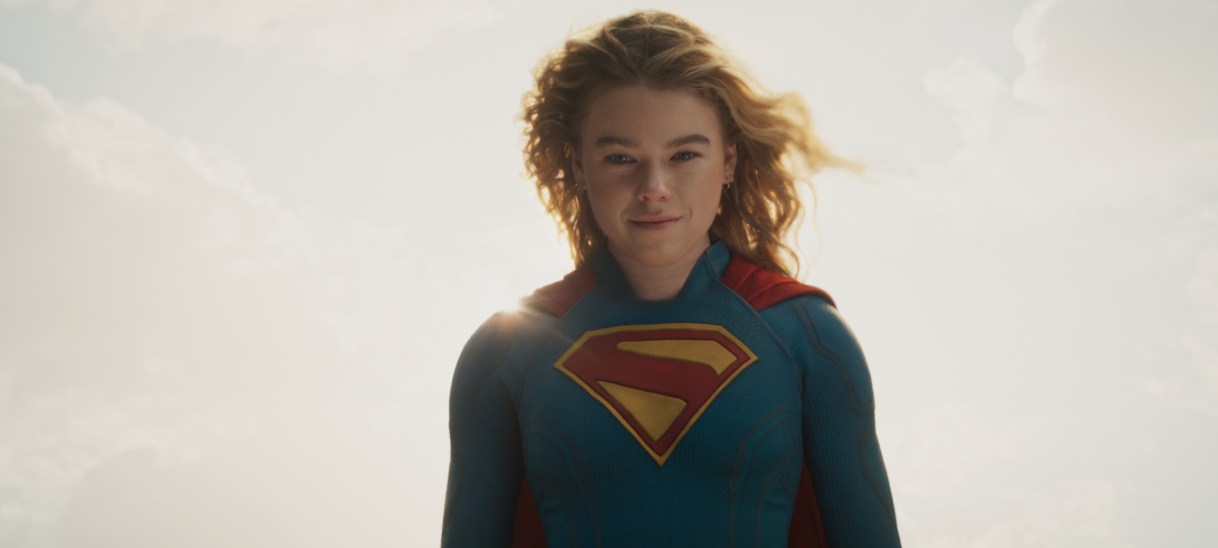
While that is the case to an extent this time around, Gunn’s said fingerprints have left smudges on Kara Zor-El / Supergirl (Milly Alcock), keeping her feeling like she’s being held back by kryptonite —poor writing, drab subplots and a one dimensional villain — rather than allowed to charge up and shine in a similar way to David Corenswet’s Superman.

Opening with a scene involving a family being slaughtered by chief movie villain Krem (Matthias Schoenaerts), lone survivor Ruthye (Eve Ridley) is left wanting revenge for their murder. She soon finds Kara drinking away in one of her pub crawls, with the duo eventually teaming up after Kara’s dog Krypto, is poisoned by Krem as he steals her ship and flys off. If this sounds like a sort of pseudo-revenge John Wick dog movie, you’re bang on the money. But revenge isn’t what Ruthye should be seeking, or so Kara tries to hammer into her. There’s more to life than revenge, Kara goes on, so let me handle this…oh wait you didn’t listen to me and now we’re on a buddy up adventure involving Marvel like one-liners and less than flashy CGI.
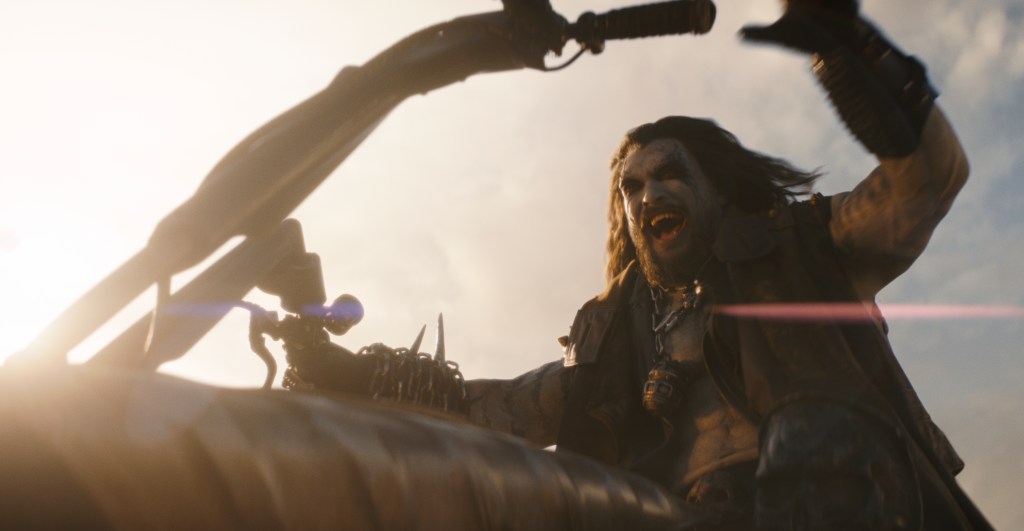
Jason Momoa as Lobo in Supergirl

It’s telling that in reinvigorating DC, Gunn has done a control c, control v approach to these first two films. While I can’t blame him for utlising a tried and true formula that (really) he put in motion with Guardians of the Galaxy (2014) —for better and worse— it reduces the film to a predictable, beat-by-beat exercise where Supergirl could be replaced by Wonder Woman and you wouldn’t bat an eyelid.

Milly Alcock does as much as she can with a script that washes over any stakes with a shrug of the shoulder and cheeky wink. Krem is about as one-dimensional a superhero villain as they come, right up there with Christian Bale’s Gorr. His motives are unclear, as he steals swords and young women who he wants to wed off in some sense like he’s Immortan Joe from Mad Max: Fury Road (2015).

The plot is as much tied to Ruthye’s character as it is to Kara, and it leaves a lot to be desired in the way of character development and a reason to care about what is happening to these people. There’s flashbacks to Kara’s home planet, giving us a different perspective to the fall of Krypton that we’ve always gotten in a Superman film. It’s welcome and makes sense for a character we haven’t seen much of on the big screen, but it leaves the moments in the present feeling short lived. Jason Momoa jets around as Lobo on a motorcycle, having as much fun as he can while scoffing down bears and revving the engine (not far from what he does in real life), and some of the action is serviceable, but beyond that this feels like a set up to an inevitable Superman and Supergirl movie at some point.

Ultimately, Gillespe’s film chooses to look forward and remind audiences that Supergirl will be a part of a wider Justice League at some point rather than giving her an origin story worth its weight. 

Supergirl opens nationally from today.

Dune is a Movie Experience that Beckons to be Lived

Rating: 4 out of 5.

Denis Villeneuve’s adaptation of Frank Herbert’s widely beloved novel of the same name, Dune (2021), is a remarkable feat in blockbuster filmmaking that reaffirms why Villeneuve is one of the best working directors today. Villeneuve’s adaptation honours Herbert’s writing by matching it with visual splendour and creating an on-screen world that feels lived-in — something that hasn’t been felt on the big screen since the director’s last film, Blade Runner 2049 (2017).

There’s a reason why Frank Herbert’s science fiction novel had always been deemed unfilmable in the same way as J.R.R Tolkien’s The Lord of the Rings. Like The Lord of the Rings, Dune is comprised of a level of detail that captures the minutia of the world it creates and the characters that occupy it; whether that be through numerous internal monologues, vivid imagery through carefully selected wording, or just the fact that the ‘hero’s journey’ isn’t approached in a way that would seek to validate the protagonist’s actions.

That protagonist is the Muad’Dib, Lisan al Gaib, Kwisatz Haderach, Messiah — Paul Atreides (Timothee Chalamet). Mentioning all of the ways in which Paul is referred to in the book and film is important because it highlights just how nuanced of a character he is. Paul is many things to many different groups and people, be it the Bene Gesserit who are a sisterhood conditioned in superhuman ways; the Fremen who are the desert people of the planet Arrakis; and to those that know him across the story like Chani (Zendaya), Lady Jessica (Rebecca Ferguson), and Duncan Idaho (Jason Momoa), to name a few.

When it comes to the plot, two houses (House Atreides and House Harkonnen) have been feuding with each other for ages. It isn’t until the Padishah Emperor requests that Duke Leto (Oscar Isaac) and the rest of House Atreides move to and oversee the desert planet of Arrakis (Dune), that tensions begin to further boil between the houses as deceit and betrayal ensues. On the planet is the galactic currency known as the spice (a melange like substance) that is the source for discontent, power, and wealth, and as mentioned in the novel, “he who controls the spice controls the universe”.

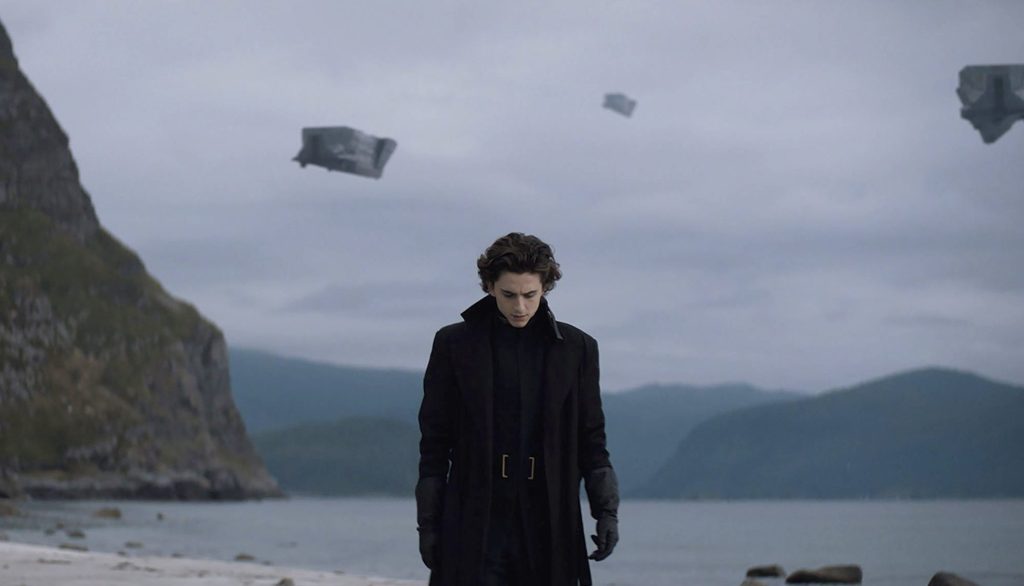
Timothee Chalamet in Dune

Alongside all of this is Paul who has a unique destiny that will change the lives of all of those around him. Paul is viewed as a messiah of sorts that has been bred and trained by the Bene Gesserit for the purpose of leading people into a better future, though at the expense of bringing about a potentially worse future known as the jihad (or ‘war’, as the film westernizes the term).

The story itself is a rather complex one, if not for Herbert’s aforementioned approach to writing the book, then for its emphasis on ideas pertaining to feudalism, mysticism, perennial truth, and a plethora of other nuanced ideas and leanings. Jon Spaihts, Eric Roth, and Villenueve do a good job of dissecting some of Herbert’s ideas for the screenplay, and adapting them for the screen through visual cues, motifs, and worldbuilding.

They take the heart of the story in Paul Atreides, and allow him to guide us through each given moment using visual storytelling and the affordances of the cinematic medium. In this way, for anyone that hasn’t picked up the novel, it’s relatively easy to follow the film and pick up on some of the concerns and ideas that penetrate Herbert’s telling through visual cues.

Villeneuve is a master of using visual storytelling to tell a complex story while leaving his own print on that story; It’s a large reason why Blade Runner 2049 worked so well and why Dune works just as well. The world he creates on-screen speaks for itself with its own visual language through setting, colour, visual effects, and cinematography. For instance, there is a scene involving the Sardaukar (the Padishah Emperor’s specially trained elite force) that captures the very essence of this force by using no dialogue. Rather, Villeneuve utilises framing, composition, visual effects and sound in a sequence that lasts barely a minute, but is able to depict the very ruthlessness of the Sardaukar in this short sequence. That’s just one of the many examples where Villeneuve shows and doesn’t tell — everything you need to know about this force is shown to you in this condensed form.

What Villeneuve isn’t able to do with Dune like with Blade Runner 2049, is give you a reason to care about the characters in this film. The first half of the film is paced incredibly quickly which is understandable given there is a lot of ground to cover in Herbert’s novel, however characters are what audiences latch onto for emotional support. The character of K (Ryan Gosling) in Blade Runner 2049 was multifaceted for an android, and the scale of the film never overwhelmed that connection built with him.

Some might view Villeneuve’s treatment of character as one that is reflective of Herbert’s own reluctance to provide overly accessible characters, however films need that connection otherwise you’re relying on visual bravado to take you where you need to go (which it does, but that aspect is a shortcoming nonetheless). I’d make the case that Herbert’s own novel offers characters like Gurney Halleck, Duke Leto, and even Paul to an extent, for emotional support and for connection.

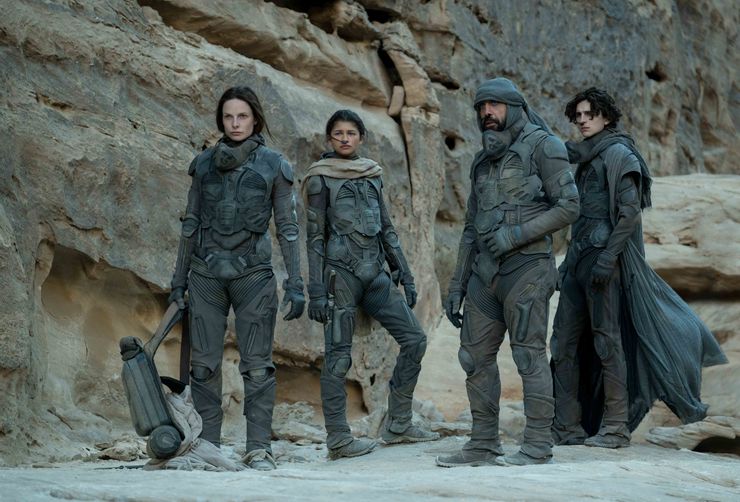
(From left to right) Rebecca Ferguson, Zendaya, Javier Bardem, and Timothee Chalamet

That said, as with any adaptation of a novel or novels as rich in detail as Dune, Villeneuve has to sacrifice key aspects of the novel in favour of an adaptation that is worthy of a 155minute feature. Certain characters like Gurney Halleck (Josh Brolin), Thufir Hawat (Stephen McKinley Henderson), and Liet Kynes (Sharon Duncan-Brewster) become side-lined more than others where in the book they would play a much more pivotal role in understanding Paul and the motifs that underpin the film.

Some of those motifs include the significance of water on a planet where water is like its own currency. A film like George Miller’s Mad Max: Fury Road (2015) did a stellar job in capturing the significance of water in a largely desolate desert setting where it is treated as a controlling tool. Villeneuve’s Dune has moments where its significance is brought to light, but it never fleshes that out in a way that would make an audience member (unless you had read the book) realise the significance of the still-suits that the characters wear, or the cannibalistic like re-purposing of a deceased persons water.

But at its core, Villeneuve’s Dune is a film that pushes what the medium can achieve at this scale and is a masterful cinematic experience that epitomizes blockbuster filmmaking. The score composed by Hans Zimmer is piercing and fitting, and makes for an enthralling soundscape (which one would hope it would be given how long he has been sitting on it for a modern Dune film); the visuals are breath-taking and unlike anything I have seen in a film before where the world feels like it exists or will exist (as though Villeneuve is his own messiah who has seen the state of the world in 10,000 years); and the cast is incredibly talented and exciting to watch (especially Stellan Skarsgard as The Baron Vladimir Harkonnen in a role that echoes the muteness of his character in the Pirates of the Caribbean franchise).

For those that haven’t read the books and even those that have, Denis Villeneuve’s Dune part 1 is a breath-taking feat in filmmaking that deserves to be seen. It’s a film that places emphasis on worldbuilding and scale at the expense of some characterisation, but it is an experience that is unlike any you will have this year. It would have been great to have had a trilogy greenlit in order to explore the complexities of Herbert’s novel in greater detail, however the fact that there will be a sequel at all is a win for fans of the book, Villeneuve, and cinema.

Dune is now streaming on HBO Max until the 22nd of November and in Australian cinemas next month