Mission: Impossible – The Final Reckoning preview screening provided by Paramount Pictures.
Whether it’s hanging suspended inside a secret vault, rock climbing on cliff faces, climbing the Burj Khalifa, HALO jumping, flying helicopters between cliffs, dangling off the side of airplanes or diving to deep depths, for the past 29 years the Mission: Impossible franchise has pushed the boundaries of what the cinematic experience can offer. The latest and last addition to this exercise, The Final Reckoning (2025), manages to impress one last time, leaving no stone unturned and no jaw undropped.
It feels as though Director Christopher McQuarrie and Tom Cruise’s bond since first collaborating on Jack Reacher (2012) has only strengthened the work they’ve done on this franchise, with The Final Reckoning representing the sixth time they’ve worked together. The duo are clearly in sync with one another, and their relationship has seen McQuarrie produce a number of other titles Cruise has starred in — their collab might just be the Robert de Niro/Martin Scorsese of modern action films.
While all of the Mission films are interlinked, they always tend to have a new threat for Ethan Hunt (Cruise) to take on. Of course, these final two are more connected than the others (title aside). Kicking off almost immediately after Dead Reckoning Part One (2023), The Final Reckoning finds Hunt once again in hiding as his narrow escape from the previous film’s derailed-train-finale has left him with the key to the vault of the lost Sevastopol submarine. The dangerous AI known as the ‘Entity’ continues to pose a risk to the survival of the world, and it’s up to Hunt to track down the sub, contain the entity, and prevent the world from becoming an ash wasteland. Just another day for cinema’s most rouge operative, right?
Tom Cruise plays Ethan Hunt in Mission: Impossible – The Final Reckoning from Paramount Pictures and Skydance.
The Final Reckoning takes Hunt to new heights as well as depths, with Cruise once again putting his body on the line for the sake of realism. It takes some time to get to the almost playful-like vibe that previous installments have been so good at capturing, though. You feel more of the dialogue this time around, with the first act in particular having a greater weightiness to it. When I think about my favourite film in the franchise, Fallout (2018), no line ever feels wasted and always drives the plot forward, but it’s as though the punchy, in-your-face-ness of dialogue this time around is a bit more… measured (I guess being the final film, there’s some understandable caution of trying to make every moment count).
Once the flood gates open, however, it’s a hold-onto-your-horses kind of ride. The elation of watching a Mission film is in the knowing that what you’re seeing isn’t a gimmick, and to add an extra layer to it, that the film’s star is the one doing it. A tank was purpose built (the largest ever for this kind of production) to have Cruise dive into, and the tension of seeing him clamber under water while the sound design holds him (and by extension, the audience) to ransom, is spine tingling, on-the-edge-of-your-seat stuff. At a later point, Cruise is literally dangling from the thin bars of a biplane in what is perhaps the most death defying stunt ever performed by the star of a movie for the big-screen. The high of seeing Cruise scramble as the plane barrel rolls and twists and turns, is just as exhilarating as you’d imagine, and it’s one of the clearest examples of the symbiotic relationship between Hunt and Cruise, a point where these two personas meet as they both battle to get into the cockpit — a feeling best exacerbated by the G-force struggle on Cruise’s face.
Tom Cruise plays Ethan Hunt, Pom Klementieff plays Paris, Greg Tarzan Davis plays Degas, Simon Pegg plays Benji Dunn and Hayley Atwell plays Grace in Mission: Impossible – The Final Reckoning from Paramount Pictures and Skydance.
Ethan’s moral compass has always been the core of what makes this franchise standout. He’s a character of conviction, one who chooses right over right and pays the consequences time and time again. Fallout really brought the fire that burns within him —for those he cares about— out to the max. These final two films have felt more mellow when it comes to character development (we know what makes him tick), but the idea that he’s not facing any one person this time around, but an AI, really brings the focus back on him and his ability to make decisions on the fly, something that really homes in on the idea that his biggest enemy is himself.
At this point, the “Tom Cruise is secretly trying to kill himself” memes are comical, but for every broken bone the actor has endured (and there have been a few), hundreds of thousands of jaws have dropped. If the Mission: Impossible films have taught us anything it’s that Cruise, like Ethan Hunt, has continued to choose the mission and risk his life for the benefit of those he will never truly meet, and cinema is all the better for it.
Mission: Impossible – The Final Reckoning opens nationally from today.
Mickey 17 preview screening provided by Universal Pictures.
It doesn’t take a genius to understand that a film about a guy who wants to leave on an expedition and chooses to willingly die and get reprinted (literally) with his memories in-tact, only to keep dying and being reprinted, is right up Bong Joon-ho’s alley. While that doesn’t capture the multifaceted space adventure that is Mickey 17 (2025) to nearly the full extent of the word, Bong’s interests are very particular in that, human dispensability —especially with regards to people in lower socio-economic situations— is a pertinent concern throughout his oeuvre.
In Snowpiercer (2013), a train is used as a motif to portray the various carriages of the caste system, with the back of the train being the lowest class citizens and the front, the highest class, while in Mickey 17, a large spaceship serves a similar purpose. In other words, it’s no secret that capitalism and the presence of an oligarchy are concerns that he hasn’t been shy about critiquing, and they’re a thematic consistency across his work. Regarding dispensability, Mickey 17 is much more literal than any of his previous films in how it reduces the human body to something that can be done away with, something that goes beyond even that of the lowliest of workers to just a recycled carcass.
That’s at least the seed from which the rest of the film grows and revolves around as Mickey (Robert Pattinson) signs himself up to be an “expendable” or an unfortunate soul who would choose to live a quasi-immortal life by living to die and dying to live. He does this after finding himself in bad company on Earth following a debt he hasn’t paid back, before ending up on a government spaceship headed up by a pompous failed politician, Kenneth Marshall (a goofy Mark Ruffalo whose performance echoes that of his one in 2023’s Poor Things), that’s on an expedition to find a new planet to preserve mankind — if this is sounding like Passengers (2016) mixed with Edge of Tomorrow (2014), then you’d be on the right track.
Robert Pattinson in Mickey 17
The spaceship finds itself headed towards Niflheim (not to be confused with that area in 2018’s God of War game), a cold planet inhabited by woolly creatures that look like roly polie, pill bugs (dubbed “Creepers”). It’s here that Mickey’s expendable state is really tested, as he’s exposed to the planet’s toxic air over and over again until a cure can be found and applied; it’s also where we eventually get to the 17th version of Mickey that opens the film in a scene we circle back to later. While comical in its portrayal of the printing process after every Mickey death, Bong’s commentary on how human life can be reduced so willy-nilly by those in power makes for a tasty treat, especially when it comes to just how dispensable the human body is in real life, especially when it comes to matters of war.
Bong never dwells though, he keeps the film moving and he keeps the action and dialogue light-hearted and cosy, but his ability to go a step further in his critique of capitalism and the frivolousness of those in power who look down on others, shows a director who is maturing in his own ideas and isn’t afraid to mine them to the full extent. It helps that Marshall and Gwen (Toni Collette) are so effortlessly unlikable in their bougieness which helps those ideas evolve easier.
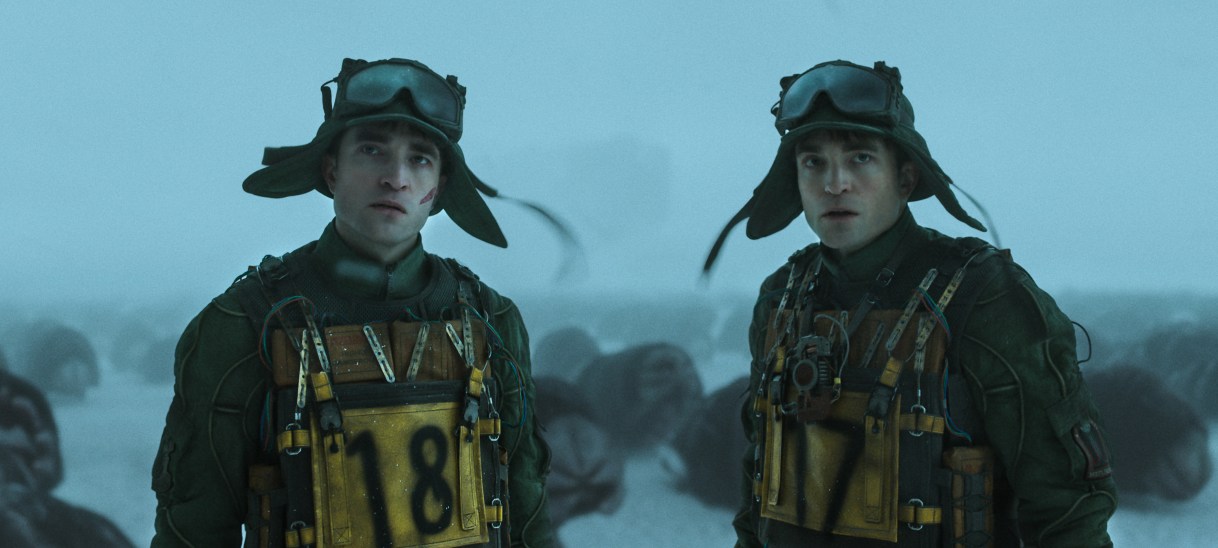
But their relationship is hardly the most shocking: after being saved by the aforementioned woolly pill bugs (following a harsh fall in an ice cave), Mickey 17 manages to find his way back to the ship where he comes across a clone of himself or a “multiple” as they’re called. It turns out Mickey 17 was presumed dead so the 18th version of him was printed, but without his pitchy accent and more akin to Pattinson’s Bruce Wayne in cadence.
Mark Ruffalo and Toni Collette in Mickey 17
It also turns out “multiples” aren’t permitted, so much so that Mickey 18 tries to kill Mickey 17 from the outset, but they soon find a commonality in the form of taking down their oppressors (very much in the vein of Snowpiercer). Pattinson’s dual performance is really a make-or-break factor in understanding what makes these multiples so unique from one another — that these reprints exhibit more humanity than the majority of the crew really adds weight to just how narcissistic and morally bleak humans can be at their worst.
At the end of the day, this is easily Bong’s most optimistic film, one that doesn’t present a bleak future but offers a chance for its characters to carve a brighter tomorrow on their own terms. Sure, he isn’t subtle about his growing interest in ideas he’s previously explored, but he also doesn’t pander to his audience, choosing to let the film’s amusing story take you on a rollercoaster comprised of the grotesque, heartfelt and humorous. In this way, it feels like his most accessible film as there are no hidden windows that keep you guessing.
Sonic the Hedgehog 3 preview screening provided by Paramount Pictures
If Sonic the Hedgehog (2020) introduced audiences, both new and old, to Sega’s speedy blue gaming icon, and Sonic the Hedgehog 2 (2022) brought with it deeper lore surrounding the Sonic universe (like Chaos Emeralds and wider characters), then Sonic the Hedgehog 3 (2024) is the sum of those parts. At once taking the fun and action to new heights (literally) as well as introducing more new characters and doubling older ones up (even more literally), the third entry in this ever growing series —which has churned out three films in five years— continues the zoomy momentum by pulling out added franchise goodies and showing no signs of slowing down.
Returning to the director’s seat is Jeff Fowler who seems to have found his groove with these films, directing them like pop culture pinball machines, however the spiritual core of them resides with Pat Casey and Josh Miller whose script finds a unique blend between action, comedy and emotional intelligence that breathes life into this revered franchise for the big screen —meaning everyone can get in on the fun.
All that said, Sonic 3 is more interested in going bigger at every turn. Sonic (Ben Schwartz), Knuckles (Idris Elba) and Tails (voice acting veteran, Colleen O’Shaughnessey) are finally the trio the series has been building them out to be and face a new threat in the form of Shadow (an aptly cast Keanu Reeves), a darker hedgehog who harnesses chaos energy that renders him dangerous and unpredictable. He comes into the picture almost instantly after breaking out of prison following 50 years of controlled sedation (with more of his backstory slowly unraveling).
Shadow (Keanu Reeves) in Sonic the Hedgehog 3 from Paramount Pictures and Sega of America, Inc.
From there, the movie fires on all cylinders, with Fowler’s kinetic approach to direction and the haphazardness of the editing really coming together to keep from any real moments of respite. We get chases throughout Tokyo, a Mission Impossible esque climax in London and a battle outside of Earth’s atmosphere — it’s an accelerated experience, but one that never threatens to become anything less than mindless, popcorn fun.
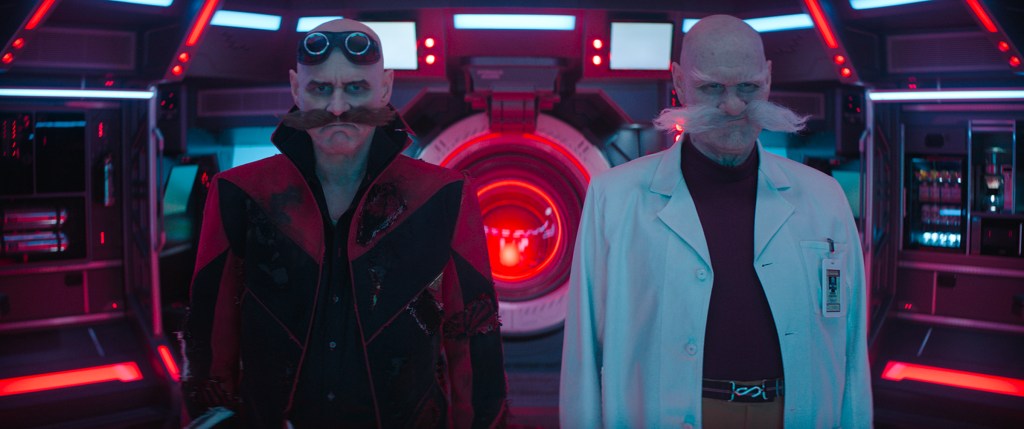
Speaking of fun, Jim Carrey is the standout here, playing two characters this time around: Dr Ivo Robotnik and his grandfather, Gerald Robotnik. Carrey steals every scene he’s in and is at the top of his game as he brings his whole overzealous being into the performances, using every trick in his book of physical humour to give these characters their own special place in the Carrey-verse of whacky weirdos. Whether it’s the whimsical banter and affection Ivo shows Gerald, the grouchy, bad-Santa esque vibe that Gerald exudes, or simply the floor crawls and random dance breakouts — Carrey is clearly having a ball and is reason enough to see the film.
Jim Carrey as Ivo Robotnik and Gerald Robotnik in Sonic the Hedgehog 3 from Paramount Pictures and Sega of America, Inc.
There are other returning faces as well, namely in the form of Tom (James Marsden) and Maddie (Tika Sumpter), but like the humans in the latest spate of MonsterVerse films, they’ve really become more like a distraction rather than an addition to proceedings. Fowler uses Tom as an emotional bridge between Shadow and Sonic, to show they’re both fighting for the same thing (those they love, or the memory of those they love), but the film is at its boisterous best when it focuses on the fun and games.
For a trilogy of films that started off on the wrong foot with that atrocious initial Sonic design, to see just how well it’s recovered and continues to be received is a testament to the heart that Fowler and the rest of the cast and crew have poured into the franchise. Whether you take a liking to the Sonic universe or are just looking for something to see over the holiday season, Sonic 3 is the perfect family film with enough humour to not feel overbearing and enough action to keep you on the edge of your seat.
Sonic the Hedgehog 3 spins into cinemas from Boxing Day.
Melbourne premiere screening provided by Universal Pictures
How does one follow up one of the greatest action films of all time? In George Miller’s case, he doubles down: double the car chases, double the explosions, double the chaos, double what’s happening in the mise-en-scene, and double the fun. But Furiosa: A Mad Max Saga should not be seen as an attempt to outdo Mad Max: Fury Road (2015), even though it speaks (sometimes explicitly) to the idea of making something epic and memorable, as though that wasn’t already achieved with the sequel.
Tonally, visually and sonically, Furiosa is on par with Fury Road which makes complete sense for the simple reason that it’s a prequel that’s there to compliment, and there’s not someone else in the director’s seat to screw it up. It’s clear that Miller went with a ‘if it ain’t broke, don’t fix it’ mentality when approaching this film, and the result is all the better for it. The biggest deviation to be felt in Furiosa is that, while it lives in the universe of Mad Max, it isn’t about him. In fact, Fury Road wasn’t exactly about him either, with these two films carving out their own place as post-apocalyptic, operatic action epics with larger-than-life stakes beyond a bloke called Max. But nonetheless, Furiosa is the character we follow and the focal point that guides our understanding of where Fury Road begins and ends.
Taking place across five chapters, Furiosa opens with the titular character (played in youth by Alyla Browne) in the green haven she attempts to return to throughout Fury Road. After noticing bandits ravaging through the haven, she tries to sabotage their bikes and alert the rest of her people of their presence; unfortunately she’s captured in the process, leading her mother (Charlee Fraser) to give chase. Eventually, Furiosa is brought to the bandits leader, Dementus (Chris Hemsworth), who is looking for his own means of survival along with the rest of his pack of bikers.
Chris Hemsworth in Warner Bros. Pictures’ action adventure “FURIOSA: A MAD MAX SAGA,” a Warner Bros. Pictures release.
It’s from here that Miller reintroduces familiar aspects from Fury Road, namely Immortan Joe (Lachy Hulme) and his goofball sons; Immortan’s white army of War Boys; and the Citadel. The first hour or so of the film focuses on Furiosa’s navigation of this space after she finds herself a captive of sorts (for reasons I won’t spoil). Alyla Browne does a fantastic job at setting the foundations of Furiosa’s arc to the point where, when Anya Taylor-Joy eventually takes the reigns after an hour, it’s not immediately apparent because of how alike the two actresses are with their pronounced blue eyes and Miller’s focus on framing them in tight close-ups.
Once Taylor-Joy is at the helm, Miller throws her into a extended chase sequence with Praetorian Jack (Tom Burke in a minor, but effective role) onboard an oil tanker, the War Rig. It echoes the chase from Fury Road where Furiosa deviates from her oil run to Gastown, but here Miller is much more interested in stretching the tension out as much as possible, almost to breaking point. It really speaks to his penchant for destruction and his eye for detail, where every nook and cranny of the truck, gears and all, is on display and pushed to the limit.
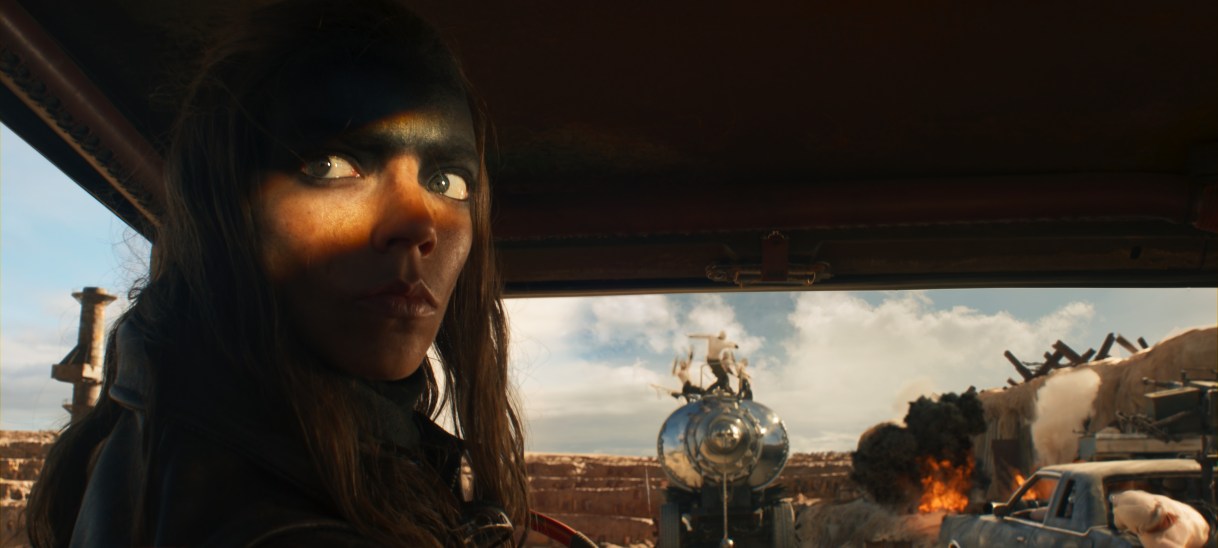
It takes some time to buy into Taylor-Joy’s performance, namely because it feels like she trying too hard to fill Charlize Theron’s boots rather than carve out her own little space for this character. Theron’s commanding screen presence, particularly the way she carries herself, is ultimately too pronounced for Taylor-Joy — she even tries to mimic her cadence of speaking — and subtlety is more effective here (which Browne brings). But Taylor-Joy does offer a level of vulnerability through her enchanting eyes; in this sense it’s easy to see why Miller might have chosen her as the lead.
Tom Burke as Praetorian Jack and Anya Taylor-Joy as Furiosa in Warner Bros. Pictures’ action adventure “FURIOSA: A MAD MAX SAGA,” a Warner Bros. Pictures release.
Hemsworth, by contrast, steals every scene he’s in, even when he goes missing for some stretches of time. Where the Thor films misplaced his larrikin humour (often at the character’s expense), Miller gives him the freedom to lean into it in a way befitting a character with a name like Dementus. His brute physique coupled with his nasally way of speaking gives Dementus a memorable edge, especially with all of the quotable lines he’s given.
Adding to the grandiose and scale of what’s on display is the fact that the Wasteland’s harshness is felt to an equal (if not greater) degree than in the first film. The addition of locations hinted at in Fury Road, like the aforementioned Gastown and Bullettown, adds weight to the stakes at play. There isn’t just more for the sake of having more, but rather Miller deliberately leaves no stone unturned and paces his film like the War Rig barrelling down a stretch of road — there’s no room for respite, you just brace yourself and try to hold on for the ride.
For what it’s worth, it’s a gorgeous ride to be had, with the visuals once again being enveloped in this orange, grainy tinge. Where in Fury Road the colours felt less saturated, there’s a much more surreal, darker quality this time around.
This is ultimately a film about Furiosa though, and her story never feels like it’s compromised or diluted for the sake of brandishing all of the fun and games that audiences will expect. Miller is a master at knowing how to capture human plight and not let it be overshadowed by the scale of his pictures. The human element of his films and this portrayal for struggle is what intensifies every car flip, gun shot and extraordinary set-piece, which is why it’s even more commendable that in a film full of incredible moments, Furiosa never loses sight of Furiosa.
Furiosa: A Mad Max Saga opens nationally from the 23rd of May.
Of all the cultural exports to emerge from Australia, arguably none is more widely recognised or celebrated than the Mad Max film series. These post-apocalyptic, dystopian tales have inspired praise and enthusiastic fan-bases the world over, from Asia to the Americas, all enamoured by the franchise’s idiosyncratic characters, punk-like aesthetics, and high-octane action sequences.
This popularity is quite remarkable when one considers the franchise’s humble origins. The initial Mad Max (1979) was conceived by its director, George Miller — a qualified surgeon — as a means of highlighting the impacts of road trauma, with the hallmarks for which the series is most-widely known not being introduced until its sequel, two years later. And even then, it is never directly stated nor explained why, or how, Max’s world operates the way it does.
This mystique has led to several theories from cinephiles, some of which help explain discrepancies that have emerged in the franchise’s four-picture, five-decade history. With the latest film in the long-running saga, Furiosa set to reach our screens this week, we’re sharing three of our favourites. Spoilers follow!
Max is Dreaming
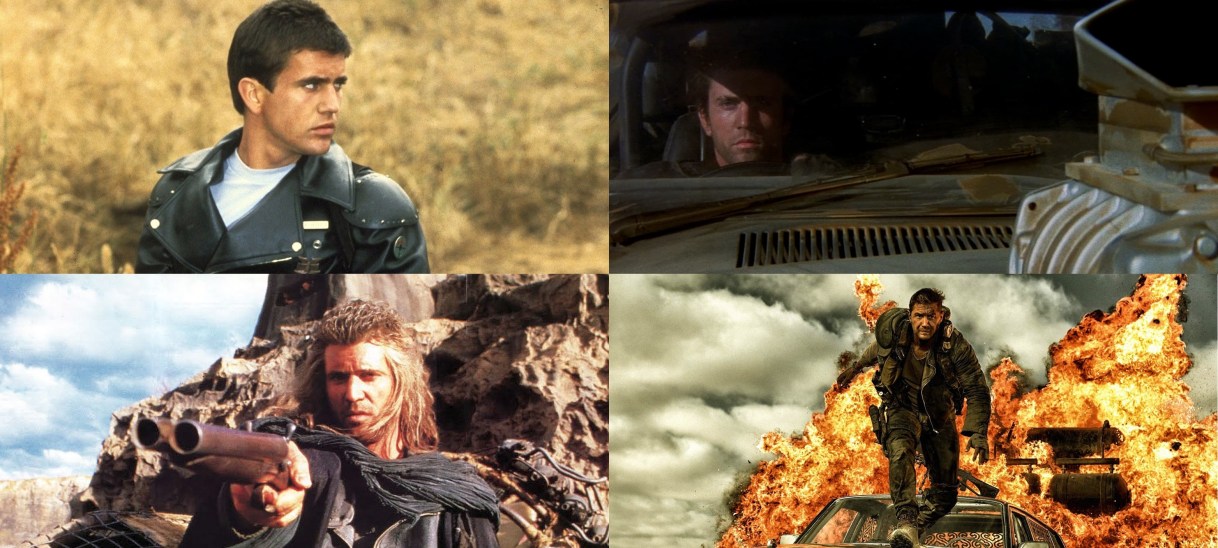
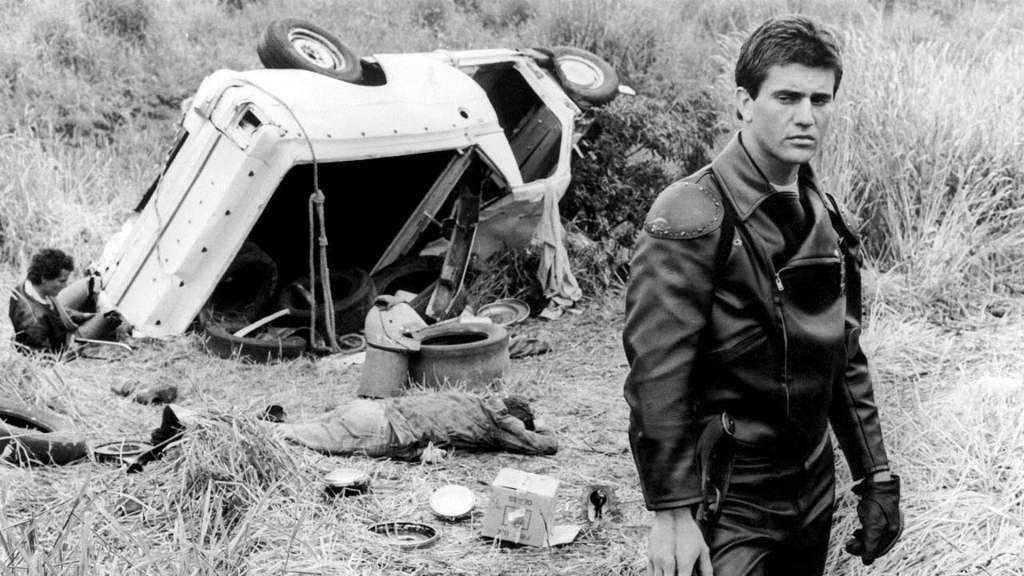
Max Rockatansky (Mel Gibson) as he appears in the final moments of the first Mad Max
This first theory postulates that our main protagonist, Max Rockatansky is imagining the events which occur in the second, third and fourth entries in the series, and stems from what transpires in the first picture. As a reminder: Max (Mel Gibson) loses his best mate, Jim “Goose” Rains (Steve Bisley), wife Jessie (Joanne Samuel) and infant son Sprog (Brendan Heath) to the violent hands of a rogue biker gang, led by The Toecutter (Hugh Keays-Byrne).
The argument here is that Max, having been distressed by the loss of those closest to him, becomes listless and descends into madness — hence the title — by entering a fantasy world of his own creation, one where he gets his revenge on Toecutter and his minions. From there, he visualises himself as a champion of the oppressed, committing vengeance against those who dare to stymie the peaceful will of others.
Applying the Caligari-esque mentality of it all being a dream may appear juvenile, but there are some elements which help provide credence to this belief. Note how, for instance, the respective plots of Mad Max 2: The Road Warrior (1981), Mad Max: Beyond Thunderdome (1985) and Mad Max: Fury Road (2015) all have Max entering a cult as an outsider, becoming their leader in all but name, and defeating their oppressors in a climactic chase sequence.
The theory also explains the use of certain actors in more than one film. Bruce Spence is a prime example — he plays the Gyro-Captain in The Road Warrior, and then appears as an amateur pilot in Beyond Thunderdome, both times assisting Max and his allies as they escape tyranny. Then there’s Max Fairchild, who appears in supporting roles in the first and second instalments; and Toecutter himself, Hugh Keays-Byrne, who portrays Fury Road’s antagonistic Immortan Joe over three decades after his first casting as a villain.
Max is a Legend
Max (Mel Gibson, again) with The Ones Left Behind in Mad Max: Beyond Thunderdome
By that, we mean he’s a mythical figure, akin to the Roman or Greek gods written about centuries ago. A couple of the examples used above could also be utilised as evidence for this second theory — the appearance of thespians as different characters in multiple films; the vaguely similar narratives of the three sequels — and more besides.
The Road Warrior is the entry which most readily identifies with Max Rockatansky being a myth. From the outset, it’s made clear the story is set in the future, with an elderly man (voiced by Harold Baigent) recounting the events of his past, who by story’s end reveals himself to be one of Max’s allies: the Feral Kid (Emil Minty).
More proof comes from the end of Beyond Thunderdome, where an adult Savannah Nix (Helen Buday) is seen recounting the tale of how she and her fellow tribespeople were rescued by Max. And then, there’s this quote which appears at the end of Fury Road:
“Where must we go… we who wander this Wasteland in search of our better selves?”
That line is attributed to “The First History Man”, and unknown and unwitnessed figure who, we can assume, is responsible for telling Max’s story.
Also indicative of this theory is the demise and unexplained return of Max’s iconic car, The Interceptor. This heavily-modified Ford XB Falcon Hardtop was stolen by Rockatansky in the third act of the original film, and destroyed in Mad Max 2, only to miraculously appear in the opening scenes of Fury Road (though in fairness, Miller circumvents this plot-hole by describing the latter picture as a “revisiting” of the franchise).
There’s More than One Max
Max (Tom Hardy) strapped to the front of a War Boy’s car in Mad Max: Fury Road
In the days and weeks following the release of Fury Road, there were certain netizens who hypothesised that this particular Max is, in fact, the aforementioned Feral Kid from Mad Max 2, owing to his long hair, the return of The Interceptor, him being played by a different actor, and the character reluctantly sharing his name.
Miller himself entertained this idea when queried by IGN, labelling it “interesting” but ultimately dismissing it, pointing to The Road Warrior’s end narration. Other factors that work against the premise include Tom Hardy being directly credited as “Max Rockatansky” in Fury Road’s opening, and his voice-over where he directly states:
“Once I was a cop, a Road Warrior searching for a righteous cause.”
But, tying into the theory that Max is a fable, it is possible that he is not the only “Max” in this universe. Again, The Interceptor helps provide weight to this theory — if this is the same Max we saw in Road Warrior and Thunderdome, how is it that “the last of the V8s” (as the car is labelled in the first and second chapters) is still in his possession after being lost?
There’s the matter of his name, too. Rockatansky only says his name twice in Fury Road — in the initial voice-over, and in the third act when he saves Furiosa’s life; he shares it about as often in Mad Max 2, and doesn’t utter it even once in Thunderdome, where he’s instead called “the Raggedy Man” or “the Man with No Name”. Perhaps our History Folk are telling of several figures who came to the aid of others, and just so happen to have named their hero “Max” in each tale.
Furiosa: A Mad Max Saga is screening in theatres nationwide from this Thursday, May 23rd. The other four Mad Max films are available via home-video, streaming and on-demand services.
The Fall Guy Melbourne Premiere provided by Universal Pictures
Car flips, ramp jumps, countless explosions and high tumbles are just some of the obstacles that stunt people face, and David Leitch’s The Fall Guy has them all. Leitch’s film seeks to celebrate the unsung heroes of stunts by putting two of Hollywood’s hottest properties, Ryan Gosling and Emily Blunt, in the driver’s seat and letting them run amok.
Stuntman Colt Seavers’ (Ryan Gosling) life takes an expected turn after a stunt-gone-wrong puts him out of the business for over a year. To make matters worse, he’s derailed a relationship with another crew member, cinematographer Jody Moreno (Emily Blunt) after ghosting her in the time since. But it’s not until a phone call from producer Gail (Hannah Waddingham), begging him to return to stunt work on a film that Jody is now directing, that his life really takes a turn. And that’s because amidst his awkward return to facing Jody, he’s also been tasked with locating the film’s missing star that he stunt-doubles for, Tom Ryder (Aaron Taylor-Johnson).
On paper, it’s hardly a unique premise, but it lends itself to a rampant few hours at the cinema, largely because of Gosling and Blunt’s on-screen chemistry. The duo, fresh off of their 2023 blockbuster hits Barbie and Oppenheimer, respectively, seamlessly work off of one another here.
Gosling has a penchant for dry humour, as evidenced by his straight faced delivery of lines, but he’s also an incredibly versatile actor and it shows here as he effortlessly exudes charisma —at once being able to cry in the car to Taylor Swift’s ‘All Too Well’ and then go and burst through a door like a clumsy Jackie Chan. Blunt matches him in her charm, where she finds a balance between being obliviously innocent and a straight-up butt-kicking baddie.
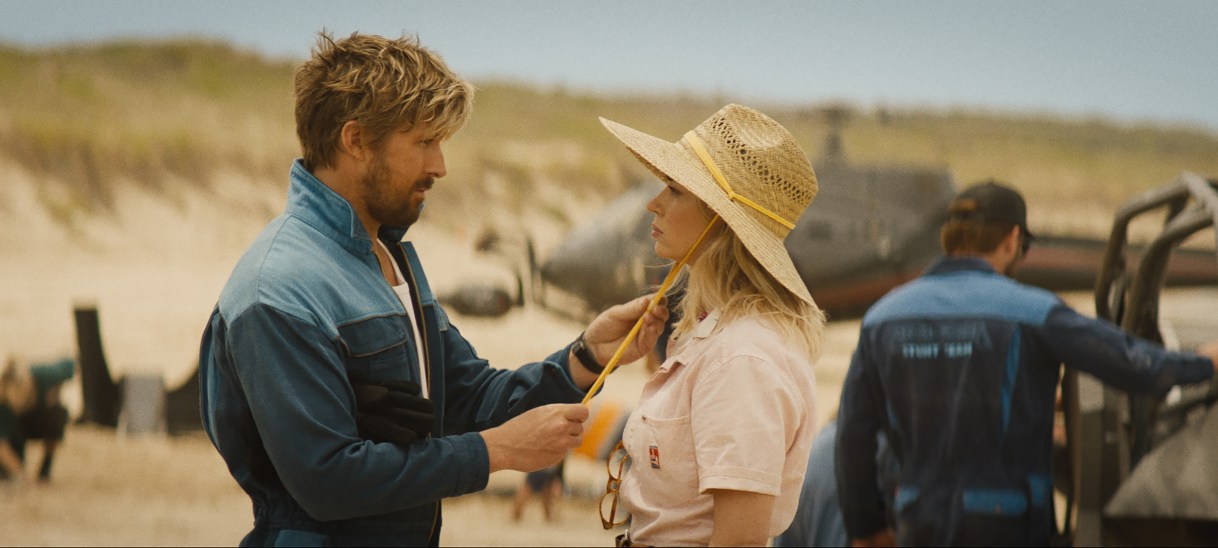
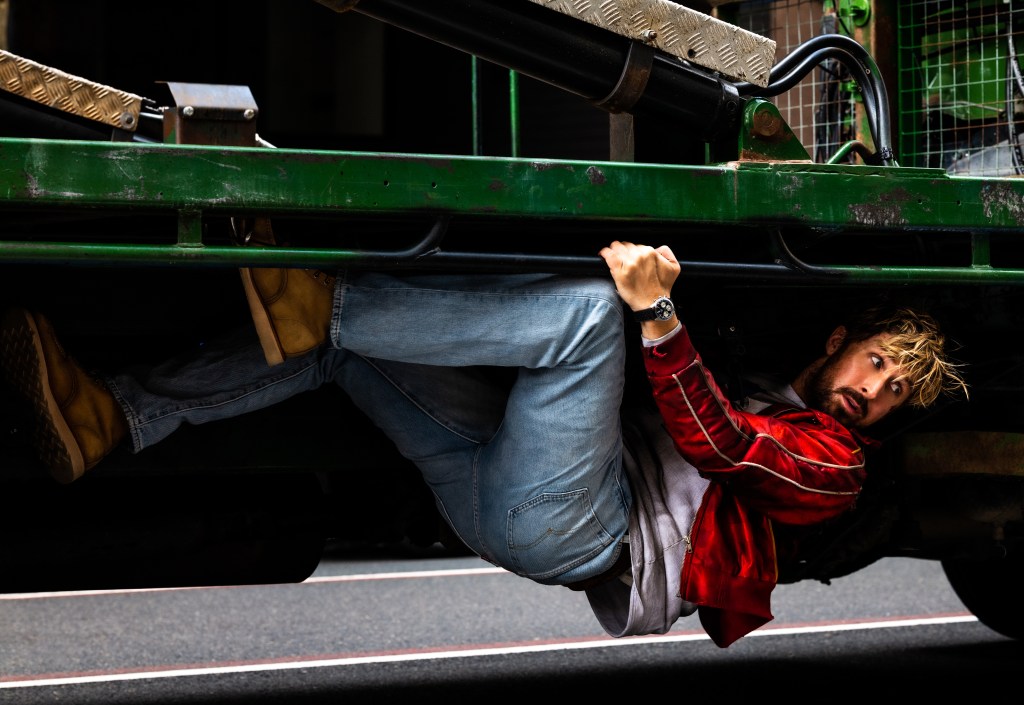
Ryan Gosling is Colt Seavers in THE FALL GUY, directed by David Leitch
The duo are really the heart and soul of the film, which sometimes gets caught up in its own self-reflexivity. Characters will often call out wider pop culture references (Winston Duke’s character slams a bad guy through a table while shouting “Dwayne Johnson!”) and sometimes the writing doesn’t take itself seriously enough, leading to a feeling that the stakes just don’t feel that important —or the wider “why should I care if you don’t” aspect that Leitch’s films are notorious for.
Make no mistake, this is a film that revels in blowing everything out of proportion, so much so that it affords little respite. There are boat chases, three major ramp jumps, a sequence where Gosling is tripping on psychedelics and seeing unicorns, street chases throughout Sydney (which has never looked better), and a closing sequence that is committed to blowing things up.
In other words, Leitch (a former stuntman himself, famously for Brad Pitt) and lead stunt coordinator Keir Beck are all-in on going as big as they can and as fast as they can. For the most part they achieve that as the film rarely gives you a moment to stop and think, at times to its own detriment (the third act resolves in a rather eye-roll moment of spewy exposition), but at the same time that’s the name of the game as stunt people rarely hesitate.
Whether or not the stunts themselves will stand the test of time in the same way Tom Cruise throwing himself off of a mountain face will, isn’t clear. For the most part they’re great in the moment, but I wouldn’t call them memorable, especially when it’s Gosling and Blunt who will steal the accolades for their effortless banter. But Leitch (like Chad Stahelski with his John Wick franchise) knows the stunt game better than anyone, and The Fall Guy delivers the popcorn filmmaking goods while celebrating the bodies behind the actors.
The Fall Guy opens nationally from the 24th of April.
While J. Robert Oppenheimer’s name might be synonymous with the deadliest device ever created, Christopher Nolan’s latest three hour biopic, Oppenheimer, looks at the man behind the atomic bomb through a much more introspective lens without ever insinuating that audiences should feel a sense of sympathy for his brilliant mistake/s. Of course, introspection is a key building block to any biopic, but given Nolan’s ouevre hasn’t ever focused on a historical figure of this magnitude —or any historical figure in this sense which still isn’t as big a shock as not casting Michael Caine—, there’s understandably a greater interest surrounding this biopic if not for the simple fact that it’s a Nolan film, then definitely because its subject is one of the most infamous, and misunderstood, scientific minds ever.
That Oppenheimer was a brilliant theoretical physicist who was the victim of his own belief that man could be trusted with forces larger than them, is undeniable. But Nolan’s film isn’t just concerned with the cookie-cutter facts that you can pull from a Wikipedia page. While the film is based on 2005’s Pulitzer winning novel, ‘American Prometheus’, Nolan’s interest jumps from the key, often glossed over moments in Oppenheimer’s life, and interrogates them more carefully.
Nolan’s Oppenheimer (a perfectly cast Cillian Murphy) is a man struggling to be faithful, who is always in his mind, viewing every next move like an equation on a chalkboard. His relationship to theory stretches into his everyday life as he struggles to maintain meaningful relationships, always approaching life by the numbers and relegating himself to a disconnected observer as opposed to a practical artisan. At one point he is in disbelief that scientists overseas have figured out how to split atoms from each other (or something to that effect), stating that it’s not possible from a theoretical point of view (POV), and it’s through this sort of mould that he carves his Oppenheimer from — a man unlike those around him, an outlier.
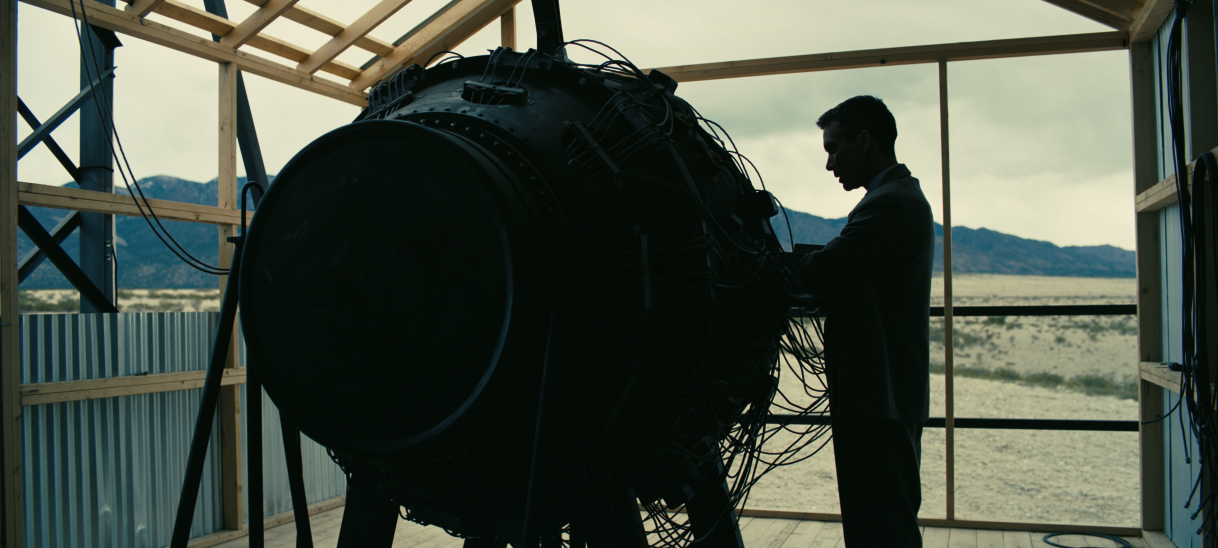
L to R: Florence Pugh is Jean Tatlock and Cillian Murphy is J. Robert Oppenheimer in OPPENHEIMER, written, produced, and directed by Christopher Nolan.
In this way, he isn’t too different from other Nolan characters like Bruce Wayne or Joseph Cooper in that he’s committed to what he knows, and does what he must for the greater good. His distant persona also affects his ability to build sustainable relationships, often pin-balling across various lovers and failing to forge a life beyond his commitment to his craft as exacerbated by a scene where he offers his crying baby to his friends as he doesn’t have the time to look after it (a selfish move he recognises).
Early in the film he’s encouraged to pursue his interest in theory and master it, and this is the point in his life that Nolan opts to introduce us to. And it’s in the early stages of the film that Nolan really portrays the internal struggle that will go on to plague Oppenheimer in the film’s later stages. He cleverly uses hazy, almost dreamlike visual motifs that equally look like beautiful stars and bomb fragments. These moments are some of the most thought-provoking as they provide a real deviation from the coolness and level head of Cillian Murphy’s performance that makes the character difficult to read — as though he’s got everything under his hat and under control.
It helps that multiple POV’s are being deployed by Nolan here in what is probably the most un-Nolan-esque part of this movie. Not only is Oppenheimer’s view of the world on display, but that of his early ‘affiliate’, Lewis Strauss (Robert Downey Jr. at his brilliant best). This duality helps build tension and allows the events of the third act to come together more tightly than might otherwise have been possible. Frequent Nolan cinematographer, Hoyte van Hoytema, shoots in colour for Oppenheimer and black and white for Strauss, further helping create this sense of separation through subjectivity and objectivity, ultimately adding to Oppenheimer’s unknowability and the difference in views that the two characters have. Whether or not this approach works in its entirety is difficult to tell from a first viewing, especially since it does tie events together, but equally throws one out of rhythm from time to time with the various timelines intersecting.
Robert Downey Jr is Lewis Strauss in OPPENHEIMER, written, produced, and directed by Christopher Nolan.
The most jarring instance of rhythmic intrusion is also the film’s best for the very fact that it’s the most speechless moment in the film. If you’ve followed the marketing, the controlled atomic set-piece (atomic in its own right) is where the full force of seeing this 70mm beast in IMAX really sells itself. By this point a lot of the establishing from the first half —namely around the politics of the Manhattan Project and the scientific lingo that will fly over most people’s heads— has been rounded off and Nolan finally gets to play with his own toys by unleashing the mother of all bombs, creating a spectacle that almost transports you to the New Mexico desert with the characters. It is really the punchline of the film, rewarding your patience by drowning out all of the noise in its countdown and the ensuing blast.
Whether or not Oppenheimer is the sort of Nolan film audiences are eager for is tough to say; there’s no tricky logic that fans of Interstellar (2014) or Inception (2010) wouldn’t wrap their heads around, but the film also sees Nolan at his rawest and most cynical, choosing to show a world destined to implode on itself just as it’s beginning to take shape. While The Dark Knight (2008) followed a similar path, there was at least the knowledge that its commentary was so distant from reality rather than a part of it. Yet in a film full of so many competing elements whether it’s the performances, the dialogue (which has has never really been the sweet-spot in a Nolan film as much as the moments around it are), the rapturous score from Ludwig Göransson, the staging of the key set piece or even the candidness of the story, there’s no doubt that like Oppenheimer, Nolan was all in on going big, and the final result is one that will stick with many long after the end credits roll by.
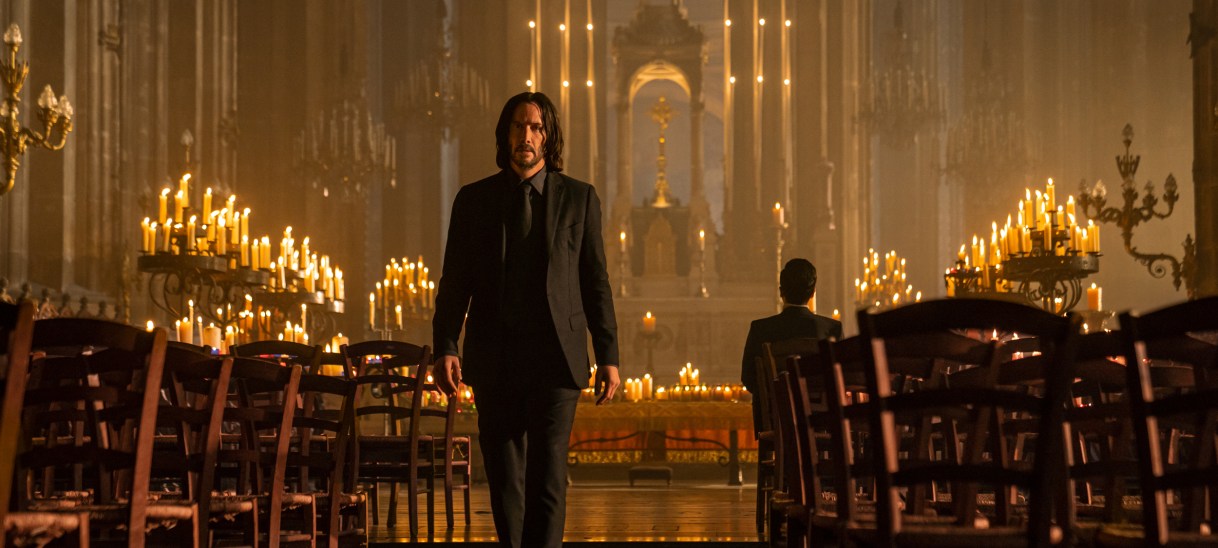
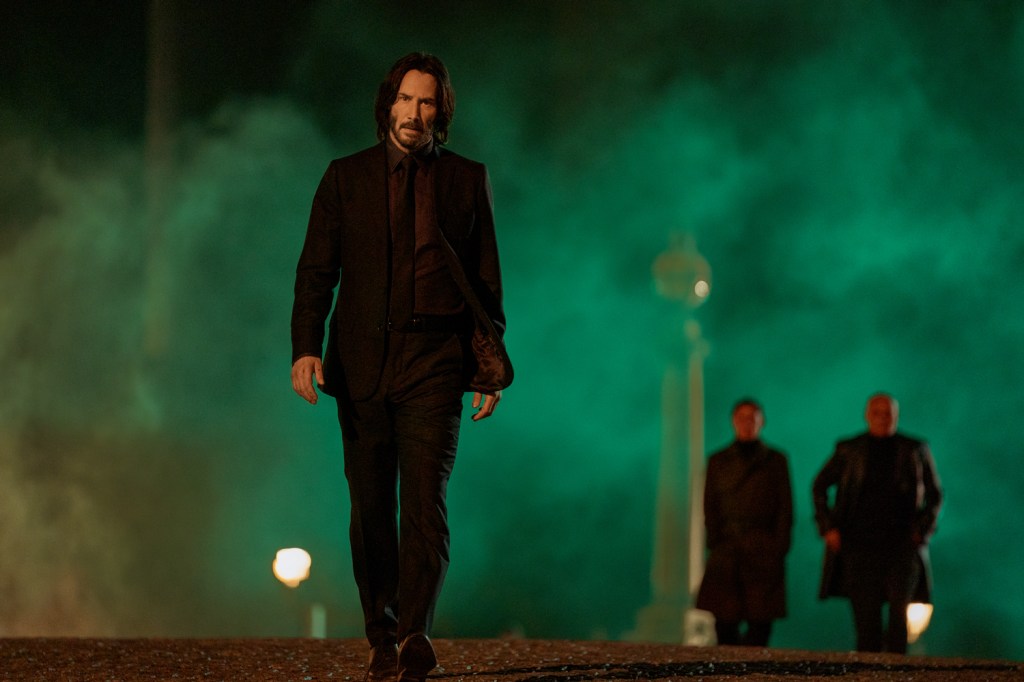
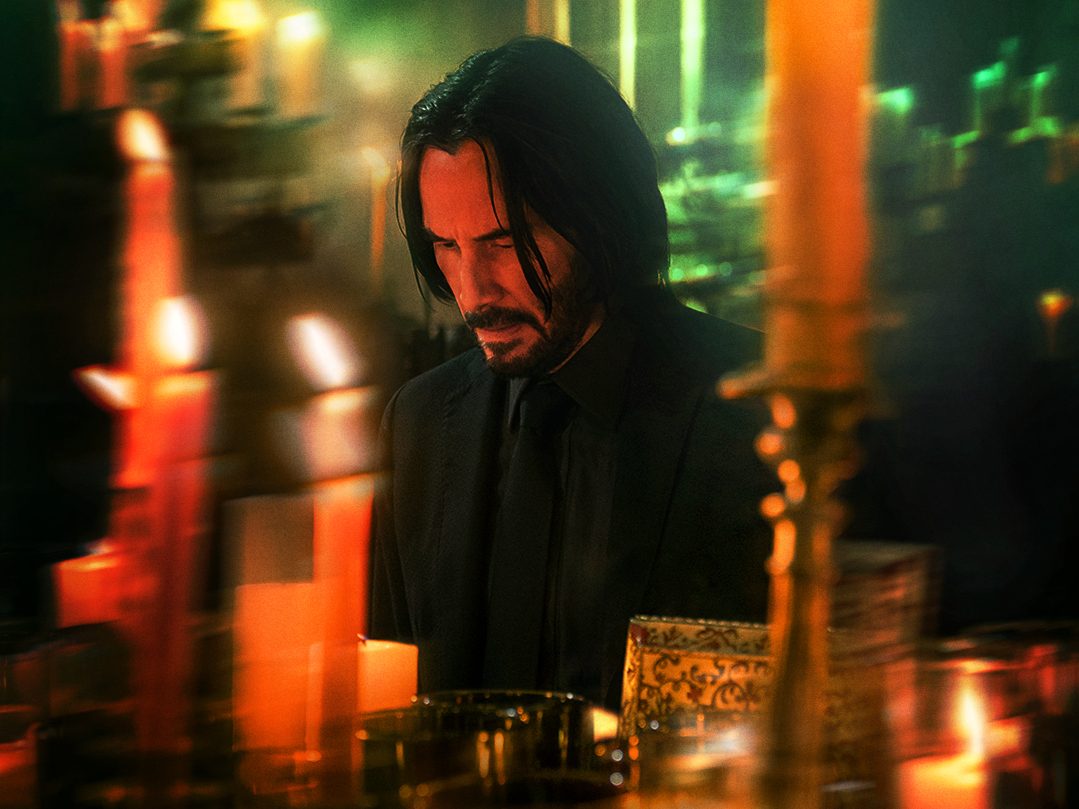
“Welcome back Mr Wick” (RIP the iconic Lance Reddick). The bravura American action franchise of the past 10 years, John Wick returns bolder, brasher, and more inventive than ever in John Wick:Chapter 4 (2023). The film, clocking in at 169 minutes with an immense 14 action set pieces, figures which on the surface would cripple most films, but in reality are remarkably well paced. Renown stuntman turned in-demand filmmaker (his IMDb page reads like a to-do list) Chad Stahelski has always focused more on individual moments than a wholly engaging narrative, which is still the case with the fourth entry in the franchise, but the attention to detail in these moments, along with an extraordinary ensemble that are all giving their best, makes the film as a whole immensely enjoyable.
The franchise has always focused on three central tenets: gloriously realistic fight choreography with one of the best to ever do it in Keanu Reeves, stunningly inventive visuals in all real locations, and minimal dialogue with an eye for larger world-building on the margins. These are all ratcheted up to extremes in Chapter 4, bringing the film closer in comparison to a David Lean film than whatever the Russo’s are producing on Netflix.
Following on from the events of Chapter 3: Parabellum (2019), John Wick (Reeves), down a finger and assumed dead by the High Table, must traverse even further reaches of the globe to take down the senior figures of the organisation. The major inclusion to the franchise here is the legendary Donnie Yen, and his presence is felt immediately as the blind retired assassin Caine, tasked with eliminating his old friend John. Caine’s story parallels John’s from the first film, a connection that is simple but effective in a film that knows when to expand the story and when to be quiet and let audiences bathe in the stylised action set pieces.
Keanu Reeves in John Wick: Chapter 4
The franchise has been able to boast an incredibly varied list of cameos from Angelica Houston to Boban Marjanović, adding a sense of scale and interest to each sequence. Added here are Yen, Bill Skarsgard, Rina Sawayama, and Hiroyuki Sanada, all improving on an already impressive ensemble that is unparalleled in an action franchise. Yen in particular is incredible, adding a coy and aloof nature to one of the best fighters in cinema history makes for a constantly compelling screen presence. To be able to add a figure like Yen to the franchise after four films shows the filmmakers are never satisfied with what was previously achieved, always seeking a greater experience for audiences, which they have accomplished in spades.
John Wick has long been a quintessential YouTube clips movie, focusing on individual moments over a cohesive narrative. Chapter 4 is easily the most ambitious entry. Whether that is in its outrageous Berlin rave sequence, incredible Donnie Yen fight sequences, or a seen-to-be-believed false roof bird’s eye oner with explosive shotgun rounds that will have audiences with their jaws on the floor and an overwhelming desire to cheer in appreciation.
The best inclusion to the franchise introduced in Chapter 3: Parabellum (besides Halle Berry and her dogs) are the locations outside of New York, something that is being further expanded here in Chapter 4. Taking place in Berlin, Paris, and Osaka, this film is able to flex its muscles visually and tonally which adds important freshness to a world that could have relied on what previously worked instead of giving audiences a three-hour endorphin rush.
Keanu Reeves in John Wick: Chapter 4
Connection to the entire franchise can be felt throughout Chapter 4, from its extraordinary Berlin rave sequence to Mr Nobody’s attack dog. These moments never feel like a tired repetition, but an evolution of form that makes this film the quintessential John Wick film. With the additions of location jumping and more convoluted plots, the John Wick franchise has morphed into a sort of John Woo-inspired, American Wuxia James Bond or Mission Impossible, with Keanu Reeves at its centre. The only thing it’s missing is the iconic score (although the music is always top-notch).
Among the best blockbuster theatre experiences this decade, Stahelski and crew have pushed every moment to its limits to put John Wick: Chapter 4 in the pantheon of action filmmaking achievements. Comfortably the best film in the series, Chapter 4 is a perfect culmination of everything that makes the previous films great, heightened and stylised to the highest degree imaginable.
No one manages to blend crime and action on the big screen quite like Michael Mann. From the sprawling cityscapes that act as their own character, to the attention-to-detail with each and every aspect of production, Mann’s films are distinctively his own. It seems fitting then to look back on his stellar oeuvre and try and rank his titles based on my sentiment towards them at this moment in time. This is especially the case following his recent novel and sequel to the iconic Heat (1995), which he co-wrote with Meg Gardiner, and leading up to his Adam Driver-led, Enzo Ferrari biopic, Ferrari (2023).
Of course, like with any list, opinions are different and feelings towards films change as time goes by and depending on where in your life you find yourself. But for now, these are his films ranked from worst (if you can call them that) to best:
11. The Keep (1983)
The Keep
Whether it’s due to the fact that large chunks of this film were cut out, or because it’s the least Mann-esque title on the list, The Keep is what I like to call Mann’s brain fart.
His second feature following the brilliant Thief (1981) represents his first and clearest (as there are elements of this in his true crime thrillers) foray into the horror genre. It’s a film plagued by bland and uninspired performances; a nonsensical narrative involving Nazis, a devilish entity, a supernatural Scott Glenn and one of the strangest but best sex-scenes you’re likely to see in a Mann film or otherwise; an interesting production design; and a pretty neat synthy score by Tangerine Dream.
Given Mann has disowned the film because of Paramount’s treatment of it, one can only imagine what the unreleased director’s cut had in store — we can only hope it graces out screens someday.
10. Manhunter (1986)
Manhunter
Many might find my ranking of Manhunter to be completely against the grain, but this thriller revolving around capturing a psychotic serial killer just never resonated with me on a narrative level like some of the other titles on this list (and I still gave it 3.5/5).
Manhunter focuses on FBI agent Will Graham (William Peterson), a detective who’s come out of retirement to help locate an elusive serial-killer with strange motives. His past experiences hunting figures like Hannibal Lecter (a subtle performance by Brian Cox) means he’s the perfect guy for the job.
Manhunter uses Will and the serial killer he’s hunting to create an interesting parallel between the mind of a psychotic man and the man capable of catching him. Its use of home video and the focus on truly seeing almost posits that these two men aren’t so different in how they see the world, but to different ends and outcomes.
Whether or not I was expecting a more conventional voyeuristic mystery-thriller in the way that Se7en (1995) or Rear Window (1954) are —where the killer feels like they’re an arm’s length away, only for the satisfaction of catching them to be snatched from you— is difficult to say (perhaps that’s what people love about this?), but I found myself at a crossroads by the third act. I hope my opinion changes on a second viewing.
9. Ali (2001)
Ali
On the surface, a film about Muhammad Ali seems like the farthest thing from a Michael Mann joint. There’s no mesmerising cityscape, no sirens or gunfire, no real suspense in the way that his crime films create suspense, and the subject matter doesn’t exactly scream ‘Michael Mann’.
But this film about the greatest boxer of all time works because of Mann’s interest in figures that don’t play by the rules. Specifically, Ali focuses on the period of time between Ali’s (Will Smith) first major heavyweight bout, the court case filed against him for refusing conscription for the Vietnam War, and his famous win against George Foreman to reclaim the heavyweight title.
Ali’s unilateral decision to not be conscripted was momentous for the fact that he was the heavyweight champion of the world, and making such a decision could affect his ability to box in his prime (which it did). He also reinvented who he was by changing his name and living on his own terms — a staple of Mann characters, but for different reasons. Often his characters are trying to protect others from who they truly are whereas Ali was trying to break away from the branding that others (white slavers) had given him and his people centuries ago.
The opening 15 or so minutes are also arguably Mann’s most compelling in the way that he establishes character, creates purpose and builds tension. At times there’s a suddenness to proceedings where the film makes abrupt leaps in time between the court case announcement, the Joe Frazier fight, and the George Foreman fight, but overall Ali is a portrait of one man’s journey to becoming in the face of adversary.
8. The Last of the Mohicans (1992)
The Last of the Mohicans
Along with The Keep, The Last of the Mohicans represents a different sort of Mann.
Like with Peter Jackson’s first film experience with the classic King Kong (1933) and his eventual reimagining of that classic on his own terms in King Kong (2005), Mann’s first vivid film memory was of 1936’s The Last of the Mohicans.
Helmed by Daniel Day-Lewis as the adopted Mohican, Hawkeye, this period piece about everything from the damning effects of bureaucracy to the Tarzan-esque romanticism of the love affair between Hawkeye and Cora Munro (Madeleine Stowe), is the first Mann film to create a sense of scale that would have greatly shaped the way he approached his later films.
By that I mean Mann finds a balance between showcasing the wide and beautiful terrain of a primeval America against the harshness of the looming modernisation that threatens its existence. This translates onto how the characters react to each other, whether it be through Magua (a mesmerising Wes Studi) and his desire for revenge against the British (for what they took from him) as well as his forward thinking to help his tribe, or through the loud and rampant battle at Fort William Henry that threatens the peace of the land.
Guided by one of the greatest scores of any film ever by Trevor Jones and Randy Edelman which at once evokes hope and sadness, picturesque vistas, and gripping direction that never falters, this Mann-epic is Mann at his most untethered.
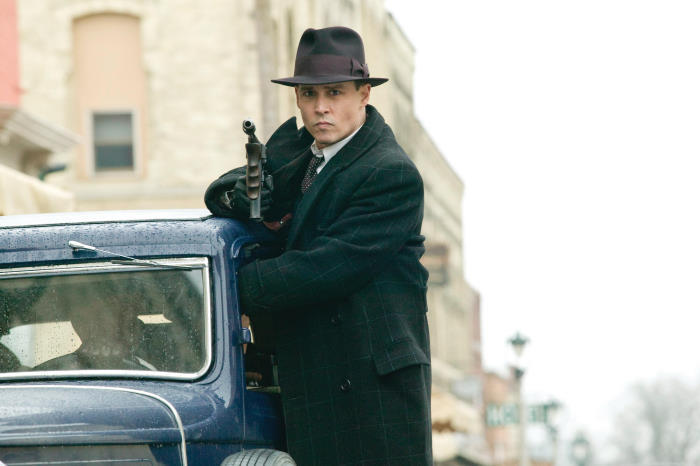
7. Public Enemies (2009)
Public Enemies
When it comes to famous outlaws, there are few that are as iconic as John Dillinger, especially given he was a man who wasn’t interested in stealing from regular people, but the state itself.
That’s partly why he’s the perfect historical figure for a Michael Mann film given his self-defined approach to life.
Public Enemies follows Dillinger (Johnny Depp) as he makes prison escape after prison escape, continuously evading capture and robbing banks before finding an added purpose in life in the form of one French-American, Billie Frechette (Marion Cotillard).
Like all of Mann’s anti-heroes, Depp’s Dillinger is charming and elusive all at once. He’s a character infused with an aura of mystique that Depp delivers with the casual suave that his own image beyond the screen has maintained.
But it’s in the reimagining of the period through a digital lens where Public Enemies really excels. The moody greys, dark passages and almost colourless world are so striking here that it creates a more profound hyper-realism — almost bringing the 1930s to life in a way that shooting on film wouldn’t.
6. The Insider (1999)
The Insider
A film about a man’s grapple with doing what’s morally right or being forced into silence by forces greater than him; The Insider, in true Mann-style, is an exercise in patience — in waiting for the right moment to make a move before it’s too late.
Unlike Mann’s other thrillers though, The Insider doesn’t have vans of heavily armed forces hiding around the corner, but it instead puts its faith in the truth overcoming the odds. That truth is in the form of former tobacco chemical scientist, Jeffrey Wigand (Russell Crowe) and the 60 Minutes producer looking to help bring his story to light, Lowell Bergman (Al Pacino). The odds are the Brown and Williamson Tobacco Company who are trying to keep Jeffrey, and this story around what really happens to tobacco, silent.
Guided by Mann’s brilliant direction, a well-crafted script by Mann and Eric Roth, and a standout performance from Al Pacino in an unfamiliar but equally familiar performance, The Insider paints a perplexing portrait of the lengths to which vindictive multi-billion dollar organisations will go to in order to supress information. It brings various parties with differing interests together, and creates a wide web of uncertainty for all involved — with no clear contingencies, but everything to lose for everyone involved.
5. Blackhat (2015)
Blackhat
Michael Mann’s most recent film feels like a sum of all of his best parts (it’s also been eight years since it was released!).
The film follows hacker Nicholas Hathaway (a career-best performance from Chris Hemsworth) who, after a series of awry events happen by an unknown source, is released from prison for the purpose of helping discover the person behind these events.
Blackhat is where ideas meet, characters converge, and where the tangible coalesces with the intangible.
In a similar way to Manhunter (but without the straining of classic thriller conventions) and Heat, this film once again depicts two sides of the same coin — Hathaway as the hacker-turned-FBI collaborator, and the unknown hacker blowing up coolant pipes and infiltrating wall-street. One is front and centre for the audience, while the other is kept faceless. While their intentions are different, they occupy a similar space like almost all of Mann’s characters do, but Blackhat is different to his past films because of how it bridges the characters worlds together and carries and communicates messages.
Mann uses modern technology to create a divide (the intangible), and forces his characters to embrace human interaction and connection (the tangible) if they are to overcome this threat.
His portrayal of the L.A. and Hong Kong maze of buildings and their bright lights speaks to the lack of personality or distinguished features in these settings, which fizzles down to the people who fade into each other like ones and zeros. It’s a wider critique on getting lost in the masses at a macro level, and getting lost in the code on a micro level.
Hathaway is the vessel Mann uses here to try and break through the code and by extension, this front that a world lacking real connections, has maintained — with Hemsworth using his size and stature to brilliant avail.
The closing sequence sees Hathaway concoct weapons and armour out of everyday tools, as though Mann is returning man to a primitive state before the world of data and technology became the guiding force. Hathaway gets the upper hand, and walks away in perhaps Mann’s most optimistic ending.
4. Thief (1981)
Thief
The OG Mann, Thief introduced audiences to this true-crime loving director who focuses on characters that take pride in the work they do, sometimes fall in love in the process, and live life on their own terms.
For expert safe-cracker and straight-talker, Frank (James Caan), he embodies the above perhaps more than any other character in Mann’s oeuvre. It might be because this is Mann’s most contained film in that it isn’t made up of major set pieces and crowded settings, but instead allows Caan to revel in the dialogue and the weight behind his words.
Thief is about a man on a mission to tick off his checklist of wants before cashing out. It’s also about a man refusing to bow down to the interests of others, instead taking it upon himself to shape his own destiny at any cost.
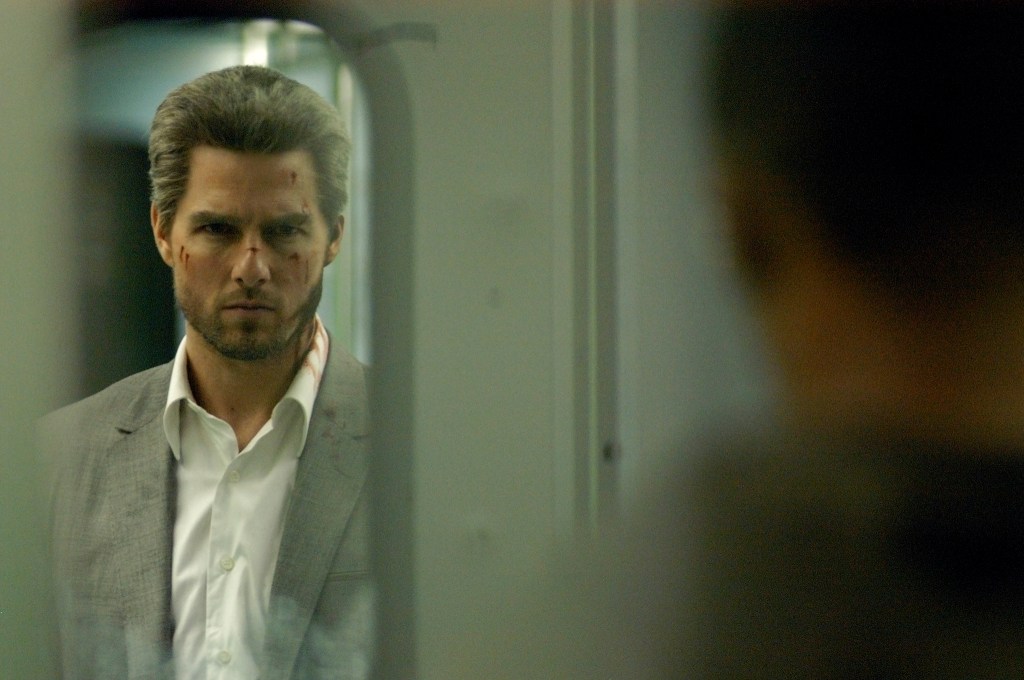
3. Collateral (2004)
Collateral
Two guys in a car, strangers to each other, both operating on a routine, a structure that they rarely break from, moving as one through the luminous L.A. night but to different ends.
Collateral is a wonderous neo-noir that pivots two men with differing moral compasses against each other: Max (Jamie Foxx), a slave to his inhibition, to his failure to act and make a difference to his life; and Vincent (Tom Cruise), a man untethered, a multi-faceted nihilistic hitman who gets in, gets out, and keeps moving forward.
Much has already been written on Collateral, from its vivid imagery to the rawness of its digitised look — at once enticing and haunting. Vincent poses a threat to Max’s idealised vision of tomorrow, but also an opportunity to start making things happen and not idle by.
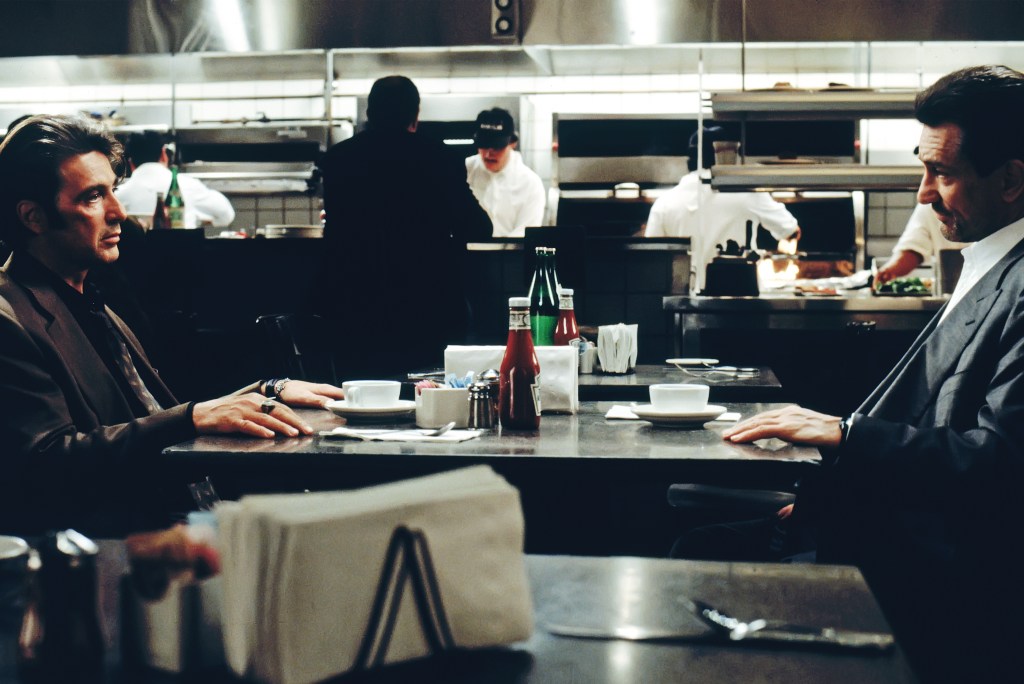
2. Heat (1995)
Heat
What does one even say about what, in the eyes of many, is Mann’s magnum-opus?
Heat is the sum of many parts, but it doesn’t work without its two key pieces: Al Pacino and Robert de Niro. The duo, reunited together on a feature for the first time (and for the first time ever in the same scene/s) since The Godfather Part II (1974), Pacino and de Niro are two sides of the same coin.
Vincent Hanna and Neil McCauley are like yin and yang — they don’t mix but they can’t function without one another. This speaks to Mann’s wider commentary on good vs evil, crime vs order which has been the focal point for 90% of his oeuvre. In Heat, Pacino and de Niro accentuate Mann’s fascination with these binary opposites to their full extent.
It’s as though these characters revel in the chase, of being the hunter and the prey, and they treat it like a drug that supersedes everything else in life. Mann brilliantly captures this through bright neon lights and the wider city which acts as its own sanctum that gives weight to the chase. Nothing is as beautiful as the city lights in a Mann film where cop cars race down the freeway in a storm of intensity.
But Heat is also made up of moments: the diner scene between Neil and Vincent is one of the greatest moments of character interaction in cinema history as these two men come face to face, pause the chase, and acknowledge each other; the downtown LA shootout where Mann shut down multiple blocks to shoot one of the most jaw-dropping scenes in any film ever; and the poignant finale where the two leads lock horns for the last time.
Without Heat, we may never have had The Dark Knight (2008), and that’s just one extra reason to watch this if you haven’t.
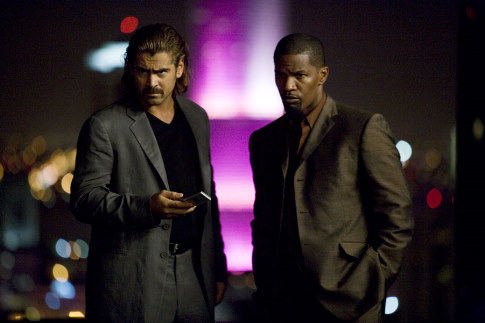
1. Miami Vice (2006)
Miami Vice
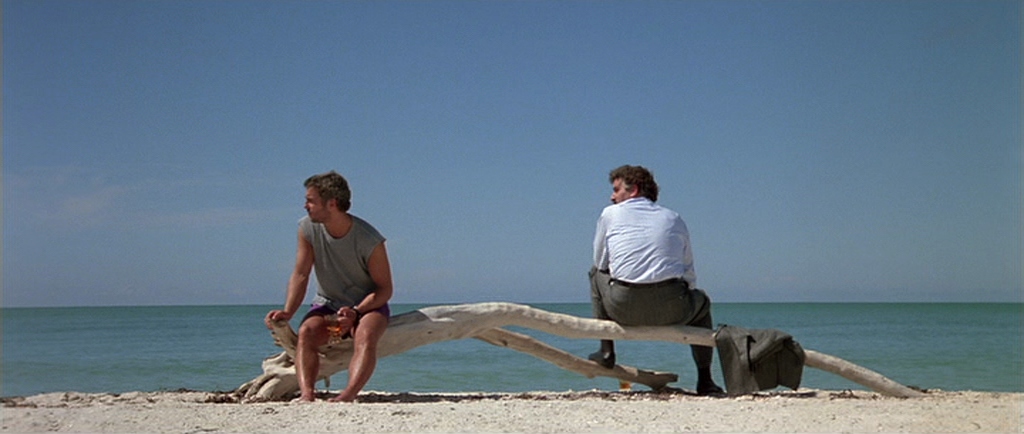
I’m sure Miami Vice is a top-three Mann on anyone’s ranking of his work, but this bustling neo-noir about two under-cover detectives goes beyond the 80s show of the same name to become a gripping tale of people accepting that they’re living on borrowed time and learning how to manage the time they have left.
On the surface, Miami Vice is a buddy-cop thriller about two detectives infiltrating an offshore drug operation where they act as the middle-man between the international supplier and the local Miami buyer. Their mission is to find out who the buyer is, but the deeper they find themselves in the operation, the more they realise they’ll never have an opportunity like this again.
Jamie Foxx and Colin Farrell are the two leads here and (while already the case with Foxx) they instantly fit the Mann-model of characters who don’t always play by the books, are good at what they do, and sometimes make rash, emotionally led decisions.
But it’s through Mann’s ability to capture the fleeting nature of life, the suddenness of a bust and the shootouts that ensue, where Miami Vice makes a case for his best film. There’s a dream-like tranquillity to the use of digital footage here that might just be the best example of creating evocative images in the digital format. From the bright hues of the nightlife and its clubs to the more intimate sensual moments, there’s a sense of liveliness and temporality mixed together in the film’s visual language.
Mann’s growing fascination with the commodification and expendability of the human body really started gaining momentum here as well. Whether it be in the film’s final shootout where bodies drop at a whim or the use of people as shields for getting what you want (drugs, cash, obedience), it’s an aspect of his films that really does speak to how precious those moments of human interaction are for his characters when they do have them.
So rarely will a group of people in a theatre howl with glee and terror in equal measure while watching a film, but that is the reaction that directing duo Daniel’s (Dan Kwan and Daniel Scheinert) newest feature Everything Everywhere All at Once elicits throughout its 144-minute runtime.
The film follows the Wang family, helmed by matriarch Evelyn (the legendary Michelle Yeoh), who is preparing for an audit from the IRS, full-time work in her struggling laundromat, Evelyn’s father Gong Gong (James Hong) arriving that morning from China, her husband Waymond (Ke Huy Quan) trying to give her divorce papers, and her daughter Joy (Stephanie Hsu) trying to get her mother to accept her girlfriend Becky (Tallie Medel). Everything is happening everywhere all at once for Evelyn, and this is all before the threat of the multiverse collapsing has entered their lives. Shock and extremity is the name of the game for Daniels so I won’t be spoiling any moment here as they would lessen the impact.
It would be so simple for Daniel’s to toss aside this opening act to get into the zany adventures in the centre of the film, but it is clear from the jump that the entire emotional weight is set up at the beginning and is allowed to mature over the runtime. This is what makes the great weird films like Back to the Future (1984) work for audiences, a clear goal and set of stakes for the story being told that is established in the opening 20-minutes, working as the firm ground to stand on as a hurricane of madness whirs around you for the rest of the film.
Those unfamiliar with the directing duo’s previous film Swiss Army Man (2016) will be taken aback by the pair’s slapstick and crude humour, as well as their frenetic pace between visually creative moments. Daniel’s crashed into the scene with their work in music videos – a common pathway for some of the industry’s best visual stylists (Michael Bay and David Fincher to name a few) – with the iconic Turn Down for What by DJ Snake and Lil Jon, one of the most-watched music videos ever. While it’s clear in their previous works the directing pair have filmmaking chops to spare, they achieve a greater scope and emotional weight in Everything Everywhere that matches with their visual creativity, a balancing act that is quite astounding.
Stephanie Hsu (left) as Joy, Michelle Yeoh (centre) as Evelyn, and Ke Huy Quan (right) as Waymond in Everything Everywhere All at Once
Floating along a constant stream of intertextuality, self-referentiality, and reverence to the films that paved the way to gift this film into audiences’ laps (The Matrix (1999), In The Mood for Love (2000), any Charlie Kaufman film), Everything Everywhere feels like a cinematic miracle that is at risk of breaking at any point. We’ve all made food (let’s say, a bagel) that we’ve overstuffed with nothing but things we enjoy eating, not realising until it’s too late that the meal has tipped over the edge into being inedible, or at the very least a meal spoilt by clashing ingredients. Like tastebuds, every person will respond to the film’s propulsive mania in different ways which are exciting, making the viewing experience with a packed audience all the more rewarding.
Everything Everywhere is a technical marvel of small budget filmmaking, from its mind-blowing costume and production design to its sound design and visual effects, but the real hero of the film is editor Paul Rogers. Rogers’ work here is nothing short of miraculous. Tasked with building a feverish momentum for over two hours while having each individual emotional moment land as impact-fully as each comedic or absurdist one. Rogers moulds the filmmaking duo’s creative madness into a deeply resonant and enjoyable film, not just another overly ambitious indie that feels more like a creative dare than a work of art with deep truths.
The film also wouldn’t work as well as it does without a perfect collection of onscreen talent that is all game for the absurdity being thrown at them. Whether it’s with IRS agent Jamie-Lee Curtis who is up for all manner of madness here and is having a blast, to Stephanie Hsu as Joy, who quickly becomes the emotional and narrative crux of the narrative, elevating an already entertaining film to transcendent levels. I am deeply looking forward to what else Hsu and Daniels can achieve together.
The film works similarly to the hyper pop genre in modern music. Both Everything Everywhere and hyper pop are mining pure emotion within the heart of excess and artifice. The movement is a direct response to the nihilism and despair of the 90s and 00s with artists like Charli XCX and the PC Music label paving the way. This form of hyper-aware, hyper-stylised emotive filmmaking operates just like a Charli XCX album; bouncing around multiple ideas with youthful energy, whilst never losing its heart and emotion. It is truly thrilling to see a similar approach made in cinema.
Some may call this film exhausting, and perhaps on a different day I may agree, so I can’t guarantee how you will feel until you witness what Daniels are doing here. But, I would stress to anyone who has seen the film and felt it exhausting, please see it again as your mood at the time you see this will heavily influence what you think of it, and it is definitely worth your time.
The Everything Everywhere All at Once is in theatres now.