The Odyssey is the Epic Christopher Nolan has been Working Towards his Entire Career

Rating: 4.5 out of 5.

The Odyssey Melbourne premiere screening provided by Universal Pictures

As one of the seminal works in literature, The Odyssey brought the mythical down to Earth, pitted gods against man and set the tone for the sort of storytelling we have seen ever since across various mediums. There have been numerous adaptations in film and TV, some focusing on key moments like Troy (2004) and The Return (2024) while others were more loose in their approach like O Brother, Where Art Thou (2000), but Christopher Nolan’s rendition stands on its own as a triumphant exercise in scale and possibility, breathing new life into a classic.

While scholars largely agree that The Odyssey was communicated orally before ever being written down anywhere, the question of whether Homer was ever actually one person or one part of a whole has always been a point of contention. What is unmistakable is that Nolan writes his version for the screen entirely in IMAX, a trailblazing feat for a director who has constantly worked to push the medium forward. His effort has seen a widespread ‘pilgrimage’ from devoted fans to locations that are showcasing the film in all its 70mm glory (one of which is here in Melbourne), and it’s worth every effort to see in that way.

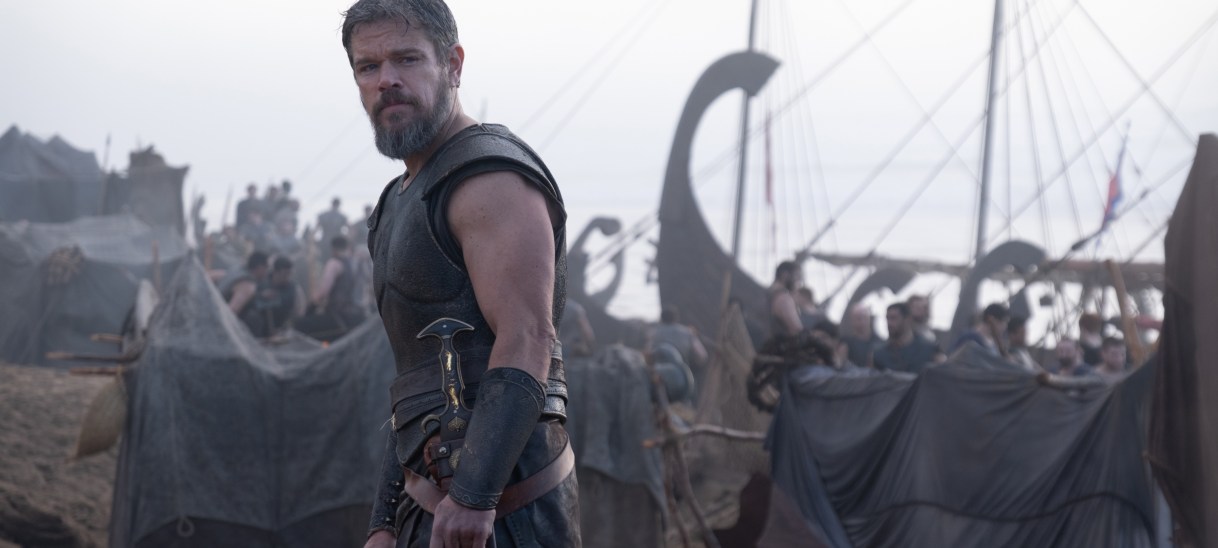
Nolan’s film finds a balance between the more contemplative moments of the novel and the sudden shifts in momentum as tension brews. Godly interactions are replaced with allusions to greater powers like the crash of thunder, flashbacks are used seamlessly to connect one moment to the next, and the film is underscored by layers of greed and regret that compliment rather than detract from the unfurling of events. After all, Nolan has always been interested in men who have self-destructive tendencies and carry grief, greed and regret within them which makes Odysseus (played expertly by Matt Damon) the perfect vessel from which to delve further into that thematic exploration.
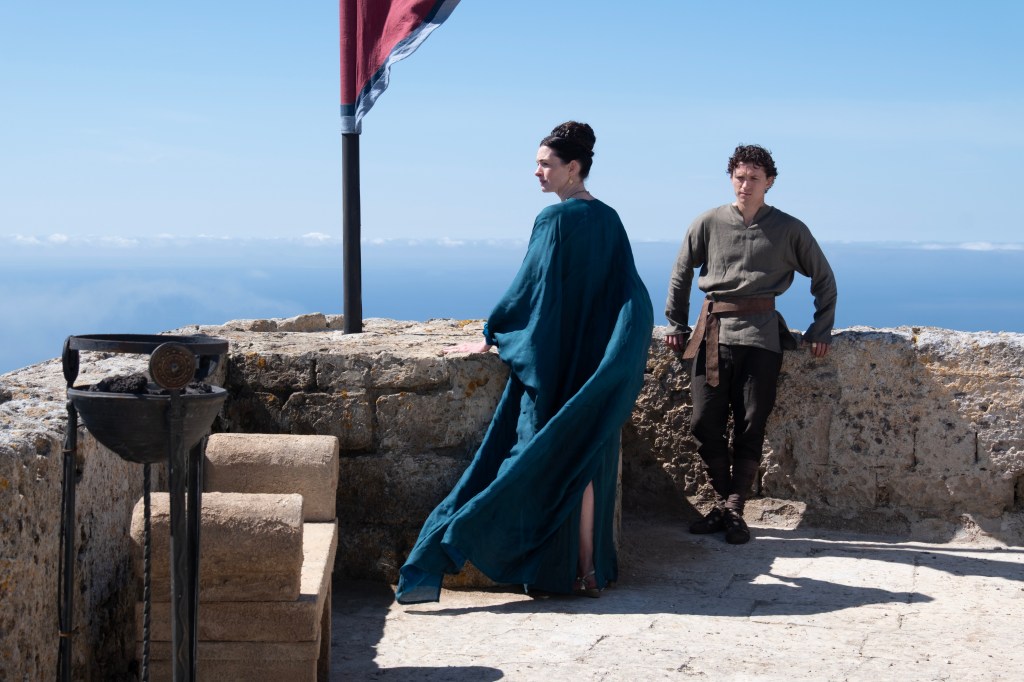
L to R: Anne Hathaway is Penelope and Tom Holland is Telemachus in The Odyssey, written, produced, and directed by Christopher Nolan.

Odysseus, like Oppenheimer, carries the weight of the world on his shoulders and people will live and die based on his actions; however, for Oppenheimer that weight threatened to destroy the world while for Odysseus, it threatens to destroy him. It’s why his journey from Ithaca to the beaches of Troy tickles Nolan’s fancy, a journey that is met by moments where the sacrifice of the few is in service of the collective whole. It leads to some of Nolan’s most haunting images of said greed, where the trials and tribulations from the novel bring into question what is morally right (like burying dead warriors) versus what is necessary (escaping and surviving).

It does take a good 30 or so minutes to actually get the ball rolling, as establishing an epic of this scale with so many potential directions to springboard from is no easy ask. This is especially the case as Nolan works to figure out how to get Telemachus (Tom Holland) out of Ithaca and away from the suitors like Antinous (Robert Pattinson) courting his mother Penelope (Anne Hathaway) while bringing Odysseus into the picture as soon as possible.

The Odyssey isn’t a complex story, but finding a way to navigate the presence of gods which so crucially inform every cause and effect chain in the story, is a challenge, especially since Nolan’s approach usually involves crashing non-chronological moments into each other like oars against rocks. His approach here is a bit more considered and surprisingly seamless though, as flashbacks do a lot of heavy lifting, cutting from the past to the present; from Calypso’s (Charlize Theron) gradual unlocking of Odysseus’ memory to Telemachus hearing the stories of his father’s journey from those who battled with him like Menelaus (Jon Bernthal). The key moment the flashbacks come back to, and the part of The Odyssey that even those who haven’t read it will be most familiar with, is the Trojan horse infiltrating Troy. This is the nucleus that bridges the rest of the film together, showing the path that Odysseus and his men took that ultimately led him to his predicament.
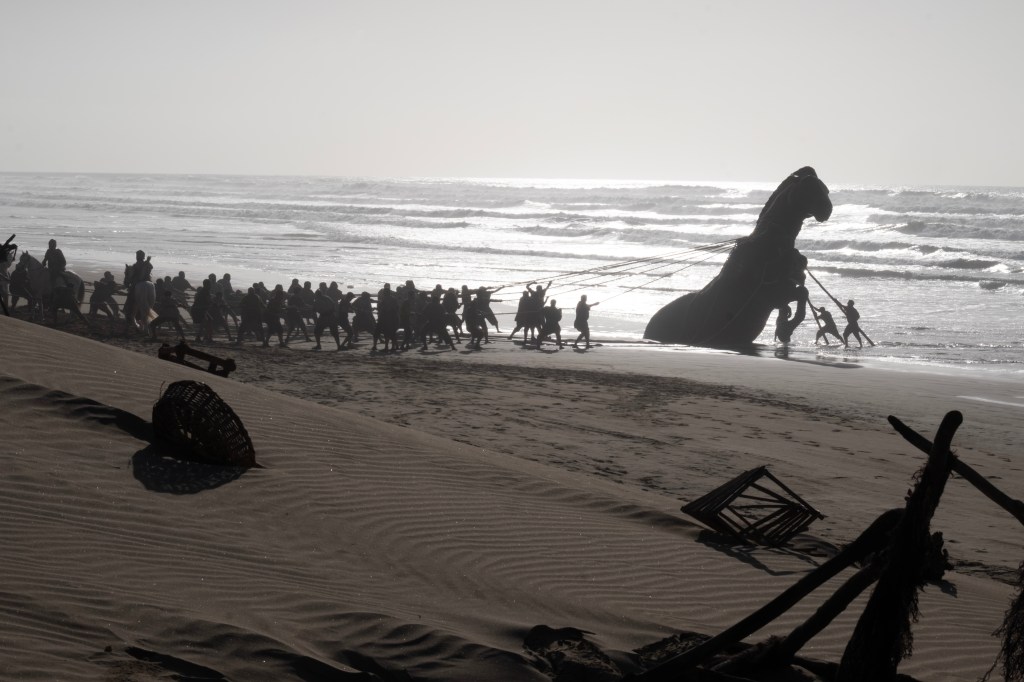
The Odyssey, written, produced, and directed by Christopher Nolan.

This path leads them from encounters with creatures like a cyclops that was physically built to tower over the actors, to a forest of giants in armour that equally tower like the Mountain from Game of Thrones, and an encounter with the dead men in ‘hell’ where ice and fire meet. A particular highlight occurs with Circe (Samantha Morton), a witch who conjures dark magic to usurp her victims. Without spoilng too much, her presence (along with that of the aforementioned creatures) almost evokes an element of horror that is reminiscent of Sam Raimi’s little horror moments throughout his Spider-Man films, and makes a strong case for a Nolan horror film at some point. The visual effects of these encounters are used sparingly, giving the film its mythical edge without overwhelming the meditative, ponderous tone that Nolan is going for.

These encounters leave Odysseus a wreck just like his ship was for the greed his men showed when they went against the wisdom that he granted them, falling victim to their own desires and demise, and Odysseus, to his self-reckoning. Matt Damon’s performance is enchanting and really crucial in buying into Odysseus’ emotional plight; he commands the screen and, especially in the film’s closing stages, brings an awe to the character that I can best compare to the first time you see Luke Skywalker take his hood off at the end of Star Wars: The Force Awakens (2015). The supporting cast are just as crucial, with Robert Pattinson playing the part of a nuisance you can’t wait to see killed, with a grace that has characterised his career, and John Leguizamo grounding the scenes back at Ithaca as the watchful Eumaeus.

The Odyssey is ultimately about one man’s journey home, charting his rise and fall from different vantage points all the while giving an otherworldly and godly feel to his presence without ever having to spell out and showcase the actual gods and their moments of intervention. Propelled forward by a rapturous score from Ludwig Göransson, one that holds tension as it pounds in synths and drumbeats that have the aura of battle about them and is supported by a hefty, transportative soundscape, as well as strong performances across the deck, Nolan’s film has the wonder of Lawrence of Arabia (1962) and the transcendent look of Denis Villeneuve’s Dune films. It is unequivocally Nolan’s film though, with the result being a measured, meditative look at the cost of triumph, the bodies it leaves in its wake, and the weight of decisions that stick with us long after we have made them.

The Odyssey opens nationally from today.
Oppenheimer: Christopher Nolan Casts some Light on the Darkness Covering the Atomic Bomb’s Father

Rating: 3.5 out of 5.

While J. Robert Oppenheimer’s name might be synonymous with the deadliest device ever created, Christopher Nolan’s latest three hour biopic, Oppenheimer, looks at the man behind the atomic bomb through a much more introspective lens without ever insinuating that audiences should feel a sense of sympathy for his brilliant mistake/s. Of course, introspection is a key building block to any biopic, but given Nolan’s ouevre hasn’t ever focused on a historical figure of this magnitude —or any historical figure in this sense which still isn’t as big a shock as not casting Michael Caine—, there’s understandably a greater interest surrounding this biopic if not for the simple fact that it’s a Nolan film, then definitely because its subject is one of the most infamous, and misunderstood, scientific minds ever.

That Oppenheimer was a brilliant theoretical physicist who was the victim of his own belief that man could be trusted with forces larger than them, is undeniable. But Nolan’s film isn’t just concerned with the cookie-cutter facts that you can pull from a Wikipedia page. While the film is based on 2005’s Pulitzer winning novel, ‘American Prometheus’, Nolan’s interest jumps from the key, often glossed over moments in Oppenheimer’s life, and interrogates them more carefully.

Nolan’s Oppenheimer (a perfectly cast Cillian Murphy) is a man struggling to be faithful, who is always in his mind, viewing every next move like an equation on a chalkboard. His relationship to theory stretches into his everyday life as he struggles to maintain meaningful relationships, always approaching life by the numbers and relegating himself to a disconnected observer as opposed to a practical artisan. At one point he is in disbelief that scientists overseas have figured out how to split atoms from each other (or something to that effect), stating that it’s not possible from a theoretical point of view (POV), and it’s through this sort of mould that he carves his Oppenheimer from — a man unlike those around him, an outlier.

In this way, he isn’t too different from other Nolan characters like Bruce Wayne or Joseph Cooper in that he’s committed to what he knows, and does what he must for the greater good. His distant persona also affects his ability to build sustainable relationships, often pin-balling across various lovers and failing to forge a life beyond his commitment to his craft as exacerbated by a scene where he offers his crying baby to his friends as he doesn’t have the time to look after it (a selfish move he recognises).

Early in the film he’s encouraged to pursue his interest in theory and master it, and this is the point in his life that Nolan opts to introduce us to. And it’s in the early stages of the film that Nolan really portrays the internal struggle that will go on to plague Oppenheimer in the film’s later stages. He cleverly uses hazy, almost dreamlike visual motifs that equally look like beautiful stars and bomb fragments. These moments are some of the most thought-provoking as they provide a real deviation from the coolness and level head of Cillian Murphy’s performance that makes the character difficult to read — as though he’s got everything under his hat and under control.

It helps that multiple POV’s are being deployed by Nolan here in what is probably the most un-Nolan-esque part of this movie. Not only is Oppenheimer’s view of the world on display, but that of his early ‘affiliate’, Lewis Strauss (Robert Downey Jr. at his brilliant best). This duality helps build tension and allows the events of the third act to come together more tightly than might otherwise have been possible. Frequent Nolan cinematographer, Hoyte van Hoytema, shoots in colour for Oppenheimer and black and white for Strauss, further helping create this sense of separation through subjectivity and objectivity, ultimately adding to Oppenheimer’s unknowability and the difference in views that the two characters have. Whether or not this approach works in its entirety is difficult to tell from a first viewing, especially since it does tie events together, but equally throws one out of rhythm from time to time with the various timelines intersecting.

Robert Downey Jr is Lewis Strauss in OPPENHEIMER, written, produced, and directed by Christopher Nolan.

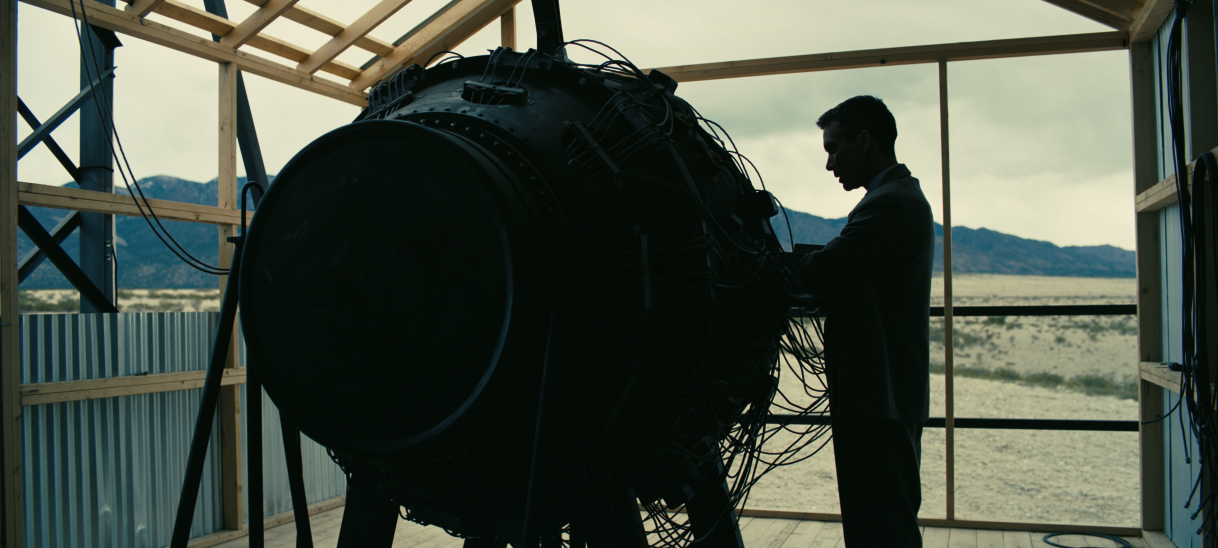
The most jarring instance of rhythmic intrusion is also the film’s best for the very fact that it’s the most speechless moment in the film. If you’ve followed the marketing, the controlled atomic set-piece (atomic in its own right) is where the full force of seeing this 70mm beast in IMAX really sells itself. By this point a lot of the establishing from the first half —namely around the politics of the Manhattan Project and the scientific lingo that will fly over most people’s heads— has been rounded off and Nolan finally gets to play with his own toys by unleashing the mother of all bombs, creating a spectacle that almost transports you to the New Mexico desert with the characters. It is really the punchline of the film, rewarding your patience by drowning out all of the noise in its countdown and the ensuing blast.

Whether or not Oppenheimer is the sort of Nolan film audiences are eager for is tough to say; there’s no tricky logic that fans of Interstellar (2014) or Inception (2010) wouldn’t wrap their heads around, but the film also sees Nolan at his rawest and most cynical, choosing to show a world destined to implode on itself just as it’s beginning to take shape. While The Dark Knight (2008) followed a similar path, there was at least the knowledge that its commentary was so distant from reality rather than a part of it. Yet in a film full of so many competing elements whether it’s the performances, the dialogue (which has has never really been the sweet-spot in a Nolan film as much as the moments around it are), the rapturous score from Ludwig Göransson, the staging of the key set piece or even the candidness of the story, there’s no doubt that like Oppenheimer, Nolan was all in on going big, and the final result is one that will stick with many long after the end credits roll by.

This post was originally published on SYN

Oppenheimer is in theatres now