F1: Brad Pitt Plays a Past-His-Prime Prodigy in Joseph Kosinski’s Adrenaline Filled Follow-Up to Top Gun: Maverick

Rating: 3.5 out of 5.

F1 preview screening provided by Universal Pictures

Swapping the skies for the circuit, Joseph Kosinski’s F1 (2025) is a speedy, four wheeled follow up to his box office smash, Top Gun: Maverick (2022). While I’m not an F1 fanatic, there’s no doubt that the exhilaration of a race with cars that push past 300km/h is an adrenaline rush for those that love that sport, and especially for the drivers behind the wheel. But what happens when you peel back the veneer that is the glitz and glamour of podium finishes, and begin to look at the gruelling process that pit crews and drivers alike go through in the lead up to a race? Well, Kosiniski understood the assignment and has created a punchy drama that both tackles that question, and is rife with everything from technical language about racing, to the fall and rise of a prodigy.

In many ways, F1 feels like a spiritual successor to Maverick in that it traces the life of someone who was young and reckless, but is now more of a “has been” who is giving it one last crack against the new stars. On paper, Kosiniski’s film feels like it was very much geared towards casting Tom Cruise and continuing to put him in the cockpit of these lightning fast death machines, but with the Mission Impossible films taking up the majority of his focus, another aging yet still youthful star had to step in.

Cue Brad Pitt. Once you’ve seen this film, it’s easy to say that it’s hard to imagine anyone else playing this role other than Pitt, but Pitt makes the character of Sonny Hayes wholly his own that it’s really, truly impossible to imagine even Cruise in his position. There’s a boyish cockiness that Pitt translates so well to the screen, and it’s no different here as he carries himself with the same reckless edge he’s delivered time and time again. And it serves the premise perfectly: a former racing prodigy who is living in his van and sporadically competing in races is given the keys to the kingdom that is F1 by his former racing competitor-friend-turned-F1-owner, as a hail mary to pull them out of the rut they’re in.

Brad Pitt as Sonny Hayes in F1 (2025)

You might be thinking: this sounds like every movie that has an ageing star who continues to try and compete at the highest level. While you might be right to a degree, on paper F1 isn’t remarkable as a fresh character study, but where it falters in storytelling it makes up for with fast paced action and a desire to authentically capture the F1 scene. Kosinski and frequent cinematographer Claudio Miranda’s work on getting the claustrophobic, tight spacing of fighter jets right in Maverick has helped them capture the same feeling of being in an F1 car; combine that with Hans Zimmer’s pulsating, punchy score, and the film has a video game simulator feel — keeping you at once on the edge of your seat and as though you’re there with Sonny.

Key to trying to give the film a little more egde beyond the generic script by Ehren Kruger is the addition of a young rookie, Josh Pearce (Damson Idris), who naturally takes the lead for the team, with Sonny serving more to amplify his movements on the track. Their dynamic helps shift the gears and keep the film from just being like every other racing film you may have seen. For one, Sonny doesn’t settle for second best and pushes Josh to be his competitor on the track so as to not have him be complacent and expecting everything will be handed to him. This push and pull between the two is like a passing of a baton but only if that baton was on a rope and it had to be caught first.

That’s all to say that F1, while a stellar showcase of zippy cinematography and snappy editing, derives its most heartfelt moments (even if the rest of the story is rather cookie-cutter) through Sonny’s redemption arc as he takes his track knowledge and turns it into a method for madness. What’s even more impressive is just how close to the real thing Kosinski has kept proceedings, with real-life racers like Max Verstappen and Lewis Hamilton cropping up (the latter being a producer as well who was involved with the project before Brad Pitt!). There’s a level of verisimilitude that the film is striving to capture, sometimes to the detriment of the wider drama that’s captured so well by films like Ferrari (2023) and Ford v Ferrari (2019), but often it nails this approach mainly because of how close each aspect of production is to the real thing, and with this approach Kosinski has clearly found himself a formula for success.

F1 opens nationally from the June 26.

Babylon Is A Frenetic Fable on Silent-Era Hollywood

Rating: 3.5 out of 5.

The only story more common in Hollywood than a film about filmmaking is an award-winning director cashing in a blank check to make a dream project they may never get the chance to do again. Babylon (2022), the new film by Oscar-winning director Damien Chazelle, is an all-in movie for a filmmaker who knows the opportunity to make a big-budget, silent-era Hollywood romp with A-list stars will not come around again. We should be grateful the prodigious filmmaker chose to use seemingly every ounce of industry capital he had to get this oddball movie made, as even if the film isn’t great, there are enough transcendent moments, particularly early on, that makes it a ride worth taking. 

Inside this whirlwind of frenetic Hollywood excess is a group of artists striving for their place in the moviemaking circus as it begins to transition from the silent era into the talkies. These include the star-to-be Nellie LaRoy (pitched to eleven Margot Robbie); a hustling upstart looking for his place in the movies and true heart of the film, Manuel Torres (Diego Calva); and ageing star with a waning grip on the top, Jack Conrad (Brad Pitt); including a suite of other terrific performers in this frenetic tragicomedy that you won’t soon forget.

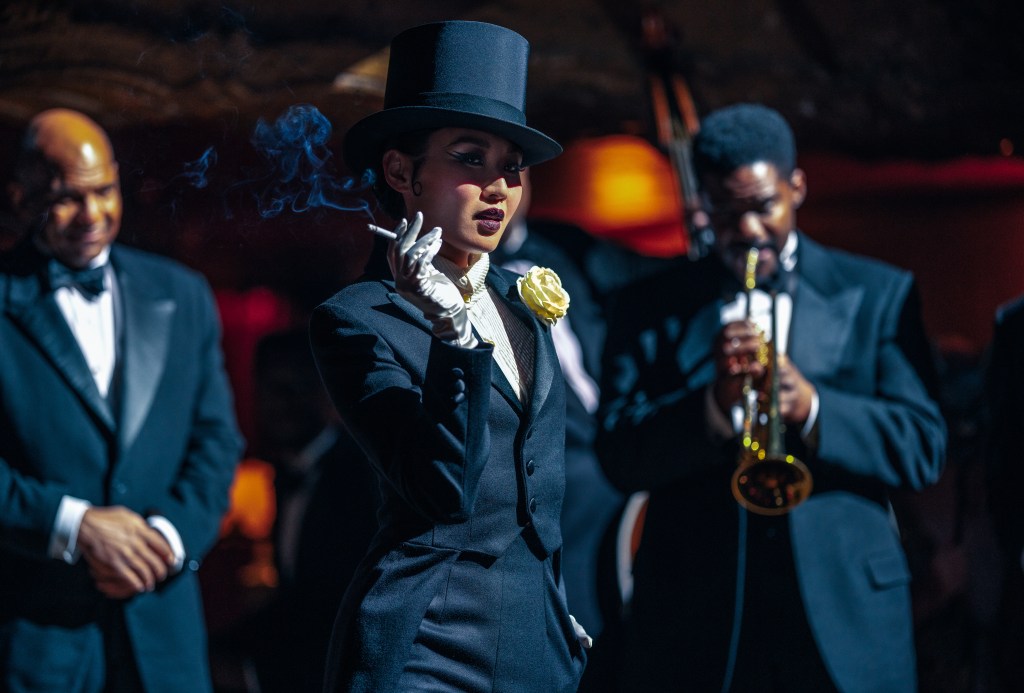
Calva is wonderful in the film and a true revelation, but the standouts for the film are Li Jun Li and Jovan Adepo, who play singer and artist Lady Fay Zhu and jazz trumpeter Sidney Palmer respectively. Both characters are great in limited time, but even in a film of this width, their stories are sidelined too easily. There are essentially four films worth of story in Babylon, from Manny and Nellie’s rise, to Palmer’s rise in the industry that does not value him, to Lady Fay’s weaving through a constantly changing industry without the recognition she deserves, to finally Jack Conrad’s slow decline from the heights of stardom into irrelevancy. All these dense stories deserve more time than they are given, sidelined in favour of ambitious dalliances into the debauchery of the industry Chazelle seems so persistent to explore.

Li Jun Li plays Lady Fay Zhu and Jovan Adepo (back right) plays Sidney Palmer in Babylon from Paramount Pictures.

Surprisingly, given the long runtime, Babylon is stretched thin by its wide array of storylines. Jack’s story rarely interweaves with Nelly and Manuel’s, making them feel isolated. Chazelle’s previous films, Whiplash (2014) and La La Land (2016) work emotionally as two-handers between the leads, whilst here the key characters are oftentimes isolated from each other, striving for their own ambitious goals alone in a chaotic world. This is clearly by design, as Jack’s declining trajectory works alongside his divergence from the young upstarts who are looking to take over the budding talkies boom, but the film ultimately falters because of it.

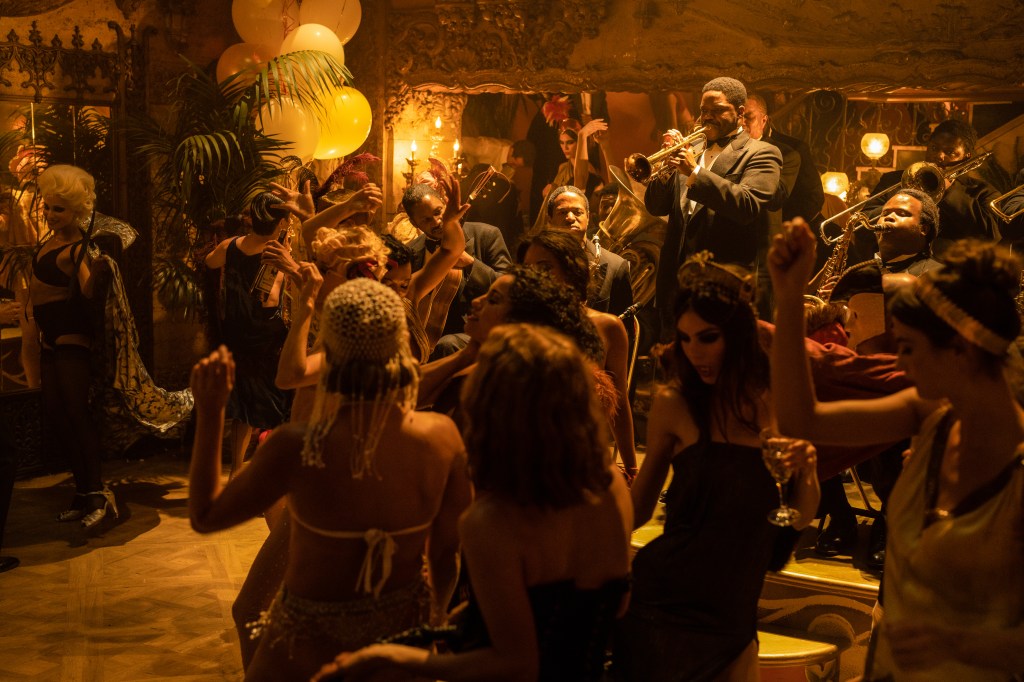
Where Babylon never falters is in the deliriously bombastic score from Justin Hurwitz, which will no doubt pick him up another Oscar. This may be his crowning achievement as a film composer as Chazelle allows him room to dominate. Full of bombastic horns and drums that propel us into each scene with boundless energy, Hurwitz is the shining light in an uneven film with easily the year’s best score.

A surprisingly dark film visually, with Chazelle and cinematographer Linus Sandgren opting for a more natural use of lighting which heightens the dynamic contrast between the debaucherous night sequences and the bright daylight where the work gets done. This is most effective through the opening two sequences from the coke-fuelled bacchanalia prologue into the extended scene of manic moviemaking. It is clear this is where Chazelle finds himself most comfortable and where Babylon truly shines. Watching Manuel organise a mass of skid row extras for Jack’s war film or Nellie’s first day on set is electric, set to Hurwitz’s bombastic score, all within the ticking clock structure of the single day shoot, is one of the best sequences of the year. While I am always in favour of directors taking big ambitious swings when given the opportunity, there is a tinge of sadness that Chazelle moves away from these high points later in the film. 

Jovan Adepo plays Sidney Palmer in Babylon from Paramount Pictures.

Chazelle has always been a filmmaker who wears his influences on his sleeve, which has been felt in the past, with Whiplash and of course La La Land, like a prodigious young filmmaker attempting to brush shoulders with both modern and canonical directors simultaneously. Here, the Oscar-winning director is working to rewrite the legendary Singin in the Rain (1952) as a tragicomedy structured somewhere between Scorsese classics Goodfellas (1990) and The Wolf of Wall Street (2013), or Paul Thomas Anderson’s braggadocio Hollywood epic Boogie Nights (1997). This is a lofty goal that is certainly appreciated, even if it doesn’t hit the mark consistently.

By wielding PTA as a key inspirational pole instead of the Boogie Nights director’s idol Robert Altman, Chazelle is playing a game of telephone with this style of film, ending up with a story with smoothed-over edges. Scenes of freneticism are shown cleanly, never feeling dangerous to the audience or its key players. Nellie and Manuel glide through manic scenes as smoothly as Sandgren’s graceful camera, creating a certain inevitability to their landing point that while interesting as a decision, ultimately flattens most defining sequences.

There are thematic depths to mine in Babylon, but they feel oftentimes short-changed in favour of larger set pieces. Manuel’s narrative of assimilation and identity is compelling and the most consistent thread being pulled throughout this 188-minute cinematic feast. We follow this immigrant story of a man who must essentially remove his nationality in pursuit of his ambitions within a rigid Hollywood system. Total annihilation of personhood for your art is something that clearly compels Chazelle as it is a key driver for his characters across his filmography, but it is here with Manuel that these themes truly land. We see him transform throughout the film, shifting into whiter clothing, changing his name to Manny more diligently, and even telling producers that he is Spanish, all in the hope that it gets him closer to his goal.

Margot Robbie plays Nellie LaRoy and Diego Calva plays Manny Torres in Babylon from Paramount Pictures.

What separates PTA’s writing from Chazelle’s is ultimately what is lacking in a garish epic like Babylon: romanticism towards its characters. This does not mean fawning over them but treating them with respect and humanity that allows us to connect with them. Chazelle too often uses his characters as vessels for obsession and ambition in a primordial sense, making them kinetic and engaging, but rarely emotionally involving. The most personal moment of the whole film is wedged between its two great opening set pieces, as we see the modest living arrangements of Nellie and Lady Fay after seeing them command the attention of the lavish Hollywood party through their powerful charisma.

Chazelle has made a career of crafting sequences with wide dynamics, thrilling highs hard cut into crushing lows that usually work wonders like in Whiplash and La La Land. Unfortunately, adding to its issues with being stretched thin, these dynamics end up compressing the emotionality into dust.

The anguish-laden death march that consumes much of the second half sucks all air and exhilaration from the theatre, so the film is unable to coast off his own momentum as it languishes to its finale. This total fever dream opening into a death spiral has been done to great effect before (Boogie Nights and Goodfellas), but in Babylon the work on characters is less involved on a human level so the feeling is widely cheapened.

Ultimately, Babylon feels like a terrarium of meticulous detail about a revered moment in Hollywood history, with the edges sanded down to create a smooth glass dome. Even its finale, which is attempting a Godard-esque swing for the fences, feels strained. Authenticity was not the predominant goal of the film (this is not 2009’s The Artist but with coke), but somewhere along the way, the heart of the film was sidelined in terms of gawking ambitious set pieces. There are incredible sequences here that will be burned into my retinas to the tune of blaring trumpets, but you may not feel anything at the end.

Babylon is in select theatres now.