Thunderbolts* is the Best Post-Endgame Marvel Film

Rating: 3.5 out of 5.

Marketed with a keen focus on its crew’s previous work with the production company de jour A24, Marvel’s attempted rebound back into the public consciousness has arrived in the Florence Pugh led Thunderbolts* (2025). The film is emotional and built from the inside out with a commitment to its characters, a collection of misfit Marvel characters played by an incredible cast of emerging talents that shows when the call is made, they will deliver.

Much like an aggressive chiropractic session, the Marvel project desperately needed realignment, no matter the clunkiness to achieve it. By bringing in emerging creatives to develop a more personal character story — what used to be the MCU’s calling card in the early years — Thunderbolts* arrives fashionably late to a series in need of rescue. While modest in its pursuits (for a blockbuster feature), Thunderbolts* is built off the back of two terrific performances in Pugh as Helena and Lewis Pullman as Bob. Their chemistry stems from the characters’ visible mental health struggles that long for meaning and connection in a world devoid of both, a difficult idea to place front and centre in a film with multiple car flips.

After a haphazard and almost impressively uninspired handover film Captain America: A Brave New World (2025), Marvel’s loaded release schedule picks back up with a darker, sharper, and wittier ensemble film that stands on its own feet before the navel-gazing returns with a new Fantastic Four and Avengers films in the next 12 months.
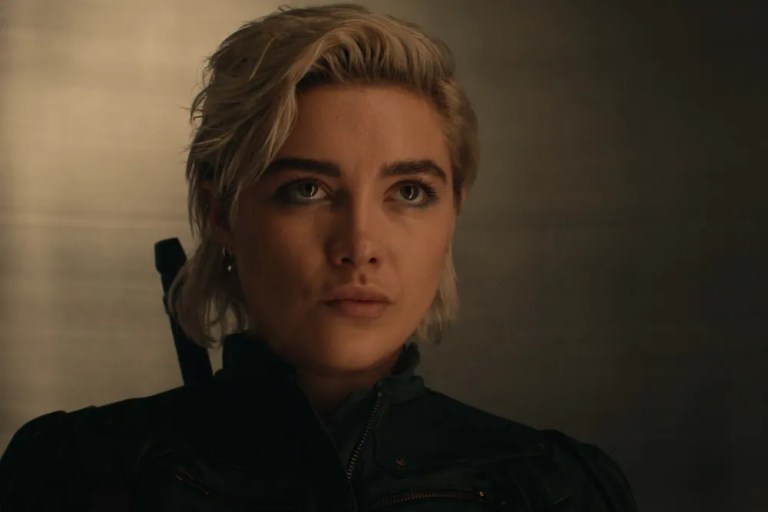
Florence Pugh in Thunderbolts*.

Beef’s (2024) Jake Schreier, alongside many of his collaborators on the acclaimed series, puts character above all in a seemingly obvious pivot away from the plug-and-play style of most post-Endgame MCU films that has put the company on the brink.

Never undercutting its emotional weight with a cheap joke in the same sentence, screenwriters Eric Pearson and Joanna Calo keep their characters, in particular Yelena (a tremendous Florence Pugh), on clearly defined and recognisable tracks. Even as one of the world’s best assassin’s, Yelena’s mental health struggles and ennui is expressed with a profound clarity that underscores the entire film.

By taking their story of literalising mental health struggles to a fulfilling breaking point, Thunderbolts* shows what can be achieved in the best comic book stories by reflecting these superpowered people’s humanity out into the world. Thunderbolts* elicits an unusual feeling: nostalgia for the early entrants in the Marvel cinematic project. Slimmed down to bare essentials with an antagonist that reflects the interior conflicts of our soon-to-be heroes, the film knows the power it holds with its outstanding cast and when to cede ground to their talents.

Sebastian Stan in Thunderbolts*.

From the outset, the score out of electronic trio Son Lux stands apart from the swathe of superhero cinema. In many critical scenes, their emotional intelligence shines through, giving the story of depression and reconciliation a clarity of vision that easily could’ve fallen through our hands like sand. The acoustic and electronic work sustains an unexpected grace that should be applauded.

With an eventual villain in The Sentry that embodies the call of the void itself, Thunderbolts* excels in grounding every element of its story within its characters. Much like Tony Stark being forced to reckon with his role in war profiteering to survive, Yelena must contend with her depression and learn to live alongside it.

The film excels in its modesty, even if it sets a pivotal confrontation in the old Avengers tower (baby steps!). Thunderbolts* uses a potent mix of humour and contemporary emotional turmoil to place itself a tier above the durge of action cinema that doesn’t even arrive at the boilerplate. While striving to be remembered as more than a footnote on the way to back-to-back billion-dollar cheques, Schreier’s film places potent themes of loneliness and emptiness at the forefront of a superhero story that separates itself from the studio’s recent shortfalls.

Thunderbolts* is in theatres now.

Dune: Part Two: A Sequel Worthy of Joining the Mount Rushmore of Sci-Fi Blockbusters

Rating: 4.5 out of 5.

Dune: Part Two preview screening provided by Universal Pictures

Few working directors have the capacity to deliver such audacious tentpole features like George Lucas and Sir Peter Jackson, and even fewer are able to do so authentically while ensuring that the end result is nothing short of spectacular. But that’s exactly what Denis Villeneuve has done with Dune: Part Two, his sequel to 2021’s Oscar winning Dune: Part One.

To call Dune: Part Two anything other than a generation defining Sci-Fi would be to undersell just how monumental an achievement the director has on his hands. Where Part One focused more on methodical world-building and planting the narrative seeds of Frank Herbert’s iconic novel (some might say in a much more trimmed down, thin fashion than expected), Part Two is all about scale and upping the ante.

And it picks up almost immediately after the first film, where Paul Atreides (Timothee Chalamet) has found his way to the Fremen and is working towards building their trust, learning to assimilate in their ways, and realising his potential as a Messiah. There is seemingly more pandering this time around, with the first film having the skeleton of what is sure to become a trilogy, established, but lacking that extra flesh for why we should care about these characters, the Kwisatz Haderach or any of the novel’s deeper lore.

The care for those aspects all starts with Paul though, with his plight becoming increasingly refined by screenwriters Villeneuve and Jon Spaihts, who inject more oomph into the script. Paul is much more nuanced here, having had to grow up faster than he would have liked, especially now that the Harkonnens have reoccupied Arrakis (or Dune) and are actively pursuing spice. In turn, time is of the essence for Paul and the Fremen, especially as the Harkonnens edge closer to their hidden locations.

(L-R JOSH BROLIN as Gurney Halleck and JAVIER BARDEM as Stilgar in Warner Bros. Pictures and Legendary Pictures’ action adventure “DUNE: PART TWO,” a Warner Bros. Pictures release. (PRESS KIT)

As a result the film places greater attention on the interplay between Paul and the Fremen. Fremen leader Stilgar (Javier Bardem) has become the guiding voice of reason who echoes the idea that the chosen one has arrived. He puts Paul through his paces via a series of trials that test out whether he truly lives up to all that was foretold. Whether that’s venturing out into the desert to overcome its harshness, battling the Harkonnens as they attempt to harvest spice, or riding a Shai-Hulud without guidance —there’s not shortage of incredible individual moments that both propel the narrative forward but also leave one in awe every time.

It’s in these moments that Part Two really shines and speaks to Villeneuve’s eye for detail and scale. It helps that the returning Greig Fraser (who won an Oscar for his cinematography for the first film) once again captures Dune’s deceptively beautiful vistas on a macro level, which allows that scale to shine through. Everything on Dune looks blown up in size which works to its advantage in creating this look of endlessness and enormity, a creative decision that speaks to the gravitas of the journey awaiting Paul. It’s all the more crystallised in the vibrancy of the desert colours, which further evoke that deceptive beauty of a world that will show you no mercy and swallow you whole.

For Paul, the only beauty that isn’t deceptive is that of young Fremen warrior, Chani (Zendaya). She helps him through his series of trials while continuing to hold her own as a character of interest that isn’t just sidelined to play second fiddle as a muse. Often she claps back against the popular opinion of Stilgar, and refuses to fall privy to what she sees as a cause that doesn’t exactly serve the interests of her people.

In fact, most of the female characters in Part Two play crucial roles in the film’s events, with Paul’s mother Jessica (Rebecca Ferguson) embracing her destiny as the Fremen’s Reverend Mother. Princess Irulan (Florence Pugh) has a much smaller part in proceedings as the Emperor’s (Christopher Walken) daughter, serving more as a springboard for the plot and entry point to its politics rather than anything else, which isn’t a problem per se.

A scene from Warner Bros. Pictures and Legendary Pictures’ action adventure “DUNE: PART TWO,” a Warner Bros. Pictures release.

On the flip side are the Harkonnens, with the Baron (Stellan Skarsgård) returning in his hauntingly enlarged state alongside his incompetent nephew Rabban (Dave Bautista) who is continually being outsmarted by the Fremen as he tries to gather spice on Arrakis. But it’s Austin Butler’s portrayal as the Baron’s nephew, Feyd-Rautha, that is a particular standout; he comes across across as both raw and subtle, at once menacingly distant yet eerily close.

When the Fremen do lock horns with the Harkonnens, the result is always jaw-dropping set pieces with well choreographed fights that are supported rather than supplanted by those unique visual effects. The battles are also much easier on the eye compared to a majority of recent blockbusters, in that the action is discernible rather than messy. To top it off, Hans Zimmer’s score is also complimentary rather than excessive, with his use of drums and sharp crescendos aptly suiting the various cultures and moments (I had literal goosebumps at moments as the soundscape reverberated through my seat and being).

If there was to be a shortcoming it would be that the closing sequence rounds off rather abruptly. At various points throughout the film I couldn’t help but wonder how Villeneuve would bring everything together as the finish line was becoming clearer and closer to the end. However, he had always said that this was a continuation rather than a direct sequel, and that aspect is felt, even though audiences might be left wondering by the end —with some threads left hanging.

That said, there are few directors who can create a spectacle at such a scale while leaving their own mark and remaining faithful to the source material. Dune: Part Two takes the best parts of the second half of Herbert’s novel —allegory and all— and serves them up in a digestible, refined and spectacular result that is reminiscent of some of the best sequels (or continuations) in cinema history.

Dune: Part Two opens nationally from the 29th of February.

Oppenheimer: Christopher Nolan Casts some Light on the Darkness Covering the Atomic Bomb’s Father

Rating: 3.5 out of 5.

While J. Robert Oppenheimer’s name might be synonymous with the deadliest device ever created, Christopher Nolan’s latest three hour biopic, Oppenheimer, looks at the man behind the atomic bomb through a much more introspective lens without ever insinuating that audiences should feel a sense of sympathy for his brilliant mistake/s. Of course, introspection is a key building block to any biopic, but given Nolan’s ouevre hasn’t ever focused on a historical figure of this magnitude —or any historical figure in this sense which still isn’t as big a shock as not casting Michael Caine—, there’s understandably a greater interest surrounding this biopic if not for the simple fact that it’s a Nolan film, then definitely because its subject is one of the most infamous, and misunderstood, scientific minds ever.

That Oppenheimer was a brilliant theoretical physicist who was the victim of his own belief that man could be trusted with forces larger than them, is undeniable. But Nolan’s film isn’t just concerned with the cookie-cutter facts that you can pull from a Wikipedia page. While the film is based on 2005’s Pulitzer winning novel, ‘American Prometheus’, Nolan’s interest jumps from the key, often glossed over moments in Oppenheimer’s life, and interrogates them more carefully.

Nolan’s Oppenheimer (a perfectly cast Cillian Murphy) is a man struggling to be faithful, who is always in his mind, viewing every next move like an equation on a chalkboard. His relationship to theory stretches into his everyday life as he struggles to maintain meaningful relationships, always approaching life by the numbers and relegating himself to a disconnected observer as opposed to a practical artisan. At one point he is in disbelief that scientists overseas have figured out how to split atoms from each other (or something to that effect), stating that it’s not possible from a theoretical point of view (POV), and it’s through this sort of mould that he carves his Oppenheimer from — a man unlike those around him, an outlier.

In this way, he isn’t too different from other Nolan characters like Bruce Wayne or Joseph Cooper in that he’s committed to what he knows, and does what he must for the greater good. His distant persona also affects his ability to build sustainable relationships, often pin-balling across various lovers and failing to forge a life beyond his commitment to his craft as exacerbated by a scene where he offers his crying baby to his friends as he doesn’t have the time to look after it (a selfish move he recognises).

Early in the film he’s encouraged to pursue his interest in theory and master it, and this is the point in his life that Nolan opts to introduce us to. And it’s in the early stages of the film that Nolan really portrays the internal struggle that will go on to plague Oppenheimer in the film’s later stages. He cleverly uses hazy, almost dreamlike visual motifs that equally look like beautiful stars and bomb fragments. These moments are some of the most thought-provoking as they provide a real deviation from the coolness and level head of Cillian Murphy’s performance that makes the character difficult to read — as though he’s got everything under his hat and under control.

It helps that multiple POV’s are being deployed by Nolan here in what is probably the most un-Nolan-esque part of this movie. Not only is Oppenheimer’s view of the world on display, but that of his early ‘affiliate’, Lewis Strauss (Robert Downey Jr. at his brilliant best). This duality helps build tension and allows the events of the third act to come together more tightly than might otherwise have been possible. Frequent Nolan cinematographer, Hoyte van Hoytema, shoots in colour for Oppenheimer and black and white for Strauss, further helping create this sense of separation through subjectivity and objectivity, ultimately adding to Oppenheimer’s unknowability and the difference in views that the two characters have. Whether or not this approach works in its entirety is difficult to tell from a first viewing, especially since it does tie events together, but equally throws one out of rhythm from time to time with the various timelines intersecting.

Robert Downey Jr is Lewis Strauss in OPPENHEIMER, written, produced, and directed by Christopher Nolan.

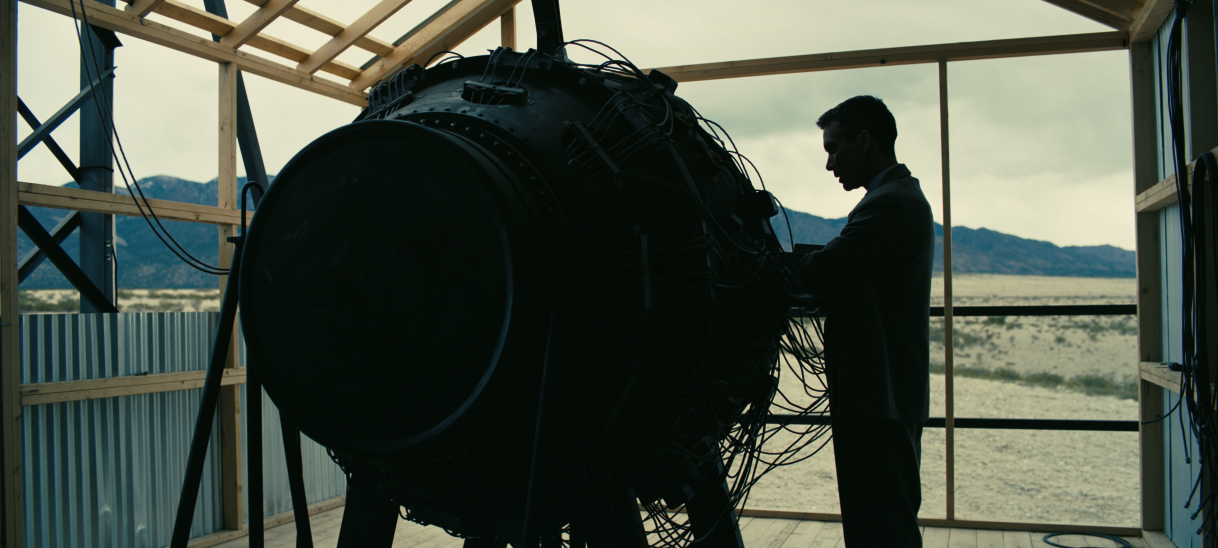
The most jarring instance of rhythmic intrusion is also the film’s best for the very fact that it’s the most speechless moment in the film. If you’ve followed the marketing, the controlled atomic set-piece (atomic in its own right) is where the full force of seeing this 70mm beast in IMAX really sells itself. By this point a lot of the establishing from the first half —namely around the politics of the Manhattan Project and the scientific lingo that will fly over most people’s heads— has been rounded off and Nolan finally gets to play with his own toys by unleashing the mother of all bombs, creating a spectacle that almost transports you to the New Mexico desert with the characters. It is really the punchline of the film, rewarding your patience by drowning out all of the noise in its countdown and the ensuing blast.

Whether or not Oppenheimer is the sort of Nolan film audiences are eager for is tough to say; there’s no tricky logic that fans of Interstellar (2014) or Inception (2010) wouldn’t wrap their heads around, but the film also sees Nolan at his rawest and most cynical, choosing to show a world destined to implode on itself just as it’s beginning to take shape. While The Dark Knight (2008) followed a similar path, there was at least the knowledge that its commentary was so distant from reality rather than a part of it. Yet in a film full of so many competing elements whether it’s the performances, the dialogue (which has has never really been the sweet-spot in a Nolan film as much as the moments around it are), the rapturous score from Ludwig Göransson, the staging of the key set piece or even the candidness of the story, there’s no doubt that like Oppenheimer, Nolan was all in on going big, and the final result is one that will stick with many long after the end credits roll by.

This post was originally published on SYN

Oppenheimer is in theatres now

Don’t Worry Darling is a Much Ado about Nothing

Rating: 1.5 out of 5.

Hollywood is littered with examples of filmmakers getting into relationships with an actor on set, causing friction with the rest of the production, as well as stoking a spectacle of drama and conflict that almost always overshadows the work. Most famous of this occurring was Ingrid Bergman’s affair with Roberto Russellini, which was unveiled just before the release of their film Stromboli (1950).

Don’t Worry Darling is the rare film where the situation involved a female director, with all the nuances that come with that difference. There will no doubt be tomes written about this production, but, for now, let’s simply discuss the text itself.

After the rapturous acclaim of 2019’s Booksmart, there was a bidding war for the follow-up feature of Olivia Wilde and screenwriter Katie Silberman, who have returned with one of the most confusing and underbaked films in years. Where their debut was an enjoyable yet frictionless teen comedy, Don’t Worry Darling is a big swing, period thriller that is after sweeping ideas on the modern world. Ideas that become exceedingly unclear the further away you get from the theatre.

Taking place in the 1950s, in a company town for the mysterious corporation Victory that is driven to create a new world, helmed by visionary Frank (Chris Pine), Don’t Worry Darling centres on young newlyweds Alice (Florence Pugh) and Jack (Harry Styles). The couple is very much in love and can barely keep their hands off each other. 

As Jack goes off to work (at the same time as the rest of the men on the street in one of many gorgeous sequences from cinematographer Matthew Libatique), Alice is left to clean and busy herself at home, which she seems content with. This seemingly ‘perfect’ life for Alice begins to come crashing down as she seeks to discover the town’s true nature and the work being done by Victory. 

Don’t Worry Darling is intended as a social thriller but is lacking any clear vision or identity in its story, which causes issues with the well-intentioned and well-executed design of the film. It forces its themes and motifs to become immediately literal. The idea of Alice’s world crashing down around her is shown with an unexplained tremor while she and Jack are in the kitchen in the very first scene. Not every film needs to be subtle and coy with its storytelling, but it’s a crucial element to the thrillers Don’t Worry Darling is cribbing from, so when you remove that element from the story, you better be doing it to heighten another aspect to make it an enjoyable experience.

Florence Pugh and Harry Styles in Don’t Worry Darling

The film is also doing itself a disservice by avoiding the story’s more thriller and horror aspects, which were crucial pillars in similar films like The Stepford Wives (1975) and Rosemary’s Baby (1967). The film has lazily been compared to Jordan Peele’s Get Out (2017) due to its socially conscious thriller nature, however, what allows Get Out to thrive as a piece of social commentary is how it fits within the structures of the genre, something Don’t Worry Darling is sorely lacking. 

Florence Pugh is doing the most with what the film offers, using her established skills at conveying palpable tension over the course of a film’s duration. Unfortunately, in contrast to Katharine Ross in Stepford Wives and Mia Farrow in Rosemary’s Baby, Pugh’s Alice is somehow always behind on what the audience knows, even when we are both unsure what’s going on. Perspective is usually the most important tool that is weaponised by filmmakers in these thrillers but is so muddled in this seemingly first-person narrative with Alice that the film becomes increasingly tiresome.

Pugh isn’t helped in the film by her partner in marriage, Jack, played by pop superstar Harry Styles. The pop star is a classic example of an arena-sized bundle of charisma and coiffed hair that is unable to translate into the film, offering nothing compelling in the crucial two-hander scenes he shares with Pugh. There is also a serious lack of chemistry between the pair which proves fatal in many of these romantic scenes. 

Some of the controversy surrounding the film has been about Shia LaBeouf’s role as Jack shifting over to Styles late in pre-production, which would’ve been equally as baffling a casting choice. That being said, with no hints towards spoilers, the final reveal makes the casting of Styles so utterly bizarre and only emphasises the baffling decision.

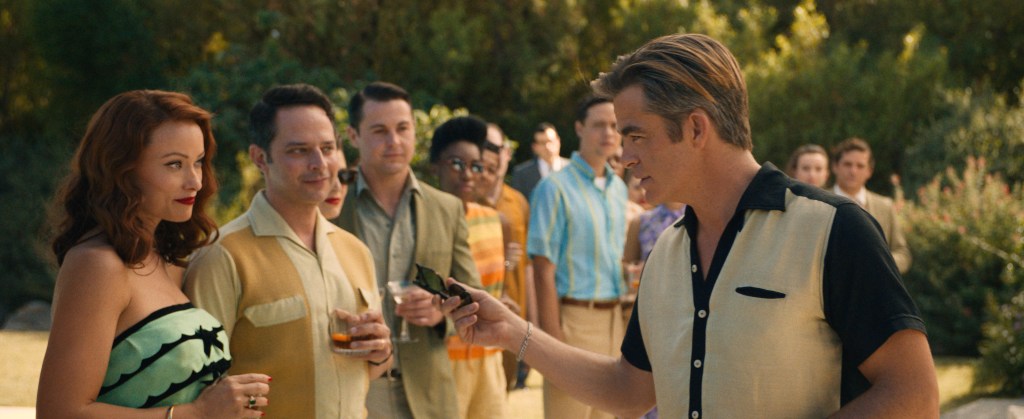
Olivia Wilde, Nick Kroll, and Chris Pine in Don’t Worry Darling

To Wilde’s credit, she has created a lush aesthetic with a suite of impressive visual flourishes with the help of Libatique and production designer Katie Byron, but it’s unfortunately always in service of a truly lacking script. There is much to like in the design of the film and will surely allow Wilde to take another bigger budget swing like this, hopefully with a tighter and more compelling story. 

However, Don’t Worry Darling is so smugly showing off its production design and recreation of 1950s America, instead of placing the story within its lavish designs. This is no better exemplified than in the opening minutes of the film where we are shown Alice’s hallucinations. No time is spent establishing the baseline world we find ourselves in before the film is trying to upend it. This would be an interesting decision if the film chose to do anything with the extra time afforded by speeding through the standard opening to most thrillers, but it doesn’t.

The film is caught up in its own withholding plot structures that never let the ideas ferment in any way. Everything feels surface level because to address the nature of the film would be giving the game away. It’s hard not to see the film in a similar way to M Night Shyamalan’s unsuccessful films like The Happening (2008) or 2015’s The Visit (although that movie has been reclaimed since release), but even that honestly feels like a compliment.

By withholding its reveal until the end, the film doesn’t allow itself to examine the implications of the world it has spent two hours crafting, preferring instead to leave the audience shocked. We are instead left confused by these decisions. In a film so heavy-handed in its choice of motifs (there is enough humming and circular imagery in this film to die from sigh-induced exhaustion), is it confounding how little air is given to its final revelations.

Don’t Worry Darling’s central issue is ultimately the striving to be a discourse movie for 2022, but without any modern ideas worth exploring. There isn’t anything new here that wasn’t explored in feminist texts 60 years ago (the film does not deserve the waves of feminist retaliatory think pieces it will stoke). This wasn’t an issue with the filmmaker’s previous film Booksmart, a low-stakes, fun teen comedy that was without friction, opting to always play it safe socially and politically. 

In Don’t Worry Darling, however, Wilde and Silberman are attempting to grasp at something outside their reach. One of the most exciting things Hollywood can do is give a large budget to give creatives the opportunity to take risks. Whether those risks land or not is up to audiences to decide. Don’t Worry Darling is a strange mix of massive risks and unfortunate turns to safety that will ultimately leave you somewhere in the flat, uninteresting middle.

Don’t Worry Darling is in theatres now.