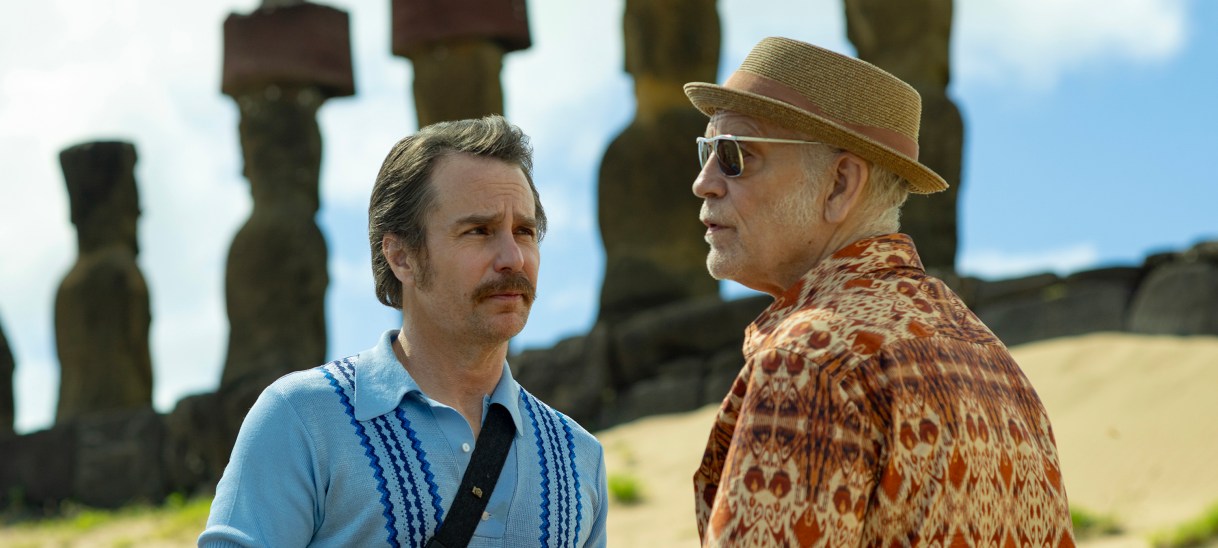
Wild Horse Nine is Vintage Martin McDonagh

Rating: 4 out of 5.

Wild Horse Nine preview screening provided by Disney.

Martin McDonagh is the king of quirky, irreverent two-handers, and with Wild Horse Nine (2026) he continues his famed tradition of pairing two elite actors — one with a testing, dry sense of humour and the other with a more logical way of thinking — together in a serene location, setting them loose and just letting them bring magic to his writing. That those actors are John Malkovich and Sam Rockwell is even more of a drawcard, with the former making you wonder why the hell it’s taken this long for McDonagh to bring him into his zany worlds and witty scripts, and the latter already a seasoned McDonagh veteran.

It’s really this pairing that makes every line of dialogue, every subtle cue and twist and turn, work. The premise isn’t a complicated one, as is tradition with a McDonagh joint: Chris (Malkovich) is dying and his memory is dwindling, and he wants his long time sidekick Lee (Rockwell) to whack him on Easter Island. It makes for a sandbox of comedic opportunity and colour, as Chris’ wish leaves a complicated web of events in its wake. For starters, he’s a CIA operative and has decided before he dies he wants to write (record) a memoir recounting his life, one which has seen him deliver some confidential tasks that his boss, MJ (Steve Buscemi) is really worried about him airing.

Like with In Bruges (2008) and The Banshees of Inisherin (2022), the setting in Wild Horse Nine is almost a character of its own, opening up moments for the characters to admire or gawk over, often making you forget that there are greater stakes to proceedings and focusing instead on the tourist-esque sightseeing going on. But stakes there are, with MJ constantly in Lee’s ear, checking to see if he has managed to do the deed yet, while hinting that he may harm his family if he doesn’t follow through on said deed.
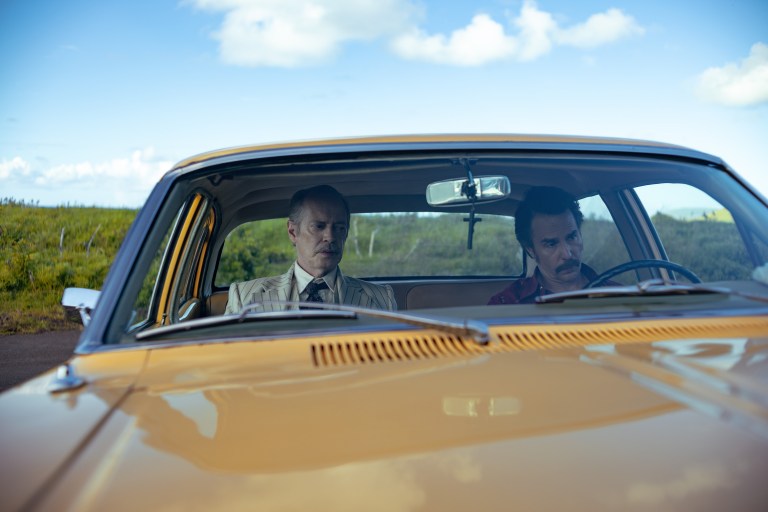
Steve Buscemi and Sam Rockwell in Wild Horse Nine

What ensues is a cleverly written and expertly delivered dark comedy, with Malkovich’s charisma and almost tepid manner of speaking leaving you hanging on to every word, bringing a level of melancholy and humour that is perfect for this genre of filmmaking. By that same token, Rockwell balances out Malkovich’s performance by having a soulful yet considered display of emotion, showing enough empathy while having a firm head all the same. In fact, no line of dialogue feels wasted to the point where it’s easy to just be led by Malkovich and Rockwell’s seamless back and forth exchanges, with the feeling that the camera may has well have just been left on by mistake and what flowed was a normal conversation between the two.

Beyond that, Wild Horse Nine operates under no illusions of grandeur; Chris’ history of being a hitman with 68 assassinations leads him to try and substantiate that his actions are less repugnant than that of a Nazi, and should see him enter heaven. It’s these self-reflexive moments that bring to the forefront the fears of a man who has seemingly feared nothing up until this point, a staple of a McDonagh film where philosophical questions and conversations stem from the characters facing a tough moment and weighing up all their actions up until this particular point in time.

Political tensions around the coup in Chile form much of the side conversations, with McDonagh introducing two politically charged travelers, Monica (Mariana di Girolamo) and Alicia (Ailín Salas) who also serve to give Chris a point from which to reflect on his own life as he comes to terms with its inevitable end. While the actual ramifications of the coup and the implications this would have on a nation for decades to come are quite undercooked, it’s a particularly tender exchange between Chris and Monica on the banks of a beach that yields a memorable line that speaks to this bittersweet mood often present in a McDonagh film: “You’re life, and I’m leaving it”. In this way, much of Wild Horse Nine is about coming to terms with one’s life, with finding a way to leave a mark even in those closing chapters when you think there isn’t much left to write.

Wild Horse Nine opens nationally from November 5.

The Banshees of Inisherin is a Feckin’ Good Time

Rating: 4.5 out of 5.

A densely compacted tragic fable on friendship, breakups, art, passions, and how one spends one’s life, Banshees of Inisherin is one of the year’s most rewarding films, with a collection of brilliant performances by Colin Farrell, Brendan Gleeson, Kerry Condon, and Barry Keoghan amplifying an extraordinary script by Oscar winning filmmaker Martin McDonagh.

At the tail end of the Irish Civil War in 1923, on the outskirts of the conflict sits the fictitious isle of Inisherin, a quiet town that feels universal in both place and time. The conversations and bickering being had on Inisherin could be happening in the 1920s, 1820s, or even today. Revered playwright turned filmmaker Martin Mcdonagh often plays with the idea of places as a form of purgatory for his characters, with Inisherin being no exception.

Reuniting after 14 years, Mcdonagh, Farrell, and Gleeson echo their masterpiece In Bruges (2008) throughout Banshees, making for a perfect double feature. Gleeson plays Colm, a folk musician in Inisherin who decides, for unclear reasons, to abruptly ignore and reject his long-time friend Pádraic, played by Farrell. He tells Pádraic he finds him dull and would rather spend the rest of his days composing music, wanting to leave behind a legacy rather than drink at the pub and listen to idle conversation. The actors seem to mirror the disposition of the other in these two films, with Farrell turning from a vessel of guilt to a sweetheart, and Gleeson from a kind and endearing soul to a self-absorbed and increasingly cruel man. 

The setup is simple with the characters devolving as Pádraic’s desire to understand and rekindle this relationship with his closest friend persists. As Pádraic continues in his endeavour, Colm’s threats towards him to be left alone grow more and more extreme, leading to truly shocking places.

Brendan Gleeson (left) and Colin Farrell in The Banshees of Inisherin

What allows Banshees to thrive is its ability to entertain throughout as a film of friendship, art, and finding meaning in one’s life, as well as operating at an incredibly high level of thematic and political resonance. McDonagh has grown exponentially as a visual storyteller, allowing his sharp pen to relax and to allow the other aspects of cinema to communicate his themes and ideas in deeply rewarding ways. 

A series of thematic ties to Colm and Van Gogh plays both into the conflict the musician is feeling about his life and his work, and his desire to emit a legacy in a town that is absent of one. Gleeson gives a nuanced and subtle performance that should hopefully be rewarded in the awards season, exuding pathos and despair in a world he finds incredibly meaningless. In an interview with GQ, production designer Mark Tildesley describes Colm’s home like a Van Gogh painting;

“When you get into Colm’s house, the inside is almost like a Van Gogh painting. It’s yellow, bright. It has a red floor, which is an old oilskin from sailcloth, and a black ceiling, [which] are strong colours for a period film.”

Hannah Strong, GQ

These striking visual choices and the obvious allusion to Van Gogh’s ear with Colm’s threat of mutilation further cement the comparison between artists. The genius of this thematic connection is in how the filmmakers create the ties through the character Colm’s own choices, not their own. The sadness of the Colm story is his desperate need to have his work evaluated and celebrated, something we are never actually shown. We never hear his completed works so his projected idea of himself as this tortured artist is never redeemed for us as the audience, allowing only the pathos and cruelty of his decisions to fester throughout. What allows the very best character-led dramas to succeed is in creating a world that is believably crafted by its characters, something Banshees achieves superbly.

Brendan Gleeson (right) and Colin Farrell in The Banshees of Inisherin

The war of friends is a microcosm of the civil war taking place on its fringes in heartbreaking ways. There are better places to learn of the Irish civil war, but in essence, it was an internal struggle between the Irish about the ownership of land by the British, occurring shortly after the Irish War of Independence that created the free state. Viewing Colm and Pádraic’s falling out between brothers, devolving into increasing brutality (both to their land and personhood) in this historical sense allows the weight of this quirky comedy to ascend to greater heights. The heartbreak at the conclusion of the film is further extended with the knowledge of the troubles to come.

But to call The Banshees of Inisherin a political film about the Irish Civil War would be to reduce the breadth of ideas McDonagh is working with here. Complicated characters working against each other and their place in the world for seemingly asinine reasons, inside a deeply enjoyable and melancholic comedy, is the work of a master writer at the top of his game.

Banshees is a brilliant balancing act that consistently grounds itself in its characters, never allowing its more ethereal themes to float away into wistful abstraction. McDonagh is at the top of his game both as a writer and filmmaker here, allowing the non dialogue heavy moments to shine as much as the musicality of his feckin’ barbs to create one of the year’s best films.

The Banshees of Inisherin is in select theatres from Boxing Day.