The Fantastic Four: First Steps is a Wholly Satisfying Sci-Fi Adventure

Rating: 3.5 out of 5.

It can be daunting being the first. The first people in space. The first superheroes in the world, uncertain of the responsibility their power demands. The first child. Crossing that uneasy bridge from the familiar into the depths of the unknown. This was once a core aspect of superhero storytelling, but after thirty-seven entries in the compounding Marvel enterprise, it feels impossible to return to. Even the recent release of James Gunn’s Superman (2025) — a new frontier on the DC side of larger storytelling building blocks, while successful in its storytelling — had notes of this and still couldn’t help itself surround their central figure with larger but unnecessary chatter.

But this is where The Fantastic Four: First Steps (2025) succeeds and earns its colonised titling and a real throwback to why the MCU has built a legacy on quality films. Set in an alternate Earth from the familiar stomping ground of the MCU, and heavily focused on its famous foursome and not its larger worldbuilding, director Matt Shackman has crafted a brisk and entertaining sci-fi-focused ride that will leave you wholly satisfied; a feeling Marvel films used to give us.

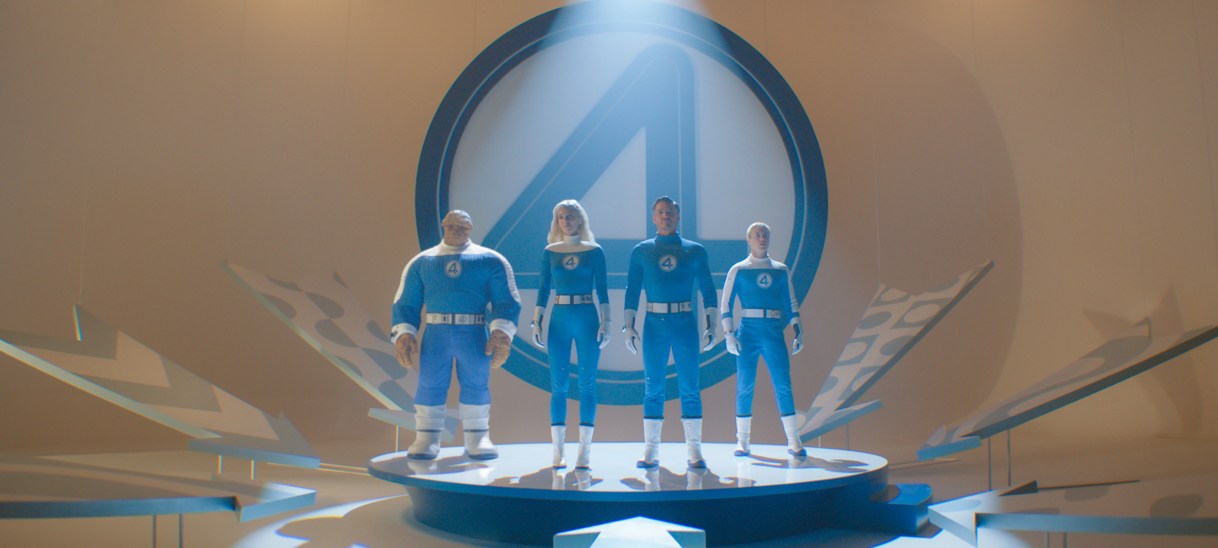
the Fantastic Four, led by Reed Richards and Sue Storm, brought to life better than ever by Pedro Pascal and Venessa Kirby, and flanked by Ben Grimm (Ebon Moss-Bachrach) and Johnny Storm (Joseph Quinn), arrive on screens in an Jetsons-themed alternate reality giving them the freedom of not needing less compelling super friends to give passing screen time too. Portrayed with enthusiasm and sincerity that reflects outwards into the whole film while still avoiding a saccharine mawkishness, making this Fantastic Four entry feel like a delightful throwback.

Four years into their journey, that is just settling in until the unexpected arrives both in-house and extra-terrestrially; the surprising pregnancy of Sue and the arrival of the Herald of Galactus (Ralph Ineson), The Silver Surfer (played with a pride and melancholy by the great Julia Garner), spelling doom for the Earth.

Joseph Quinn and Pedro Pascal in The Fantastic Four: First Steps

Building a competent film around these four characters has proved difficult in the past (this is the fourth go around for the crew in cinema, maybe they needed the luck?), but writers Eric Pearson, Josh Friedman, Jeff Kaplan, and Ian Springer have found success by properly centering the four actors, allowing plot and CGI battles to whizz past their family sci-fi soap opera. Told with sincerity and a deep love of the characters strengths and weaknesses, Shackman is allowed to stretch out and tell a full story, showing the potential from his directorial work on WandaVision (2021), perhaps the only successful Marvel TV show post Daredevil, even if it relied on a lazy final battle to conclude its story.

By centring two terrific performers who have shown the ability to operate in an old Hollywood mode, Pedro Pascal (in full Clark Gable mode) and Venessa Kirby jump off the screen with a chemistry and guile built from the characters out. Even as the world around them monumentally shifts with the arrival of a new child and a new Earth-destroying threat, we constantly see them lock eyes and respond to each other with a depth of understanding and empathy that wouldn’t be amiss in an awards season marriage drama. Pascal is at his best as a supportive scene partner, an invisible hand that allows others to shine instead of absorbing the audience’s attention.

Rounding out the team is Ebon Moss-Bachrach and Joseph Quinn who have an easy banter built on warmth and care that adds to scenes. Quinn in particular is given a full story that is surprising and compelling, improving on the reductive framing we often see of the Human Torch.

A refreshing turn in the superhero genre that is potentially in its death throes, The Fantastic Four: First Steps focuses on an older sci-fi genre package with longer dialogue scenes, fewer action moments with a passing amount of care and attention to story, and a visual language that mostly grounds itself in its own reality (several scenes still feel deeply 2020s which the film seemed intent on avoiding in its first hour).

Pedro Pascal in The Fantastic Four: First Steps

With special effects that actually looked like the VFX team was given time to fully render and actualise ideas from scratch, The Fantastic Four: First Steps withheld the action at the centre of the story in place for a simple but emotive narrative built on a new, emerging family. Even Galactus, once portrayed as a large cloud in a film too embarrassed by its own sci-fi story, is given a tactile nature and a quality performance by Ineson, perhaps the best voice in the industry. In few words, Ineson displays a menace to his words but a clarity in character motivation one wouldn’t expect from an enormous villain desperate to consume planets. It’s not just that Shackman found space for the key six characters to show dimension and character through considered relationship work within a sci-fi framework; it’s that we could achieve this while wrapping up the film in under two hours. 

The Fantastic Four: First Steps is a fast-moving train that has a real destination in mind, an aspect of American genre storytelling we took for granted and allowed to bloat and stagnate, too satisfied with its own navel-gazing to realise they were left as the only people looking. With a recent run of superhero films, Thunderbolts* (2025), Superman, and The Fantastic Four: First Steps, we are potentially rounding the corner into the enjoyment and craft that built this genre into the cinematic tentpole that it strives to hold onto.

By giving these characters a fully rounded narrative that satisfies more than stringing you along with the promise of a larger experience in the future, Shackman and co have achieved what was supposed to be the goal of cinematic genre storytelling; something familiar and something new, contained in an entertaining and sometimes emotional time at the movies. Where James Gunn’s Superman stretched far and wide to populate his emerging franchise venture, making for a fun but frustrating experience, The Fantastic Four: First Steps focuses on a small collection of characters where the biggest spectacle is the arrival of a new family member, the largest event in most audience members’ lives as well.

The Fantastic Four: First Steps is in theatres now.

Thunderbolts* is the Best Post-Endgame Marvel Film

Rating: 3.5 out of 5.

Marketed with a keen focus on its crew’s previous work with the production company de jour A24, Marvel’s attempted rebound back into the public consciousness has arrived in the Florence Pugh led Thunderbolts* (2025). The film is emotional and built from the inside out with a commitment to its characters, a collection of misfit Marvel characters played by an incredible cast of emerging talents that shows when the call is made, they will deliver.

Much like an aggressive chiropractic session, the Marvel project desperately needed realignment, no matter the clunkiness to achieve it. By bringing in emerging creatives to develop a more personal character story — what used to be the MCU’s calling card in the early years — Thunderbolts* arrives fashionably late to a series in need of rescue. While modest in its pursuits (for a blockbuster feature), Thunderbolts* is built off the back of two terrific performances in Pugh as Helena and Lewis Pullman as Bob. Their chemistry stems from the characters’ visible mental health struggles that long for meaning and connection in a world devoid of both, a difficult idea to place front and centre in a film with multiple car flips.

After a haphazard and almost impressively uninspired handover film Captain America: A Brave New World (2025), Marvel’s loaded release schedule picks back up with a darker, sharper, and wittier ensemble film that stands on its own feet before the navel-gazing returns with a new Fantastic Four and Avengers films in the next 12 months.

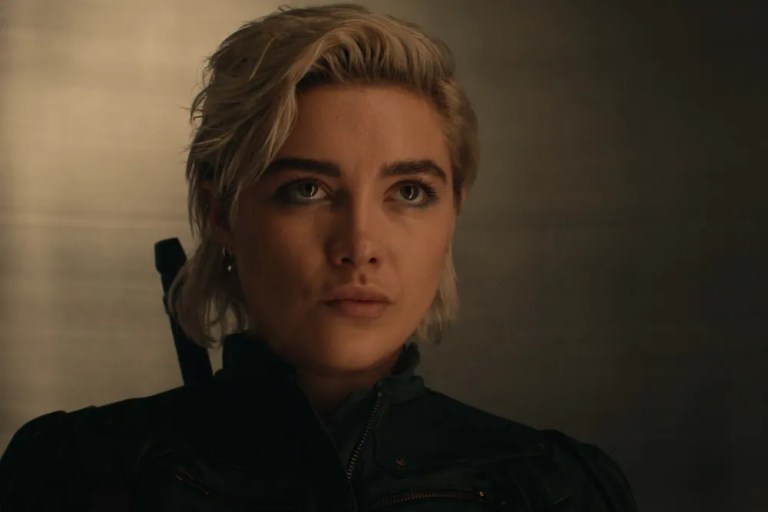
Florence Pugh in Thunderbolts*.

Beef’s (2024) Jake Schreier, alongside many of his collaborators on the acclaimed series, puts character above all in a seemingly obvious pivot away from the plug-and-play style of most post-Endgame MCU films that has put the company on the brink.

Never undercutting its emotional weight with a cheap joke in the same sentence, screenwriters Eric Pearson and Joanna Calo keep their characters, in particular Yelena (a tremendous Florence Pugh), on clearly defined and recognisable tracks. Even as one of the world’s best assassin’s, Yelena’s mental health struggles and ennui is expressed with a profound clarity that underscores the entire film.

By taking their story of literalising mental health struggles to a fulfilling breaking point, Thunderbolts* shows what can be achieved in the best comic book stories by reflecting these superpowered people’s humanity out into the world. Thunderbolts* elicits an unusual feeling: nostalgia for the early entrants in the Marvel cinematic project. Slimmed down to bare essentials with an antagonist that reflects the interior conflicts of our soon-to-be heroes, the film knows the power it holds with its outstanding cast and when to cede ground to their talents.

Sebastian Stan in Thunderbolts*.

From the outset, the score out of electronic trio Son Lux stands apart from the swathe of superhero cinema. In many critical scenes, their emotional intelligence shines through, giving the story of depression and reconciliation a clarity of vision that easily could’ve fallen through our hands like sand. The acoustic and electronic work sustains an unexpected grace that should be applauded.

With an eventual villain in The Sentry that embodies the call of the void itself, Thunderbolts* excels in grounding every element of its story within its characters. Much like Tony Stark being forced to reckon with his role in war profiteering to survive, Yelena must contend with her depression and learn to live alongside it.

The film excels in its modesty, even if it sets a pivotal confrontation in the old Avengers tower (baby steps!). Thunderbolts* uses a potent mix of humour and contemporary emotional turmoil to place itself a tier above the durge of action cinema that doesn’t even arrive at the boilerplate. While striving to be remembered as more than a footnote on the way to back-to-back billion-dollar cheques, Schreier’s film places potent themes of loneliness and emptiness at the forefront of a superhero story that separates itself from the studio’s recent shortfalls.

Thunderbolts* is in theatres now.

Guardians of the Galaxy Vol. 3 is Marvel at its Best

Rating: 3.5 out of 5.

Guardians of the Galaxy have long been the under-appreciated Marvel gang of underdogs (now including an actual dog in Cosmo, played by Oscar nominee Maria Bakalova), that, against all odds, have formed a surprising trilogy of films that can all be put amongst the enduring enterprises very best. The three films are simple, emotional, and dynamic in ways that are becoming increasingly rare in the MCU – largely off the back of filmmaker James Gunn’s writing and directing style – but a great portion of credit should be given to their strong ensembles and creative art and production designs.

It’s been 6 years since the last stand-alone Guardians adventure, with Gunn being immensely busy in the interim. He has switched allegiances from Marvel to DC, first with his own The Suicide Squad (2021) film alongside a John Cena TV show, and now operating as the franchise’s own Kevin Feige overlord, beginning with his own Superhero rebirth story set for 2025.

What allows this new instalment, Guardians of the Galaxy Volume 3 (2023), to thrive is its basic retrieval mission with crystal clear stakes, a divergence not just from recent Marvel plots, but from most third entries in franchises. When Adam Warlock (Will Poulter) crashes through Knowhere in a failed attempt to kidnap Rocket (Bradley Cooper) for mysterious reasons, resulting in significant injuries, the remaining Guardians must go back through his past in order to save their friend’s life. Where Volume 2 (2017) narrowed its focus to Peter Quill’s (Chris Pratt, who is at his best here) backstory with his family, Volume 3 smartly focuses on the origins of Rocket Racoon. Cooper’s Rocket has always been the hipster pick for best performance in the MCU, and he is given an interesting role here as the tech genius Racoon is shown mostly in flashback for the film’s runtime, slowly becoming the grizzled vet we know today. Volume 2 excelled in the tertiary moments between Rocket and Michael Rooker’s Yondu, a formula Volume 3 follows similarly in this flashback origin structure.

(From Left) Dave Bautista, Pom Klementieff, Chris Pratt, and Karen Gillan Guardians of the Galaxy Vol. 3

Music has always been a heavy focus of the Guardians story from the 80s Yacht Rock focus of the first two films (with Peter’s beloved cassette player), to the introduction of the Zune player in Volume 3, allowing the film to have a distinct 90s flavour. Opening with a wonderful sequence on Knowhere with an acoustic version of Radiohead’s Creep, we see Rocket (Bradley Cooper) singing and moving amongst the ragtag community they have cultivated. It is clear that Rocket is now as closely attached to this Earth music as Peter, a connection that has slowly been growing across the three films. Volume 3 is scattered with outstanding music cues from The Flaming Lips, Beastie Boys, and Florence + the Machine, which surprisingly feels more cohesive to the film’s style than the built-in nostalgia of the 80s music that is so integral to the Guardian’s story. 

The ensemble has grown to accommodate a few welcome faces, including Will Poulter and Chukwudi Iwuji as Adam Warlock and The High Evolutionary respectively.  Poulter’s charming wide eyed emergence into the world as a young celestial is a wonderful inclusion, especially the two hander scenes between Adam and Ayesha (Elizebeth Debiki), which are the comedic highpoint of the film. Debiki’s devolution from a pompous ruler at the beginning of Volume 2 to a desperate lackey to a maniacal boss here showcases the actress’s comedic chops, breathing new life into a character that was previously given little time.

Iwuji does his best 90s action villain impression as twisted experimental scientist The High Evolutionary – the whole movie has a great ongoing Face/Off (1997) bit –  that heightens his scenes, making him more enjoyable than recent Marvel villains. The film’s villain storyline closely resembles the arc of X-Men 2 (2003), with Rocket in the Wolverine role and The High Evolutionary in the role of Brian Cox’s William Stryker, the man responsible for his claws through unethical experimentations.  With this close resemblance, an audience is able to settle into a familiar story, allowing the emotional stakes to become the focus instead of a convoluted plot that derails too many comic stories.

(From Left) Karen Gillan, Chris Pratt, and Zoe Saldana in Guardians of the Galaxy Vol.3

Where Volume 3 exceeds well above the previous two films is the wildly inventive world-building and production designs. The warm interiors of Knowhere feel like a home to these characters, which garners emotional weight when it gets put in jeopardy. Guardians has always been about its misfit community with Knowhere at its heart, so it is never a chore the film cuts back to the misadventures of the crew on board while the Guardians are away on a mission. But the inclusion of new locations in Volume 3, like the 80s Star Trek-styled organic security hub Orgosphere or Stepford Wives (1972) tinged Counter-Earth, feels wholly unique in the MCU. Gunn’s Guardians trilogy consistently breathes new life into the wider MCU establishment, with Volume 3 coming at a time they need a major kickstart.

Although the Guardians were integral to the plot of the later Avengers films, it is remarkable how cohesive this trilogy of films is when viewed together. Comparatively, the Jon Watts Spider-Man trilogy and Peyton Reed Ant-Man trilogy are tonally jarring when viewed as a collective story, instead being pulled and twisted into the larger MCU puzzle set. 

The very best filmmakers to operate within this larger Superhero space have been those that have been able to wrestle with the large enterprise while maintaining their own sensibilities. Ryan Coogler was able to bring his political and empathic filmmaking chops from Fruitvale Station (2013) into his Black Panther films, while Gunn has been able to weave a satisfying and hilarious adventure romp that never lacks bite, qualities that made him such a compelling emerging filmmaker. 

Gunn has a penchant for having his characters plainly express their feelings about any situation, which is a creative quirk that takes a while to settle into but can often lead to moments of immense emotionality. Much like Aaron Sorkin’s or Quentin Tarantino’s distinct writing style, Gunn trusts his audience to move to the rhythms of his character’s dialogue to an emotionally satisfying conclusion, accepting the occasional off-notes on the journey.

In spite of its long runtime and simple retrieval plotting, Volume 3 excels through the strong emotional connection that has been made with this world and its characters. Gunn has perfected his emotionally candid dialogue style, with an ensemble of quality performances, highlighted by Cooper, to create the most satisfying Marvel film in years.

Guardians of the Galaxy Volume 3 is in theatres now.

Ant-Man and the Wasp: Quantumania is the Most Inventive Marvel Film in Years

Rating: 3 out of 5.

Marvel (by way of Star Wars and Rick and Morty), the surprising third instalment in the Ant-Man franchise, Ant-Man and the Wasp: Quantumania (2023), is one of the most enjoyable and cohesive Marvel films in years, and a great entry point into the new Phase of the universe. With a wildly inventive world that enchants and inspires awe, Quantumania manages to create something that’s been lacking from Marvel of late: pure imagination and efficient storytelling.

Quantumania kicks off with a return to the Lang family. Scott (Paul Rudd) is touring his ant-pun-filled memoir; Hope (Evangeline Lily) is running the company to improve many noble causes from affordable housing to environmental rehabilitation; Hank (Michael Douglas) and Janet (Michelle Pfieffer) are reunited and retired; and Cassie (Kathryn Newton), now 18, is getting arrested protesting the police for tearing down displacement camps. The surprising heart of the film, Cassie both sparks the plot by creating a beacon to the Quantum Realm, as well as the thematic (socialist uprising via ants combats tyranny in a blockbuster? A+) and emotional story that is never beholden to other properties. The speed in which we are thrown into the world is appreciated and economical, especially in comparison to recent superhero films that have felt bloated and undercooked. 

The Rick and Morty-fication of Marvel is complete in Ant-Man and the Wasp: Quantumania, with longtime comedy writer Jeff Loveness (Jimmy Kimmel Live, Rick and Morty) given sole screenwriting credit here. Previous Rick and Morty writers landing at Marvel include Jessica Gao (She-Hulk: Attorney at Law), Michael Waldron (Loki, Doctor Strange in the Multiverse of Madness, Avengers: Secret Wars), and Loveness. This connection to the cult TV show is felt particularly through its world-building and humour, as Loveness and Reed are clearly having a blast creating these unique quantum aliens, from snail horses to amoeba buildings and freedom fighters, all with a visual and comedic flair that feels considered. The parallel is also felt in its storytelling, as Loveness is able to craft an efficient and entertaining film that works independently of its outside world, maintaining a coherent thematic pull with compelling characters that feel genuinely changed through the experience. 

(From left) Paul Rudd, Kathryn Newton, and Evangeline Lily in Ant-Man and the Wasp: Quantumania

Fears were rising that, with the emergence of the multiverse and glut of recent Marvel products, regular movie fans would be left in the dust. Thankfully, Quantumania is a refreshingly standalone film and a great entry point for this new phase of Marvel. The briskness of the storytelling allows you to get swept up in the world-building and creature design, sharing the sense of wonder Scott and Cassie have for the Quantum Realm. We are shown many sides to this new realm, from its refugee camps to its high society bars inspired by the Star Wars cantina (I was shocked not to have an original tune playing when they entered the room), all fully realised. The craft and consideration here are leagues ahead of recent entry Doctor Strange in the Multiverse of Madness (2022), where the biggest leap in the boundless opportunity of multiversal storytelling was an Earth where green means stop.

Director Peyton Reed, hot off helming a couple of great episodes of The Mandalorian, returns to complete his highly improbable but all-enjoyable Ant-Man trilogy. The list of directors crafting a full trilogy is short, with Reed joining Spider-Man directors Sam Raimi and Jon Watts on the superhero trilogy front. Through a consistently robust supporting cast, the Rudd-helmed franchise has always felt light on its feet and affable, mirroring its star.

Reed’s Ant-Man films thrive more in the conversational moments, both in comedy and tension than when action is required. Early entries allowed the action set pieces to play out like big-budget Honey I Shrunk the Kids (1989) homages, but in Quantumania, the action feels taken straight from the Marvel assembly line, with its rapid cuts, poor blocking, and hand lasers. Fortunately, Reed seems aware of these shortcomings, as the film does not rely on these moments for its crescendos, opting instead for more personal battles against Kang the Conqueror.

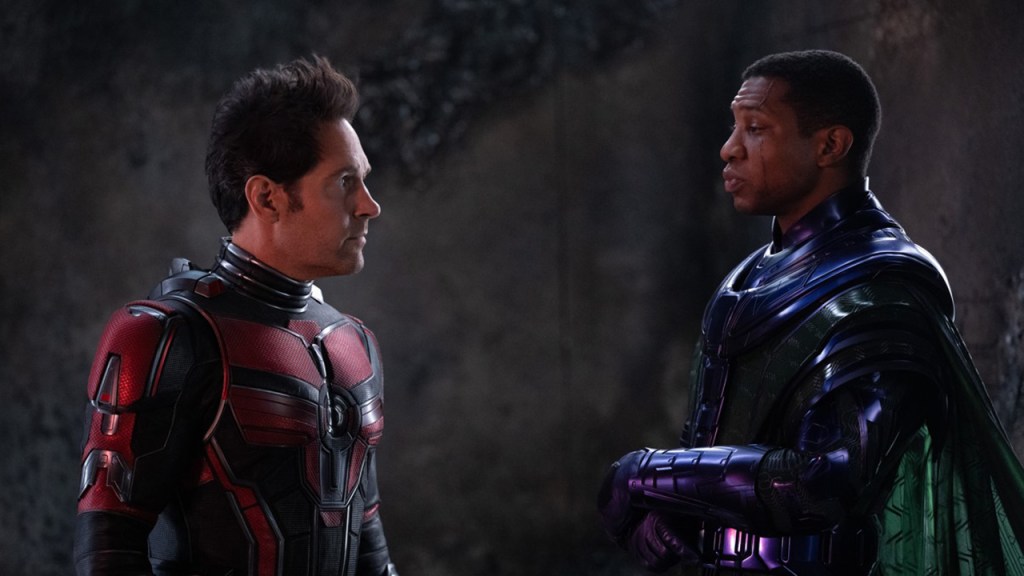
Paul Rudd and Jonathan Majors in Ant-Man and the Wasp: Quantumania

Jonathan Majors, the greatest recruit into the Marvel acting army thrives as the ominous but deeply felt villain Kang the Conqueror. Acting alongside Michelle Pfieffer for many scenes, Majors uses his physicality and always surprising depth of feeling to keep Kang more interesting and compelling to the audience, allowing him to balance out the film in ways we rarely see in Marvel villains. There is a tension and friction to his scenes that allows other actors to occupy space to play off of Majors, instead of merely dominating every moment of screen time, a rare gift to be used in a blockbuster film. The next Avengers film, Kang Dynasty (2025), is more likely to match the quality of Endgame with the emerging A-lister at its core.

No one would’ve imagined back in 2015 that Reed and Rudd would be completing a trilogy of Ant-Man films in 2023, with the third entry becoming crucial to the wider Marvel project with the emergence of Johnathan Majors’ Kang as the next Avengers villain (Loki appearance notwithstanding), let alone creating one of this quality. While still overfilled with messy CGI action set pieces, Quantumania thrives in its inventive world-building, with an economic and satisfying script by Loveness that allows its impressive ensemble to shine.

Ant-Man and the Wasp: Quantumania is in theatres now.