Hope screening provided by Madman Entertainment.
It’s taken almost 9 years, but we finally have a new Michael Bay Transformers film, except it isn’t Transformers and it isn’t by Michael Bay. Na Hong-jin’s Hope (2026) hails from South Korea and is carved from the same rowdy, loud and unshamedly plotless stone as a Bayhem Transformers film, and the result is a wild experience that you’re either with or against, with no room in-between.
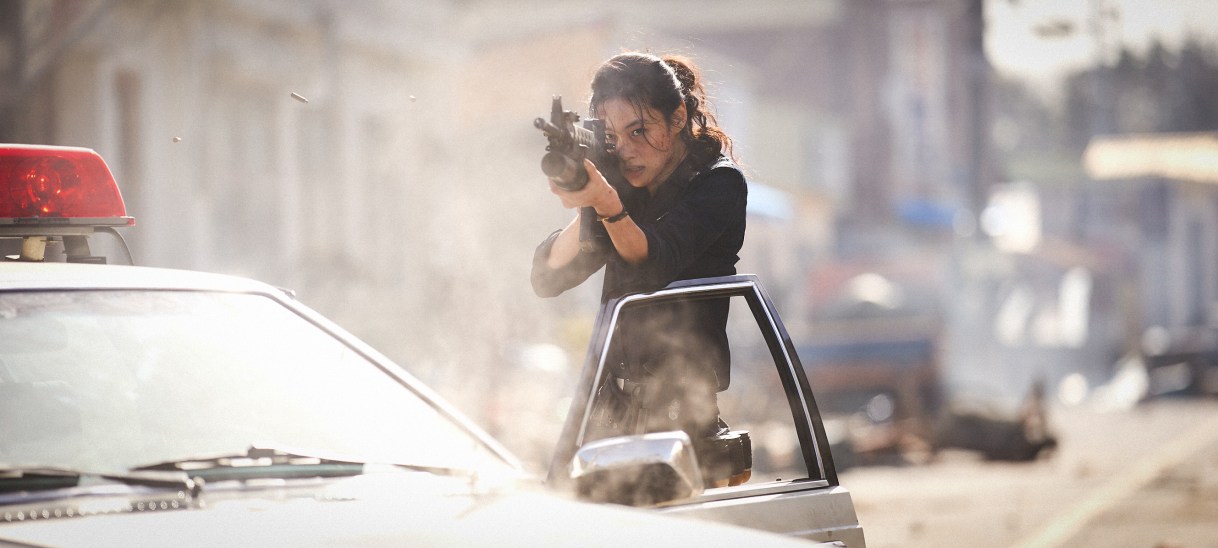
The context for this wild experience is as such: a creature is wreaking havoc across a small mining/fishing town called Hope, with some locals saying it’s a bear, and others claiming it’s a tiger, and it’s up to police chief Bum-seok (Hwang Jung-min) to get to the bottom of what is going on. I’ll admit, I wasn’t feeling convinced that Hope would be worth seeing through beyond the first hour where nonsensical gunfire and chase scenes seem to just repeat on a loop with little to show in the way of any plot or character development. These scenes, while technically sound, left me on the edge of my seat, and less in the the “I’m gripped” way and more in the “I’m about to leave this cinema” way, but then the turning point happens: we see the creature.
Like Bay’s Transformers films, there’s more than meets the eye to this foreign, 10-foot green looking being, and it’s enough for Na to show a tear drop on its face in a close up as it’s being hunted to tell you that the first hour was worth your patience. This one close-up flips the film on its head by turning what was essentially a hunt you were rooting for, to a revelation where you quickly realise that even in moments where a human can recognise suffering on a foreign being, the urge to gun it down is too tempting.
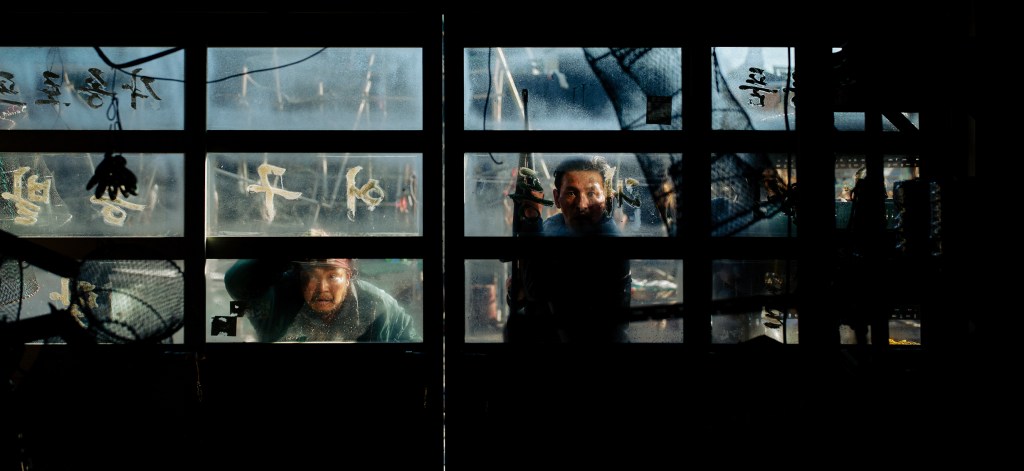
Na cleverly relegates the humans to one-dimensional, underwritten goofballs —a feature, more than a shortcoming in Korean films— and this gives the second and third act an edge that reduces the idea of the Western hero (someone who fights for their land, for justice) to something more akin to a monster than the monsters themselves.
That’s right, there are multiple monsters, with Taylor Russell, Alicia Vikander, and Michael Fassbender each playing them. Whether it was clever marketing, a decision to cut costs, or both (I think the latter), the A-list actors have almost nothing to do as they’re masked behind shoddy CGI that, weirdly, I found quite memorable. Much of the film is cleverly shot with frenetic tracking shots and haphazard editing that gives urgency even when the setting (as beautiful as it can be, like in the final act) is barren and lifeless; it’s a testament to the commitment to just lean into the gung ho of it all and double down on the nonsense, with a particular monologue from an older gentleman that had my cinema of established Melburnian critics in hysterics.
It’s hard to believe that Hope exists. In his recent press tour for The Odyssey (2026), Christopher Nolan noted that Guillermo del Toro taught him that “a monster is never just a monster” and Na has taken that to the extreme by turning the mirror back on the audience, subverting expectations and flipping the film on its head to almost make you want to believe that it’s really the humans who are encroaching on these extraterrestrial beings. Hope is a thought-provoking genre picture that takes sharp turns at every turn, challenging the audience to look inward while simultaneously seeing Na adopt an unwavering, uncompromising adrenaline-induced approach to filmmaking that doesn’t disappoint, punching above its weight boldly and assuredly.
Hope opens nationally from this Thursday.

