Mickey 17 preview screening provided by Universal Pictures.
It doesn’t take a genius to understand that a film about a guy who wants to leave on an expedition and chooses to willingly die and get reprinted (literally) with his memories in-tact, only to keep dying and being reprinted, is right up Bong Joon-ho’s alley. While that doesn’t capture the multifaceted space adventure that is Mickey 17 (2025) to nearly the full extent of the word, Bong’s interests are very particular in that, human dispensability —especially with regards to people in lower socio-economic situations— is a pertinent concern throughout his oeuvre.
In Snowpiercer (2013), a train is used as a motif to portray the various carriages of the caste system, with the back of the train being the lowest class citizens and the front, the highest class, while in Mickey 17, a large spaceship serves a similar purpose. In other words, it’s no secret that capitalism and the presence of an oligarchy are concerns that he hasn’t been shy about critiquing, and they’re a thematic consistency across his work. Regarding dispensability, Mickey 17 is much more literal than any of his previous films in how it reduces the human body to something that can be done away with, something that goes beyond even that of the lowliest of workers to just a recycled carcass.
That’s at least the seed from which the rest of the film grows and revolves around as Mickey (Robert Pattinson) signs himself up to be an “expendable” or an unfortunate soul who would choose to live a quasi-immortal life by living to die and dying to live. He does this after finding himself in bad company on Earth following a debt he hasn’t paid back, before ending up on a government spaceship headed up by a pompous failed politician, Kenneth Marshall (a goofy Mark Ruffalo whose performance echoes that of his one in 2023’s Poor Things), that’s on an expedition to find a new planet to preserve mankind — if this is sounding like Passengers (2016) mixed with Edge of Tomorrow (2014), then you’d be on the right track.

The spaceship finds itself headed towards Niflheim (not to be confused with that area in 2018’s God of War game), a cold planet inhabited by woolly creatures that look like roly polie, pill bugs (dubbed “Creepers”). It’s here that Mickey’s expendable state is really tested, as he’s exposed to the planet’s toxic air over and over again until a cure can be found and applied; it’s also where we eventually get to the 17th version of Mickey that opens the film in a scene we circle back to later. While comical in its portrayal of the printing process after every Mickey death, Bong’s commentary on how human life can be reduced so willy-nilly by those in power makes for a tasty treat, especially when it comes to just how dispensable the human body is in real life, especially when it comes to matters of war.
Bong never dwells though, he keeps the film moving and he keeps the action and dialogue light-hearted and cosy, but his ability to go a step further in his critique of capitalism and the frivolousness of those in power who look down on others, shows a director who is maturing in his own ideas and isn’t afraid to mine them to the full extent. It helps that Marshall and Gwen (Toni Collette) are so effortlessly unlikable in their bougieness which helps those ideas evolve easier.
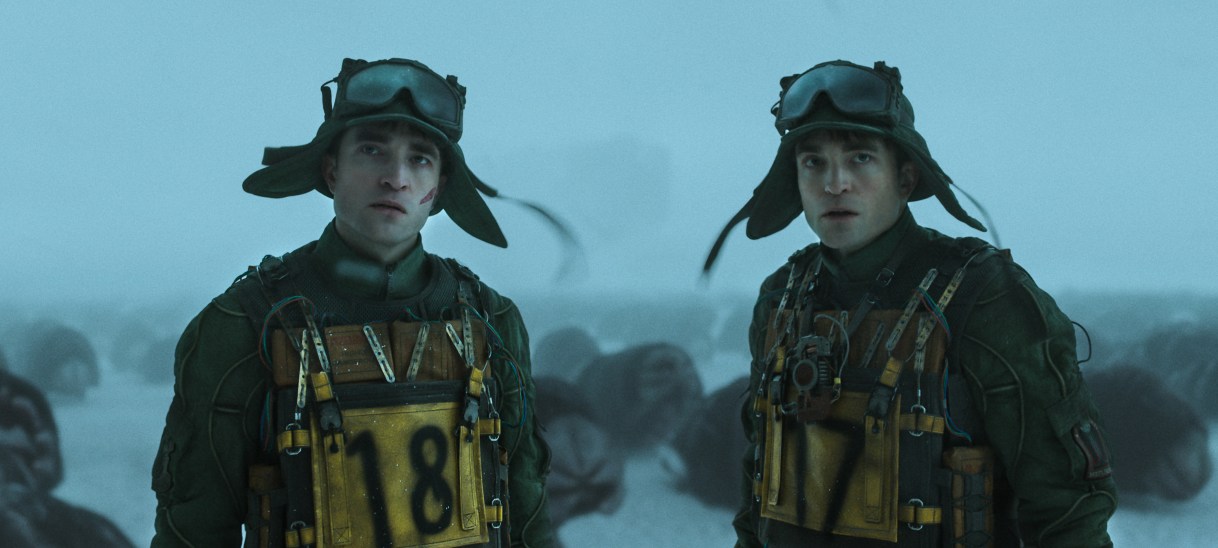
But their relationship is hardly the most shocking: after being saved by the aforementioned woolly pill bugs (following a harsh fall in an ice cave), Mickey 17 manages to find his way back to the ship where he comes across a clone of himself or a “multiple” as they’re called. It turns out Mickey 17 was presumed dead so the 18th version of him was printed, but without his pitchy accent and more akin to Pattinson’s Bruce Wayne in cadence.

It also turns out “multiples” aren’t permitted, so much so that Mickey 18 tries to kill Mickey 17 from the outset, but they soon find a commonality in the form of taking down their oppressors (very much in the vein of Snowpiercer). Pattinson’s dual performance is really a make-or-break factor in understanding what makes these multiples so unique from one another — that these reprints exhibit more humanity than the majority of the crew really adds weight to just how narcissistic and morally bleak humans can be at their worst.
At the end of the day, this is easily Bong’s most optimistic film, one that doesn’t present a bleak future but offers a chance for its characters to carve a brighter tomorrow on their own terms. Sure, he isn’t subtle about his growing interest in ideas he’s previously explored, but he also doesn’t pander to his audience, choosing to let the film’s amusing story take you on a rollercoaster comprised of the grotesque, heartfelt and humorous. In this way, it feels like his most accessible film as there are no hidden windows that keep you guessing.
Mickey 17 opens nationally from today.


 Rating Frames