The Fantastic Four: First Steps is a Wholly Satisfying Sci-Fi Adventure

Rating: 3.5 out of 5.

It can be daunting being the first. The first people in space. The first superheroes in the world, uncertain of the responsibility their power demands. The first child. Crossing that uneasy bridge from the familiar into the depths of the unknown. This was once a core aspect of superhero storytelling, but after thirty-seven entries in the compounding Marvel enterprise, it feels impossible to return to. Even the recent release of James Gunn’s Superman (2025) — a new frontier on the DC side of larger storytelling building blocks, while successful in its storytelling — had notes of this and still couldn’t help itself surround their central figure with larger but unnecessary chatter.

But this is where The Fantastic Four: First Steps (2025) succeeds and earns its colonised titling and a real throwback to why the MCU has built a legacy on quality films. Set in an alternate Earth from the familiar stomping ground of the MCU, and heavily focused on its famous foursome and not its larger worldbuilding, director Matt Shackman has crafted a brisk and entertaining sci-fi-focused ride that will leave you wholly satisfied; a feeling Marvel films used to give us.

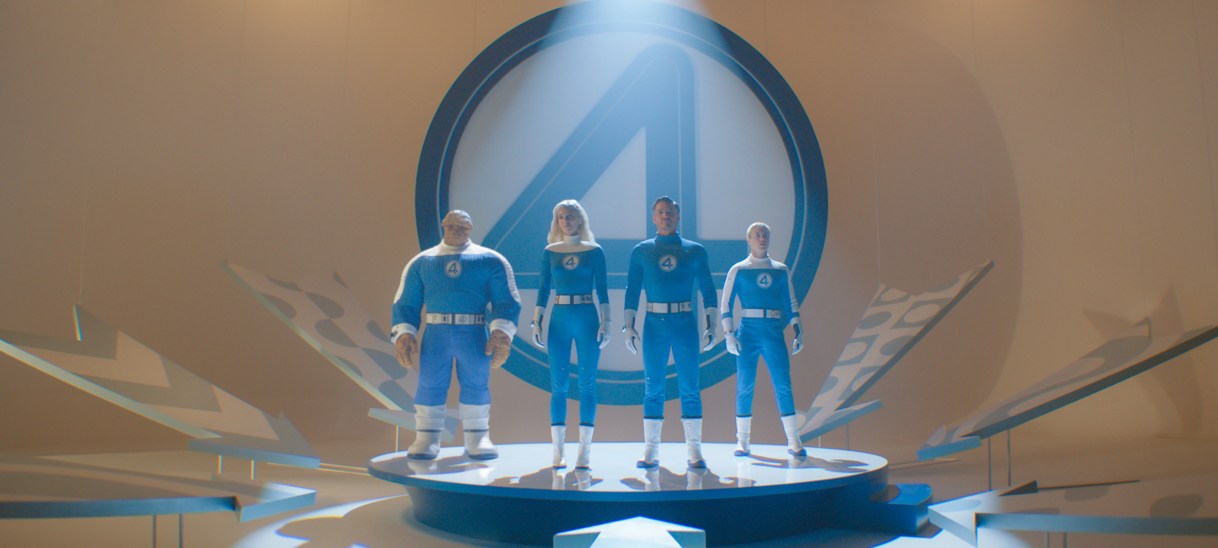
the Fantastic Four, led by Reed Richards and Sue Storm, brought to life better than ever by Pedro Pascal and Venessa Kirby, and flanked by Ben Grimm (Ebon Moss-Bachrach) and Johnny Storm (Joseph Quinn), arrive on screens in an Jetsons-themed alternate reality giving them the freedom of not needing less compelling super friends to give passing screen time too. Portrayed with enthusiasm and sincerity that reflects outwards into the whole film while still avoiding a saccharine mawkishness, making this Fantastic Four entry feel like a delightful throwback.

Four years into their journey, that is just settling in until the unexpected arrives both in-house and extra-terrestrially; the surprising pregnancy of Sue and the arrival of the Herald of Galactus (Ralph Ineson), The Silver Surfer (played with a pride and melancholy by the great Julia Garner), spelling doom for the Earth.

Joseph Quinn and Pedro Pascal in The Fantastic Four: First Steps

Building a competent film around these four characters has proved difficult in the past (this is the fourth go around for the crew in cinema, maybe they needed the luck?), but writers Eric Pearson, Josh Friedman, Jeff Kaplan, and Ian Springer have found success by properly centering the four actors, allowing plot and CGI battles to whizz past their family sci-fi soap opera. Told with sincerity and a deep love of the characters strengths and weaknesses, Shackman is allowed to stretch out and tell a full story, showing the potential from his directorial work on WandaVision (2021), perhaps the only successful Marvel TV show post Daredevil, even if it relied on a lazy final battle to conclude its story.

By centring two terrific performers who have shown the ability to operate in an old Hollywood mode, Pedro Pascal (in full Clark Gable mode) and Venessa Kirby jump off the screen with a chemistry and guile built from the characters out. Even as the world around them monumentally shifts with the arrival of a new child and a new Earth-destroying threat, we constantly see them lock eyes and respond to each other with a depth of understanding and empathy that wouldn’t be amiss in an awards season marriage drama. Pascal is at his best as a supportive scene partner, an invisible hand that allows others to shine instead of absorbing the audience’s attention.

Rounding out the team is Ebon Moss-Bachrach and Joseph Quinn who have an easy banter built on warmth and care that adds to scenes. Quinn in particular is given a full story that is surprising and compelling, improving on the reductive framing we often see of the Human Torch.

A refreshing turn in the superhero genre that is potentially in its death throes, The Fantastic Four: First Steps focuses on an older sci-fi genre package with longer dialogue scenes, fewer action moments with a passing amount of care and attention to story, and a visual language that mostly grounds itself in its own reality (several scenes still feel deeply 2020s which the film seemed intent on avoiding in its first hour).

Pedro Pascal in The Fantastic Four: First Steps

With special effects that actually looked like the VFX team was given time to fully render and actualise ideas from scratch, The Fantastic Four: First Steps withheld the action at the centre of the story in place for a simple but emotive narrative built on a new, emerging family. Even Galactus, once portrayed as a large cloud in a film too embarrassed by its own sci-fi story, is given a tactile nature and a quality performance by Ineson, perhaps the best voice in the industry. In few words, Ineson displays a menace to his words but a clarity in character motivation one wouldn’t expect from an enormous villain desperate to consume planets. It’s not just that Shackman found space for the key six characters to show dimension and character through considered relationship work within a sci-fi framework; it’s that we could achieve this while wrapping up the film in under two hours. 

The Fantastic Four: First Steps is a fast-moving train that has a real destination in mind, an aspect of American genre storytelling we took for granted and allowed to bloat and stagnate, too satisfied with its own navel-gazing to realise they were left as the only people looking. With a recent run of superhero films, Thunderbolts* (2025), Superman, and The Fantastic Four: First Steps, we are potentially rounding the corner into the enjoyment and craft that built this genre into the cinematic tentpole that it strives to hold onto.

By giving these characters a fully rounded narrative that satisfies more than stringing you along with the promise of a larger experience in the future, Shackman and co have achieved what was supposed to be the goal of cinematic genre storytelling; something familiar and something new, contained in an entertaining and sometimes emotional time at the movies. Where James Gunn’s Superman stretched far and wide to populate his emerging franchise venture, making for a fun but frustrating experience, The Fantastic Four: First Steps focuses on a small collection of characters where the biggest spectacle is the arrival of a new family member, the largest event in most audience members’ lives as well.

The Fantastic Four: First Steps is in theatres now.

Gladiator II Continues the Original Story with Bigger, Wilder Action

Rating: 3.5 out of 5.

Gladiator II preview screening provided by Paramount Pictures

Some might say that retracing your steps is a copout, a way of looking back rather than forward. It’s why a film like Blade Runner 2049 (2017) is just as revered as the original, because it went with a new direction courtesy of Denis Villeneuve while remaining faithful to the ethos of the original film. But in the same way that JJ Abrams treaded old ground while elevating the look and feel of an iconic IP with Star Wars: The Force Awakens (2015), so too does Ridley Scott in Gladiator II (2024), his sequel to his critically acclaimed Gladiator (2000).

Gladiator stood out for many reasons, not least because it won Russell Crowe a rightful acting Oscar, but it also represented the merging of the old with the new, practicality with increased digitisation. It paved the way for films like Peter Jackson’s The Lord of the Rings trilogy and Gore Verbinski’s Pirates of the Caribbean trilogy, films that we now look back on with reverence because of how they combined scale (in setting, in action etc.) with those close, intimate moments of characterisation and the human condition.

Gladiator II doesn’t stray too far from the path of the original film, going so far as to retain the meagre visual effects, but it speaks to an era of filmmaking that caught audiences by surprise for all the right reasons.

Scott once again transports audiences back in time to arena battles, slave trading and overly pompous rulers. There’s no Maximus anymore but his presence is still felt. It’s Lucius (Paul Mescal), however, who, after attempting to defend his home in Numidia before it’s besieged by Roman battle ships, finds himself back in Rome as a captive years after fleeing from those who would have seen him killed.

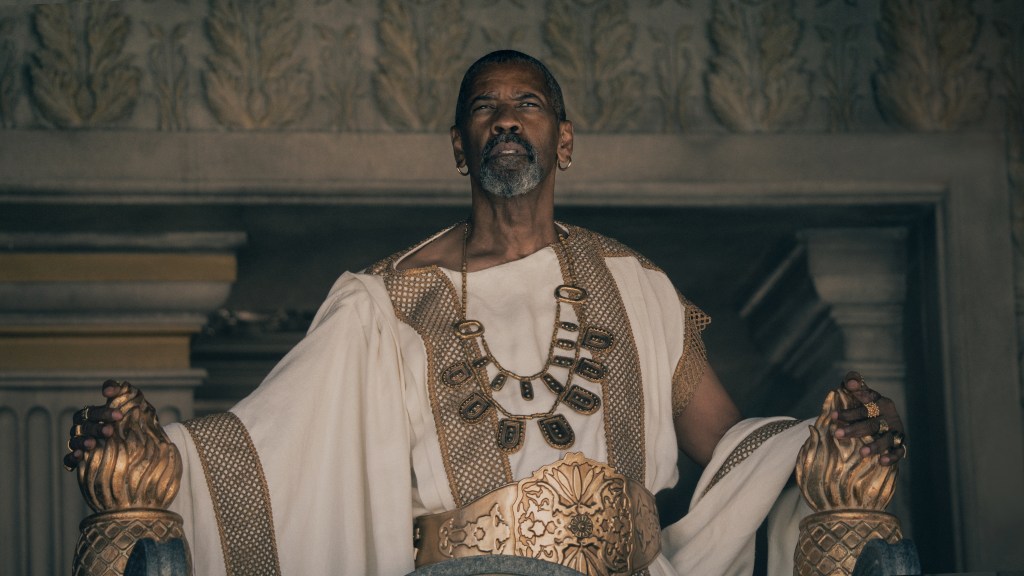
Denzel Washington as Macrinus in Gladiator II.


Lucius, like Crowe’s Maximus but via different circumstances, is forced to reconcile with his destiny to restore order back to a Rome that’s being ruled by two incompetent emperors. It takes some time to get to that point though as he’s put through his paces in a brutal bout with enraged CGI baboons, impressing a slave trader in Macrinus (Denzel Washington) who buys him for his prospects in the gladiator arena.

If that all sounds familiar it’s because Scott has repurposed the plot of the original film and doubled down on everything from flashier set pieces to a wider array of production elements and even more CGI. There’s a great deal of fan service in this film in the same way that the aforementioned The Force Awakens or even Alien: Romulus (2024) cater to returning audiences.

There’s nothing inherently wrong with this approach, especially when an actor like Washington revels in his snakey, almost Baelish-Game-of-Thrones-esque approach to proceedings while delivering lines like Robert McCall if he lived hundreds of years ago (“gimme the bow”) — you just can’t quite read him. Even more than that, this genre of filmmaking is Scott’s bread and butter to the point where, regardless of its historical inaccuracies (sharks in the Colosseum anyone?), it never feels like he’s trying to outdo his past film, but give you more of the same.

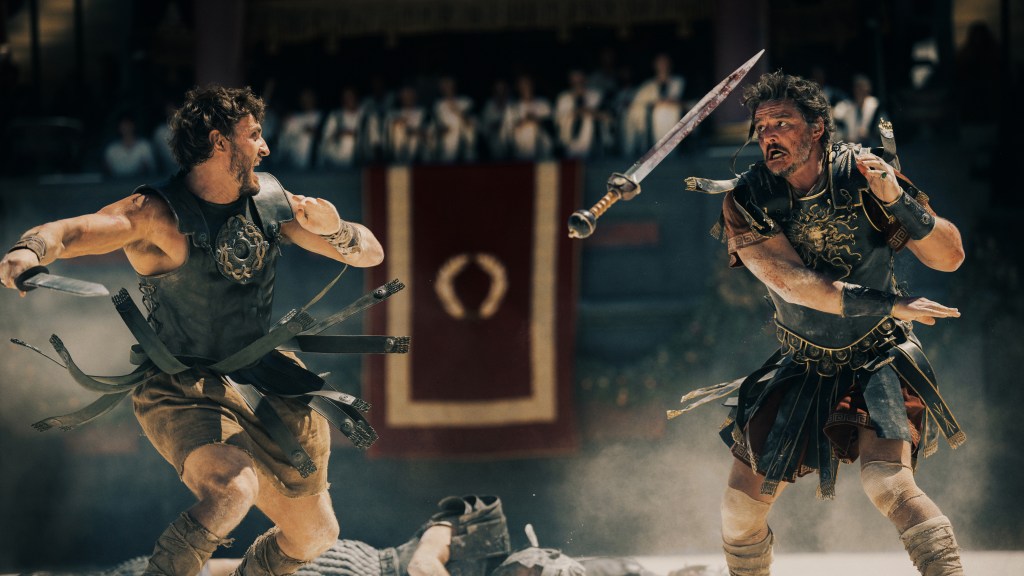
Paul Mescal as Lucius and Pedro Pascal as Marcus Acacius in Gladiator II.


The biggest fault in a film about a man who’s lost it all and is coming back from the brink is that you need to be able to buy into his cause and feel his emptiness. While Mescal has cashed in some really soul-tugging performances like in Aftersun (2022) or All of Us Strangers (2023) he doesn’t command the screen with the same gravitas that Crowe did. It helped that in the original, Joaquin Phoenix delivered just as compelling a performance as Commodus and was given ample screen time to have you loathe him just as much as Maximus did.

This time around, you have whiny emperors, a slowly unraveling Macrinus, and a misunderstood General in Marcus Acacius (Pedro Pascal). In this way, Lucius’ battle is spread across characters who are also in one way or another, battling each other. As a result, the stakes don’t feel nearly as big as the scale of the rest of the film, as great as it is to see these various storylines and plot lines interconnect and clash.

There’s a lot going on this time around whereas the screenwriters of the original, (David Franzoni, John Logan, and William Nicholson) spent more time exploring who Maximus was and giving him that more refined arc that makes him so iconic to this day. The same can’t be said for David Scarpa’s script as it does lack the deeper exploration of character needed to get you that aforementioned buy-in. This is a Ridley Scott film, however, and what’s never lacking is a memorable time or several key memorable moments; it’s all the same at the end of the day, so there’s no need for another rhetorical “are you not entertained”, it’s enough for Scott to leave you entertained.

Gladiator II opens nationally from the 14th of November.

The Unbearable Weight of Massive Talent Celebrates Nicolas Cage

Rating: 4 out of 5.

There are actors and then there are actors, but there’s also Nicolas Cage, a thespian unlike any other who has long been swimming in his own pool of creativity, films and the characters left in their wake. The Unbearable Weight of Massive Talent (2022) represents a celebration of all things Nic Cage, serving as its own museum that displays (quite literally) some of Nic’s most iconic on-screen moments, characters and artifacts while at the same time offering an enjoyable buddy-up action comedy.

Out of all the odd and unique actors throughout cinema history, it seems fitting that it would be Nicolas Cage who would play a hyper-fictionalised version of himself to such an extent. The actor’s unrivalled commitment to exploring all aspects of his craft has seen him play some of the most craze-filled (Red in 2019’s Mandy, Caster Troy/Sean Archer in 1997’s Face/Off) and heartfelt (Robin in 2021’s Pig, Joe Ransom in 2013’s Joe) characters of all time.

What Director Tom Gormican has provided with The Unbearable Weight of Massive Talent is a service to all fans of Cage. With Nick Cage (Nicolas Cage) running short on money and struggling to balance his work and home life, he decides to take his agent’s (Neil Patrick Harris) advice to attend a birthday party for Cage superfan Javi Gutierrez (Pedro Pascal) and get paid $1 million. What Nick doesn’t realise is that behind the lovey-dovey, Cage-admiring Javi, is a drug kingpin, crime family and a missing girl. Unbeknownst to Nick, CIA agent Vivian (Tiffany Haddish) plants a tracking device on him and soon informs him of Javi’s dangerous side. It is up to Cage to find the truth of it all by channelling his most iconic screen characters to save himself and those around him.

The film plays out like a pastiche on the body of Cage’s work while also offering something new in the way of performance. Cage has often spoken of his “nouveau shamanic” neologism as an approach to performance that tries to get to the essence of a character through a deeper engagement with one’s imagination — ultimately enabling a performance that is as true as can be. He has also said in a recent Reddit AMA (ask me anything) that playing Nick Cage was the most challenging role he has taken on, with the need to “protect a person named Nick Cage” and make sure that he “facilitated the director’s absurdist vision of so-called Nick Cage”.

Nicolas Cage in The Unbearable Weight of Massive Talent (2022)

It’s no surprise then that even for an actor of Cage’s calibre, it would take more than a “nouveau shamanic” approach to performance to truly play Nick Cage. But play Cage, Nicolas Cage does, as he brings all of his signature idiosyncrasies to the table: explosive moments of rage, overzealous mannerisms, signature one liners and so forth. There is a level of self-awareness here that never borders on excessiveness as Cage plays into these idiosyncrasies in a way that would speak to Gormican’s absurdist vision of what a hyper-fictionalised version of the actor and his life would look and feel like.

It’s easy for films to poke too much fun at their source material to the point where they overdo it — like in This is the End (2013). Ultimately, there is a still a need to provide a plot that brings everything together and serves a purpose beyond the gimmicks, and fortunately Gormican manages to keep a level head amongst the excitement of it all. Gormican uses the situation that Nick finds himself in to prompt the action that follows while at the same time managing to bring it all back to the crux that is Cage. The fact that Javi isn’t an unlikable antagonist (or an antagonist at all really) also helps to keep it light hearted and grounded, even with the tonal shift that happens around the second act.

It is quite fitting that, out of all the moments of overblown absurdity, the most striking moment —Nick Cage French-kissing a young, Wild at Heart (1990) era Cage— would come from the mind of Cage himself. The film pays homage to outlandish moments like this from the actor’s career and yet the process of making this film has brought another intrinsically “Nicolas Cage” moment; this moment hits like the smell of sea salt as you make your way to the beach for the first time in the summer, and it’s a beautiful feeling.

Never short on pop culture references (any mention of 2017’s Paddington 2 is always welcome) and always set on celebrating the cultural significance of its star lead, The Unbearable Weight of Massive Talent is everything fans of Nicolas Cage will have wanted it to be and more. While having massive talent might be unbearable, a film with Nicolas Cage playing Nick Cage is anything but unbearable — it might just be what cinema and the world has been missing.

The Unbearable Weight of Massive Talent opens nationally from the 21st of April, 2022