A Stellar Cast Can’t Save The Dog Stars From an Undercooked Script

Rating: 2 out of 5.

The Dog Stars preview screening provided by Disney.

From first glance, The Dog Stars (2026) has the makings of a Ridley Scott film with its post-apocalytic setting giving the veteran director an opportunity to build suspense in the unknown, but it feels like anything but a Ridley Scott film.

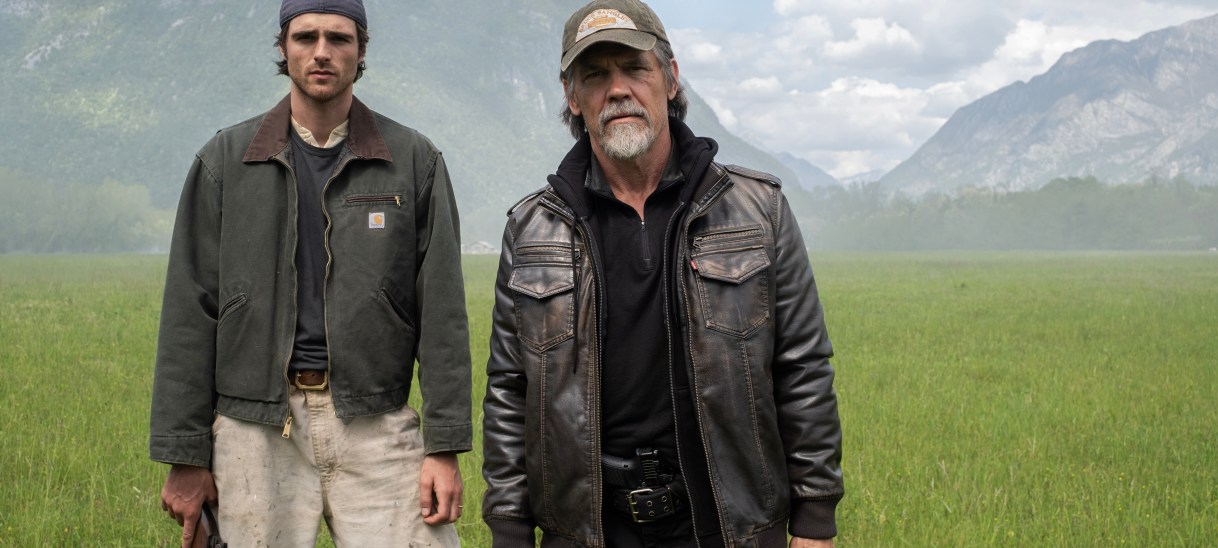
Having been adapted for the screen by Mark L. Smith from Peter Heller’s 2012 novel of the same name, the film calls to mind the recent hit show The Last of Us (2023 – ), opting for the same sort of lived-in yet barren wasteland as the backdrop to events. Mankind has experienced a plague of some kind that has taken the lives of the majority and left others scraping by, defending the little they can gather while scavengers work to steal it. Jacob Elordi plays a mechanic who lives out on a big block of land with a rugged Josh Brolin and a dog, Jasper.

The film almost carries a tranquil quality with sweeping vistas, shots of a plane flying over said vistas and just a serenity that makes you wonder how it’ll be disrupted. There’s a whole lofty backstory built around Elordi’s character that informs his attachment to his dog, with flashbacks cutting from the past to the present showing these interactions with his wife. At some point though, the plot needs to move forward and what better way to get it moving than by having a scuffle with those aforementioned scavengers which sees his dog be killed. (John Wick vibes, anyone?). This leads to Hig (Elordi’s character) making the decision to head out with his plane to the “Grand Junction” in search of a mystery voice he’s been picking up while surveying the land from the sky.
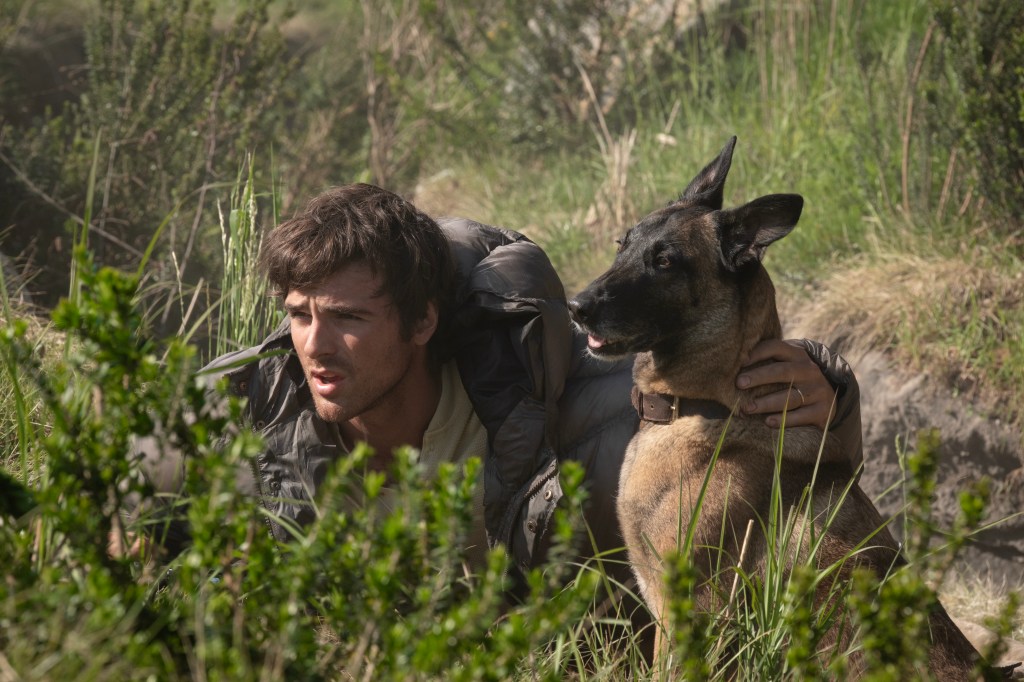
Jacob Elordi as Hig and Jasper in 20th Century Studios’ THE DOG STARS.

There’s a sloppiness to the writing to get the plot to this point, and just a randomness to proceedings which doesn’t stop here. Hig ventures out where he crash lands and meets the duo of “pop” (a Guy Pearce who the audience I was with said looked like Brolin) and a young former medical student Cima (Margaret Qualley). Here, the film splits into two: you have Brolin’s character facing a wrath of skinhead-like scavengers who look like they’ve been pulled from Mad Max: Fury Road (2015), and Elordi and co getting acquainted.

The latter side sees a wonky, unconvincing love subplot be thrown in between Elordi and Qualley’s characters that is incredibly underwritten and isn’t helped by the actors having zero chemistry with each other. Elordi’s performance also feels incredibly stale —no doubt due to the terrible writing— and probably wasn’t helped by him being cast on account of Paul Mescal dropping out of the film (there’ll be no Oscar nomination this time like when Elordi was recast in the Frankenstein’s monster role).

It’s as though there was a desire to have a more contemplative approach to a novel with writing that no doubt reads that way, but the need to add action and energy was playing on people’s minds so some of it was thrown in for good measure. Beyond that, there just isn’t the punchiness of a Ridley film; the stakes feel watered down, the set pieces are quite blasé and this just plays like a very ‘autopilot’ project from a director we know can do so much more.

The Dog Stars opens nationally from 27 August 2026.

Gladiator II Continues the Original Story with Bigger, Wilder Action

Rating: 3.5 out of 5.

Gladiator II preview screening provided by Paramount Pictures

Some might say that retracing your steps is a copout, a way of looking back rather than forward. It’s why a film like Blade Runner 2049 (2017) is just as revered as the original, because it went with a new direction courtesy of Denis Villeneuve while remaining faithful to the ethos of the original film. But in the same way that JJ Abrams treaded old ground while elevating the look and feel of an iconic IP with Star Wars: The Force Awakens (2015), so too does Ridley Scott in Gladiator II (2024), his sequel to his critically acclaimed Gladiator (2000).

Gladiator stood out for many reasons, not least because it won Russell Crowe a rightful acting Oscar, but it also represented the merging of the old with the new, practicality with increased digitisation. It paved the way for films like Peter Jackson’s The Lord of the Rings trilogy and Gore Verbinski’s Pirates of the Caribbean trilogy, films that we now look back on with reverence because of how they combined scale (in setting, in action etc.) with those close, intimate moments of characterisation and the human condition.

Gladiator II doesn’t stray too far from the path of the original film, going so far as to retain the meagre visual effects, but it speaks to an era of filmmaking that caught audiences by surprise for all the right reasons.

Scott once again transports audiences back in time to arena battles, slave trading and overly pompous rulers. There’s no Maximus anymore but his presence is still felt. It’s Lucius (Paul Mescal), however, who, after attempting to defend his home in Numidia before it’s besieged by Roman battle ships, finds himself back in Rome as a captive years after fleeing from those who would have seen him killed.

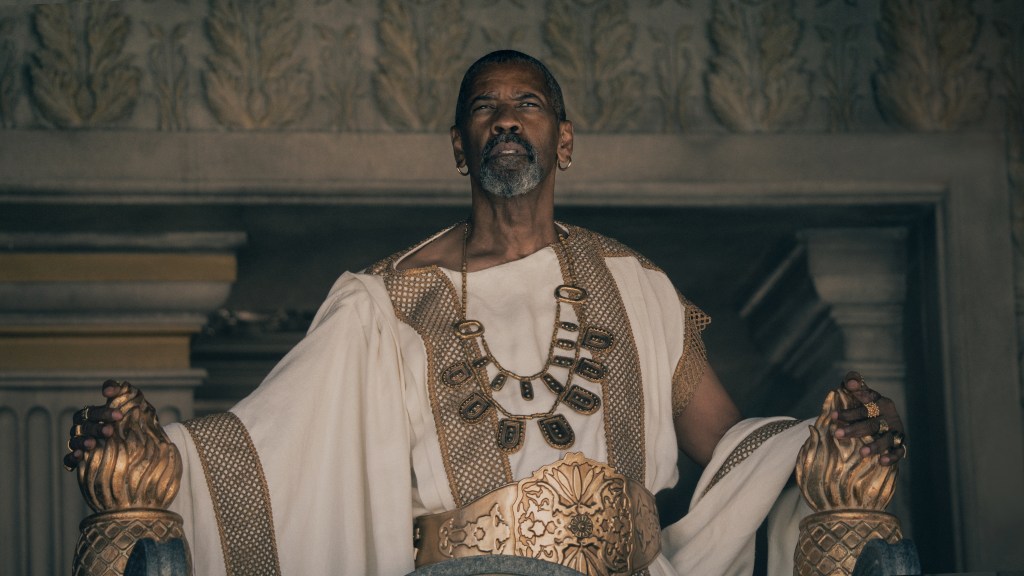
Denzel Washington as Macrinus in Gladiator II.


Lucius, like Crowe’s Maximus but via different circumstances, is forced to reconcile with his destiny to restore order back to a Rome that’s being ruled by two incompetent emperors. It takes some time to get to that point though as he’s put through his paces in a brutal bout with enraged CGI baboons, impressing a slave trader in Macrinus (Denzel Washington) who buys him for his prospects in the gladiator arena.

If that all sounds familiar it’s because Scott has repurposed the plot of the original film and doubled down on everything from flashier set pieces to a wider array of production elements and even more CGI. There’s a great deal of fan service in this film in the same way that the aforementioned The Force Awakens or even Alien: Romulus (2024) cater to returning audiences.

There’s nothing inherently wrong with this approach, especially when an actor like Washington revels in his snakey, almost Baelish-Game-of-Thrones-esque approach to proceedings while delivering lines like Robert McCall if he lived hundreds of years ago (“gimme the bow”) — you just can’t quite read him. Even more than that, this genre of filmmaking is Scott’s bread and butter to the point where, regardless of its historical inaccuracies (sharks in the Colosseum anyone?), it never feels like he’s trying to outdo his past film, but give you more of the same.

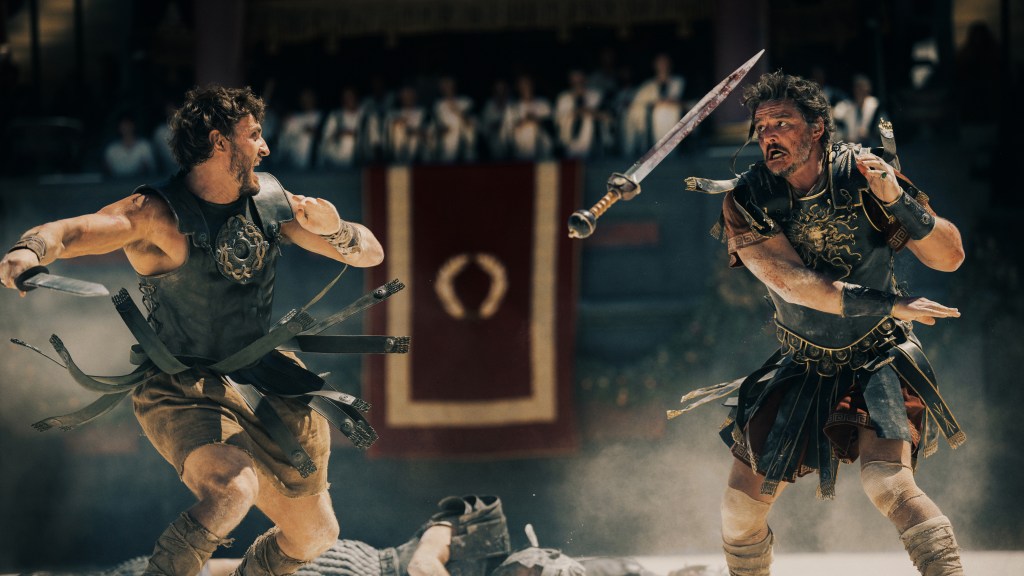
Paul Mescal as Lucius and Pedro Pascal as Marcus Acacius in Gladiator II.


The biggest fault in a film about a man who’s lost it all and is coming back from the brink is that you need to be able to buy into his cause and feel his emptiness. While Mescal has cashed in some really soul-tugging performances like in Aftersun (2022) or All of Us Strangers (2023) he doesn’t command the screen with the same gravitas that Crowe did. It helped that in the original, Joaquin Phoenix delivered just as compelling a performance as Commodus and was given ample screen time to have you loathe him just as much as Maximus did.

This time around, you have whiny emperors, a slowly unraveling Macrinus, and a misunderstood General in Marcus Acacius (Pedro Pascal). In this way, Lucius’ battle is spread across characters who are also in one way or another, battling each other. As a result, the stakes don’t feel nearly as big as the scale of the rest of the film, as great as it is to see these various storylines and plot lines interconnect and clash.

There’s a lot going on this time around whereas the screenwriters of the original, (David Franzoni, John Logan, and William Nicholson) spent more time exploring who Maximus was and giving him that more refined arc that makes him so iconic to this day. The same can’t be said for David Scarpa’s script as it does lack the deeper exploration of character needed to get you that aforementioned buy-in. This is a Ridley Scott film, however, and what’s never lacking is a memorable time or several key memorable moments; it’s all the same at the end of the day, so there’s no need for another rhetorical “are you not entertained”, it’s enough for Scott to leave you entertained.

Gladiator II opens nationally from the 14th of November.