F1: Brad Pitt Plays a Past-His-Prime Prodigy in Joseph Kosinski’s Adrenaline Filled Follow-Up to Top Gun: Maverick

Rating: 3.5 out of 5.

F1 preview screening provided by Universal Pictures

Swapping the skies for the circuit, Joseph Kosinski’s F1 (2025) is a speedy, four wheeled follow up to his box office smash, Top Gun: Maverick (2022). While I’m not an F1 fanatic, there’s no doubt that the exhilaration of a race with cars that push past 300km/h is an adrenaline rush for those that love that sport, and especially for the drivers behind the wheel. But what happens when you peel back the veneer that is the glitz and glamour of podium finishes, and begin to look at the gruelling process that pit crews and drivers alike go through in the lead up to a race? Well, Kosiniski understood the assignment and has created a punchy drama that both tackles that question, and is rife with everything from technical language about racing, to the fall and rise of a prodigy.

In many ways, F1 feels like a spiritual successor to Maverick in that it traces the life of someone who was young and reckless, but is now more of a “has been” who is giving it one last crack against the new stars. On paper, Kosiniski’s film feels like it was very much geared towards casting Tom Cruise and continuing to put him in the cockpit of these lightning fast death machines, but with the Mission Impossible films taking up the majority of his focus, another aging yet still youthful star had to step in.

Cue Brad Pitt. Once you’ve seen this film, it’s easy to say that it’s hard to imagine anyone else playing this role other than Pitt, but Pitt makes the character of Sonny Hayes wholly his own that it’s really, truly impossible to imagine even Cruise in his position. There’s a boyish cockiness that Pitt translates so well to the screen, and it’s no different here as he carries himself with the same reckless edge he’s delivered time and time again. And it serves the premise perfectly: a former racing prodigy who is living in his van and sporadically competing in races is given the keys to the kingdom that is F1 by his former racing competitor-friend-turned-F1-owner, as a hail mary to pull them out of the rut they’re in.
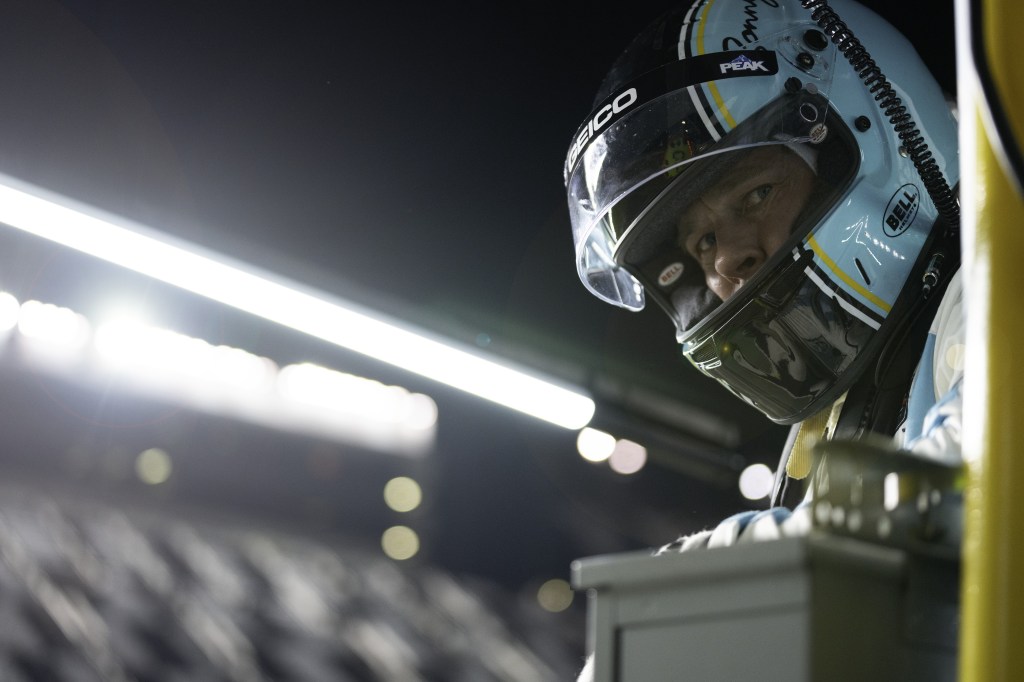
Brad Pitt as Sonny Hayes in F1 (2025)

You might be thinking: this sounds like every movie that has an ageing star who continues to try and compete at the highest level. While you might be right to a degree, on paper F1 isn’t remarkable as a fresh character study, but where it falters in storytelling it makes up for with fast paced action and a desire to authentically capture the F1 scene. Kosinski and frequent cinematographer Claudio Miranda’s work on getting the claustrophobic, tight spacing of fighter jets right in Maverick has helped them capture the same feeling of being in an F1 car; combine that with Hans Zimmer’s pulsating, punchy score, and the film has a video game simulator feel — keeping you at once on the edge of your seat and as though you’re there with Sonny.

Key to trying to give the film a little more egde beyond the generic script by Ehren Kruger is the addition of a young rookie, Josh Pearce (Damson Idris), who naturally takes the lead for the team, with Sonny serving more to amplify his movements on the track. Their dynamic helps shift the gears and keep the film from just being like every other racing film you may have seen. For one, Sonny doesn’t settle for second best and pushes Josh to be his competitor on the track so as to not have him be complacent and expecting everything will be handed to him. This push and pull between the two is like a passing of a baton but only if that baton was on a rope and it had to be caught first.

That’s all to say that F1, while a stellar showcase of zippy cinematography and snappy editing, derives its most heartfelt moments (even if the rest of the story is rather cookie-cutter) through Sonny’s redemption arc as he takes his track knowledge and turns it into a method for madness. What’s even more impressive is just how close to the real thing Kosinski has kept proceedings, with real-life racers like Max Verstappen and Lewis Hamilton cropping up (the latter being a producer as well who was involved with the project before Brad Pitt!). There’s a level of verisimilitude that the film is striving to capture, sometimes to the detriment of the wider drama that’s captured so well by films like Ferrari (2023) and Ford v Ferrari (2019), but often it nails this approach mainly because of how close each aspect of production is to the real thing, and with this approach Kosinski has clearly found himself a formula for success.

F1 opens nationally from the June 26.
Ferrari: Michael Mann’s Measured Portrait of Enzo Ferrari is one to Savour

Rating: 4.5 out of 5.

Driven, work-oriented men who struggle to balance the personal with the professional and are often trapped by their own desires has always been Michael Mann’s bread and butter. In Ferrari (2023), his latest foray into biopics after Ali (2001), Public Enemies (2009) and to a lesser extent, The Insider (1999), he tackles automotive titan Enzo Ferrari. A figure notorious for his desire to win at all costs, Ferrari fits perfectly into the book of self-destructive but purposeful protagonists that Mann has been exploring.

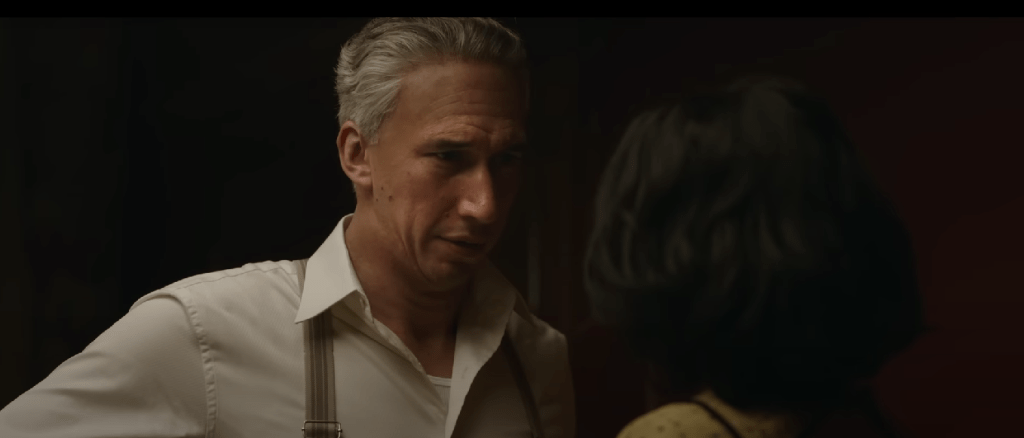
A perfectionist professionally but a loose cannon personally, Enzo Ferrari (Adam Driver) was a multi-faceted man, with his mind ever so focused on innovating and winning races but also ever so muddled when it came to his marriage and family life. Mann wastes no time in connecting those two worlds, introducing Ferrari (after a short montage of recreated black-and-white footage of a young Enzo behind the wheel) slipping out of the home of his mistress Lina (Shailene Woodley), slowly pushing a car downhill before jumping into it and speeding off. It’s a subtle introduction but helps establish what follows as a deeper look beneath the bonnet.

Where he’s speeding off to is his blindsided, somewhat estranged wife Laura (Penelope Cruz) whom he shares his struggling business with as well as a deceased son, Alfredo, whose death is a trigger point Mann continually comes back to over the course of the film to access that hidden internal layer that Enzo tries to hide.

It makes sense to ground the film to a particular moment in time rather than simply treating this as a by-the-books, cookie cutter biopic. The moment he chooses here is in 1957, with Enzo continuing to grapple with the loss of his son while living a double life with another woman and a second child, Piero. It’s a period in time where the Ferrari brand was at risk of collapse and the Mille Miglia race was a way for Enzo to clap back at doubters and hopefully, debt.

Mann is an expert at extrapolating key info from his subject matter, something Driver attests to in a Collider interview by stating that Mann’s characters “internal lives are so rich and so specific” and that “all of his notes are about character and internal life”. And Troy Kennedy Martin’s screenplay, based on Brock Yates’ Enzo Ferrari: The Man, the Cars, the Races, the Machine, offers enough legroom for Mann to build out the sort of bubbling tension that Enzo is harbouring over the course of the film where you feel that at any given moment, something will burst as it often does in his films.

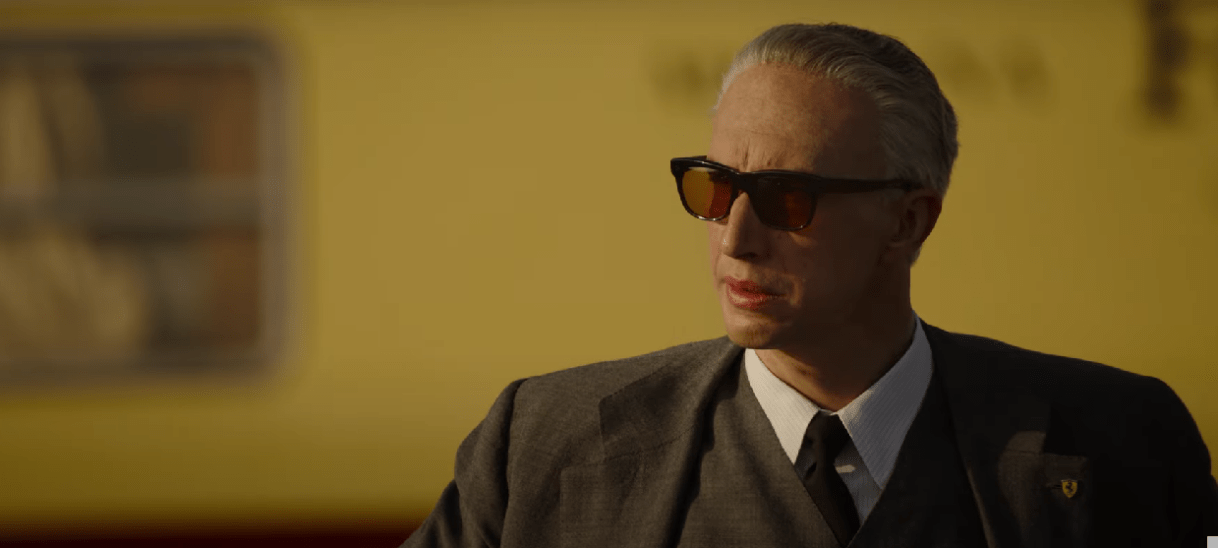
Adam Driver is Enzo Ferrari in FERRARI, directed and produced by Michael Mann

As mentioned, the Mille Miglia feels like the Hail Mary for Enzo to redeem his brand, and across the film he tests cars around a track with professional drivers while reminding them that it’s a privilege to race in one of his cars. It’s in these very transaction-like conversations that his ruthlessness and hunger to win comes through, with Driver playing the Commendatore (as he was known) with a composed edge but towering presence as though he was truly a force of nature in this world. Not to take away from Driver, but at times his performance feels a little less accessible than some of Mann’s other characters who share similar traits but often have a more engaging charisma.

It’s in the more personal exchanges he has with those he cares about that the true duality of his life comes through. Laura matches him in bluntness, with the loss of their son evidently creating a rift between the two that’s left them stagnant in their marriage. Cruz’s performance here is up there with the best of the year as she plays Laura as a woman on the cusp of losing it, with her dark, hollow eyes and blank expressions evoking the rawness she stills feels for her son’s death and distance from her husband.

While the film is more of a melodrama in its muted moments, it wouldn’t be a Mann film without some thrills and spills. The racing sequences, including that of the track tests and the Miglia itself, are shot expertly by cinematographer Erik Messerschmidt with cameras situated in seemingly every part of the car except the drivers laps. The sound-design adds to the flair of the races and the sense of foreboding doom as the cars rocket around turns and narrowly avoid knocking into each other.

The closing sequence is one of the most confronting of Mann’s career and definitely of the last year, with a crash that kills nine onlookers at the Miglia. Sure the CGI feels a bit jarring in a film that focuses on practical effects for its majority, but the moment itself and Enzo’s reaction afterwards speaks to the coolness that he projects where things happen in this line of work and you move on, because that’s what winners do, no matter the cost.

Ferrari is in theatres now.