Dad, Larrikin, Friend, Genius, Icon, Documentary Subject But Also John Clarke

Rating: 4.5 out of 5.

“Life could be pretty boring if we didn’t make it funnier.”

Eight years have passed since Australia, and the world lost legendary satirist John Clarke, a New Zealander whose comedic alter-ego made him a national celebrity, before he made the trip across the Tasman, called Melbourne home and delighted another whole country with his distinct brand of humour. His death in 2017 was met with the kind of despair our brethren generally reserve for athletes, movie stars or royalty; praise came forth from all quarters – journalists, thespians, second-rate critics and the very individuals he so often lampooned, politicians, all effusively praising his wit and drawing attention to his huge body of work in written, aural and visual formats.

No figure is better placed to tell the story of this Kiwi multihyphenate than his eldest daughter Lorin, who emulates his diverse artistic talents by performing the manifold roles of director, producer, writer, interviewer and narrator of the very documentary that bares his name: But Also John Clarke (2025). Through monologues, conversations, anecdotes and a treasure-trove of archival footage – including home-videos, and Lorin’s own conversations with her father before his untimely death – viewers are presented with a captivating and amusing portrait that cordially pays homage to its eponymous focal point.

Much of the narrative’s first half is spent (as is often the case with stories of a biographical nature) exploring Clarke’s younger days in his mother-country, detailing a tumultuous upbringing that saw his creative spirit very nearly stymied by an oppressive boarding school, and a court blame him for the failed marriage of his parents rather than the more logical explanations of “irreconcilable differences” or “emotional trauma stemming from the horrors experienced in the Second World War”. Such torment would have broken an ordinary man, but not John Clarke, who overcame this animosity by way of several failed university courses, a brief sojourn to Europe and applying himself to the scene of theatre. This, of course, begat the persona we know as Fred Dagg.

Our attention is soon diverted to happenings in Australia, where John raised his family, refined his craft and began making allegorical waves via supporting roles on ABC Radio’s Science Show – despite having virtually no knowledge of any scientific pursuits – and ABC TV’s The Gillies Report, on the latter programme earning recognition as the globe’s foremost authority on farnarkeling. Then came sketches with Bryan Dawe on A Current Affair, in which Clarke masterfully impersonated political dignitaries and those of a comparable persuasion through the simple act of bearing their name and emulating their mannerisms, followed by the equally-innovative mockumentary series The Games.

Shaun Micallef (left) is one of several talking-heads acquiesced for But Also John Clarke

Parties from Clarke’s homeland and adopted nation lend their voices to the film on a pro rata basis, ranging from his theatrical contemporaries to the funnymen he himself would go on to inspire, and some fellow NZ expatriate by the name of Sam Neill (we’re told he’s quite famous). As director, editor et al, Lorin utilises their insights to craft a story warm and moving without succumbing to the egregious crime of saccharinity that all too often befalls personality-driven documentaries. More impressive still is her compelling argument put forward that Fred Dagg, and by extension John not only gave birth to New Zealand’s comedy scene, but also helped to foster an irreverent, self-deprecating sense of national pride.

Faults in the picture are few and far between, especially when viewed on a cinema screen via digital projection. A more discerning eye may be saddened by the lack of consideration given to Clarke’s international standing, with an opening remark from Britain’s Stephen Fry being the only moment to suggest he had any influence outside of the Antipodes; others will be left to ponder why nothing is said of him providing his vocal talents to Wal in the Footrot Flats movie, The Dog’s Tail Tale (1986).

One element certainly not lacking is a steady provision of humorous clips from John’s frequent and plentiful appearances on the stage and screen during his lifetime. Some of these extracts are four or even five decades in age, yet timeless in terms of their amusement value – at the Melbourne International Film Festival screening this reviewer attended, hearty laughs were often elicited from audience members young and old. Most hilarious of all proved to be a very early sketch involving a Fred Dagg precursor named Farmer Brown, the punchline of which had yours truly succumbing to fits of tittering long after the credits had rolled.

Countless luminaries have dreamed of being the subject of a critically-acclaimed documentary that bears their name in years gone by; now, they’ll be hoping such a production is as earnest, mirthful and brilliantly told as what Lorin Clarke has put together in honour of her forebear. But Also John Clarke is a more-than-fitting tribute to a man of infinite jest who meant so much to so many people, not least his ever-talented daughter.

But Also John Clarke is screening in limited release now.
The Fantastic Four: First Steps is a Wholly Satisfying Sci-Fi Adventure

Rating: 3.5 out of 5.

It can be daunting being the first. The first people in space. The first superheroes in the world, uncertain of the responsibility their power demands. The first child. Crossing that uneasy bridge from the familiar into the depths of the unknown. This was once a core aspect of superhero storytelling, but after thirty-seven entries in the compounding Marvel enterprise, it feels impossible to return to. Even the recent release of James Gunn’s Superman (2025) — a new frontier on the DC side of larger storytelling building blocks, while successful in its storytelling — had notes of this and still couldn’t help itself surround their central figure with larger but unnecessary chatter.

But this is where The Fantastic Four: First Steps (2025) succeeds and earns its colonised titling and a real throwback to why the MCU has built a legacy on quality films. Set in an alternate Earth from the familiar stomping ground of the MCU, and heavily focused on its famous foursome and not its larger worldbuilding, director Matt Shackman has crafted a brisk and entertaining sci-fi-focused ride that will leave you wholly satisfied; a feeling Marvel films used to give us.

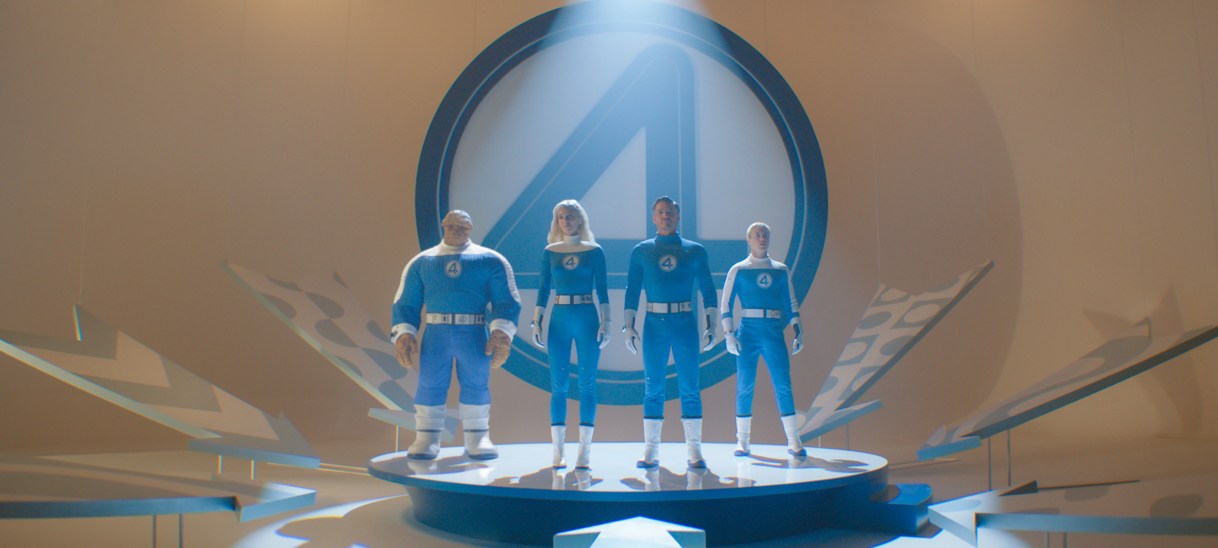
the Fantastic Four, led by Reed Richards and Sue Storm, brought to life better than ever by Pedro Pascal and Venessa Kirby, and flanked by Ben Grimm (Ebon Moss-Bachrach) and Johnny Storm (Joseph Quinn), arrive on screens in an Jetsons-themed alternate reality giving them the freedom of not needing less compelling super friends to give passing screen time too. Portrayed with enthusiasm and sincerity that reflects outwards into the whole film while still avoiding a saccharine mawkishness, making this Fantastic Four entry feel like a delightful throwback.

Four years into their journey, that is just settling in until the unexpected arrives both in-house and extra-terrestrially; the surprising pregnancy of Sue and the arrival of the Herald of Galactus (Ralph Ineson), The Silver Surfer (played with a pride and melancholy by the great Julia Garner), spelling doom for the Earth.

Joseph Quinn and Pedro Pascal in The Fantastic Four: First Steps

Building a competent film around these four characters has proved difficult in the past (this is the fourth go around for the crew in cinema, maybe they needed the luck?), but writers Eric Pearson, Josh Friedman, Jeff Kaplan, and Ian Springer have found success by properly centering the four actors, allowing plot and CGI battles to whizz past their family sci-fi soap opera. Told with sincerity and a deep love of the characters strengths and weaknesses, Shackman is allowed to stretch out and tell a full story, showing the potential from his directorial work on WandaVision (2021), perhaps the only successful Marvel TV show post Daredevil, even if it relied on a lazy final battle to conclude its story.

By centring two terrific performers who have shown the ability to operate in an old Hollywood mode, Pedro Pascal (in full Clark Gable mode) and Venessa Kirby jump off the screen with a chemistry and guile built from the characters out. Even as the world around them monumentally shifts with the arrival of a new child and a new Earth-destroying threat, we constantly see them lock eyes and respond to each other with a depth of understanding and empathy that wouldn’t be amiss in an awards season marriage drama. Pascal is at his best as a supportive scene partner, an invisible hand that allows others to shine instead of absorbing the audience’s attention.

Rounding out the team is Ebon Moss-Bachrach and Joseph Quinn who have an easy banter built on warmth and care that adds to scenes. Quinn in particular is given a full story that is surprising and compelling, improving on the reductive framing we often see of the Human Torch.

A refreshing turn in the superhero genre that is potentially in its death throes, The Fantastic Four: First Steps focuses on an older sci-fi genre package with longer dialogue scenes, fewer action moments with a passing amount of care and attention to story, and a visual language that mostly grounds itself in its own reality (several scenes still feel deeply 2020s which the film seemed intent on avoiding in its first hour).

Pedro Pascal in The Fantastic Four: First Steps

With special effects that actually looked like the VFX team was given time to fully render and actualise ideas from scratch, The Fantastic Four: First Steps withheld the action at the centre of the story in place for a simple but emotive narrative built on a new, emerging family. Even Galactus, once portrayed as a large cloud in a film too embarrassed by its own sci-fi story, is given a tactile nature and a quality performance by Ineson, perhaps the best voice in the industry. In few words, Ineson displays a menace to his words but a clarity in character motivation one wouldn’t expect from an enormous villain desperate to consume planets. It’s not just that Shackman found space for the key six characters to show dimension and character through considered relationship work within a sci-fi framework; it’s that we could achieve this while wrapping up the film in under two hours. 

The Fantastic Four: First Steps is a fast-moving train that has a real destination in mind, an aspect of American genre storytelling we took for granted and allowed to bloat and stagnate, too satisfied with its own navel-gazing to realise they were left as the only people looking. With a recent run of superhero films, Thunderbolts* (2025), Superman, and The Fantastic Four: First Steps, we are potentially rounding the corner into the enjoyment and craft that built this genre into the cinematic tentpole that it strives to hold onto.

By giving these characters a fully rounded narrative that satisfies more than stringing you along with the promise of a larger experience in the future, Shackman and co have achieved what was supposed to be the goal of cinematic genre storytelling; something familiar and something new, contained in an entertaining and sometimes emotional time at the movies. Where James Gunn’s Superman stretched far and wide to populate his emerging franchise venture, making for a fun but frustrating experience, The Fantastic Four: First Steps focuses on a small collection of characters where the biggest spectacle is the arrival of a new family member, the largest event in most audience members’ lives as well.

The Fantastic Four: First Steps is in theatres now.

Drop: First Date Nerves come into Full Force in this Cheeky Thriller

Rating: 3 out of 5.

Drop preview screening provided by Universal Pictures.

Have you ever been on a date where you’re getting random AirDrops from someone in your vicinity, threatening your family unless you kill your date? Me neither, and that’s another reason I’m sticking with Android. But mobile ecosystems aside, that’s exactly what Christopher Landon’s (2017’s Happy Death Day and 2020’s Freaky) textbook thriller, Drop, anchors its focus around for its tight 90 minute runtime. As far as thrillers go, Drop is neither groundbreaking nor is it something you’ll be eager to revisit, but it’s kooky and self assured in an M Night Shyamalan-esque way with a neat twist at the end.

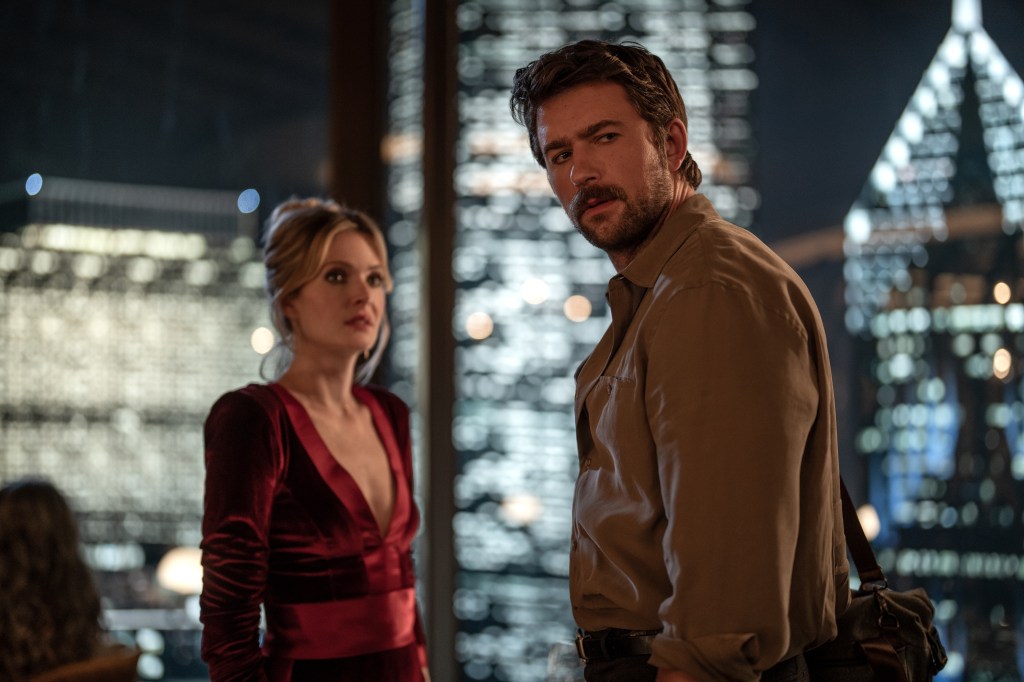
That approach will fly with audiences who like cheesy dialogue that regular people probably wouldn’t say, and movies that take a simple activity like a date and give it some sinister flavour. Landon’s film captures the angst of putting oneself back into the dating sphere by taking single mum Violet (Meghann Fahy) and having her meet up with Henry (Brandon Sklenar) in a highrise restaurant for the first time after 3 months of texting.

Similar to other Screenlife movies that focus on the dangers of screen culture like Searching (2018) or Missing (2023), Landon’s film builds its tension by capturing the modern dread of being watched, of having multiple eyes on you through surveillance or simply using your own surveillance against you. The latter is true for Violet who, after settling in with her date at the dinner table, is told to check her security cameras by her anonymous AirDropper where she sees a masked man in her house with a gun, with the choice being: do as I say or we kill your sister and son (if her first date jitters around what to wear weren’t scary enough, that really complicates things).

(from left) Violet (Meghann Fahy) and Henry (Brandon Sklenar) in Drop, directed by Christopher Landon.

This is where Landon’s film kicks into gear as it wastes no time in building out all of the directions that Violet will have to follow while focusing on keeping her date going as smoothly as possible. Fahy and Sklenar’s dynamic is what the film really banks on to sell the premise, with little actual room to cut to anything beyond the restaurant. There’s also the added element of shifty side-characters, all of whom could be the AirDropper making her life difficult; whether it’s the boisterous first-time waiter, the distant bartender or the Jamie Dornan-looking businessman who can’t seem to stop running into Violet (literally) — Drop is to Knives Out (2019) what mini-golf is to golf… a smaller playing field but just as satisfying.

The title, a play on words, might also describe the shift in pace in the final third, where there is almost a literal drop as the heat intensifies and as plot threads start to come together. For one, Violet literally hangs out of the highrise by a tablecloth. While this final third does feel like it’s been crammed into an otherwise tight screenplay, it gives the film some added momentum, even if the result feels like it gets away from the better part of the build up to it. That said, Drop is clean and will get a chin scratch or two as you try to piece together its puzzle, and proves that you may never know where your next date might take (or drop) you.

Drop opens nationally from the 17th of April.

The Alto Knights: Robert De Niro Delivers a Dual Performance in a Modern 80s Crime Film

Rating: 2 out of 5.

The Alto Knights preview screening provided by Universal Pictures.

While the odd gangster film does pop up every now and then, the genre has felt like it’s been on life support for the better part of ten years. With misses like The Many Saints of Newark (2021), Capone (2020) and Gotti (2018) coming to mind, it’s no surprise why that feeling is in the air. The Alto Knights isn’t a terrible film for the genre, but it doesn’t exactly have the legs to stretch beyond being simply another story about honouring a code and betrayal between close friends.

Knowing that Barry Levinson’s film has been in development since 1970 gives a world of perspective in understanding how this subject matter and story would have been eaten up in the heyday of the genre. The fact that this has been released in 2025 to audiences that have either seen the genre be done to death or are seeking out alternative stories, hasn’t worked in its favour. That’s not to say that these stories can’t work for modern audiences, with The Irishman (2019) providing a unique look at ageing crime figures mixed with wider political commentary, while Killers of the Flower Moon (2023) is masked as a crime-thriller but uses themes from the genre and orients them around Native American plights in history (the difference being, you guessed it, Martin Scorsese).

The Alto Knights, by contrast, is slow, it’s weighty, and it doesn’t reinvent itself or its framing of events in a new and crisp way for the genre. It’s a by-the-books gangster drama that cuts to one of Robert de Niro’s two characters, Frank Costello, looking down the barrel of the camera and narrating various parts of the film. It’s a shortcoming of the film that speaks to the rest of the exposition and general hand-holding that’s overdone in its roughly two-hour runtime (modest, for this sort of film). But The Alto Knights isn’t inherently bad, rather, it’s just a bit too textbook for my taste in that it doesn’t really offer much we haven’t seen from some of those aforementioned similar films.

Caption: Robert De Niro as “Vito Genovese” in Warner Bros. Pictures “THE ALTO KNIGHTS,” a Warner Bros. Pictures release.

Taking place across different time periods, but mainly in the mid to late 50s, Levinson’s film focuses on the friendship and betrayal between Frank Costello and Vito Genovese (both played by Robert De Niro). After Costello survives an assassination attempt from one of Genovese’s henchmen, Levinson takes us back in time from the incident to show us how the duo got to that point of division. It sees familiar tropes like courtroom scenes and political unrest take place as power dynamics switch from one boss to another, in this case from Genovese to Costello.

De Niro plays both characters with a classy, but sharp edge that’s like child’s play for him at this point. The supporting cast aren’t nearly as interesting as his dual performances though, with many of the actors bordering the line of “too much wise talking” while lacking the screen presence to match De Niro (even Cosmo Jarvis is relegated to a mumbling mafioso, a ways away from his breakout performance in hit series Shogun).

The script sometimes feels contrived, in part because there’s clearly a lot going on to the point where we need De Niro speaking all of the exposition, and the jumps in time don’t exactly help, with part of me wondering whether a version exists that doesn’t become bogged down in the final third where the pace begins to falter after we’ve finally caught up to all of the backstory.

The Alto Knights is a been-there-done-it kind of crime film, one that feels like it’s come a bit too late to have its subject matter and story land, but it hits the beats we’ve come to expect from similar films. For what it’s worth, seeing De Niro saddle up for any mobster film is a blessing, no matter how many times he does them, but where The Irishman felt like a capstone of sorts to the genre and the actors who brought it to life, The Alto Knights doesn’t quite find the same level of ingenuity.

The Alto Knights opens nationally from today.

MIFF 2024: Powerful Performances Amplify the Trauma of Memory

Rating: 3.5 out of 5.

Screener provided as part of MIFF 2024

With heavy handed issues such as dementia and rape, films always run the risk of oversimplification and misrepresentation in less-than capable hands. Michel Franco’s Memory (2023) tackles these issues with a sincerity and empathy that doesn’t demote or reduce them, but rather examines them from the perspective of two struggling souls.

It’s through Sylvia (Jessica Chastain), a recovered alcoholic who was raped when she was 12, and Saul (Peter Sarsgaard), a widower with onset dementia, that Franco’s examination unfolds. If the situations of the two aforementioned characters are anything to go by, Memory is the sort of film that could very easily tailspin into, and be written off as, a grim and depressing sob story that treads old ground that similar films have already excelled at (like 2020’s The Father); fortunately, it does not.

The film’s tone is set from the outset, with Sylvia attending an AA meeting with her daughter, immediately establishing the sort of emotional roller-coaster that awaits. Clearly in a better place in her life now, Sylvia’s past deliberately remains unclear for most of the film (at least until a wider reveal in the third act) to ensure that enough tension remains throughout the modest 99-minute runtime.

Franco frames her as uneasy and on-edge, as she pedantically locks her apartment door, sets her alarms and assumes a guarded position when in uncomfortable situations, something that she extends to her daughter in an instinctively maternal, but overprotective, way.

It’s not until an evening at a high-school reunion, that the direction of Memory becomes clear. Sylvia is followed home by a man who casually approached and sat next to her, going so far as to sleep outside of her apartment in a tyre with nothing but a rubbish bag as a blanket. Saul is his name, and Sylvia quickly finds out that he’s not well.

It’s from here that Franco takes the duo and their past and current problems, and uses them as a catalyst for exploring how peoples situations and serious problems can so easily be reduced by those closest to them, that these people ultimately gravitate towards other troubled souls to find solace and understanding. And that approach is felt mainly because Chastain and Sarsgaard deliver profoundly moving and complex performances. The duo capture the trauma and pain their characters are going through in a way that elevates what, on paper, could have been a very basic thematic exercise that comfortably ticks the sort of boxes you’d expect from a film about grief.

Sarsgaard is subtle as Saul, giving enough from his performance to capture a man who is on the brink of losing his sense of self, while never losing the warmth he brings that draws you in; in this way, I was reminded a lot of Robin Williams’ Oscar-winning performance in 1997’s Good Will Hunting. Chastain is just as compelling, playing off of Sarsgaard effortlessly, and giving greater depth to Sylvia the more the two are on the screen together, slowly opening up as she builds trust for him after being asked to be his caretaker by his brother. It’s hard to take your eyes off of them, and if there is something that will stick with you beyond the end credits, it’s definitely the choices they make in bringing these characters to life.

Bubbling beneath the surface of the film’s central duo is a dysfunctional family thread that, while relevant in understanding the circumstances of Sylvia’s situation, does almost pop up at a wobbly moment. That said, it speaks to the idea that there never really is a great time to confront your past, especially when it’s as harrowing as Sylvia’s — it just presents itself in a tacked-on kind of fashion (especially when the film is at its strongest when it’s solely with Sylvia and Saul).

While the relationship that develops between Sylvia and Saul might not sit comfortably with everyone (given Saul’s growing dementia and need for specialist care), Memory asks its audience to see beyond circumstance and try to empathise with two damaged human beings who understand each other more than their own families do — something that its non-ending ending, invites.

Memory will be screening as part of MIFF 2024 in August.

Furiosa: A Mad Max Saga: George Miller’s Return to the Wasteland is just as Chaotic and Fun as Ever

Rating: 4.5 out of 5.

Melbourne premiere screening provided by Universal Pictures

How does one follow up one of the greatest action films of all time? In George Miller’s case, he doubles down: double the car chases, double the explosions, double the chaos, double what’s happening in the mise-en-scene, and double the fun. But Furiosa: A Mad Max Saga should not be seen as an attempt to outdo Mad Max: Fury Road (2015), even though it speaks (sometimes explicitly) to the idea of making something epic and memorable, as though that wasn’t already achieved with the sequel.

Tonally, visually and sonically, Furiosa is on par with Fury Road which makes complete sense for the simple reason that it’s a prequel that’s there to compliment, and there’s not someone else in the director’s seat to screw it up. It’s clear that Miller went with a ‘if it ain’t broke, don’t fix it’ mentality when approaching this film, and the result is all the better for it. The biggest deviation to be felt in Furiosa is that, while it lives in the universe of Mad Max, it isn’t about him. In fact, Fury Road wasn’t exactly about him either, with these two films carving out their own place as post-apocalyptic, operatic action epics with larger-than-life stakes beyond a bloke called Max. But nonetheless, Furiosa is the character we follow and the focal point that guides our understanding of where Fury Road begins and ends.

Taking place across five chapters, Furiosa opens with the titular character (played in youth by Alyla Browne) in the green haven she attempts to return to throughout Fury Road. After noticing bandits ravaging through the haven, she tries to sabotage their bikes and alert the rest of her people of their presence; unfortunately she’s captured in the process, leading her mother (Charlee Fraser) to give chase. Eventually, Furiosa is brought to the bandits leader, Dementus (Chris Hemsworth), who is looking for his own means of survival along with the rest of his pack of bikers.

Chris Hemsworth in Warner Bros. Pictures’ action adventure “FURIOSA: A MAD MAX SAGA,” a Warner Bros. Pictures release.

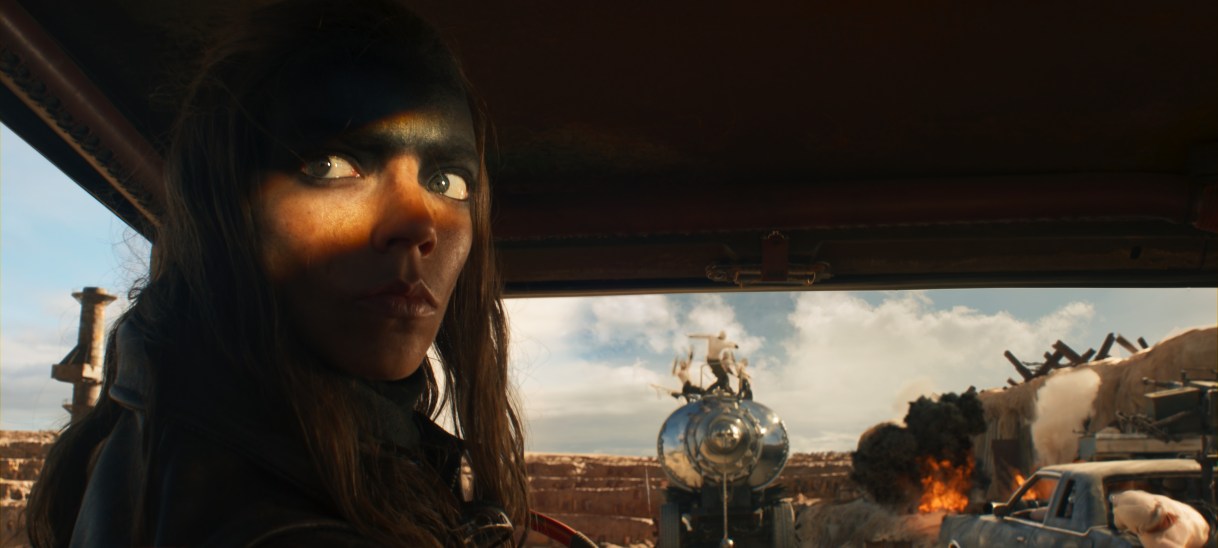
It’s from here that Miller reintroduces familiar aspects from Fury Road, namely Immortan Joe (Lachy Hulme) and his goofball sons; Immortan’s white army of War Boys; and the Citadel. The first hour or so of the film focuses on Furiosa’s navigation of this space after she finds herself a captive of sorts (for reasons I won’t spoil). Alyla Browne does a fantastic job at setting the foundations of Furiosa’s arc to the point where, when Anya Taylor-Joy eventually takes the reigns after an hour, it’s not immediately apparent because of how alike the two actresses are with their pronounced blue eyes and Miller’s focus on framing them in tight close-ups.

Once Taylor-Joy is at the helm, Miller throws her into a extended chase sequence with Praetorian Jack (Tom Burke in a minor, but effective role) onboard an oil tanker, the War Rig. It echoes the chase from Fury Road where Furiosa deviates from her oil run to Gastown, but here Miller is much more interested in stretching the tension out as much as possible, almost to breaking point. It really speaks to his penchant for destruction and his eye for detail, where every nook and cranny of the truck, gears and all, is on display and pushed to the limit.

It takes some time to buy into Taylor-Joy’s performance, namely because it feels like she trying too hard to fill Charlize Theron’s boots rather than carve out her own little space for this character. Theron’s commanding screen presence, particularly the way she carries herself, is ultimately too pronounced for Taylor-Joy — she even tries to mimic her cadence of speaking — and subtlety is more effective here (which Browne brings). But Taylor-Joy does offer a level of vulnerability through her enchanting eyes; in this sense it’s easy to see why Miller might have chosen her as the lead.

Tom Burke as Praetorian Jack and Anya Taylor-Joy as Furiosa in Warner Bros. Pictures’ action adventure “FURIOSA: A MAD MAX SAGA,” a Warner Bros. Pictures release.

Hemsworth, by contrast, steals every scene he’s in, even when he goes missing for some stretches of time. Where the Thor films misplaced his larrikin humour (often at the character’s expense), Miller gives him the freedom to lean into it in a way befitting a character with a name like Dementus. His brute physique coupled with his nasally way of speaking gives Dementus a memorable edge, especially with all of the quotable lines he’s given.

Adding to the grandiose and scale of what’s on display is the fact that the Wasteland’s harshness is felt to an equal (if not greater) degree than in the first film. The addition of locations hinted at in Fury Road, like the aforementioned Gastown and Bullettown, adds weight to the stakes at play. There isn’t just more for the sake of having more, but rather Miller deliberately leaves no stone unturned and paces his film like the War Rig barrelling down a stretch of road — there’s no room for respite, you just brace yourself and try to hold on for the ride.

For what it’s worth, it’s a gorgeous ride to be had, with the visuals once again being enveloped in this orange, grainy tinge. Where in Fury Road the colours felt less saturated, there’s a much more surreal, darker quality this time around.

This is ultimately a film about Furiosa though, and her story never feels like it’s compromised or diluted for the sake of brandishing all of the fun and games that audiences will expect. Miller is a master at knowing how to capture human plight and not let it be overshadowed by the scale of his pictures. The human element of his films and this portrayal for struggle is what intensifies every car flip, gun shot and extraordinary set-piece, which is why it’s even more commendable that in a film full of incredible moments, Furiosa never loses sight of Furiosa.

Furiosa: A Mad Max Saga opens nationally from the 23rd of May.

The Fall Guy: Ryan Gosling and Emily Blunt Amplify David Leitch’s Ode to Stuntwork

Rating: 3 out of 5.

The Fall Guy Melbourne Premiere provided by Universal Pictures

Car flips, ramp jumps, countless explosions and high tumbles are just some of the obstacles that stunt people face, and David Leitch’s The Fall Guy has them all. Leitch’s film seeks to celebrate the unsung heroes of stunts by putting two of Hollywood’s hottest properties, Ryan Gosling and Emily Blunt, in the driver’s seat and letting them run amok.

Stuntman Colt Seavers’ (Ryan Gosling) life takes an expected turn after a stunt-gone-wrong puts him out of the business for over a year. To make matters worse, he’s derailed a relationship with another crew member, cinematographer Jody Moreno (Emily Blunt) after ghosting her in the time since. But it’s not until a phone call from producer Gail (Hannah Waddingham), begging him to return to stunt work on a film that Jody is now directing, that his life really takes a turn. And that’s because amidst his awkward return to facing Jody, he’s also been tasked with locating the film’s missing star that he stunt-doubles for, Tom Ryder (Aaron Taylor-Johnson).

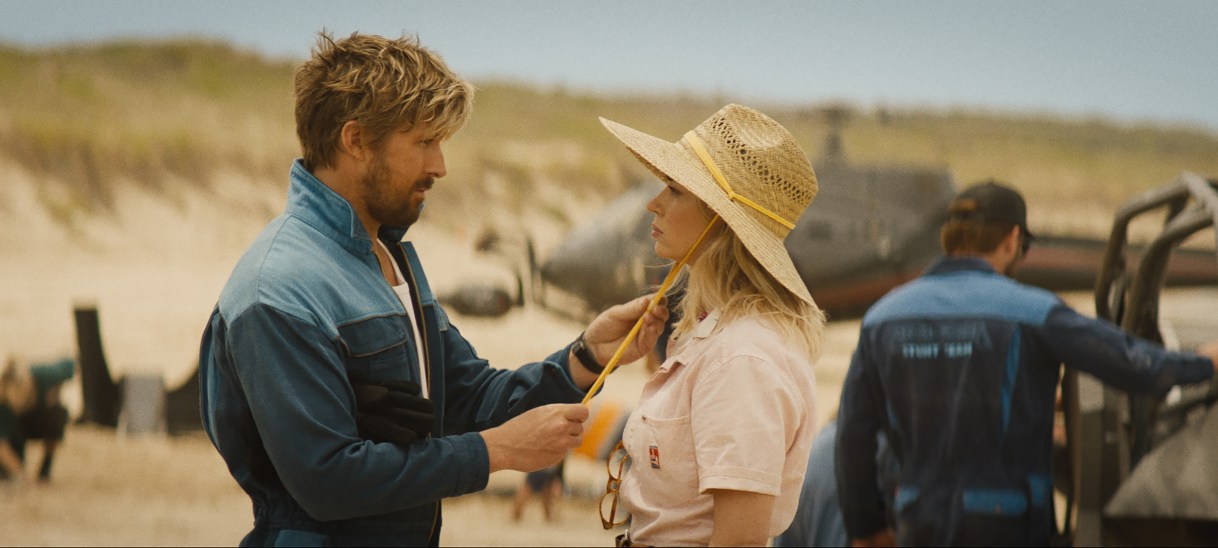
On paper, it’s hardly a unique premise, but it lends itself to a rampant few hours at the cinema, largely because of Gosling and Blunt’s on-screen chemistry. The duo, fresh off of their 2023 blockbuster hits Barbie and Oppenheimer, respectively, seamlessly work off of one another here.

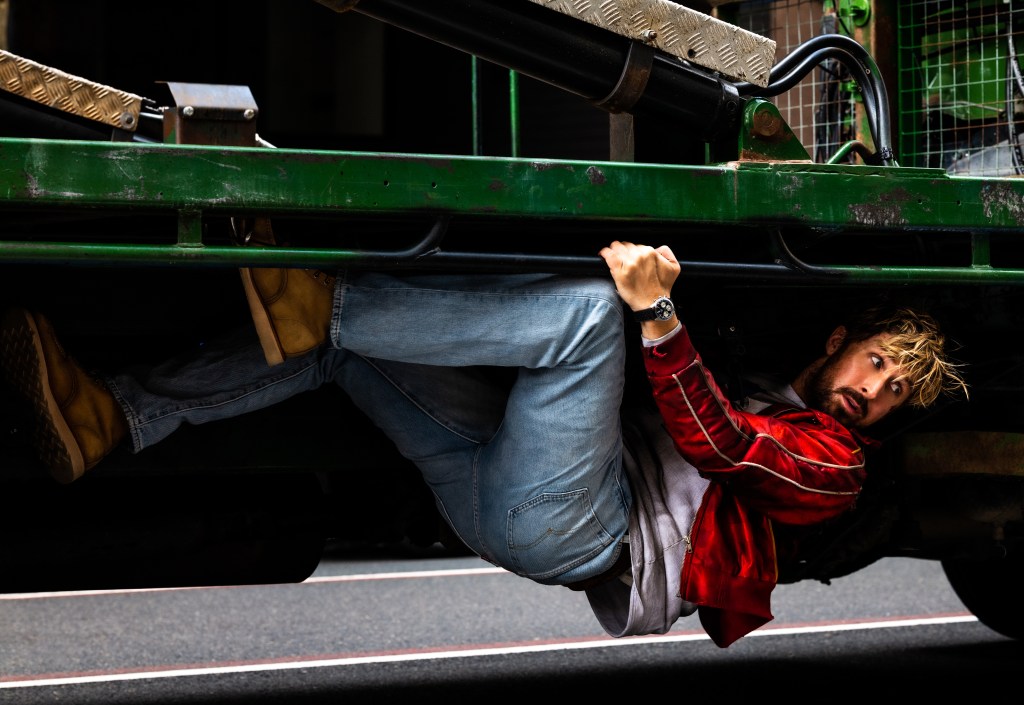
Gosling has a penchant for dry humour, as evidenced by his straight faced delivery of lines, but he’s also an incredibly versatile actor and it shows here as he effortlessly exudes charisma —at once being able to cry in the car to Taylor Swift’s ‘All Too Well’ and then go and burst through a door like a clumsy Jackie Chan. Blunt matches him in her charm, where she finds a balance between being obliviously innocent and a straight-up butt-kicking baddie.

Ryan Gosling is Colt Seavers in THE FALL GUY, directed by David Leitch

The duo are really the heart and soul of the film, which sometimes gets caught up in its own self-reflexivity. Characters will often call out wider pop culture references (Winston Duke’s character slams a bad guy through a table while shouting “Dwayne Johnson!”) and sometimes the writing doesn’t take itself seriously enough, leading to a feeling that the stakes just don’t feel that important —or the wider “why should I care if you don’t” aspect that Leitch’s films are notorious for.

Make no mistake, this is a film that revels in blowing everything out of proportion, so much so that it affords little respite. There are boat chases, three major ramp jumps, a sequence where Gosling is tripping on psychedelics and seeing unicorns, street chases throughout Sydney (which has never looked better), and a closing sequence that is committed to blowing things up.

In other words, Leitch (a former stuntman himself, famously for Brad Pitt) and lead stunt coordinator Keir Beck are all-in on going as big as they can and as fast as they can. For the most part they achieve that as the film rarely gives you a moment to stop and think, at times to its own detriment (the third act resolves in a rather eye-roll moment of spewy exposition), but at the same time that’s the name of the game as stunt people rarely hesitate.

Whether or not the stunts themselves will stand the test of time in the same way Tom Cruise throwing himself off of a mountain face will, isn’t clear. For the most part they’re great in the moment, but I wouldn’t call them memorable, especially when it’s Gosling and Blunt who will steal the accolades for their effortless banter. But Leitch (like Chad Stahelski with his John Wick franchise) knows the stunt game better than anyone, and The Fall Guy delivers the popcorn filmmaking goods while celebrating the bodies behind the actors.

The Fall Guy opens nationally from the 24th of April.

Challengers: Tennis and Sexual Tension are Blended Together in Luca Guadagnino’s Latest

Rating: 3.5 out of 5.

Challengers preview screening provided by Universal Pictures

Challengers feels like both a breath of fresh air for sports movies and a film struggling to find air, mainly because it’s less about the act of winning and more about savouring the build up to a point, soaking in the tension, and when Luca Guadagnino is the director, pushing the boundaries of continuous edging that only free spirited, experimental youths seem to bring. Make no mistake, tennis is the lens through which we untangle Guadagnino’s webs and fascination with youths being unorthodox, but this is by no means a sports rags-to-riches story like King Richard (2021) or a light-hearted underdog tale like Next Goal Wins (2023).

It follows two up-and-coming tennis prodigies, childhood friends Art Donaldson (Mike Faist) and Patrick Zweig (Josh O’Connor), and an established youth pro, Tashi Duncan (Zendaya). Things get a little complicated for this trio who meet long before Art becomes a touring pro and Tashi, his coach and wife. In fact, Guadagnino’s film takes many turns, often dovetailing from one moment in time to another, with Marco Costa’s editing giving the film this back-and-forth rally like quality, sometimes a bit too excessively but enough to keep you on your toes.

We open in the present, where Art’s game isn’t as great as it once was and Tashi signs him up for a challenger event in New Rochelle to find some flair before the US Open. Unbeknownst to Art, Patrick, now his former friend, will also be competing. It’s from here that Guadagnino cuts between the present and the past, sometimes for a matter of days, other times for years. It becomes clear that there’s some unresolved history between the trio who first met 12 years ago at a juniors tournament where they hit it off both on and off the court.

Zendaya as Tashi in CHALLENGERS, directed by Luca Guadagnino, a Metro Goldwyn Mayer Pictures film. Credit: Niko Tavernise / Metro Goldwyn Mayer Pictures © 2023 Metro-Goldwyn-Mayer Pictures Inc. All Rights Reserved.

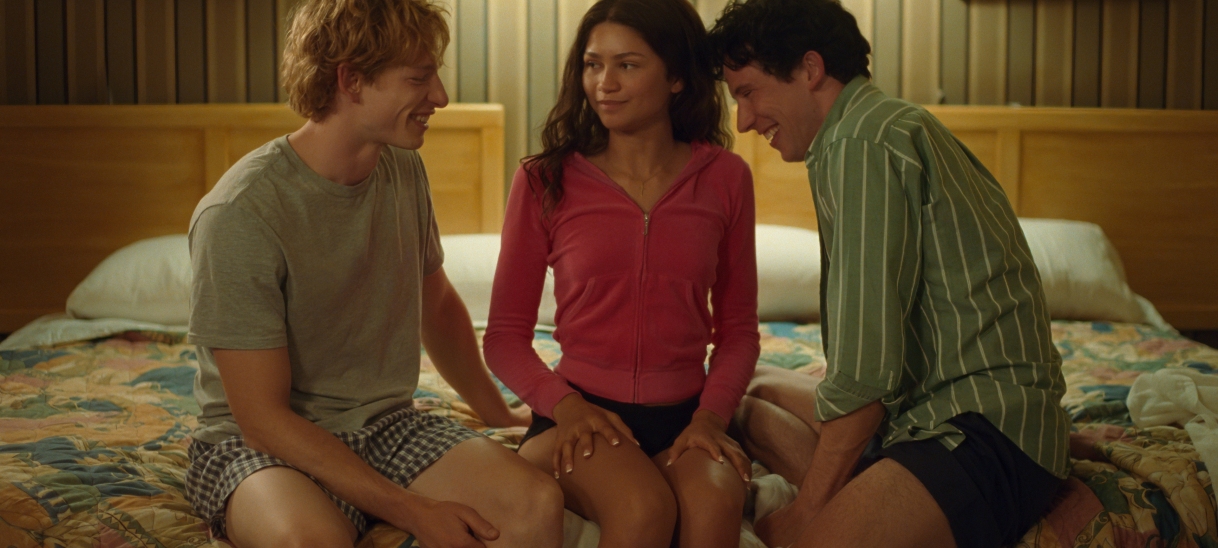
Guadagnino, an expert at extrapolating meaning from odd situations, uses Tashi as a catalyst for carnage, or to put it in her own words, a “homewrecker”. From early stages, her motivations aren’t entirely clear in terms of her fascination with the duo —there’s a steamy scene where the trio lock lips before Tashi pulls back and leaves Art and Patrick still going at it before she admires her work and ducks out— but she’s clearly the focal point that pushes the narrative forward. And that’s largerly because Zendaya does a great job at conveying this larger than life presence, mainly since that’s how she’s perceived in pop culture more broadly. Guadagnino is able to tap into that to a greater degree, working with cinematographer Sayombhu Mukdeeprom to box her into the frame through tight close-ups and really portray her as a figure of authority who has a grip on Art and Patrick that can’t be shaken off.

The enjoyment of the film comes from the tension that is bubbling beneath the surface, after all this is a story about competing and winning no matter the cost. That’s at least the mentality that Tashi has instilled into both Art and Patrick who, no matter their rankings in the wider sense, constantly seem to be tussling with one another. At the same time, this tussle seems to be less about proving anything to themselves and more about proving something to Tashi.

Ultimately, tennis provides the perfect platform for Guadagnino to pivot such ideas against one another, with the underlying horniness of it all working to give the film a unique edge —especially when paired with Trent Reznor and Atticus Ross’ pulsating techno score which further breathes life in any given moment. Whether or not this is the sort of film you’ll walk away from and continue to ponder isn’t clear, especially with an ending that doesn’t exactly prod you to ask any more questions but almost leaves you wanting more answers in the same unfulfilled way the trio have been all movie.

Challengers opens nationally from the 18th of April, 2024.

Monkey Man: Dev Patel Channels his Inner John Wick

Rating: 3.5 out of 5.

Monkey Man preview screening provided by Universal Pictures

It doesn’t take long for Monkey Man, Dev Patel’s directorial debut 10 years in the making, to thrust you into a world teeming with injustice, blood and grime. In fact, it’s there from the outset following a short monologue describing the backstory to an Indian legend, Hanuman, that drives much of the film’s undertones.

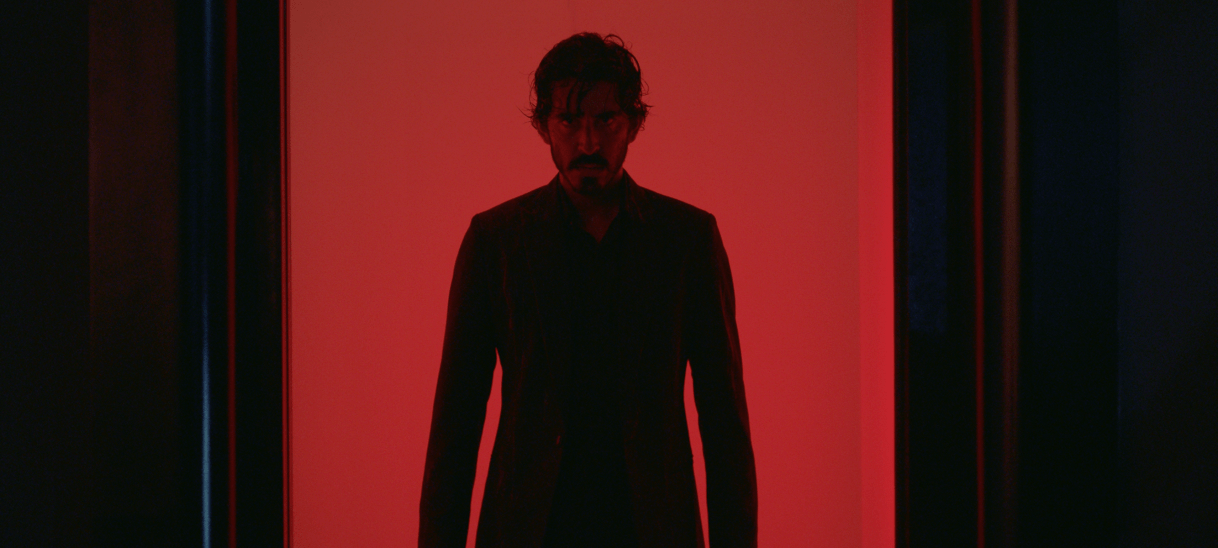
Monkey Man is a brutal revenge thriller charting a man’s rise from blood soaked human cockfighting in the slums, to the bustling streets of the vibrant, fictional Yatana city beyond. It’s not unlike similar action revenge flicks of recent times like the John Wick series (which it even name drops) or Nobody (2021), yet it retains a level of verisimilitude through its distinguishable identity that Patel has clearly spent time trying to workshop on top of the frenetic fight sequences.

Kid (Patel) has experienced loss at the hands of people in power (namely the police and its chief), and like John Wick, he’s all-in on enacting vengeance to those who did him wrong. As you’d expect, much of this film plays out in a rather formulaic fashion where we see our hero rise from the ashes and fall again before re-building himself up for once last hurrah.

Where Patel has tried to impose himself on the genre is by weaving in the aforementioned legend of Hanuman to imbue the character with a purpose that extends beyond simply trying to kill and be done with it. Ultimately this never really lands in the way Patel might hope it would, with large chunks of the second act often falling flat when away from the action while Kid is nursed back to health following a failed assassination of Rana (Sikandar Kher as the film’s prime adversary) and attempt to flee. This dip takes away from the momentum that has been building up in the moments prior and feels like Patel is trying to get all of his eggs in a basket in ways that similar directorial debuts tend to go —and that’s not surprising since the film was in limbo for a while until producer Jordan Peele practically ‘saved’ it.

MONKEY MAN, directed by Dev Patel

Yet when Monkey Man is hitting, it’s really hitting, and that’s through the well crafted hand-to-hand and gun combat that is reminiscent of classic Bruce Lee titles like Enter the Dragon (1973) or fellow suit-wearer John Wick’s tussles, respectively. There’s a greater freedom in these sequences with Patel experimenting a bit more and having fun with the affordances of breakable chairs, glass and the wider space of these fancy venues (there’s even a few knife and axe moments that had me squirming).

By the time the third act has rolled around Kid is a fully fledged badass who has embraced his proverbial destiny. It opens the film up from the shell it became in the second act and is really where it’s at its best. Some of the political tendencies that Patel tries to inject feel forced in this third act and really reiterate that the film just has too much it wants to say but not the leg room or the chops to do so. The punches in the film land great, the subtext, not so much. Then again, this is a director finding his voice, and if Monkey Man is anything to go by, this won’t be the last we see of Patel behind the camera, and that’s the best hit of the bunch.

Monkey Man opens nationally from the 4th of April.

Kung Fu Panda 4: Po and Co Return for a New but Familiar Adventure

Rating: 3 out of 5.

Kung Fu Panda 4 preview screening provided by Universal Pictures

It’s been nearly 16 years since the first Kung Fu Panda film graced our screens and introduced audiences to the fun loving, butt kicking Dragon Warrior, Po (Jack Black), yet you wouldn’t think a day has passed. A large majority of older animations that have had sequels years later tend to show just how dated the animations of their predecessor are in comparison; by contrast, the latest entry in this franchise looks just as vibrant and polished as it did all those years ago.

The same can’t be said for the story, which feels like it’s treading old ground by returning a character who has reached the peak of his powers to a point where most franchises tend to begin (including this one). Eight years have passed since Kung Fu Panda 3 (2016), but as the beauty of animation so allows it, time moves much much slower. Po (Jack Black), having seemingly cleared the Valley of Peace of all adversaries and cast them into the Spirit Realm, must now select a new Dragon Warrior to take his place. As expected, this doesn’t make sense to him, no matter how much Master Shifu (Dustin Hoffman) tries to remind him that he has a new purpose to assume: that of Spiritual Leader of the Valley. Stubborn and set in his ways, he reluctantly agrees.

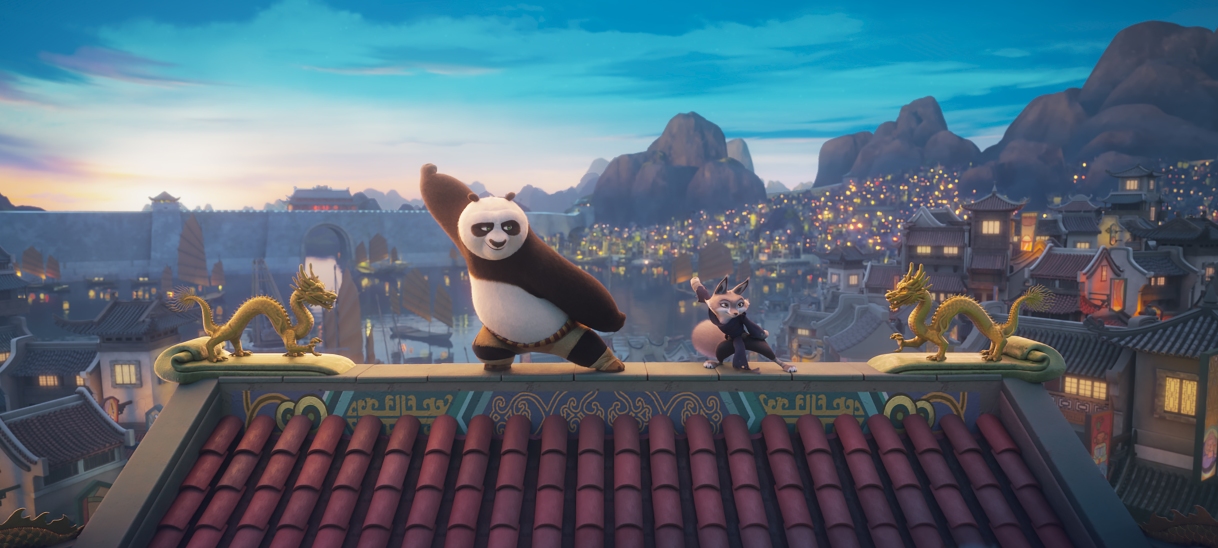
It doesn’t take long for his focus to shift though as word of the return of Tai Lung (Ian McShane), Po’s foe from the first film, reaches his ear. But things aren’t as they seem, with Po coming to realise a new threat has emerged in the form of the Chameleon (Viola Davis), a shapeshifter set on luring Po and his Staff of Wisdom from the Valley and enacting her own sinister plans. Naturally, Po’s curiosity gets the better of him and he decides to pursue the Chameleon along with the help of Zhen (Awkwafina), a thieving fox who agrees to take him to the Chameleon after being captured while trying to steal a bunch of precious artefacts from the temple in his town.

(Center) Chameleon (Viola Davis) in ‘Kung Fu Panda 4’ directed by Mike Mitchell.

So begins the duo’s quest from the Valley to Juniper City where the Chameleon resides. There are thrills and spills that keep them (and the audience) on edge; whether at a tavern on the brink of falling off a cliff where crooks of all sorts gather to gamble and stuff their faces, or through the streets of Juniper City where foot chases ensue —director Mike Mitchell has nailed the look and feel of the first three.

While a majority of the original cast, specifically that of the Furious Five —comprised of Angelina Jolie, Jackie Chan, Seth Rogen, Lucy Liu and David Cross— haven’t reprised their roles (much to this critic’s dismay), the heart of the film that is Po, returns with the same rampant energy and sincerity as he had in the first three films. And that’s largely owed to the cuddly and sincere Jack Black who consistently brings his A-game to any and every role he takes on. Black has carried this franchise on his voice and boisterousness alone, and he once again saddles up in the voice acting booth as though 16 years haven’t passed.

Joining him are some of those aforementioned familiar faces and voices from past entries including Mr. Ping (James Hong) and Li (Bryan Cranston) who have their own subplot as they venture out to help Po. The humour of the film is derived from their back-and-forths and while amusing, serves more as an afterthought especially in the absence of more thought-out plotting for the main quest.

(from left) Po (Jack Black) and Zhen (Awkwafina) in ‘Kung Fu Panda 4’ directed by Mike Mitchell.

As with most DreamWorks animations (and the best Disney animations), there’s always a simple moral underpinning the story. This time around it’s not being afraid of change which, in essence, was what the first film did so well in communicating especially given the stakes felt greater and Po had more to gain than lose. The message itself doesn’t lose weight per se, but it doesn’t land as meaningfully either which is perhaps owed more to the first three films rounding off really well as a trilogy and the fourth opening up threads that felt nicely closed.

Even still, Mitchell’s film is a breezy time at the cinema and never overstays its welcome. The animations are crisp and the world is teeming with goofy action that is reminiscent of the best parts of its predecessors —especially towards the closing sequence which contains some well executed kung fu fighting. Could more have been done in giving the script less of a repetitive feel? Definitely. Then again, this franchise has survived as long as it has because of Black’s penchant for comic timing and the unconventional hero arc of Po, and that’s the perfect recipe for further longevity if it so requires a fifth film.

Kung Fu Panda 4 opens nationally from the 28th of March.