The Alto Knights preview screening provided by Universal Pictures.
While the odd gangster film does pop up every now and then, the genre has felt like it’s been on life support for the better part of ten years. With misses like The Many Saints of Newark (2021), Capone (2020) and Gotti (2018) coming to mind, it’s no surprise why that feeling is in the air. The Alto Knights isn’t a terrible film for the genre, but it doesn’t exactly have the legs to stretch beyond being simply another story about honouring a code and betrayal between close friends.
Knowing that Barry Levinson’s film has been in development since 1970 gives a world of perspective in understanding how this subject matter and story would have been eaten up in the heyday of the genre. The fact that this has been released in 2025 to audiences that have either seen the genre be done to death or are seeking out alternative stories, hasn’t worked in its favour. That’s not to say that these stories can’t work for modern audiences, with The Irishman (2019) providing a unique look at ageing crime figures mixed with wider political commentary, while Killers of the Flower Moon (2023) is masked as a crime-thriller but uses themes from the genre and orients them around Native American plights in history (the difference being, you guessed it, Martin Scorsese).
The Alto Knights, by contrast, is slow, it’s weighty, and it doesn’t reinvent itself or its framing of events in a new and crisp way for the genre. It’s a by-the-books gangster drama that cuts to one of Robert de Niro’s two characters, Frank Costello, looking down the barrel of the camera and narrating various parts of the film. It’s a shortcoming of the film that speaks to the rest of the exposition and general hand-holding that’s overdone in its roughly two-hour runtime (modest, for this sort of film). But The Alto Knights isn’t inherently bad, rather, it’s just a bit too textbook for my taste in that it doesn’t really offer much we haven’t seen from some of those aforementioned similar films.
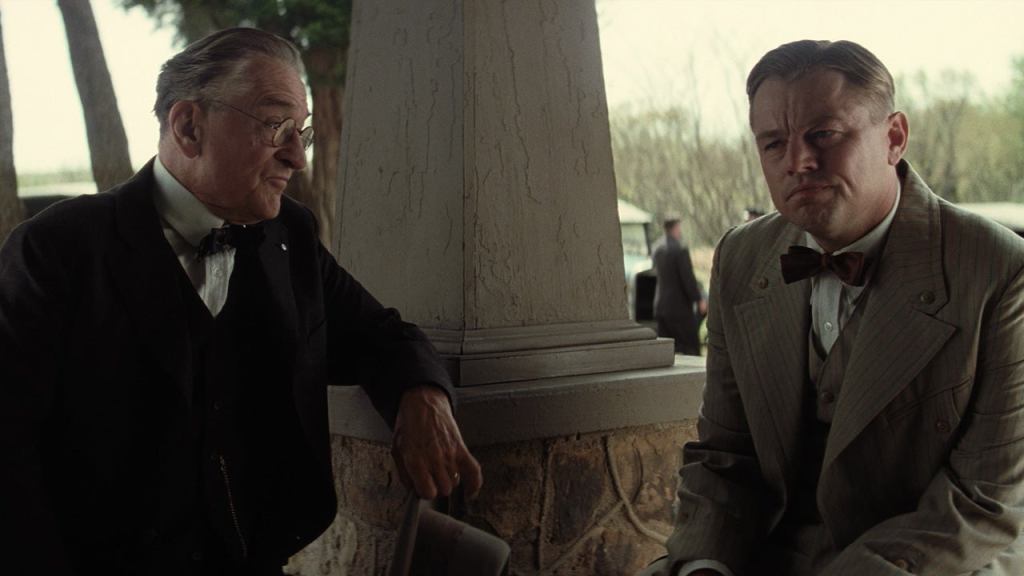
Caption: Robert De Niro as “Vito Genovese” in Warner Bros. Pictures “THE ALTO KNIGHTS,” a Warner Bros. Pictures release.
Taking place across different time periods, but mainly in the mid to late 50s, Levinson’s film focuses on the friendship and betrayal between Frank Costello and Vito Genovese (both played by Robert De Niro). After Costello survives an assassination attempt from one of Genovese’s henchmen, Levinson takes us back in time from the incident to show us how the duo got to that point of division. It sees familiar tropes like courtroom scenes and political unrest take place as power dynamics switch from one boss to another, in this case from Genovese to Costello.
De Niro plays both characters with a classy, but sharp edge that’s like child’s play for him at this point. The supporting cast aren’t nearly as interesting as his dual performances though, with many of the actors bordering the line of “too much wise talking” while lacking the screen presence to match De Niro (even Cosmo Jarvis is relegated to a mumbling mafioso, a ways away from his breakout performance in hit series Shogun).
The script sometimes feels contrived, in part because there’s clearly a lot going on to the point where we need De Niro speaking all of the exposition, and the jumps in time don’t exactly help, with part of me wondering whether a version exists that doesn’t become bogged down in the final third where the pace begins to falter after we’ve finally caught up to all of the backstory.
The Alto Knights is a been-there-done-it kind of crime film, one that feels like it’s come a bit too late to have its subject matter and story land, but it hits the beats we’ve come to expect from similar films. For what it’s worth, seeing De Niro saddle up for any mobster film is a blessing, no matter how many times he does them, but where The Irishman felt like a capstone of sorts to the genre and the actors who brought it to life, The Alto Knights doesn’t quite find the same level of ingenuity.
“Can you find the wolves in this picture?” As the simple Earnest (Leonardo DiCaprio) reads from a history book given to him by his uncle William “King” Hale (Robert De Niro) about the Osage Nation, to acclimatise himself to the new land in Oklahoma he has found himself in after returning from the war, we are not so subtly asked to investigate the frame of each scene. The land is almost entirely owned by the First Nations Osage community that, after being slaughtered and chased out of other states before finding themselves here, struck a reserve of oil on the land they had legal rights to, making them the richest per capita community in the world. And now their people are being brutally killed in careless succession, with the government nowhere in sight to investigate.
Killers of the Flower Moon (2023), a sprawling period crime epic based on the incredible best-selling nonfiction book of the same name by David Grann tracking the 1921 Osage Nation murders (potentially hundreds even though the reported count reached only 20), is the best film to arrive in theatres in years. An astonishing work of the clashing worlds of empathy and cruelty, the legendary director Martin Scorsese, alongside veteran screenwriter Eric Roth set out to explore and probe the original sins of white exploitation and destruction that dismantled a once thriving community in the Osage Nation.
Central to the story is Mollie Kyle (Lily Gladstone in the must-see performance of the year), and her family who were amongst the wealthiest in the community through their Osage headrights. From the opening moments of the film, the plan is established by the wolf Hale: set up his family to marry into and then assassinate Mollie’s family to gain their land through these headrights, with the newest entrant Earnest, Hale’s young (in reality Earnest was 19) nephew with nowhere else to go, to be placed alongside Mollie.
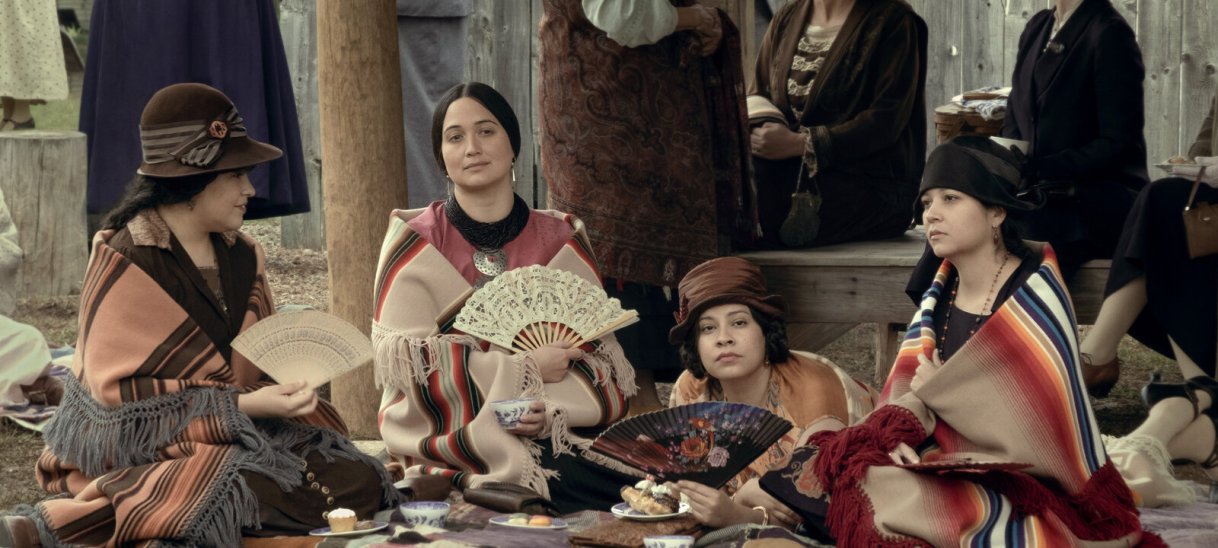
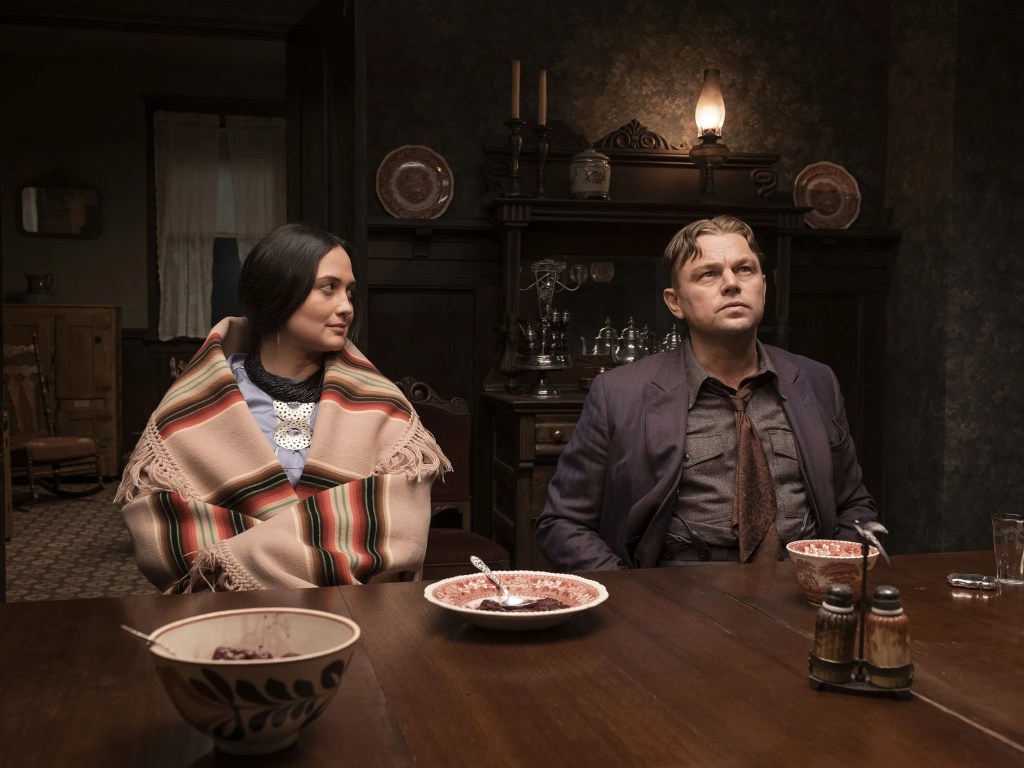
Lily Gladstone, Robert De Niro, and Leonardo DiCaprio in Killers of the Flower Moon
With a task as grave and serious about a community unfamiliar to their own, Scorsese and Roth’s script remarkably lands at a point of empathy and understanding they can reach as outsiders to this world. Scorsese’s self-reflective limitations as the person to tell this story are palpable throughout the film. This crime film’s capacity to tell a story of a community not his own arrives at a peak in a final sequence that may not evoke the same emotions in audience members as personal opinions of this vary (more on this later). However, it is disingenuous to wholly dismiss this remarkable film on those grounds, just as it is disingenuous to wholly dismiss the air of white guilt and limitations as storytellers that frame Killers.
The film is a surprisingly straightforward narrative story, using its 206-minute runtime to form as tight a compulsive story as is possible with Grann’s sprawling book, with the marriage of Earnest and Mollie at its core. There are many changes in structure and perspective to the book, with the most crucial being the shift in storytelling philosophy with the character of William Hale. In Grann’s book, the revelation of Hale’s orchestration of the gaining of head rights through systemic murders of the Osage Nation plays out closer to a whodunit true crime thrill ride that concludes with the formation of the FBI and the men that uncovered the truth — a sharp contrast to how the story is presented in the film. By changing the storytelling style from a whodunit into a bottomless well of foreboding dread through our connection to his character, Scorsese is tying us to the poison in his veins, feeling the bounds of the American condition and original sin within this vile man more directly.
Roth’s original screenplay focused on a more procedural whodunit that would’ve subbed as a perfectly adequate recreation of Grann’s book, centring early on Mollie and following onto Tom White’s (Jesse Plemons) role in the FBI investigation. Scorsese, in his first co-screenwriting credit since Silence (2016), alongside Roth, altered the perspective of the script, maintaining focus on Mollie and Ernest. In Grann’s book, the primary question being posed is: who is the culprit of these hideous acts? In Killers, the power of the storytelling comes from pursuing the more unanswerable questions at the core of their relationship and marriage: How can you do this to someone you believe to love? And how can you not see the root from which all these horrible events are stemming from? The boiling frustrations that stem from these probing, emotional questions are allowed to simmer across the entire extended runtime of the film, evolving into a profound sadness that will last with you a lifetime. Very few films attempt this level of emotional connection with the viewer, and even fewer films achieve it.
Lily Gladstone and Leonardo DiCaprio in Killers of the Flower Moon
What allows Killers to capture an audience’s hearts and minds across its extended runtime is the trio of performances by DiCaprio, Gladstone, and De Niro in one of the finest ensembles in Scorsese’s storied career. De Niro, in his best performance in many years, is nightmarish as the wolf Hale, able to talk and smile through both sides of his mouth, taking up residence as a haunting figure of colonial greed and arrogance in the early 20th century. Alongside him is DiCaprio in his Calvin Candie mode from Django Unchained (2012), a performance style he has grown more comfortable with in recent years. The choice of DiCaprio to play an individual some 30 years his junior is a fascinating one. It can be read as a director pulling his muse into another film for the central role, or as a compelling provocation to the audience of seeing the star portray a despicable and complicated person. The weight of Earnest’s wilful ignorance is also deepened when placed across DiCaprio’s face than a more age accurate performer. What allows the film to transcend however, is Gladstone, perhaps the most compelling screen presence to emerge in a decade, whether in a single scene in the great TV series Reservation Dogs (2022) or Certain Women (2016), she is simply astonishing. Gladstone’s chemistry with DiCaprio is established early and becomes the crux of the film, with each scene together tethered to an anchor of tension that remains all the way into their incredible final meeting.
There are arguments to be made that Gladstone is sidelined for too much of the back end of the film due to her illness, which is as much a compliment to her performance as a narrative choice. This element of the film is also forced due to the reality of Mollie’s poisoning and illness, a storytelling hurdle that would’ve been disrespectful to sidestep. Her powerful presence is felt on and off screen equally, her piercing eyes hold a deep well of humanity which buries into your psyche for the elongated runtime. To avoid this aspect of the real story is to avoid the real pain that was subjugated on each member of this community, something that was clear throughout the production as being integral to telling this story. This family of women, with Mollie at the centre, want for a normal, wealthy American life that should have been afforded to them, but the ingrained systems of racial vilification and capitalism — the two are intrinsically linked — force them into a victimhood they should have been able to avoid through their wealth.
The longer Roth and Scorsese worked with the community, listening to their stories and hearing their truth, the deeper the well of understanding was established which is felt in powerful sequences throughout the film. A key moment displaying this respect to the Osage Nation is in the profoundly moving sequence as Lizzie (Tantoo Cardinal), Mollie’s mother, passes on, holding hands with her ancestors as she walks, smiling and without regret, into the next life. The sequence is quiet, simply staged, and made with great respect, with the air of an Apichatpong Weerasethakul film. The sequence echoes Silence (2016), Scorsese exploration into his own faith late in life, through its stripped-down and respectful style, displaying the utmost care when dealing with the faith of the people portrayed on screen.
Robert De Niro and Leonardo DiCaprio in Killers of the Flower Moon
By saddling the audience with Earnest for much of the film, a man with absolutely no moral core in the centre of the frame, Scorsese seeks to probe and destabilise us in equal measure. We don’t have the comforts of a future-set flashback to reassure us of his remorse, nor do we have saccharine familial moments that give us an easy out of the atrocities portrayed in the film. The further and further we are stretched, the more determined we are to uncover some hidden truth in DiCaprio’s performance, but he is equally as withholding with us as he is with his own wife. Over 200 minutes, the greatest living filmmaker is asking us not to find the wolves in sheep’s clothing, but to ask how these wolves can live amongst sheep after consuming their families.
As an Australian, it’s impossible to ignore the echoes of our own history in this story, of The Stolen Generations and the arrogant dark seed of colonialism at its core. The pain in seeing the universality of these vicious and callous crimes is overwhelming, especially as it overlaps with this year’s referendum vote. It has never been easier to be wilfully ignorant of our past, dooming ourselves to continue them.
This dark cloud hangs over many aspects of the story of Killers. There is a deliberate air of inevitability to the murders and distressing moments of the story, shown through the edit and deliberately bleak sound cues that saddens whilst never veering into an unbearably solemn experience. Too often a film, especially an epic of this scale and runtime, will lose all propulsion as a compelling narrative in order to express the grave nature of the experience. This is a balancing act that is beautifully achieved, where the wealth of film knowledge of Scorsese and his long-time crew shines through to create this tremendous work of art.
Legendary musician and collaborator Robbie Robertson in his final work feels an inch off screen at all times, holding court on proceedings through his Stratocaster with a beautifully anachronistic score that brings to mind the famous Neil Young improvised score for Dead Man (1996). The real highlight piece for Robertson is the mournful guitar and vocal duet “They Don’t Live Long”, which seeps into your bone marrow through its mixture of seething rage and sorrow at the feeling of utter helplessness to these vile acts we are bearing witness to.
Leonardo DiCaprio, Lily Gladstone, Martin Scorsese, and Robert De Niro on the set of Killers of the Flower Moon
There is a care taken to each death that is heart wrenching and overwhelming that builds across the film. These moments aren’t calloused, or moments of entertainment that Scorsese has been accused of leaning too heavily on in the past. They are stark and honest, allowing the pulverising emotion of an audience experiencing these brutishly evil acts without a guide rope.
There is a special kind of pain Scorsese is carving out of you through the ham-fisted manner in which these horrific crimes are taking place. Not only is no one properly investigating these crimes due to the collective apathy those in real power hold for the Osage, but that is understood by those involved. This is not some elaborate web of seemingly innocuous murders, but a collection of obvious crimes committed by a group that never thought they’d get caught due to the privilege they wield over this community. For the master of the organised crime genre in cinema to focus on this collection of brutish, disorganised crime figures is pointed and considered, a continuation of his previous film The Irishman (2019), which is present throughout.
The film concludes with a charming Lucky Strike-helmed 50s radio play — sponsored by the FBI, valorising and sensationalising their involvement in the events — performing the events that transpire post the film in place of the usual text over photographs that close many a nonfiction adaptation. In these final moments, Scorsese enters the frame in an emotionally charged note to Molly’s ending, emanating both a solemn goodbye and apology for the nightmarish life she had to endure. He is overtly surrendering to the material and the Osage Nation. Not in some Variety interview or for your consideration campaign spot, but in the very text itself. The greatest living American filmmaker – and perhaps the country’s greatest ever auteur – closing potentially his final film in this manner will resonate till the end of time.
Killers of the Flower Moon is in select theatres now and streaming soon on Apple TV+.
No one manages to blend crime and action on the big screen quite like Michael Mann. From the sprawling cityscapes that act as their own character, to the attention-to-detail with each and every aspect of production, Mann’s films are distinctively his own. It seems fitting then to look back on his stellar oeuvre and try and rank his titles based on my sentiment towards them at this moment in time. This is especially the case following his recent novel and sequel to the iconic Heat (1995), which he co-wrote with Meg Gardiner, and leading up to his Adam Driver-led, Enzo Ferrari biopic, Ferrari (2023).
Of course, like with any list, opinions are different and feelings towards films change as time goes by and depending on where in your life you find yourself. But for now, these are his films ranked from worst (if you can call them that) to best:
11. The Keep (1983)
The Keep
Whether it’s due to the fact that large chunks of this film were cut out, or because it’s the least Mann-esque title on the list, The Keep is what I like to call Mann’s brain fart.
His second feature following the brilliant Thief (1981) represents his first and clearest (as there are elements of this in his true crime thrillers) foray into the horror genre. It’s a film plagued by bland and uninspired performances; a nonsensical narrative involving Nazis, a devilish entity, a supernatural Scott Glenn and one of the strangest but best sex-scenes you’re likely to see in a Mann film or otherwise; an interesting production design; and a pretty neat synthy score by Tangerine Dream.
Given Mann has disowned the film because of Paramount’s treatment of it, one can only imagine what the unreleased director’s cut had in store — we can only hope it graces out screens someday.
10. Manhunter (1986)
Manhunter
Many might find my ranking of Manhunter to be completely against the grain, but this thriller revolving around capturing a psychotic serial killer just never resonated with me on a narrative level like some of the other titles on this list (and I still gave it 3.5/5).
Manhunter focuses on FBI agent Will Graham (William Peterson), a detective who’s come out of retirement to help locate an elusive serial-killer with strange motives. His past experiences hunting figures like Hannibal Lecter (a subtle performance by Brian Cox) means he’s the perfect guy for the job.
Manhunter uses Will and the serial killer he’s hunting to create an interesting parallel between the mind of a psychotic man and the man capable of catching him. Its use of home video and the focus on truly seeing almost posits that these two men aren’t so different in how they see the world, but to different ends and outcomes.
Whether or not I was expecting a more conventional voyeuristic mystery-thriller in the way that Se7en (1995) or Rear Window (1954) are —where the killer feels like they’re an arm’s length away, only for the satisfaction of catching them to be snatched from you— is difficult to say (perhaps that’s what people love about this?), but I found myself at a crossroads by the third act. I hope my opinion changes on a second viewing.
9. Ali (2001)
Ali
On the surface, a film about Muhammad Ali seems like the farthest thing from a Michael Mann joint. There’s no mesmerising cityscape, no sirens or gunfire, no real suspense in the way that his crime films create suspense, and the subject matter doesn’t exactly scream ‘Michael Mann’.
But this film about the greatest boxer of all time works because of Mann’s interest in figures that don’t play by the rules. Specifically, Ali focuses on the period of time between Ali’s (Will Smith) first major heavyweight bout, the court case filed against him for refusing conscription for the Vietnam War, and his famous win against George Foreman to reclaim the heavyweight title.
Ali’s unilateral decision to not be conscripted was momentous for the fact that he was the heavyweight champion of the world, and making such a decision could affect his ability to box in his prime (which it did). He also reinvented who he was by changing his name and living on his own terms — a staple of Mann characters, but for different reasons. Often his characters are trying to protect others from who they truly are whereas Ali was trying to break away from the branding that others (white slavers) had given him and his people centuries ago.
The opening 15 or so minutes are also arguably Mann’s most compelling in the way that he establishes character, creates purpose and builds tension. At times there’s a suddenness to proceedings where the film makes abrupt leaps in time between the court case announcement, the Joe Frazier fight, and the George Foreman fight, but overall Ali is a portrait of one man’s journey to becoming in the face of adversary.
8. The Last of the Mohicans (1992)
The Last of the Mohicans
Along with The Keep, The Last of the Mohicans represents a different sort of Mann.
Like with Peter Jackson’s first film experience with the classic King Kong (1933) and his eventual reimagining of that classic on his own terms in King Kong (2005), Mann’s first vivid film memory was of 1936’s The Last of the Mohicans.
Helmed by Daniel Day-Lewis as the adopted Mohican, Hawkeye, this period piece about everything from the damning effects of bureaucracy to the Tarzan-esque romanticism of the love affair between Hawkeye and Cora Munro (Madeleine Stowe), is the first Mann film to create a sense of scale that would have greatly shaped the way he approached his later films.
By that I mean Mann finds a balance between showcasing the wide and beautiful terrain of a primeval America against the harshness of the looming modernisation that threatens its existence. This translates onto how the characters react to each other, whether it be through Magua (a mesmerising Wes Studi) and his desire for revenge against the British (for what they took from him) as well as his forward thinking to help his tribe, or through the loud and rampant battle at Fort William Henry that threatens the peace of the land.
Guided by one of the greatest scores of any film ever by Trevor Jones and Randy Edelman which at once evokes hope and sadness, picturesque vistas, and gripping direction that never falters, this Mann-epic is Mann at his most untethered.
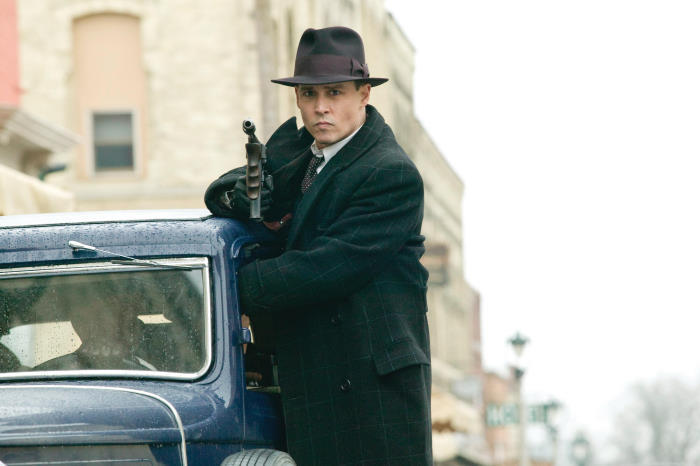
7. Public Enemies (2009)
Public Enemies
When it comes to famous outlaws, there are few that are as iconic as John Dillinger, especially given he was a man who wasn’t interested in stealing from regular people, but the state itself.
That’s partly why he’s the perfect historical figure for a Michael Mann film given his self-defined approach to life.
Public Enemies follows Dillinger (Johnny Depp) as he makes prison escape after prison escape, continuously evading capture and robbing banks before finding an added purpose in life in the form of one French-American, Billie Frechette (Marion Cotillard).
Like all of Mann’s anti-heroes, Depp’s Dillinger is charming and elusive all at once. He’s a character infused with an aura of mystique that Depp delivers with the casual suave that his own image beyond the screen has maintained.
But it’s in the reimagining of the period through a digital lens where Public Enemies really excels. The moody greys, dark passages and almost colourless world are so striking here that it creates a more profound hyper-realism — almost bringing the 1930s to life in a way that shooting on film wouldn’t.
6. The Insider (1999)
The Insider
A film about a man’s grapple with doing what’s morally right or being forced into silence by forces greater than him; The Insider, in true Mann-style, is an exercise in patience — in waiting for the right moment to make a move before it’s too late.
Unlike Mann’s other thrillers though, The Insider doesn’t have vans of heavily armed forces hiding around the corner, but it instead puts its faith in the truth overcoming the odds. That truth is in the form of former tobacco chemical scientist, Jeffrey Wigand (Russell Crowe) and the 60 Minutes producer looking to help bring his story to light, Lowell Bergman (Al Pacino). The odds are the Brown and Williamson Tobacco Company who are trying to keep Jeffrey, and this story around what really happens to tobacco, silent.
Guided by Mann’s brilliant direction, a well-crafted script by Mann and Eric Roth, and a standout performance from Al Pacino in an unfamiliar but equally familiar performance, The Insider paints a perplexing portrait of the lengths to which vindictive multi-billion dollar organisations will go to in order to supress information. It brings various parties with differing interests together, and creates a wide web of uncertainty for all involved — with no clear contingencies, but everything to lose for everyone involved.
5. Blackhat (2015)
Blackhat
Michael Mann’s most recent film feels like a sum of all of his best parts (it’s also been eight years since it was released!).
The film follows hacker Nicholas Hathaway (a career-best performance from Chris Hemsworth) who, after a series of awry events happen by an unknown source, is released from prison for the purpose of helping discover the person behind these events.
Blackhat is where ideas meet, characters converge, and where the tangible coalesces with the intangible.
In a similar way to Manhunter (but without the straining of classic thriller conventions) and Heat, this film once again depicts two sides of the same coin — Hathaway as the hacker-turned-FBI collaborator, and the unknown hacker blowing up coolant pipes and infiltrating wall-street. One is front and centre for the audience, while the other is kept faceless. While their intentions are different, they occupy a similar space like almost all of Mann’s characters do, but Blackhat is different to his past films because of how it bridges the characters worlds together and carries and communicates messages.
Mann uses modern technology to create a divide (the intangible), and forces his characters to embrace human interaction and connection (the tangible) if they are to overcome this threat.
His portrayal of the L.A. and Hong Kong maze of buildings and their bright lights speaks to the lack of personality or distinguished features in these settings, which fizzles down to the people who fade into each other like ones and zeros. It’s a wider critique on getting lost in the masses at a macro level, and getting lost in the code on a micro level.
Hathaway is the vessel Mann uses here to try and break through the code and by extension, this front that a world lacking real connections, has maintained — with Hemsworth using his size and stature to brilliant avail.
The closing sequence sees Hathaway concoct weapons and armour out of everyday tools, as though Mann is returning man to a primitive state before the world of data and technology became the guiding force. Hathaway gets the upper hand, and walks away in perhaps Mann’s most optimistic ending.
4. Thief (1981)
Thief
The OG Mann, Thief introduced audiences to this true-crime loving director who focuses on characters that take pride in the work they do, sometimes fall in love in the process, and live life on their own terms.
For expert safe-cracker and straight-talker, Frank (James Caan), he embodies the above perhaps more than any other character in Mann’s oeuvre. It might be because this is Mann’s most contained film in that it isn’t made up of major set pieces and crowded settings, but instead allows Caan to revel in the dialogue and the weight behind his words.
Thief is about a man on a mission to tick off his checklist of wants before cashing out. It’s also about a man refusing to bow down to the interests of others, instead taking it upon himself to shape his own destiny at any cost.
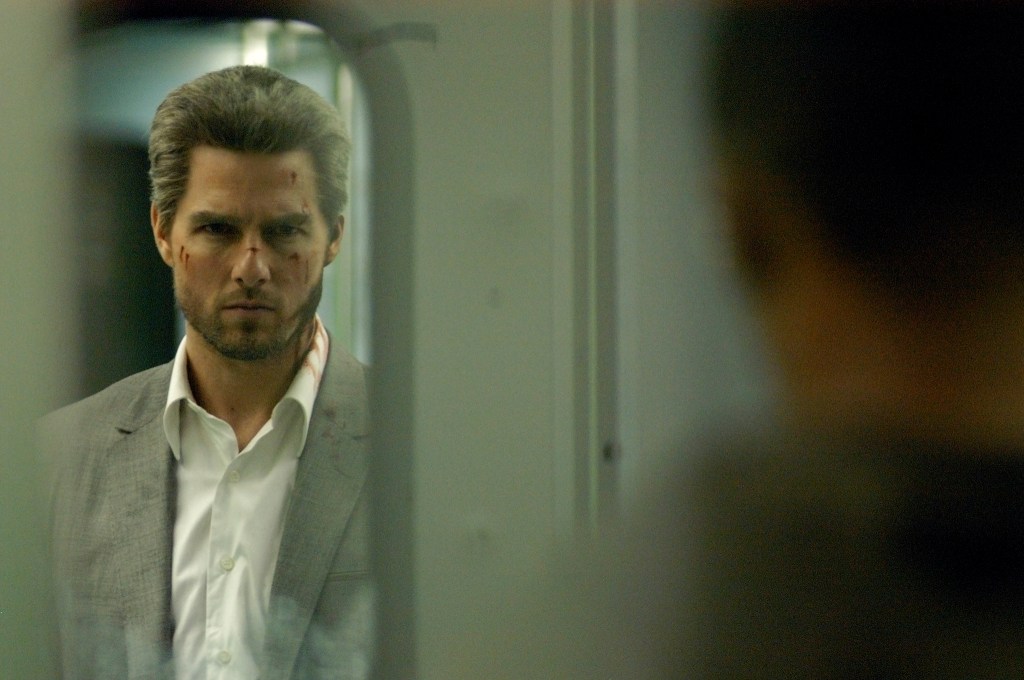
3. Collateral (2004)
Collateral
Two guys in a car, strangers to each other, both operating on a routine, a structure that they rarely break from, moving as one through the luminous L.A. night but to different ends.
Collateral is a wonderous neo-noir that pivots two men with differing moral compasses against each other: Max (Jamie Foxx), a slave to his inhibition, to his failure to act and make a difference to his life; and Vincent (Tom Cruise), a man untethered, a multi-faceted nihilistic hitman who gets in, gets out, and keeps moving forward.
Much has already been written on Collateral, from its vivid imagery to the rawness of its digitised look — at once enticing and haunting. Vincent poses a threat to Max’s idealised vision of tomorrow, but also an opportunity to start making things happen and not idle by.
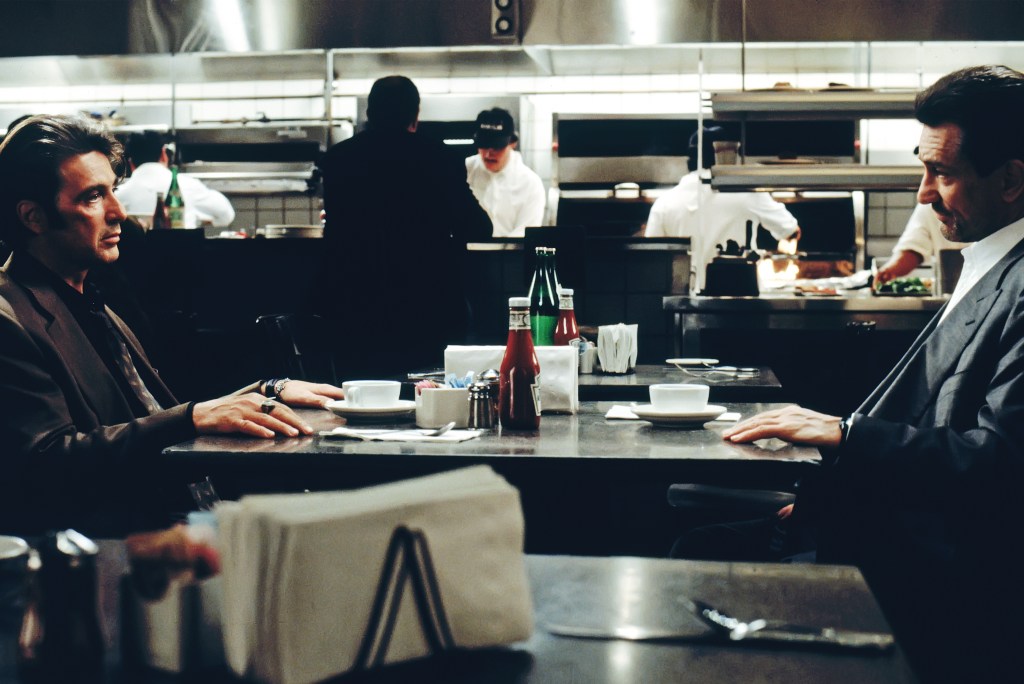
2. Heat (1995)
Heat
What does one even say about what, in the eyes of many, is Mann’s magnum-opus?
Heat is the sum of many parts, but it doesn’t work without its two key pieces: Al Pacino and Robert de Niro. The duo, reunited together on a feature for the first time (and for the first time ever in the same scene/s) since The Godfather Part II (1974), Pacino and de Niro are two sides of the same coin.
Vincent Hanna and Neil McCauley are like yin and yang — they don’t mix but they can’t function without one another. This speaks to Mann’s wider commentary on good vs evil, crime vs order which has been the focal point for 90% of his oeuvre. In Heat, Pacino and de Niro accentuate Mann’s fascination with these binary opposites to their full extent.
It’s as though these characters revel in the chase, of being the hunter and the prey, and they treat it like a drug that supersedes everything else in life. Mann brilliantly captures this through bright neon lights and the wider city which acts as its own sanctum that gives weight to the chase. Nothing is as beautiful as the city lights in a Mann film where cop cars race down the freeway in a storm of intensity.
But Heat is also made up of moments: the diner scene between Neil and Vincent is one of the greatest moments of character interaction in cinema history as these two men come face to face, pause the chase, and acknowledge each other; the downtown LA shootout where Mann shut down multiple blocks to shoot one of the most jaw-dropping scenes in any film ever; and the poignant finale where the two leads lock horns for the last time.
Without Heat, we may never have had The Dark Knight (2008), and that’s just one extra reason to watch this if you haven’t.
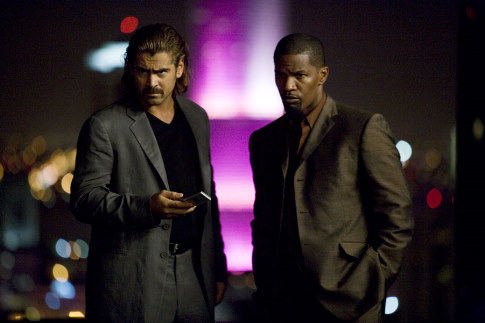
1. Miami Vice (2006)
Miami Vice
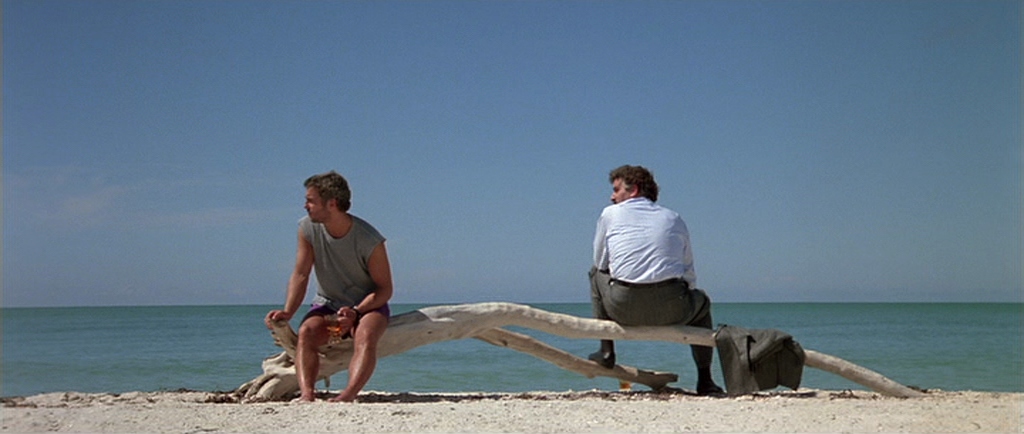
I’m sure Miami Vice is a top-three Mann on anyone’s ranking of his work, but this bustling neo-noir about two under-cover detectives goes beyond the 80s show of the same name to become a gripping tale of people accepting that they’re living on borrowed time and learning how to manage the time they have left.
On the surface, Miami Vice is a buddy-cop thriller about two detectives infiltrating an offshore drug operation where they act as the middle-man between the international supplier and the local Miami buyer. Their mission is to find out who the buyer is, but the deeper they find themselves in the operation, the more they realise they’ll never have an opportunity like this again.
Jamie Foxx and Colin Farrell are the two leads here and (while already the case with Foxx) they instantly fit the Mann-model of characters who don’t always play by the books, are good at what they do, and sometimes make rash, emotionally led decisions.
But it’s through Mann’s ability to capture the fleeting nature of life, the suddenness of a bust and the shootouts that ensue, where Miami Vice makes a case for his best film. There’s a dream-like tranquillity to the use of digital footage here that might just be the best example of creating evocative images in the digital format. From the bright hues of the nightlife and its clubs to the more intimate sensual moments, there’s a sense of liveliness and temporality mixed together in the film’s visual language.
Mann’s growing fascination with the commodification and expendability of the human body really started gaining momentum here as well. Whether it be in the film’s final shootout where bodies drop at a whim or the use of people as shields for getting what you want (drugs, cash, obedience), it’s an aspect of his films that really does speak to how precious those moments of human interaction are for his characters when they do have them.









 Rating Frames