Die My Love Finally Brings Lynne Ramsay Back to Our Screens 

Rating: 4 out of 5.

An anxious romance with a pair of actors in total lockstep with the filmmakers, the impressionistic Die My Love (2025) aims to rattle your cage, making you uneasy and unguarded to the emotionality of a world unable to contain the breadth of human emotion. Lynne Ramsay is a visual poet with a scorpion’s tail. A middle ground between the Terrences, Malick and Davies, that sees the world clearly but is in constant search of its beauty through its humanity. After bursting onto the scene with one of the best modern debuts in Ratcatcher (1999), Ramsay has struggled in an industry that seems incapable of turning her one-of-a-kind visual poeticism into a marketable arthouse name. With the star-driven Die My Love, the world might finally be ready to catch up to her greatness.

How does one begin to describe the indescribable with this film. In a sense, Die My Love is a character study and an exploration in doomed romance, through a dissolving inevitability that does not ache with the sadness of a love soon to be lost. At the heart of it all is Grace, a true lightning-in-a-bottle cinematic character, embodied by never-better Jennifer Lawrence. A bipolar, feverish writer with an animalistic charm moves out of New York to the Montana wilderness with her partner Jackson (a layered and defeated Robert Pattinson), and quickly gives birth, expanding her family and her responsibilities while dissociating herself from the world.

This film is many things, just don’t call it a movie solely about postpartum depression (although the best writing on the film will come from great female writers). Grace is a great many things, but to narrow her down to a collection of symptoms would be reductive to the potency of Ramsay’s storytelling and ability to craft complex characters across a large screen. Her balance of poetry and clarity allows familiar story beats of Grace’s post-pregnancy malaise and outbursts to overwhelm with a sharp and violent energy. 

Jennifer Lawrence and Robert Pattinson in Die My Love (2025).

The film owes a great deal to John Cassavetes’ film A Woman Under the Influence (1974), particularly the relationship between the central pair as they attempt to coexist alongside mental illness while living in constant fear of saying its name. It stands wholly on its own, however, through Ramsay’s singular eye and perspective on people, which have been consistent throughout her work. She is a filmmaker who builds a narrative through a single earth-shattering moment that fundamentally changes the characters. While at first glance the inciting incident is Grace’s pregnancy and birth, the more ground-shifting moment is the passing of Jackson’s uncle and the couple’s acquisition of his house in the Montana woods, allowing him to ease into a domesticity through convenience he secretly craves, even as he (and the audience) are enthralled by Grace’s charm and energy.

Enough cannot be said for Lawrence’s performance here. Her rapturous, physical energy quickly becomes the film’s energy, establishing its roaming camera into something out of a nature documentary. It is a rare thing for a lead performance like this to not completely overwhelm and ultimately topple the film, but Lawrence and Ramsay are in sync with the narrative’s unique rhythm. In a film that focuses on isolation and boredom for a character incapable of becoming listless, Die My Love uses Lawrence’s charm and screen presence to drag us from one impulsive thought to another. 

Pattinson’s hangdog expression is used effectively here as an inoculating agent against the charming roars of Lawrence’s primal energy. Even as he is introduced, seemingly moving out of the city to the countryside to write music, and Lawrence’s character to write, Ramsey’s camera feels flippant and uninspired by his artistic dreams. As we are locked onto this old, decaying house highlighted by a fallen light fixture in the centre of the room, we are quietly told how to view the pair’s doomed environment and artistic goals.

Jennifer Lawrence in Die My Love.

What allows that rhythm to glide from scene to scene is the tremendous weight given to linear storytelling, while never losing its ethereal, dreamlike temperament. Some moments feel like dreamscapes or whiplash flashbacks, but with its continued linear narrative, we become rooted to Grace’s interiority in a radical way. This high-wire act is a rare feat that will frustrate some viewers, but will deeply reward those who stay on the path.

Alongside her tremendous use of camera and editing, Ramsay uses music like the tip of a knife, sometimes in sight, ratcheting tension with its mere presence, or as a shocking stab seemingly out of the smoke. While Die My Love is an intimate, mental health family drama, the rapturous music alone requires the film to be seen in a cinema. With familiar story beats executed through her unique perspective as a visual stylist, Ramsay has reemerged after 8 long years without a film with a clear-eyed and emotive exploration of mental illness, with a powerful performance from Lawrence. While not a traditional star vehicle for an awards push, Ramsay and Lawrence have come together to craft one of the year’s best character studies and artistic statements.

Die My Love is in select theatres now.
Mickey 17: Bong Joon-ho’s Long-Awaited Follow-Up to Parasite is Amusing, Insightful and Downright Fun

Rating: 4 out of 5.

Mickey 17 preview screening provided by Universal Pictures.

It doesn’t take a genius to understand that a film about a guy who wants to leave on an expedition and chooses to willingly die and get reprinted (literally) with his memories in-tact, only to keep dying and being reprinted, is right up Bong Joon-ho’s alley. While that doesn’t capture the multifaceted space adventure that is Mickey 17 (2025) to nearly the full extent of the word, Bong’s interests are very particular in that, human dispensability —especially with regards to people in lower socio-economic situations— is a pertinent concern throughout his oeuvre.

In Snowpiercer (2013), a train is used as a motif to portray the various carriages of the caste system, with the back of the train being the lowest class citizens and the front, the highest class, while in Mickey 17, a large spaceship serves a similar purpose. In other words, it’s no secret that capitalism and the presence of an oligarchy are concerns that he hasn’t been shy about critiquing, and they’re a thematic consistency across his work. Regarding dispensability, Mickey 17 is much more literal than any of his previous films in how it reduces the human body to something that can be done away with, something that goes beyond even that of the lowliest of workers to just a recycled carcass.

That’s at least the seed from which the rest of the film grows and revolves around as Mickey (Robert Pattinson) signs himself up to be an “expendable” or an unfortunate soul who would choose to live a quasi-immortal life by living to die and dying to live. He does this after finding himself in bad company on Earth following a debt he hasn’t paid back, before ending up on a government spaceship headed up by a pompous failed politician, Kenneth Marshall (a goofy Mark Ruffalo whose performance echoes that of his one in 2023’s Poor Things), that’s on an expedition to find a new planet to preserve mankind — if this is sounding like Passengers (2016) mixed with Edge of Tomorrow (2014), then you’d be on the right track.

Robert Pattinson in Mickey 17

The spaceship finds itself headed towards Niflheim (not to be confused with that area in 2018’s God of War game), a cold planet inhabited by woolly creatures that look like roly polie, pill bugs (dubbed “Creepers”). It’s here that Mickey’s expendable state is really tested, as he’s exposed to the planet’s toxic air over and over again until a cure can be found and applied; it’s also where we eventually get to the 17th version of Mickey that opens the film in a scene we circle back to later. While comical in its portrayal of the printing process after every Mickey death, Bong’s commentary on how human life can be reduced so willy-nilly by those in power makes for a tasty treat, especially when it comes to just how dispensable the human body is in real life, especially when it comes to matters of war.

Bong never dwells though, he keeps the film moving and he keeps the action and dialogue light-hearted and cosy, but his ability to go a step further in his critique of capitalism and the frivolousness of those in power who look down on others, shows a director who is maturing in his own ideas and isn’t afraid to mine them to the full extent. It helps that Marshall and Gwen (Toni Collette) are so effortlessly unlikable in their bougieness which helps those ideas evolve easier.

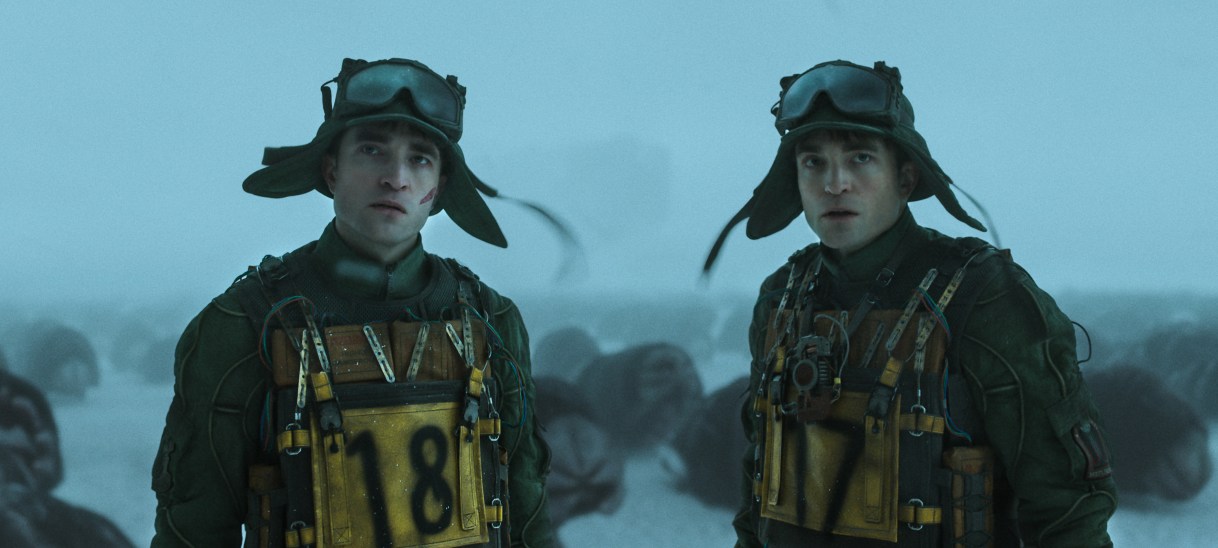
But their relationship is hardly the most shocking: after being saved by the aforementioned woolly pill bugs (following a harsh fall in an ice cave), Mickey 17 manages to find his way back to the ship where he comes across a clone of himself or a “multiple” as they’re called. It turns out Mickey 17 was presumed dead so the 18th version of him was printed, but without his pitchy accent and more akin to Pattinson’s Bruce Wayne in cadence.

Mark Ruffalo and Toni Collette in Mickey 17

It also turns out “multiples” aren’t permitted, so much so that Mickey 18 tries to kill Mickey 17 from the outset, but they soon find a commonality in the form of taking down their oppressors (very much in the vein of Snowpiercer). Pattinson’s dual performance is really a make-or-break factor in understanding what makes these multiples so unique from one another — that these reprints exhibit more humanity than the majority of the crew really adds weight to just how narcissistic and morally bleak humans can be at their worst.

At the end of the day, this is easily Bong’s most optimistic film, one that doesn’t present a bleak future but offers a chance for its characters to carve a brighter tomorrow on their own terms. Sure, he isn’t subtle about his growing interest in ideas he’s previously explored, but he also doesn’t pander to his audience, choosing to let the film’s amusing story take you on a rollercoaster comprised of the grotesque, heartfelt and humorous. In this way, it feels like his most accessible film as there are no hidden windows that keep you guessing.

Mickey 17 opens nationally from today.

The Batman is a Wonderfully Grimy Noir in Superhero Clothes

Rating: 4 out of 5.

It’s a beautiful thing, when each element of a film is working so harmoniously together, where nothing dominates the other, all working to execute a singular vision. There was a mountain of expectations put on Matt Reeves to create a unique Batman story, a character so embedded into the story of the last 35 years of Hollywood filmmaking, and, most surprisingly, the filmmaker has met those expectations.

We are entering the Batman story a couple years into Bruce Wayne’s journey as the Caped Crusader. With so many recent iterations of the character in film, the writing here is aggressively avoiding overlapping elements from the other franchises. There is no scene of Martha Wayne’s pearls falling to the floor (although it could be argued this iteration required this scene more than any other), or extended montages of Bruce learning to fight. Modern films are increasingly aware of its audience’s background with these stories, allowing each individual film to spread its wings and flourish on its own terms.

It is here that The Batman flourishes. Reeves has crafted a true auteurist vision inside a blockbuster superhero film that is remarkable. With an outstanding cast and arguably the best working cinematographer behind the camera – Melbourne’s own Greig Fraser – The Batman shows us that with enough creativity and craft, the superhero genre can still execute high-level filmmaking.

We should start with the casting, which is excellent and wonderfully refreshing. Pattinson helms the ship like it’s an A24 trauma thriller, with a performance of an emerging Batman and still grief-ridden Bruce Wayne that has you deeply compelled and tense throughout. Pattinson is an impressively nervy actor who is able to show us a mask that is just on the verge of cracking. The film positions Pattinson’s more dour Batman with a wonderful cast of actors, all at the top of their game, to ground the story in a level of humanity that could easily have gone missing in a story like this. The ensemble of Zoë Kravitz as Selina Kyle/Catwoman, Jeffrey Wright as Commissioner Gordon, John Turturro as Carmine Falcone, Paul Dano as The Riddler, an unrecognisable Colin Farrell as The Penguin, and Andy Serkis as Alfred, are all excellent and are perfect counterweights to Pattinson’s aura throughout the film.

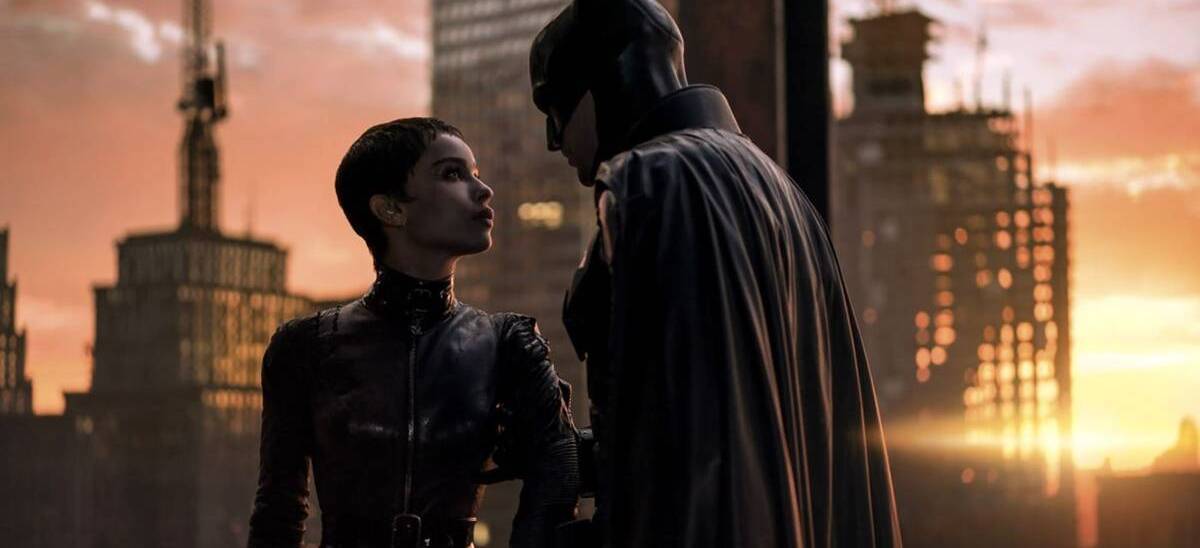
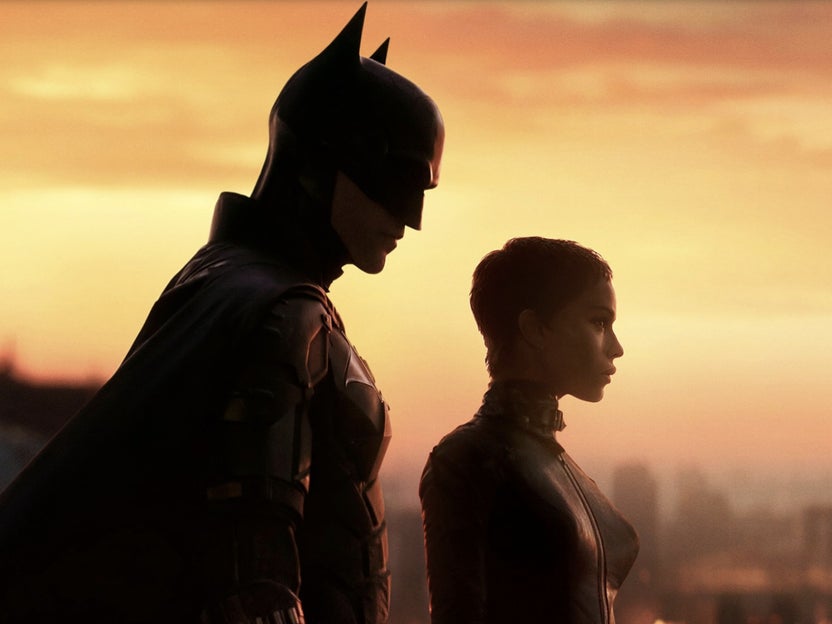
Robert Pattinson (left) as Batman and Zoë Kravitz (right) as Catwoman in The Batman

Reeves’ previous experience as a horror director (2010’s underrated Let me in) comes through in several chilling scenes with Paul Dano’s Riddler, a character that has been adapted from one of the campiest in the rogue’s gallery to a harrowing villain that wouldn’t feel out of place in the Saw franchise.

It was clear from the beginning they wanted to craft a story that leaned more heavily into the grime and detective noir aspects of the character, with several scenes that wouldn’t seem out of place in Seven (1995). The use of Riddler in the Batman franchise has always called upon a more detective and serial killer-tinged story, an aspect the film runs headfirst into instead of avoiding. It’s pretty remarkable that this film was able to achieve an M rating in Australia (PG-13 rating).

The level of craft in The Batman is where this film shines and this review could definitely pick each individual element to highlight how it perfectly sits in the pocket of the vision Reeves has for the film. One crucial element I will highlight is the score. The Jaws-ifying of the iconic Batman theme by Michael Giacchino throughout the film works brilliantly, showcasing Pattinson’s iteration of the character as a foreboding presence.

This is further emphasised by Fraser, cribbing from his own work in Rogue One (which Giacchino also scored) of Darth Vader in the hallway, a sequence that has now become that films defining moment and one of the best in the Star Wars franchise, with Batman stepping out of the darkness to enact vengeance.

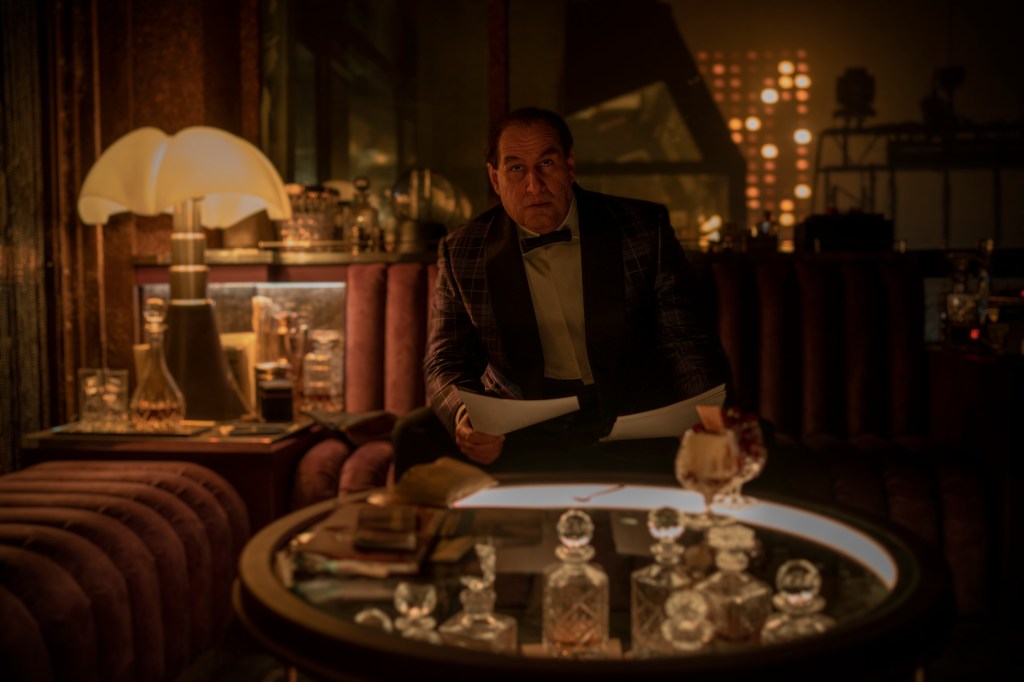
Colin Farrell as The Penguin in The Batman

It’s impossible not to view the film from the lens of the other Batman films, in particular the Nolan franchise which is still the benchmark for this sort of superhero storytelling. While there are no individual performances as totemic as Heath Ledger, there are many moments that The Batman has improved upon from those films. The political narrative that Nolan experimented with on Dark Knight Rises (2012) has been refined here. In Nolan’s film, the political aspect centred around an Occupy Wall Street allusion felt pasted onto the story being told. Whereas in Reeves’ film, the political narrative is rooted deeply in every aspect of the story, and is a large reason Paul Dano’s Riddler works so effectively. In 2022, there is no more apt American villain than a QAnon leader whose ultimate plan involves a mass shooter plot at an iconic New York venue (I won’t spoil which). Reeves and Pattinson have been active in the press the last month expressing how bleak and dark this iteration of Batman is, and it is in this story choice where that darkness is evident and chilling.

But this film is still a big-budget blockbuster and there are some exhilarating sequences, including a remarkable car chase that maintains the same viscerality that defines every moment of Reeves’ film. The Batman’s legacy will most likely focus on the emo vibe and the runtime, but its action set pieces are worthy of the same acclaim given to Nolan’s trilogy.

What The Batman has achieved feels momentous. After almost 20 years of superhero dominance in Hollywood, it is remarkable to have a filmmaker come in and make the genre feel as fresh and vital as it’s ever been. The Batman is a showcase for some of the best craftspeople and performers in the industry, and is hopefully just the beginning for this new caped crusader.