Fly Me to the Moon: Scarlett Johansson and Channing Tatum Team Up for Space Race

Rating: 3 out of 5.

Fly Me to the Moon preview screening provided by Sony Pictures.

As far as films about space go, Fly Me to the Moon is about as far from the launchpad as they come —which is not to say there isn’t a takeoff. Set against the backdrop of the 60s, specifically around the Space Race, Greg Berlanti’s (director of 2018’s Love, Simon) film mixes romance with rockets, focusing on one of mankind’s greatest achievements in the man-finally-meets-moon Apollo 11 mission, while throwing Scarlett Johansson and Channing Tatum in the mix to see how they bounce off of one another. There’s a sincere, if not contrived aura about Fly Me to the Moon; in other words, it’s incredibly playful, sometimes to its own detriment.

Johansson plays con artist advertiser, Kelly Jones, whose successful career is noticed by the Nixon administration and one of their shady executives, Moe Berkus (Woody Harrelson). Moe commissions Kelly to sell the moon landing with her advertising chops. On the other side of the coin is Cole Davis (Tatum), a NASA employee and veteran who oversaw the tragic Apollo 1 mission. Their paths briefly cross in a flirtatious happenstance at a diner, one they thought was just a once off, before they realise they’ll be spending more time together.

Berlanti’s film is surprisingly clever, taking the conspiracy ideas behind the Apollo 11 mission and working them into an original script that satirises this notion playfully. But more than that, Fly Me to the Moon (though too long for its own good) makes good use of its two leads who effortlessly bicker and banter amongst all the turmoil around the launch. In particular, Johansson commands the screen, playing the part with the same zest and reverence for the time as in Asteroid City (2023), proving she could be warped back to the 1960s and fit right into the classic Hollywood setting.

Kelly Jones (Scarlett Johansson) and Cole Davis (Channing Tatum) in Fly Me to the Moon.

It’s almost bemusing that a film like this would cut past streaming and land on the big screen, not because it isn’t deserving of it, but because it seems like a hard sell —even with the Johansson/Tatum pairing. While the Apollo 11 mission was a big deal at the time, it’s easy to see audiences struggling to stay with it for 132 minutes. Characters like Lance (an unsurprising scene stealer in Jim Rash) and Moe inject energy when the pace starts to falter, giving moments like a sequence around building a fake Apollo 11 stage, a much needed boost.

While still a stud at 44, Tatum doesn’t completely bring the same flair as he does in the Magic Mike films or Logan Lucky (2017). His character is there to bear the weight of deceit from Kelly, but he often plays in Johansson’s shadow, even with their enjoyable jabs, serving more as a weight that levels her character out when she’s reaching for the stars faster than others.

Fly Me to the Moon does come at an interesting time though, where conspiracies and disinformation, truth and reality, are as distorted as ever. Though it doesn’t necessarily usher the audience to think a certain way, Berlanti’s film offers food for thought for those familiar with the controversy around the moon landing, and an interesting foot in the door for those that never paid it any mind. It doesn’t quite hit the landing it hopes for, but it’s not short on fuel.

Fly Me to the Moon opens nationally from the 11th of July.
MIFF 22: Cheap Laughs Abound as Triangle of Sadness Lays Waste to the Wealthy

Rating: 3 out of 5.

In Ruben Östlund’s latest overblown, satirical romp, Triangle of Sadness (2022), there is a wealthy German stroke survivor whose only words of communication are “in der wolken” (translated: in the clouds). It’s a phrase she yells out countlessly across the film to the point where it wouldn’t be surprising if it pops its head in like an M. Night Shyamalan twist at the film’s close. It never does though, but it perfectly captures the underlying message behind Östlund’s rich ripping, caste crushing film — the wealthy just love to live in the clouds, out of touch with reality, no matter how dire a situation can get.

While most of the rich folk in this film are overblown caricatures that breach the threshold of excessiveness, for Östlund, excessiveness is the name of the game. Structuring his film into three chapters (three edges that make up a “Triangle of Sadness”, if you will), Östlund takes aim at the false pretences that the wealthy hide behind — fancy yachts, material goods like Rolex watches, and cosmetic procedures among other things — and bares them for viewers in all their grotesqueness. It’s nothing that hasn’t been depicted throughout cinema history in the past (2013’s The Great Gatsby and The Wolf of Wall Street come to mind from recent films), but Östlund isn’t privy to subtlety, rather, he’s going all in until you’re either exhausted, squeamish, or both.  

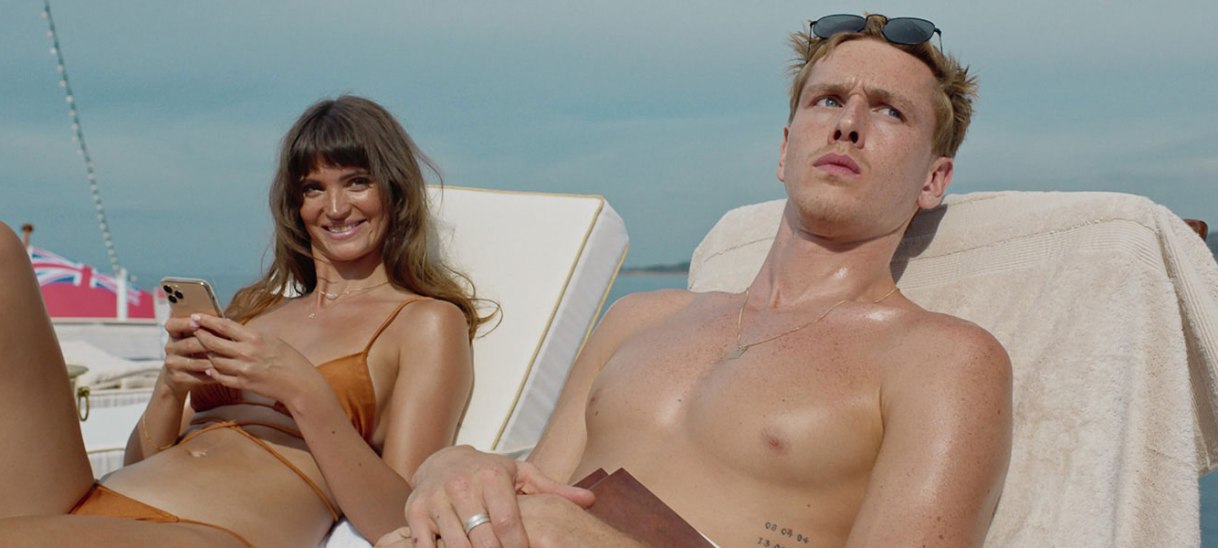
Where there is beauty, there is deceit — at least that’s part of the message that underpins Triangle of Sadness. Set on a luxurious yacht for the most part, the film is comprised of a solid ensemble that plays seamlessly off of Östlund’s material and each other. It’s Yaya (Charlbi Dean Kriek) and Carl (Harris Dickinson), two models and partners-with-benefits, that serve as the entry point into the mayhem that ensues. Both characters skimp by on their looks, and it’s part of the reason they find themselves in the company of millionaires and billionaires on the aforementioned yacht as Yaya is gifted a free trip courtesy of her influencer status.

On the ship we find a bunch of rich folk and everyone in-between including the ship’s crew. There’s a British couple who boast about their contribution to the munitions industry including their role in creating land mines and hand grenades (which Östlund returns to in explosive fashion); a down-on-his-luck code-seller whose partner didn’t join him on the cruise; the vessel’s drunk captain (Woody Harrelson); a Russian billionaire who made his money selling manure; and the chief stew of the ship, among others.

Charlbi Dean Kriek in Triangle of Sadness

Each character has a role to play in Östlund’s charade as events spiral from controlled to chaotic in an instant. He rocks the boat to the point where characters are literally spewing their guts out (of both ends) after a slimy buffet and storm, he throws in a pirate attack at one point, and in the third act he leaves some characters stranded on an island where he flips the hierarchical triangle on its head.

There’s a lot happening in Triangle of Sadness to the point where you can feel the lengthy runtime weighing proceedings down. This is undoubtedly a conscious choice on Östlund’s part as he leans into the satire he is going for to create an equally exhausting experience for his characters (especially in that third act).

At times it feels like his screenplay is made up of a bunch of short films or mini sketches that have just been welded together. There’s a scene involving the yacht’s captain and the rich Russian Dimitry (Zlatko Buric) as they indulge in a Marxist and capitalist back-and-forth while playing a drinking game that they continue in the captains quarters over the yacht’s PA system. There’s also a sexploitation sequence on the island portion of the film where the yacht’s Toilet Manager pays Carl for his services with pretzel sticks and shelter. All of these sequences are comical, but there’s never greater substance or deeper subliminal messaging beyond the superficiality of being rich and the vanity of these characters.

Triangle of Sadness is at its best during its first half, where it plays around with ideas of inadequacy and superficiality at a more measured level. The longer the film chugs on though, the more it tailspins into a cartoonish satire that trades subtlety for unhinged chaos, where you’re fed what you know and nothing more.

Triangle of Sadness hits Australian cinemas in late December.